

Quantum has spent the last few years focused on qubits, error rates, roadmaps and commercial quantum advantage, but more recently, it’s become increasing common to also reference billion-dollar valuations, commonly known as “unicorns”.
At the end of 2025, there were approximately six quantum companies with valuations in excess of $1 billion whereas today that number has doubled to twelve, and with at least three more billion dollar valuation deals announced. The following chart highlights the current quantum unicorn universe:
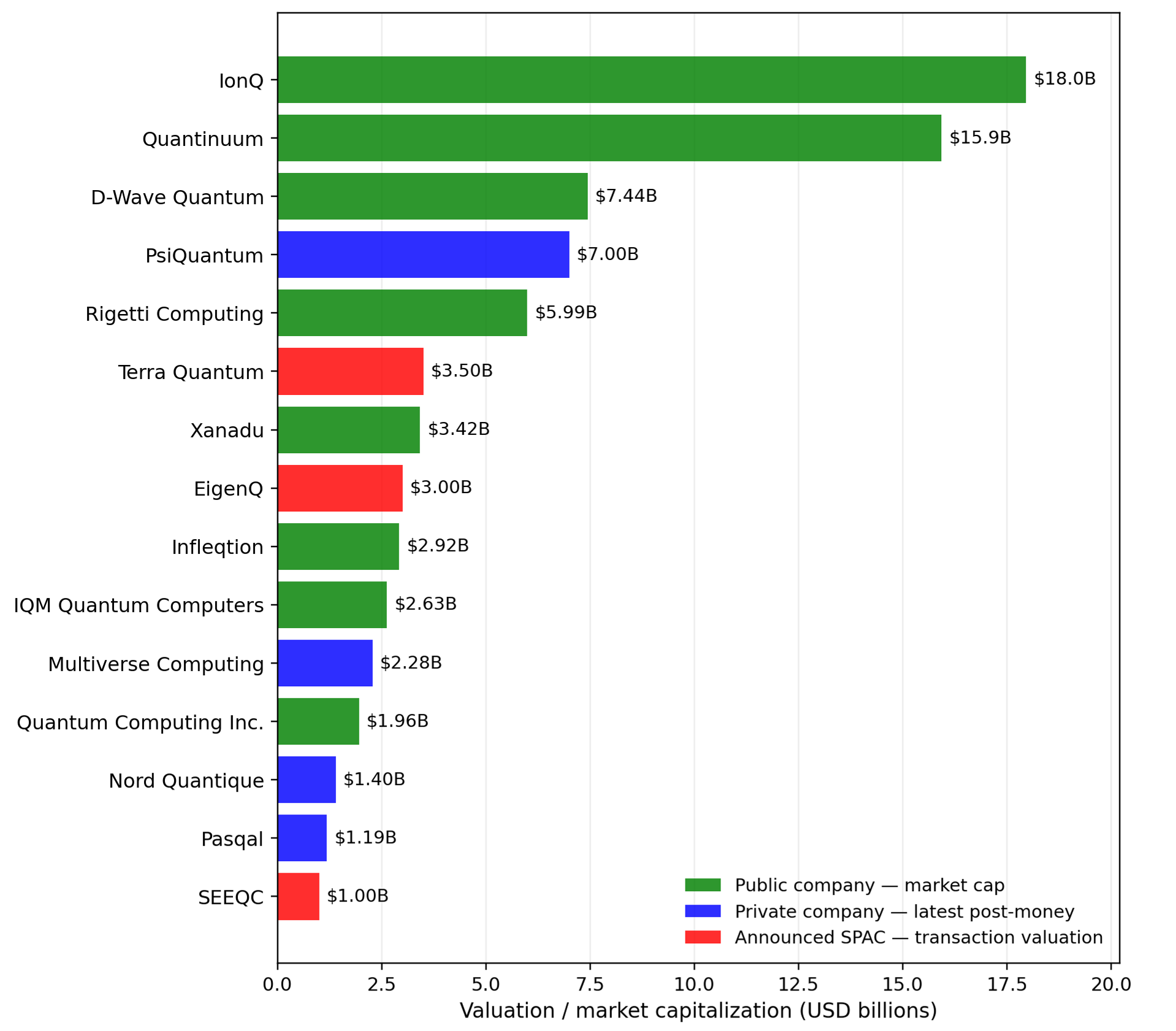
In addition to the observation that the quantum unicorn club has recently doubled its membership, there are a few other conclusions to be drawn:
Valuation is Spreading Across Modalities: Trapped ions, superconducting, photonics, neutral atoms and annealing are all represented.
Quantum Software is Now Included: Multiverse, a software/application-layer entrant, has achieved quantum unicorn status.
Conventional IPOs: After a number of SPAC deals, which seemed like the only path to public markets for a quantum company, Quantinuum completed a traditionally underwritten IPO.
The Much Feared “Quantum Winter” Never Arrived: And the current combination of record capital formation, expanding public markets, government commitments and continued technical progress makes a broad-based quantum winter increasingly unlikely.
A few of these conclusions warrant deeper dives.
Multiverse closed its Series C in July of this year at a $1.7 billion pre-money valuation, and per PitchBook, the completed round was valued at $2.28 billion post-money. This is an important development because Multiverse is not building qubits or Quantum Computers, it is developing quantum and quantum-inspired algortithms for optimization and other enterprise problems.
Multiverse Computing is a Spanish software company founded in 2019 that grew out of the intersection of quantum computing, applied mathematics and artificial intelligence. Unlike most of the companies in the quantum-unicorn group, Multiverse does not build quantum computers. Its original focus was software that allowed companies to use quantum and quantum-inspired algorithms for practical problems in areas such as finance, energy, manufacturing, logistics and life sciences. Its Singularity platform, for example, was designed to match business problems with appropriate quantum or quantum-inspired algorithms and available computing resources.
The company’s flagship technology, CompactifAI, uses mathematical techniques derived from tensor networks—a tool with roots in quantum physics—to compress large AI models so they require less memory, computing power and energy. The important point is that these techniques run on conventional hardware; customers do not need a quantum computer to use them. Multiverse now markets compressed versions of models such as Llama, Mistral and DeepSeek for deployment in cloud, on-premise and edge environments.
That evolution makes Multiverse particularly interesting in the context of quantum investing. It is an example of a company whose quantum expertise has produced commercially relevant technology before large-scale fault-tolerant quantum computers exist. The company still works in quantum software and quantum-inspired optimization, but its current growth story is increasingly tied to solving one of AI’s immediate economic problems: the enormous cost of running increasingly large models. In that sense, Multiverse sits somewhere between the quantum and AI ecosystems rather than fitting neatly into either one.
For the unicorn discussion, that distinction is precisely what makes the company notable. Most billion-dollar standalone quantum companies are fundamentally bets on building better quantum hardware. Multiverse is instead a bet that intellectual property developed around quantum mathematics can create substantial value on classical computers today. That broadens the investment thesis for quantum considerably: economic value from the field may emerge not only from the companies that ultimately build useful quantum computers, but also from software, algorithms and adjacent technologies that commercialize quantum-derived ideas along the way.
Last fall, when I wrote about the acceleration in quantum capital markets, I argued that one of the real milestones to watch would be a conventional underwritten IPO rather than another SPAC (see that prior post here). We recently got one. Quantinuum completed a traditional IPO in June, selling 28 million shares at $60 per share, raising $1.58 billion in gross proceeds. This was a more important capital-markets milestone than simply creating another unicorn.
It gives Quantinuum direct access to the public-equity financing market, forcing institutional investor to place an actual share price on the business through a marketed book-building process. For a capital-intensive industry like quantum, access to such markets is particularly important. Fabrication, packaging, control electronics, lasers, cryogenics, cleanrooms, data centers, specialized talent and select acquisitions are expensive, and while an IPO does not solve all problems, it makes them easier to finance.
Interestingly, Quantinuum had a very healthy balance sheet before the IPO, with $677 million in cash as of 3/31/26, and its stock has been fairly consistent since the IPO (and was $59.34 as of the writing of this post). While they have not yet used their stock to fund acquisitions, that seems to be a likely option for the future. So the $2.1 billion of cash now on the balance sheet, combined with a multibillion-dollar acquisition currency, provides Quantinuum with substantial flexibility and a very long runway with which to accelerate its growth.
According to PitchBook, there was $3.9 billion in Quantum Computing venture investment in 2025, spread across 127 deals, the highest annual total in its dataset. In Q1 of 2026, another $1.2 billion was invested in quantum. Preqin estimates that $21.7 billion has been invested across 1,549 global quantum venture deals since 2017 and of that, $10.5 billion (48% of the total), was deployed since the start of last year. Said another way, nearly half of all quantum venture capital deployed the past decade arrived over the past 18 months.
The implication is not that every quantum startup suddenly has unlimited capital, although more and more are gaining access to intermediate stage financing rounds. And a small group of companies with credible roadmaps, can now raise enough money to fund several years of engineering, manufacturing and commercialization in a single financing.
For quantum companies, raising $30 million likely means constantly managing the runway, but for those raising $100’s of millions, they can build facilities, place long-lead equipment orders, acquire technology (and expertise) and support customers through multi-year deployment cycles.
Valuation is not technical validation but it determines how much runway a company can establish.
A common phrase in venture investing is “product-market fit”, used to confirm that a start-up has built something that the market actually wants. And now, an increasingly relevant derivative statement is “capital-market fit,” meaning that investors have demonstrated a strong investment appetite. The quantum sector has figured out how to attract private growth capital, how to find SPAC sponsors willing to finance quantum companies and has opened the traditional IPO market. But it’s important to acknowledge that “capital-market fit” cannot permanently substitute for “product-market fit”. Eventually customers have to arrive, revenue has to scale, and profits need to follow.
The 2026 quantum valuation surge is both encouraging and consequential. The money being raised and deployed gives the quantum industry increasingly longer runways. But the high valuations also set the bar. What does this mean?
For quantum founders: Raising at a multibillion-dollar valuation is not merely a trophy. It dramatically increases the commercial and technical milestones required to make the next round (or the public market) work. Capital buys time, but valuation creates expectations.
For customers: Better-capitalized vendors are more credible long-term partners. They can support installations, hire field teams, maintain hardware, fund roadmaps and survive long enterprise procurement cycles. But a $5 billion market cap is not evidence that a particular quantum system is commercially useful for your problem today.
For investors: Public markets are providing real-time price discovery across multiple quantum modalities. But “quantum” is not a homogeneous comp set. Comparing a photonic architecture, an annealer, a trapped-ion system and a software company because all four have roots in quantum, can create as much confusion as insight.
For the ecosystem: Multiverse may be the most interesting signal of all. The economic value created by quantum science may not wait for a fault-tolerant QPU. Some of it may show up earlier in precision clocks, software, security, sensing, control systems, algorithms and technologies that borrow heavily from quantum mathematics without requiring a quantum computer in the final product.
For a long time, the quantum investment debate was mostly about whether the technology could attract enough patient capital to survive the long road from physics experiment to commercial platform.
I think 2026 is giving us an answer: Capital is no longer the obvious bottleneck.
There are now 12 quantum unicorns with several more pending. Quantum VC deployment has accelerated sharply. And Quantinuum has demonstrated that a quantum company can raise more than $1.5 billion through a conventional underwritten IPO.
That doesn’t mean quantum has “arrived,” but the capital markets have provided the industry with more money, more liquidity and more time.
Now the technology, and more importantly, the customers, have to catch up.
Stay tuned to the Quantum Leap to follow along as the industry continues to mature.
Disclosure: The author is a venture investor with investment interests in quantum and may have an interest in companies discussed in this post. The views expressed herein are solely the views of the author and are not necessarily the views of Corporate Fuel Partners or any of its affiliates or any companies it has investment interests in. Views are not intended to provide and should not be relied upon for investment advice.

References:
Bennett-Lynch, Will, “National initiatives push quantum investing to the next level”, Preqin First Close, June 16, 2026
“EigenQ and Silicon Valley Acquisition Corp. Announce Definitive Business Combination Agreement”, PRNewswire.com, June 17, 2026
“Multiverse Computing Announces Series C Fundraising Targeting up to $570M (€500M) to Power Efficient AI from Edge to Cloud”, Multiversecomputing.com, July 27, 2026
“Pasqal, a Global Leader in Neutral Atom Quantum Computing, to Go Public via Business Combination with Bleichroeder Acquisition Corp. II”, Pasqal.com, March 4, 2026
PitchBook Data, Multiverse Computing deal profile, accessed August 11, 2026
Private-company and deal profiles for PsiQuantum, SandboxAQ, Nord Quantique, and Pasqal, PitchBook.com, accessed August 11, 2026
“Proposed Quantisimo Business Combination”, SEC.gov, June 25, 2026]
“Quantinuum Announces Closing of Upsized Initial Public Offering”, Quantinuum.com, June 5, 2026
S&P Global Market Intelligence via StockAnalysis, market-capitalization pages for IonQ, Quantinuum, D-Wave Quantum, Rigetti Computing, Xanadu, IQM, Infleqtion and Quantum Computing Inc., accessed August 11, 2026
“SEEQC and Allegro Merger Corp. Announce Business Combination”, SEC.gov, January 16, 2026
Teare, Gené, “Global Startup Investment Hit Record $510B In H1 2026 As AI Boom Accelerates Funding And Exits”, Crunchbase News, July 2, 2026
“Terra Quantum and Axiom Intelligence Acquisition Corp 1 Announce Business Combination”, SEC.gov, May 26, 2026
Zabelin, Dimitri, “Bit by Qubit: Global Quantum Computing Funding Hits New Records and Is Accelerating”, PitchBook, June 25, 2026
Zabelin, Dimitri, “Inside quantum computing’s record-setting investment run”, PitchBook, June 26, 2026
No posts
Comments
Nothing yet. Say the first thing.
Sign in to join the conversation.