
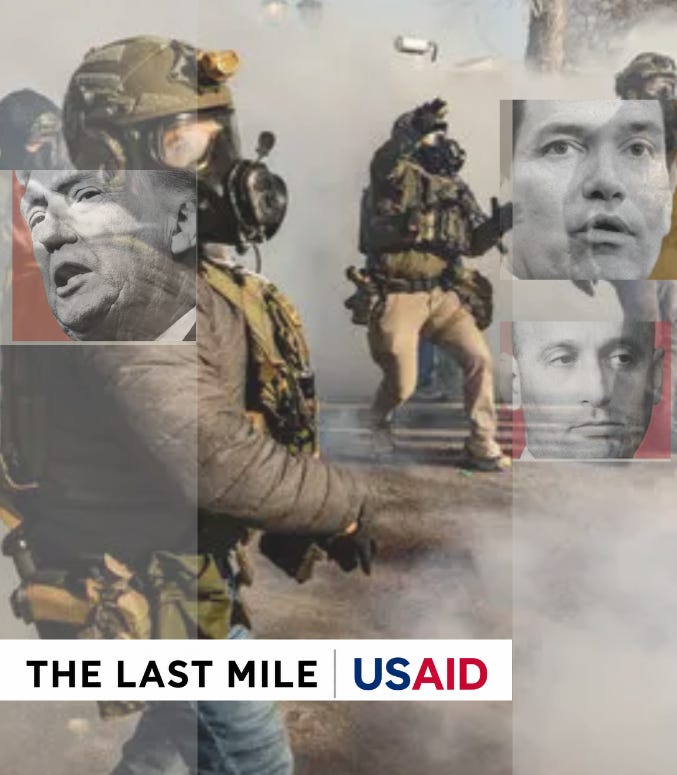
On July 16, 2026, the United States government gave three speeches in one day.
In the evening, from the White House, President Trump told the country in a primetime address that China had stolen 220 million American voter files and that members of a deep state had covered it up. The documents his own White House posted showed the files were commercial voter data, publicly available for purchase, and the intelligence community had reported in 2021 that China made no effort to change the 2020 outcome. One document he released actually showed Russia working to defeat Biden. The fraud claim did the work. The demand followed: states must surrender their voter rolls to federal screening, and Congress must pass his election bill, because future elections could be rigged.
That afternoon, at the State Department, Secretary of State Marco Rubio convened officials from more than sixty countries for a “Ministerial on the Resurgence of Political Terrorism.” The threat, he explained, came from the left. Anti-capitalists, anti-imperialists, communists, anarchists, Marxists: different names, he said, same fundamental character, “a poisonous resentment cloaked in the language of equality and justice and liberation.” Radical leftism, he told the room, is “a distinctive and unique evil,” a “revolt of the worst against the best,” and he vowed to dismantle its networks “brick by brick.”
And between them, at the same podium, White House deputy chief of staff Stephen Miller told the assembled diplomats to look at photographs of antifa demonstrations. “Not one of the people that is demonstrating looks like a normal person,” he said. “Not one looks normal. They’re all deformed in some way, in their appearance, in their dress, in their mannerism.” Their outer appearance, he explained, “becomes a manifestation of their inner hatred.” He called the left a “cancer” that must be rooted out, named its supporters “enemies of civilization,” and listed the government’s intentions under its new counterterrorism memorandum: “to disrupt, identify, defund, debank, arrest, and prosecute these political terrorists.”
An American official stood at the headquarters of American diplomacy and described his domestic political opponents as bodies marked by inner corruption, then read out the administrative verbs that would be applied to them. One speech declared the elections compromised. One speech declared the opposition terrorists. One speech declared them physically corrupt. That is not a news cycle. That is an architecture.
The next morning, the machinery moved. Homeland Security Secretary Markwayne Mullin threatened election officials with fines and prison if they refused to run their voter rolls through a federal database called SAVE, a threat Democracy Docket reported reached all fifty states and the District of Columbia. A federal judge had already blocked the government from using that database on voter rolls, because it was built for immigration benefits, violates rules on Social Security records, and misidentifies newly naturalized citizens as noncitizens. Mullin blamed “activist judges” and promised that noncompliant states would have their voters investigated and their officials held “accountable.”
The financial apparatus moved the same day. Treasury Secretary Scott Bessent announced that FinCEN, OFAC, and IRS Criminal Investigation would expand scrutiny of charitable and nonprofit structures suspected of illicit finance tied to political terrorism. Treasury added that it would act on suspected unlawful conduct, not beliefs. The caveat is on the record. So is the target category.
The sequence is the story. The president alleges fraud. The security state demands the voter rolls. A court says no. The security state threatens to imprison the officials who obey the court. The financial surveillance apparatus turns toward organizations the administration associates with the opposition. All of it inside seventy-two hours, all of it on the record.
Communist. Fascist. Anti-American. These words have meanings, catalogued across a century by historians, political scientists, and this administration’s own officials. What follows is an exercise in consistency. I have taken the three definitions this government aims at its opponents and applied each one to the government doing the aiming.
One clarification belongs up front. What is emerging in the United States is not classical communism, which the administration’s celebration of concentrated private wealth refutes on its own, and it is not a replica of European fascism, since the party militia and the formal racial state are absent. The claim is narrower. This government is adopting the operational methods of the regimes it denounces, faster than the institutions built to stop it can respond, while using those regimes’ vocabulary as a targeting system against its opponents. The subject is method, not doctrine.
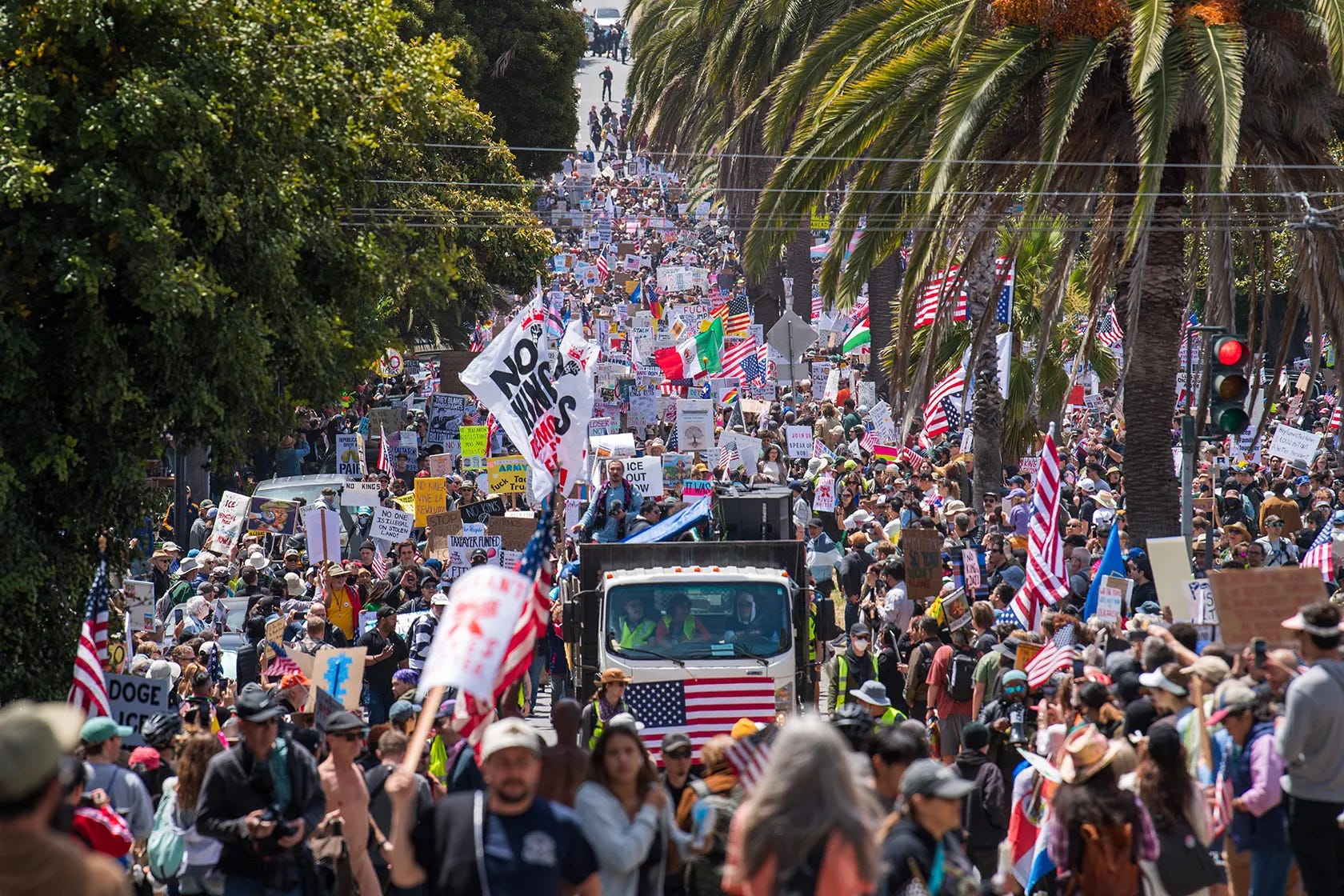
Rubio has spent two decades telling Americans how authoritarian regimes behave, and he is the most credentialed anti-communist in American public life. In his July speech he named the core: centralization of power, destruction of the individual, subordination of every institution to the state. The regimes he condemns do not need theory to identify. They leave paperwork. They crush independent unions, punish speech, demand ideological loyalty from public servants, control elections, and surveil beliefs.
Now put that list next to the government whose cabinet table he sits at.
Start with labor. On March 27, 2025, President Trump signed Executive Order 14251, invoking national security to strip collective bargaining rights from large parts of the federal workforce, and expanded it in August. More than one million workers, most of the unionized federal workforce, lost their bargaining rights. Georgetown labor historian Joseph McCartin called it the largest single act of union-busting in American history. The Castro government dissolved Cuba’s free trade unions within two years of taking power. Solidarity was born in Gdansk because Poland’s communist state permitted no real ones. Authoritarian states do not begin by abolishing labor. They begin by deciding which workers are allowed to bargain and which are treated as threats. And when a court enjoined the TSA termination and Congress passed bipartisan legislation to restore the rights, the Department of Homeland Security terminated the TSA contract anyway, in December 2025, in defiance of both.
Then there is speech. In September 2025, Rubio announced that the State Department was revoking the visas of foreign nationals over their reaction to a political assassination. His words: “If you are here on a visa and cheering on the public assassination of a political figure, prepare to be deported.” The offense was an opinion, not a crime. The State Department revoked thousands of visas, and consular officers were instructed to review social media for “hostile attitudes” toward the United States. A federal court in AAUP v. Rubio found the administration violated the First Amendment by arresting, detaining, and attempting to deport noncitizen students and faculty for pro-Palestinian advocacy. Expelling people from a country over their political expression has a long pedigree in the regimes Rubio condemns. His biography is not the evidence. His record is.
Then the loyalty of public servants, which arrived through two mechanisms. The first is ideological screening at the door. In May 2025, the Office of Personnel Management required federal job applicants at GS-5 and above to write essays on how they would advance the President’s executive orders. OPM later said the questions were not to be used as an ideological litmus test and that non-answers would not disqualify applicants. But the questions exist, on the application, in writing. The Soviet nomenklatura was a far more comprehensive instrument, a party-controlled appointment system governing every post of consequence in a one-party state. The relevant similarity is narrower: both make demonstrated alignment with the ruling leadership a consideration in access to public office.
The second mechanism is the purge behind the door. Roughly 200,000 federal employees left through firings, buyouts, and forced retirements as DOGE, operating through executive reorganization while performing functions critics argue exceeded any statutory authorization, dismantled agencies from the inside. USAID, where I served for ten years, ceased independent operations entirely, its programs absorbed into the State Department while litigation over its legal existence continues. The Schedule Policy/Career rule finalized in February 2026 then reclassified thousands of career positions to strip their civil service protections, converting merit posts into political ones. The purge made room, and the rule locks the door behind it.
Then the machinery reaches elections. Authoritarian systems seldom cancel elections outright. They arrange the conditions under which opposition competes. Beginning in summer 2025, at the President’s personal urging, Republican states launched an unprecedented wave of mid-decade redistricting: Texas redrew its map in a gambit Reuters reported was aimed at flipping five Democratic-held seats, and Missouri, North Carolina, Ohio, and Florida followed. Across much of the South the maps now approach a single-answer machine. Where the maps end, the database begins. DOJ has demanded nonpublic voter data from roughly thirty states, most of them led by Democrats, and lost all seventeen cases decided at the time of this writing. The response to losing was Mullin’s threat to prosecute the election officials the courts had just protected. The ballots may still be counted. The fight is over how much has been decided before anyone marks one.
The behaviors Rubio warns against are now the documented behaviors of the administration in which he is the senior cabinet officer. He gave the speech about poisonous resentment on July 16. The mirror was on the podium.
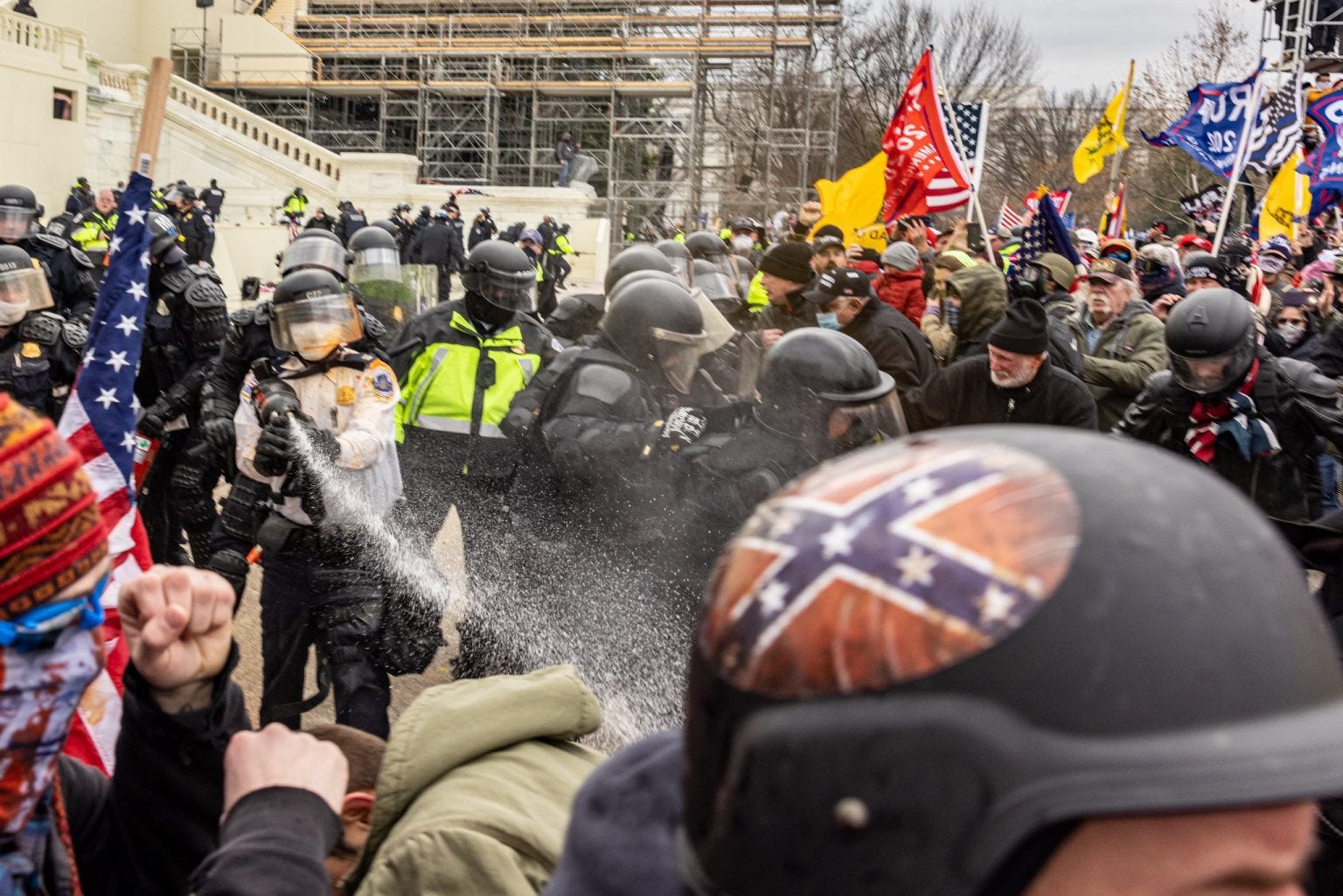
Political scientists identify fascism by clusters of observable features, never a single trait. The classic references are Robert Paxton, Umberto Eco, Roger Griffin, and Stanley Payne, and though their frameworks differ in structure, they converge around the same warning: the danger lies in combination and acceleration.
Mythic national rebirth. Griffin calls this the defining feature: a once-great nation, corrupted by internal enemies, reborn through radical transformation under decisive leadership. “Make America Great Again” runs on exactly this engine. The slogan presupposes decline, promises restoration, and locates the corruption in named enemies.
A leader above institutions. The hiring essays require personal loyalty in writing. In 2025, the president fired Federal Trade Commissioner Rebecca Kelly Slaughter without cause, in defiance of a 91-year-old precedent that protected independent regulators from exactly that. On June 29, 2026, the Supreme Court ratified the firing and overturned the precedent. The removals are no longer a norm violation. They are the law.
Internal enemies, and their dehumanization. In 2024, Trump ally Jack Posobiec and Joshua Lisec published Unhumans: The Secret History of Communist Revolutions (and How to Crush Them). Steve Bannon wrote the introduction. Donald Trump Jr. blurbed it as a playbook to deploy “immediately.” So did then-Senator J.D. Vance, now the Vice President of the United States, who wrote that today’s communists “march through HR, college campuses, and courtrooms.” The book does not argue with the left as a political adversary. It recasts the left as a category outside ordinary political humanity. Its heroes include Francisco Franco, who ordered mass killings in the name of social cleansing. Bannon’s introduction has been quoted as opening with an epigram describing communism as rule by “ugly deformed freaks.”
Two years later, Stephen Miller stood at a State Department ministerial and described American demonstrators as deformed, abnormal, scarred, their bodies manifesting their inner hatred, while invoking, as the left’s imagined victim, “a perfect family that goes to church every Sunday.” If he was not reading from the book, he did not need to. The language had already become doctrine, and the doctrine traveled from a bestseller’s front matter to the podium of American diplomacy in twenty-four months.
Dehumanization changes the political category of the target, from opponent to contaminant. Surveillance, purges, and stripped process are easier to justify against contaminants than against fellow citizens. The book’s title does that work in one word.
Fusion of state and private power. The record does not show a completed corporatist state. It shows private capacity, political access, and coercive state power converging in the same hands. Elon Musk, one of the president’s most significant donors, directed DOGE’s assault on the federal bureaucracy while companies he led retained federal contracts. Palantir received a $30 million ICE contract modification to build ImmigrationOS, a tool designed to support identification, prioritization, and removal operations, while its broader federal portfolio ran into hundreds of millions. Treasury, meanwhile, aimed FinCEN, OFAC, and IRS Criminal Investigation at charitable structures it associates with political terrorism. Not every contractor is rewarded and not every critic is punished. But contracting, enforcement, and ideological targeting increasingly run through the same channels.
Disdain for liberal democracy. The president called the Supreme Court “completely inept and embarrassing” after an adverse ruling. Chief Justice Roberts publicly warned that personally directed hostility toward judges is “dangerous” and must stop. Legal scholar Stephen Vladeck, writing in an American Bar Association publication, analyzed more than 200 cases and found no pattern of improper judging, contradicting the claim of rogue courts. And the administration’s practical answer to adverse rulings has ranged from noncompliance to threatening the officials who comply with them.
Paxton defines fascism by observable behavior: national crisis, internal enemies, devotion to a leader, willingness to weaken democratic institutions in the name of renewal. Hold that definition next to July 16. The Vice President of the United States is on the book jacket.
On September 25, 2025, the White House wrote ideology into domestic counterterrorism policy. Almost no one noticed, and the obscurity is part of the design.
National Security Presidential Memorandum 7 retooled the federal counterterrorism apparatus against domestic targets. It identifies the following ideological markers:
“Anti-Americanism, anti-capitalism, and anti-Christianity,” along with “extremism on migration, race, and gender” and hostility toward “traditional American views on family, religion, and morality.”
The memorandum says implementation must be “consistent with applicable law.” It never uses the phrase “First Amendment,” an omission legal analysts identified as a departure from comparable national security directives.
Then came the money. The FBI’s fiscal year 2027 budget request seeks $166.1 million and 328 positions, including 130 special agents, for homeland terrorism threats and NSPM-7 implementation, funding a Joint Mission Center staffed from ten agencies. The budget request matters because it converts the memorandum from rhetoric into capacity. Attorney General Bondi’s implementing memo directs prosecutors toward “anti-fascist” actors and people with “extreme viewpoints on immigration, radical gender ideology, and anti-American sentiment,” and instructs them to compile information on groups, consider tax crimes, and review Antifa-related matters. The memo carries a First Amendment caveat. The machinery has a disclaimer. It also has a budget, 130 agents, and ideological categories built into its threat-mapping. Congress has defined domestic terrorism in statute, but it has never enacted a freestanding criminal offense by that name. Enforcement runs through predicate crimes, which means the ideological markers describe people, not charges.
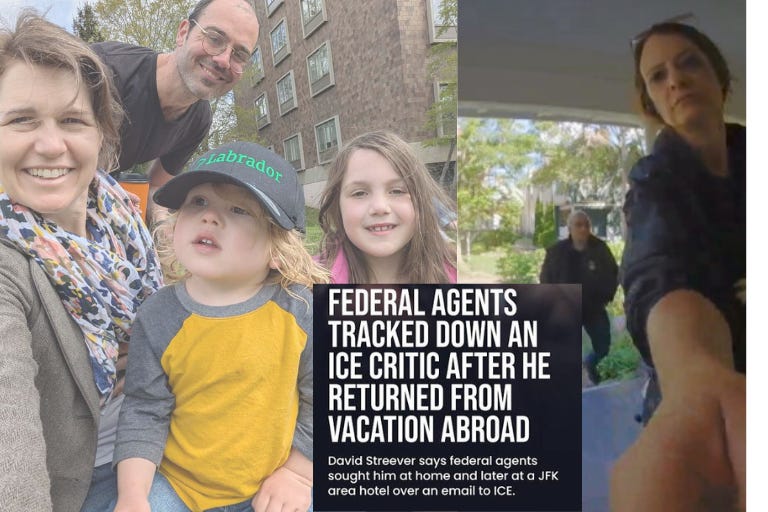
The apparatus has already appeared at a front door. On June 23, 2026, Homeland Security Investigations agents arrived at the Rochester, New York home of David Streever, a private citizen, over an email he had sent five months earlier calling the acting ICE director “a monstrous human being” after agents fatally shot two U.S. citizens. The agents left his wife a warning notice citing federal threat statutes, then tracked him days later to a New York City hotel, where he was returning from vacation with his seven-year-old daughter. The same day, agents confronted a Syracuse woman at her polling-place job over an Instagram post. Streever is now suing, arguing the five-month gap between the email and the visit gives the game away: the purpose was chill, not safety.
The memorandum’s central term, anti-Americanism, is never defined in it. The omission is doing work. The Constitution supplies a definition the administration cannot object to, and it begins with one word: person.
The Due Process Clauses protect persons, not only citizens. No person shall be deprived of life, liberty, or property without due process of law, and the Supreme Court has held from Yick Wo v. Hopkins to Zadvydas v. Davis that this covers every person within the country’s territorial jurisdiction. When a federal court finds that officials used detention and deportation power to chill protected political speech, the constitutional word at stake is person.
The First Amendment carries the next part. There is no constitutional requirement to be pro-capitalist, religious, or aligned with government policy. NSPM-7 places anti-capitalism, anti-Christianity, and anti-Americanism inside the government’s description of the motives and indicia of political violence. The FBI budget then funds the personnel and institutions that will act on that description.
Article III carries the last part, and the administration’s defenders have a real argument here. The courts are fighting. Judges have blocked the SAVE database, enjoined the union terminations, stalled the mass firings. The Merit Systems Protection Board still hears appeals. DOJ has lost all seventeen voter-roll cases decided so far. Those facts matter. They are not enough. Watch what happens at each point of contact. The court blocks the database; the Secretary of Homeland Security threatens to prosecute the state officials who honor the ruling. The court enjoins the union termination; the department executes it anyway. The MSPB still exists; new rules cut employee response windows to as little as one to five days and strip whole categories of workers from its jurisdiction. Institutional erosion works by repetition, converting each legal limit into a new target for executive pressure.
On June 29, 2026, the pressure reached the top. The Supreme Court overturned Humphrey’s Executor v. United States, the 91-year-old precedent that let Congress shield independent agency leaders from removal except for cause. Chief Justice Roberts, writing for a 6-3 majority, declared that “subordinates who exercise the president’s power are subject to removal by him.” The ruling reaches roughly two dozen agencies built to operate above partisan politics, from the FCC to the Nuclear Regulatory Commission. Justice Sotomayor’s dissent warned the decision “promises only chaos.” The district courts are holding a line the Supreme Court is redrawing behind them.
The same theory of power appears abroad. In February 2025, the president declared a national emergency over the International Criminal Court and signed Executive Order 14203, and the State Department under Rubio proceeded to sanction sitting ICC officials in successive rounds: judges from Canada, Uganda, Benin, Slovenia, Peru, France, Georgia, and Mongolia, along with prosecutors from the United Kingdom, Fiji, and Senegal. In June 2026, three of the judges, Prost, Bossa, and Alapini-Gansou, sued in federal court in Manhattan. Their complaint says the sanctions froze their bank accounts, canceled their credit cards, cut off their Google and Amazon accounts, and in some cases stripped their health insurance, all for having “done nothing more than faithfully discharge their judicial offices,” measures they call tantamount to a financial death penalty. They are foreign judges punished personally for judging. A government reveals what it thinks courts are for when it meets a ruling it dislikes, and this one’s answer, at home and abroad, is the same.
Now run the test the administration’s own memorandum implies. Does this government defend the institutions that constrain its power, or only the ones that serve it? It has attacked the judiciary that checks it, sanctioned the foreign judges beyond its reach, purged the civil service that outlasts it, broken the unions that bargain with it, coerced the states that run its elections, sent federal agents to the homes of citizens over emails, and turned the counterterrorism and financial surveillance apparatus toward organizations it associates with the opposition. The memorandum defines the threat as hostility toward the constitutional order. By that definition, the most systematically anti-American actor in the United States today is the government hunting for anti-Americanism.
Twentieth-century regimes did not share a single ideology. Mussolini’s Italy, Stalin’s Soviet Union, and Hitler’s Germany justified power through different doctrines, and historians long ago observed that they converged anyway on the same instruments: subordinated courts, captive media, politicized administration, surveillance of belief. The comparison in this essay concerns those instruments.
Neither historical system is being reproduced whole here, and the contest is real; courts, states, unions, journalists, and civil servants are fighting daily. What the administration has borrowed is the usable core: identify the internal enemy, treat ideology as danger, weaken independent institutions, make resistance administratively costly. It labels dissent as terrorism and loyalty tests as patriotism. It detains and attempts to deport people for speech in the name of freedom. It pressures maps and demands voter rolls in the name of election integrity. It calls its opponents deformed, from the podium where America once addressed the world.
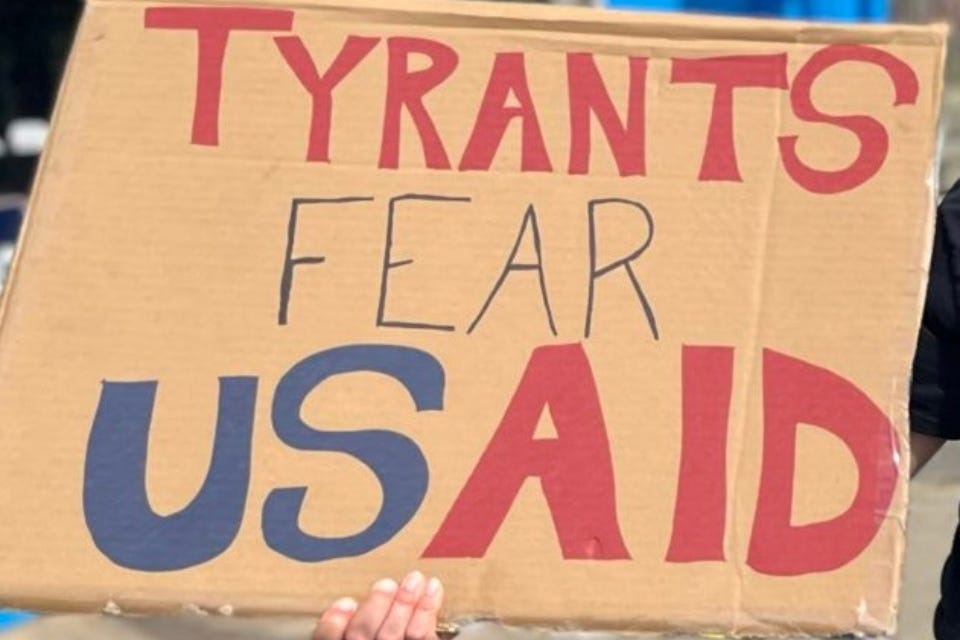
Before power acts on a category, it has to invent one.
Steve Bannon named the mechanism on his podcast, in remarks transcribed by Media Matters: the July 16 speech was “a predicate for immediate action,” a national security emergency order on elections. In the rhetoric, opponents become extremists, then terrorists, then unhumans. Somewhere along that road the Constitution stops being a charter and becomes an obstacle.
The category is already in electoral use. Six days after the ministerial, Miller went on Fox News and applied it to the entire opposition party: Democrats, he said, have embraced “straight-up, outright, full-throated communism,” and the choice before voters is Trump or “the crazy communist lunatics who will steal everything you know and love in this nation.” The word that once described Soviet divisions and Cuban prisons is now a midterm turnout tool, aimed at roughly half the American electorate, by the official who told sixty governments the left is a cancer to be rooted out.
The administration wrote anti-Americanism into counterterrorism policy, funded the apparatus, and placed the blurb writer for Unhumans one heartbeat from the presidency. On July 16, all three heads spoke in a single day.
By their own definitions, they are the thing they claim to be hunting.
Comments
Nothing yet. Say the first thing.
Sign in to join the conversation.