
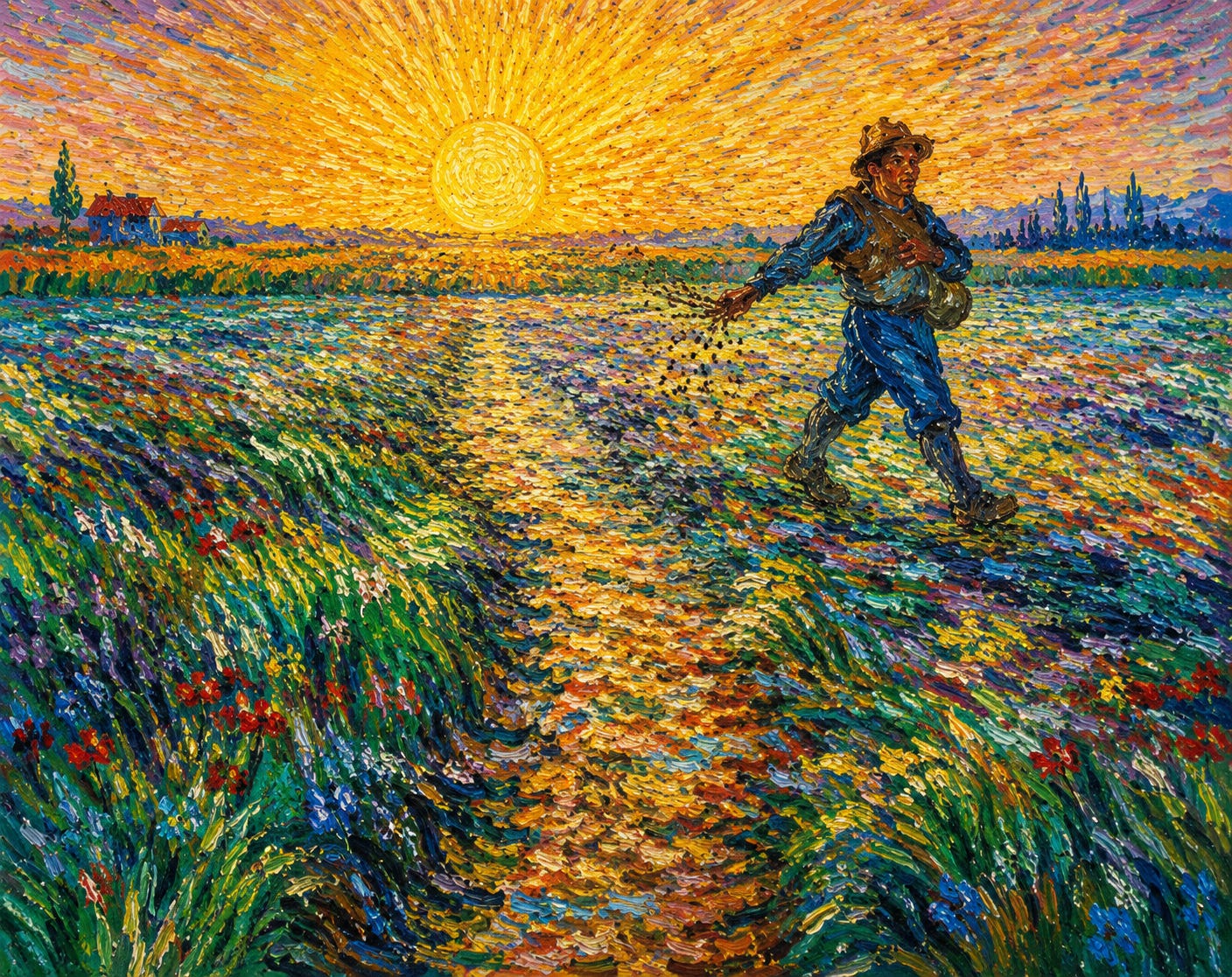
The arrival of generative AI challenges the global education system so deeply that it gives us an opportunity to ask again a fundamental question: what is education for?
In an earlier blog I suggested that AI could support a search for meaning by connecting learners to real-world problems and larger systems. On reflection, however, this answer feels a bit thin. Connecting to bigger networks, the global dialogue of scientific inquiry, for example, might work for some people, but it will not work for everyone. It presupposes what first needs to be formed: people open to finding meaning through participation.
The deeper challenge for education is that meaning is not usually formed consciously or individually. Human beings are shaped pre-reflectively through embodiment, relationships, language, ritual, and culture long before they are able to articulate beliefs about themselves or the world. It is through induction into forms of life, within families, communities, friendships, and institutions, that we first learn who we are, what matters, whether the world is trustworthy, and whether life is worth living.
The wellbeing data here is striking. Children raised within religious communities consistently show lower rates of depression, anxiety, addiction, and suicide, alongside a stronger sense of meaning and belonging. This finding comes not from religious apologetics but from mainstream social science, including the work of Jonathan Haidt, a self-described atheist who has written candidly about where the evidence appears to lead. State education systems must serve children of all faiths and none. But that should not prevent us asking what religious traditions still understand about formation, ritual, belonging, and moral purpose that secular institutions may be able to learn from.
If we do not shape culture consciously, culture will shape people unconsciously anyway. Much contemporary education rests on assumptions it rarely makes explicit. Science, as commonly taught, can imply that the universe is mechanical and indifferent. Literature often encourages suspicion toward the idea that meaning genuinely resides in the world. History, as taught in schools, often dissolves larger narratives into contingency and struggles for power. Official aims speak of teaching for awe, creativity, and human flourishing, yet the hidden curriculum transmitted through assessment, credentialism, and competition points elsewhere.
Into this vacuum students are offered only one clear path to meaning: personal success. Whether in school exam results or comparisons of lifestyles on TikTok, it becomes clear that being ordinary is not enough. What counts is individual achievement, status, or success. The results are visible. Not wisdom or belonging, but anxiety, isolation, and the sense that meaning must be manufactured alone against a universe that offers none of its own.
Schools once existed within thicker webs of formation where families, neighbourhoods, religious communities, and civic cultures all shared responsibility for shaping identity and purpose. Today social media and AI are increasingly absorbing that role without democratic mandate or accountability.
One of the strongest critiques of social media and AI is that they shape us unconsciously. Haidt and others are right to worry. Yet the standard response often misunderstands the problem in a way that actually serves further to contribute to it. We are told that we need more transparency, more individual control over data, or simply banning phones for young people until they are old enough to give full consent. Beneath these responses lies a questionable assumption: that there exists a fully autonomous self standing outside culture, capable of giving consent and rationally choosing its own formation once sufficiently informed.
But we humans are always already formed through language, education, institutions, media, and relationships. This is not a failure of freedom. It is the condition through which meaning and freedom become possible. The self is not prior to formation but emerges through it.
The question, then, is not whether technology shapes us. It always will. The question is whether we can consciously and collectively take responsibility for shaping the culture that shapes us.
Education presupposes faith in the possibility of transformation: the possibility of learning, growth, and deepened understanding. Without this faith the very idea of education becomes self-contradictory.
Progress through education and inquiry is not just about science and technology. In earlier blogs I quoted Plato. We still read Plato more than two thousand years after he wrote. Philosophy has been described as ‘footnotes to Plato’ but progress in philosophy is real. It takes the form of expanded dialogue. Where once a few carefully preserved texts were read with reverence in medieval universities, today almost anyone can read Plato in dialogue with Confucius, Buddhism, feminism, ecology, postcolonial thought, and neuroscience and learn from participation in this expanded dialogue.
Progress then is not a line from A to B, from error to truth, but from A to A-plus-B: through widening relationships, expanding perspectives, and deepening reflexive awareness. Technology has made this possible. Meaning, for those with sufficient faith in the larger tradition of education, grows through participation in expanding processes of inquiry, connection, and shared understanding.
Modern science itself did not emerge from a rejection of religious faith, as many now claim, but largely from developments within Christianity grounded in the conviction that a rational Creator had made a world that rational creatures could investigate. Medieval Islamic scholarship made indispensable contributions in mathematics, optics, and medicine. Rational inquiry into the conditions that support human psychological flourishing is central to strands of Hinduism, Buddhism, and other philosophical and religious traditions.
Science, in this broader sense, is disciplined collective inquiry, not only into the apparently outer world, but also into the inner world of experience, ethics, and spirituality. This collective inquiry is not the opposite of faith but one historical continuation of humanity’s search for truth through dialogue, humility before evidence, and openness to revision. Inquiry generates its own ethical demands: honesty, patience, courage, trust, and willingness to learn from others. A genuine culture of inquiry is already a culture of formation.
Religious traditions remind us of something modern education consistently underestimates. Human beings are not shaped by ideas alone but through shared practices and embodied participation: through singing, mourning, celebrating, gathering, spending time in nature, and participating in rituals and stories that connect individual lives to larger patterns of meaning. Meaning is often lived collectively before it is articulated intellectually.
Modern education still contains rituals, but many are organised primarily around testing, ranking, performance, and competition rather than around shared inquiry and meaningful participation in collective life.
Used badly, AI will intensify the worst tendencies of the existing system: passive consumption, cognitive outsourcing, manipulation, and the shallow optimisation of measurable outcomes at the expense of everything that matters.
Used well, however, AI could help education recover what modern institutions have partly lost. It could connect learners across cultures around shared human questions, stage dialogues between traditions separated by language and history, and enable forms of collective inquiry at scales previously impossible. It could support sustained reflection, collaborative creation, and practices of dialogue that reconnect individuals to something larger than themselves: not through indoctrination, but through participation in humanity’s ongoing conversation about truth, meaning, and the future.
The important point is that social media and AI systems are never neutral. They already shape habits of attention, norms of communication, assumptions about success, and even emotional tone through the forms of feedback they provide. Current social media often reward speed, outrage, self-promotion, and compulsive engagement because these increase measurable activity. But different systems could be designed around different formative goals.
AI tutors, moderators, and social platforms could instead be designed to reward curiosity, listening, intellectual humility, courage in questioning assumptions, collaborative problem-solving, and sustained inquiry. Rather than maximising addictive engagement, systems could encourage periods of reflection, dialogue in diverse groups, participation in shared projects, or even practices that reconnect people with embodiment, community, and the natural world. AI could help organise collective rituals of inquiry and reflection at local and global scales in ways that social media platforms currently do not.
The issue, then, is not whether AI will shape human beings. It already does. The issue is whether we consciously shape these systems around educational and civilisational values supportive of human flourishing.
Education always inducts students into a worldview and a way of being in the world, consciously or not. The real question is what kind of worldview and way of being in the world we now wish to cultivate. Not dogmatic certainty. Not technological utopianism. Not atomised individualism. But a renewed faith in the practice of collective inquiry itself — faith in the possibility that through dialogue, imagination, science broadly understood, and shared practices of creative sharing and learning, human beings can continue expanding their world of meaning together.
Science in this broader sense is not merely a collection of disciplines. It is a civilisation-scale practice of collective learning through which humanity reflects on itself, tests ideas against reality, revises assumptions, and consciously participates in shaping its own development. Democracy in this deeper sense is not merely a mechanism for aggregating preferences but the collective practice of self-determination: the ongoing attempt of a society to reflect upon, question, and consciously reshape the conditions of shared life. We can be proud of what we have achieved so far and what we might yet achieve in the future and not ashamed to induct our young into that shared pride and that shared project.
The educational challenge of the age of AI is therefore not simply how to use new tools efficiently. It is whether education can help cultivate forms of collective intelligence and collective wisdom capable not only of sustaining but also of calling into being a self-reflective, self-organising, and consciously self-evolving planetary culture.
That, at its deepest level, is what education has always been for.
Comments
Nothing yet. Say the first thing.
Sign in to join the conversation.