
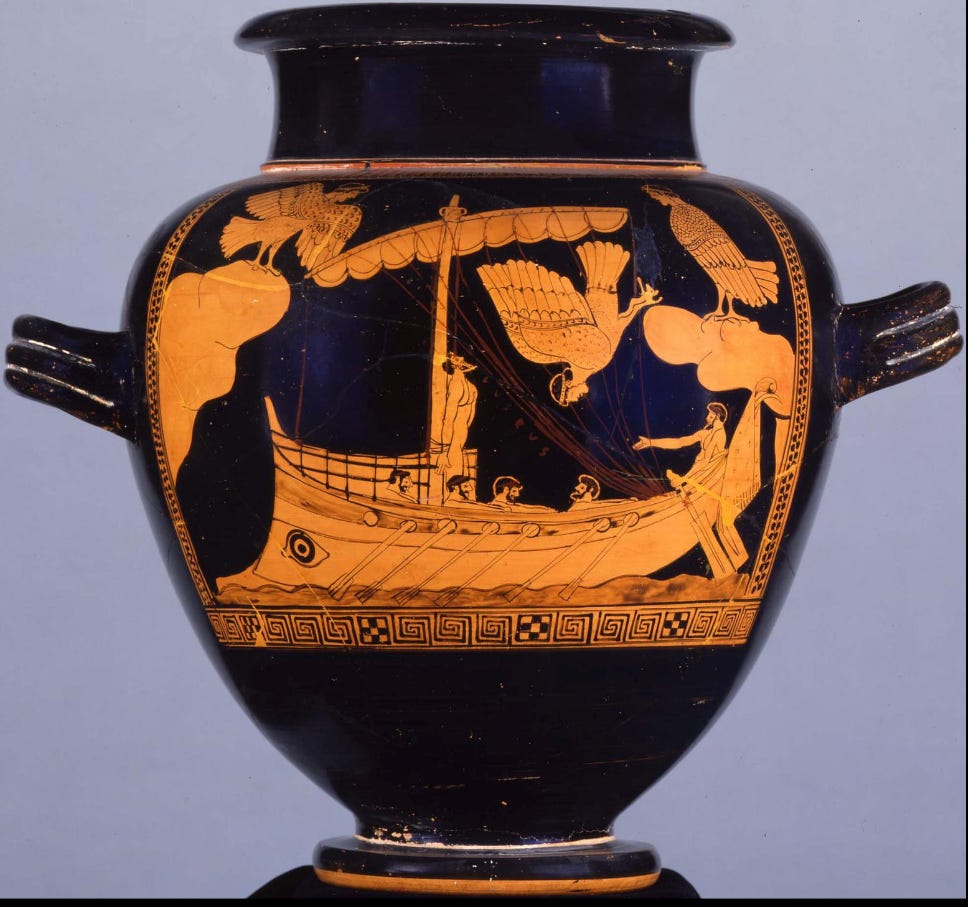
[The Siren Vase. British Museum]
Like many people at the moment, I have been thinking about The Odyssey, prompted by Christopher Nolan’s new film. My wife and I loved it so much that we went to see it a second time, this time on an IMAX screen, to make sure we had not missed anything.
Nolan has described The Odyssey as a foundational text. It is above all the great homecoming story. Countless later stories have been influenced by it. The Greek word for homecoming is nostos, one of the roots of our word nostalgia. Homer’s homecoming story is about the long detours, distractions and trials that lie between us and home, so that when we finally return, we return as someone else, changed by the journey.
I like this idea of returning to the beginnings of things. Everyday words in education, words such as knowledge, thinking and dialogue, are used so often and so easily that we forget where they came from. Reading the foundational texts in which these ideas first took shape can help us hear them freshly.
Those who read this Substack will know that thinking about AI and education often leads me back to Plato’s Phaedrus, perhaps the first critique of an educational technology. Plato has Socrates describe written words as being like painted figures. They stand before us as if alive, but if we ask them a question they remain solemnly silent. They go on saying the same thing forever. Once separated from the living voice that first spoke them, they cannot explain themselves or respond appropriately to the person before them.
As a contrast, Socrates describes another kind of word, one “written in the soul of the learner.” This word can answer when questioned. It knows when to speak and when to remain silent. It is not merely a record of something once meant. Phaedrus responds: “You mean the living word of knowledge which has a soul, and of which the written word is properly no more than an image?”
The difference Socrates is pointing to runs deeper than the technology of writing. It cannot simply be that speech is alive and writing is dead. A teacher can recite dead words from the front of a classroom, while a sentence written thousands of years ago can address me, disturb me and change my life.
Writing comes alive when it is taken up again in a real act of response. Reading is then not the transfer of information from page to memory, something that AI can do rather better than I can, but it is the taking up of what is written into my own concerns and projects, letting it question me and letting it matter. To read in this way is already to participate in the world.
Another foundational text, the Book of Genesis, offers a different image of what it means to know. In Genesis it is written that Adam “knew” Eve and she conceived. Here, knowing clearly means more than possessing information. It means intimate participation.
There is a beautiful folk etymology of the Hebrew word yada, “to know.” The earliest forms of Hebrew used pictorial signs. The two main characters in the word yada were, it is claimed, originally pictures of an eye and a tent door. On this reading, to know becomes an eye passing through a tent door.

Imagine standing outside a tent. You can locate it and describe it. You may produce a perfectly accurate representation. But another kind of knowing begins when you lift the flap, step inside, sit down and share tea and conversation with the people who live there.
Here is the distinction that follows from Socrates’ contrast between the living word and the dead word. Knowledge can be representation, but it can also be participation.
Modern education overwhelmingly favours remaining outside the tent. It is largely about teaching people to produce representations of knowledge and then checking whether those representations are correct.
Socrates’ foundational criticism of writing as an educational technology proved prophetic. Education can produce people who sound knowledgeable because they can reproduce what has been written, without necessarily knowing how to respond to another person, to a new situation or to the world itself.
There are enormous benefits to representation. Writing allows knowledge to travel across time and space. Books, diagrams, mathematics and scientific models have transformed civilisation. Representations allow us to stand back, compare, criticise and reflect.
The problem begins when representation becomes the only kind of knowing we recognise. We forget how to step inside again: to take what we have learned back into the living weave of our projects and relationships, until it becomes not merely an object we look at but a way of seeing and acting, and the ground for the next step forward.
My own experience of formal education led me to see the problem of focusing only on representational knowledge. I began life pretty happy most of the time, simply participating in the world. As a child, I did not stand outside life looking at it. I lived it.
Gradually, through education, I learned to see the world as an object to be represented rather than as a partner in dialogue. Worse, I came to see myself from the outside: as an image, a label, a personality, an object occupying a particular place in space and time. I began to see myself as I imagined other people saw me.
The centre of gravity shifted. Instead of living from the inside and using representations when I needed them, I became trapped in the representation. I suspect that many people experience something similar. They emerge from education knowledgeable and successful, but somehow estranged from their own lives. They know how they appear. They know how they have been classified. But they no longer know what it means simply to be alive and to answer the world from where they are.
If the soul is formed through living relationships, an education that consistently places representation above participation may do more than give us a narrow idea of knowledge. It may damage the soul.
It is interesting that it was important to Nolan to make The Odyssey without generative AI. He insisted on real places, physical sets and human performers, and has argued that this mattered to the kind of film he wanted to make.
AI represents a remarkable new stage in the history of writing: for the first time, the written word appears able to answer back. This is exactly what Socrates claimed that written words could not do. But this only makes Socrates’ challenge more urgent. What is now the essential difference between the living word and the dead word?
The Russian thinker Mikhail Bakhtin illuminates the issue. Dialogue is not simply an exchange of sentences. A living word is answerable. It comes from someone who has to stand behind it. A promise matters because someone must keep it. An apology matters because someone accepts responsibility. A declaration of love matters because a life is being placed at risk in the saying of it.
AI can produce answers, but it is not answerable. It has no life to answer for.
This is the crucial difference. A living word is not simply a better sentence. It is an event. Something happens. A possibility opens that was not there before.
And this answerability reaches further than the immediate exchange. We answer not only to a teacher, an employer or another individual, but to the larger horizon behind them: to other people, to the living world, to the future and to everything that has not yet been decided.
Perhaps this is how a soul comes into being: through learning to answer the call of the world. Education is the growing of that relationship.
Perhaps education now needs its own homecoming. I do not mean that we need to abandon writing, examinations, knowledge or technology. Odysseus could not return home without making the journey. A true homecoming includes everything learned along the way.
The question is: which serves which—or perhaps even, who serves who?
Representations should help us enter more fully and intelligently into life. They should not leave us standing outside our own experience, looking on and asking ChatGPT how we are supposed to feel or what we are supposed to do.
For centuries, education required students to store and reproduce representations. There was no other way for knowledge to be carried forward. But now AI can reproduce established knowledge faster and more fluently than any student. If producing the expected answer remains the main purpose of education, then the machine has already beaten us.
But the purpose of education is not merely to produce correct answers. It is to help people enter the conversation: to encounter other voices, make judgements, take responsibility, discover possibilities and learn how to answer for what they say and what they do.
Real education invites us to step inside: to discover how we are called by the world and how we might answer that call.
Like Odysseus, we come home changed. We do not return to childhood or to a world before writing. We return with everything the journey has taught us, yet able to recognise, as if for the first time, the value of what was there all along.
Comments
Nothing yet. Say the first thing.
Sign in to join the conversation.