
There are few premium brands in hedge funds or investing like Citadel or Millennium. These are platforms beyond their legendary founders. They have immense pricing power illustrated by their sky-high pass-throughs. They could both raise new money – tens of billions of dollars or more – at will, if they wanted.
Early last year I wrote about how Citadel and Millennium are always bucketed together but there are large business model differences:
- the level of collaboration across investment teams at Citadel is much greater than the siloed de-centralized pod structure of Millennium,
- there are hard fixed drawdown limits at Millennium versus no hard limits/stop losses at Citadel,
- much higher historical returns at Citadel but lower volatility at Millennium,
- larger trading books at Citadel drive much higher AUM per employee
- huge external manager allocations that Millennium makes,
- the unique power of Citadel’s incredible commodities business.
·
March 30, 2025

Wandering around Mayfair in recent weeks and listening to friends who work for multi-manager pod shops and other hedge funds made me wonder if the conventional narrative that pod shops are a homogenous herd copying each other endlessly is right.
Today, all those things remain true but one noticeable trend is how Millennium is being more aggressive on expansion than Citadel. Both firms remain elite and selective. They are hiring and firing. They are returning money to investors periodically.
But Millennium is allocating money at an intensity not seen before in the industry. A senior executive at one of their competitors said to me the other day that $1 billion ticket sizes are the new $100 million tickets when it comes to Millennium’s allocations to external hedge funds. QRT may be catching up in terms of numbers of allocations, but the sure size of Millennium’s external commitments is unprecedented.
A sizeable gap has opened in recent years in AUM between Millennium and Citadel. But is this gap temporary or is it likely to get wider?
Millennium Management has grown its headcount over the last 3 years by more than 40% to more than 6,800 people. It has over 140 employee locations. It is now of the scale of a mini-investment bank.
The hedge fund Citadel has grown headcount by more than 15% over the same period to 3,300 employees. It has a much smaller number of locations with Ken Griffin evangelical about the benefits of working from the office and the collaboration this drives. At the end of last year when Citadel announced plans to open a Dubai office it was one of the last major hedge funds to open a local office in the region, illustrating Citadel’s preference for a smaller number of offices.
The trend in AUM growth has been even more stark. Over the last 3 and a half years, Millennium’s AUM has grown by around 50% while Citadel’s has grown by high single digit percentages in total. The numbers in the chart below are for the year end.
Citadel’s AUM of around $70 billion is now more than $20 billion lower than Millennium.
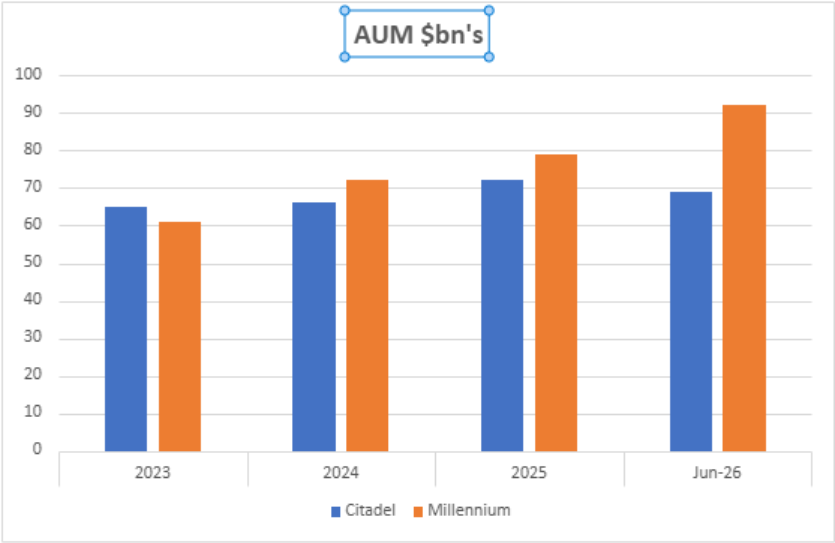
Point in time comparisons are always open to not telling the exact picture so the above chart is meant to make the point directionally rather than scientifically.
Firstly, Citadel had two monster years of 27% and 38% returns in 2021 and 2022 outperforming Millennium and almost everyone else. It also did slightly better in 2023. This had meant that its AUM had grown faster than Millennium in the lead up to this snapshot. 2024 and 2025 returns were similar between the two firms. But in 2026 Millennium is up 10% while Citadel is up around 5%.
Secondly Citadel has returned over $30 billion to its investors since 2017 including $7 billion at the start of 2024 and $5 billion in early 2026. By contrast, Millennium has not had these sizeable annual distributions during this period. It had rotated around $30 billion of funds into new longer duration share classes in 2021 and 2022. In fact, Millennium raised $10 billion of fresh funds in late 2024 in a private equity style drawdown structure - pledged amounts to be deployed over several years.
This trend is not specific to just Millennium. Point72 reported AUM of $50.7 billion at the end of Q1 2026 and had returns of around 10% in the Q2 2026, which would imply an end of H1 2026 AUM of more than $55 billion. So, the AUM gap between Millennium and Citadel is now bigger than between Citadel and Point72. This is particularly notable as at the end of 2023 Citadel’s AUM was twice as large as Point72. I wrote about the Point72 comeback at the start of this year in…
Point72 - The reincarnation of SAC Capital
·
Jan 16

“It’s Stevie on the line I have to take this” I heard. The main course had just arrived, an expensive lobster ordered by my client at the hedge fund SAC Capital. He had been looking forward to lobster at his favourite midtown Manhattan restaurant but suddenly a call had come from the SAC Capital offices and Cohen was on the line! Out, he dashed into a private space to conduct the rest of the call.
On the quant side, the giants are also growing fast. D.E. Shaw has seen incredible returns this year. According to Bloomberg, D.E. Shaw’s flagship composite fund was up 14% (3.2% in June) and its macro Oculus fund up 27.5% (5.6% in June) in the first half of 2026. The company’s website says “as of June 1, 2026, the D. E. Shaw group had more than $100 billion in investment and committed capital.
For more on D.E. Shaw read…https://rupakghose.substack.com/p/de-shaw-the-quant-king
Business Insider reported last week that QRT’s AUM had hit $50 billion a multiple of the $14 billion the firm managed in 2023.
For more on QRT read…https://rupakghose.substack.com/p/the-rise-of-qrt
Looking forward this gap will only grow.
A larger percentage of the AUM of Citadel comes from Ken Griffin and other insiders than the percentage of AUM at Millennium that comes from Israel Englander and his team. Citadel has higher return expectations than Millennium. Moreover, this year and in 2025 Citadel uncharacteristically lagged the peer group. Its giant world-leading energy trading franchise faced tougher market conditions. But what has been a little concerning is how its fixed income business has lagged top fixed income players. Millennium also lagged peers last year but has shown solid returns this year with Bloomberg citing the success of its large index rebalancing team.
The bigger question is really about the vision of the founders. Griffin is very much focused on generating alpha within a cohesive organization with very rare examples of external allocations. At the same time his other business Citadel Securities (separately run) is in the middle of a scaling period.
Meanwhile last year Millennium sold a 15% stake at a valuation of $14 billion. I wrote at the time that: https://rupakghose.substack.com/p/is-millennium-worth-14bn
“The Millennium stake sale is likely more about succession planning and creating a sensible valuation from which to price share options for his senior management than Englander calling the top. Institutional Investor Magazine estimated that Englander made $4bn last year and he is worth more than $15bn so the proceeds of the stake sale are not material in that context.”
A few weeks ago, Bloomberg reported that Millennium is planning on raising another drawdown fund of $10 billion. This should help push the firm over the $100 billion mark. It is also unsurprising given the upcoming external commitments that Millennium has made. Jain Global has struggled to scale with the costly drag of running a full-fledged pod shop. Although running money exclusively for Millennium should allow it to reduce costs substantially it will require a very large allocation from Millennium above the $4-5 billion currently in the main Jain Global fund. Of course, the hugely diversified Millennium can add a little leverage to this allocation, but it is still a substantial amount of client funds/equity capital that will required to back it.
I wrote in https://rupakghose.substack.com/p/jain-and-the-house-of-millennium about how the desire for collaboration or not in-house spills over into whether external allocations make sense for the two firms:
“The theme of external allocations also highlights fundamental business model differences between Millennium and Citadel that are often understated. I compared the two firms in an earlier piece. Both are hyper competitive and performance focused but there is a widening gulf in terms of levels of internal integration. Citadel very rarely even considers external allocations.”
Millennium has also made several other high-profile commitments to external managers recently. This includes more than $1 billion to former Citadel quant researcher Paul Dou’s Hong Kong-based Third Epilson and a future allocation to the new hedge fund of one of Jump Trading’s most senior quant researchers Yiming Zhang.
Comments
Nothing yet. Say the first thing.
Sign in to join the conversation.