
“With fifteen to twenty good, uncorrelated return streams, you can dramatically reduce your risks without reducing your expected returns.” Ray Dalio
The holy grail of hedge fund investing is of course to find uncorrelated returns. The high beta and lack of downside protection given by the industry during the GFC caused flows to stutter, and a new type of hedge fund came to dominate the industry, the multi-strategy hedge fund, and specifically the multi-manager platforms. Market-neutral, obsessed with factor exposure and correlation. The poster child for this, Millennium, a firm with only $8 billion of AUM at the end of 2009 is about to cross the $100 billions of AUM mark soon. Citadel pivoted its business model after its massive 2008 drawdown.
For almost a decade, the hedge fund industry was out in the wilderness at least relative to private markets. Things started to gain further traction last year when the industry saw strong net inflows underpinned by a good year of returns across most strategies.
Hedge fund investment returns for the first half of this year have been even better. Everyone is bullish on hedge funds and bearish on private credit. Hedge funds are suddenly seen as the safe bet – liquid, transparent, and well diversified.
If anyone was doubting the power and leverage of the industry, US bank earnings season this week was a stark reminder. Financing revenues at banks from hedge funds continues to skyrocket. Goldman Sachs just reported a 91% increase year on year for Q2 in equity financing revenues. Hedge fund AUM is growing; leverage is rising, and Asia has been particularly ballistic.
But the age-old question around repeatability hasn’t gone away:
Has new alpha been found across the board or were trading conditions just cyclically better?
What is the breadth of the incremental alpha generation, and what are the risks?
Equity hedge funds had led the way in 2025, and it was more of the same in the first half of this year. This included the standout performance of Tiger Cubs that are geared plays on the AI trade or of broad equity long/short hedge funds like Marshall Wace’s Eureka discretionary fund that was up around 20% in the first half.
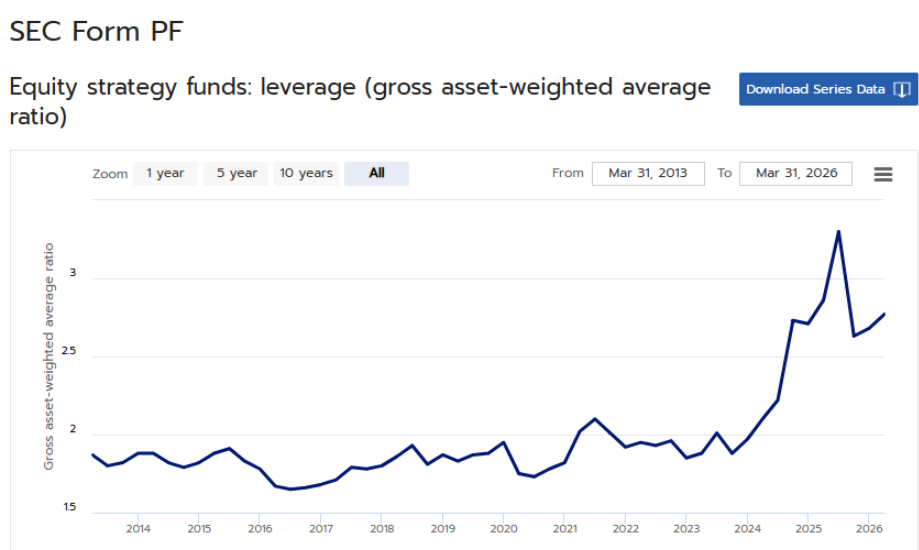
Although pulling back in recent days, gross leverage across the equity hedge fund segment was high in the second quarter. It has also risen significantly in recent years as illustrated by the below chart from the US Treasury's Office of Financial Research.
The sugar highs that we have seen for industry AUM, net inflows and overall investment performance mask a more mixed performance when looking at strategies beyond discretionary equity long/short.
Despite the media periodically talking about “quant quakes”, the quant funds across the spectrum have done well when we look at the first half in aggregate. Of course, July has been tougher for both strategies.
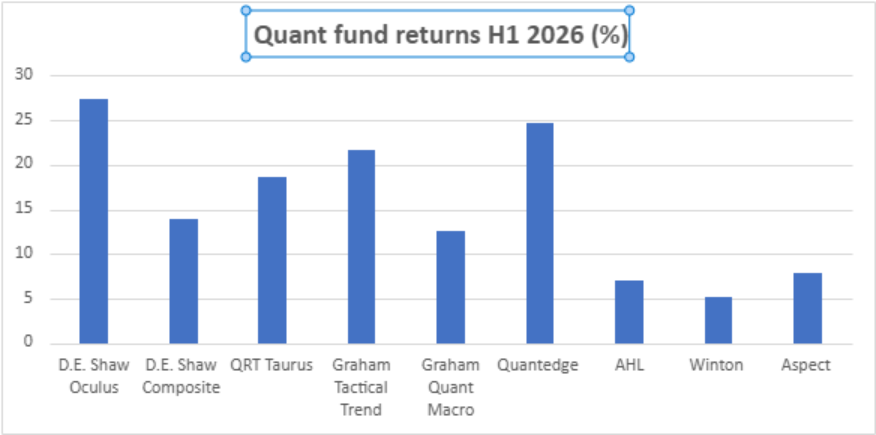
The chart below illustrates investment returns across some large quant players for the first half of 2026. D.E. Shaw’s macro fund Oculus continues to produce incredible returns. Asian fund Quantedge also led the pack albeit it has net long bias and heavy correlation to equity markets. Its low Sharpe ratio contrasts massively with the high Sharpe ratios of top US quant firms.
In addition to the above, Two Sigma had shown decent returns through the early months of the year. The flagship vehicle for the fast-growing Capital Fund Management (CFM), a Paris-based hedge fund managing $29 billion, has been a laggard with low single digit returns this year but it's other funds that are in aggregate just as large have seen high single digit and low double-digit returns. These include ones with more focus on trend-following and systematic macro.
Although not as obvious from the bull market headlines, it has been a more mixed year for discretionary macro, fixed income relative value, credit and commodities.
Discretionary macro managers that massively outperformed systematic rivals last year have underperformed significantly as a group with things particularly tough for fixed income relative value funds that haven’t really recovered from the March bloodbath. This contrasts with the bullish sentiment from allocators towards discretionary macro over the last year.
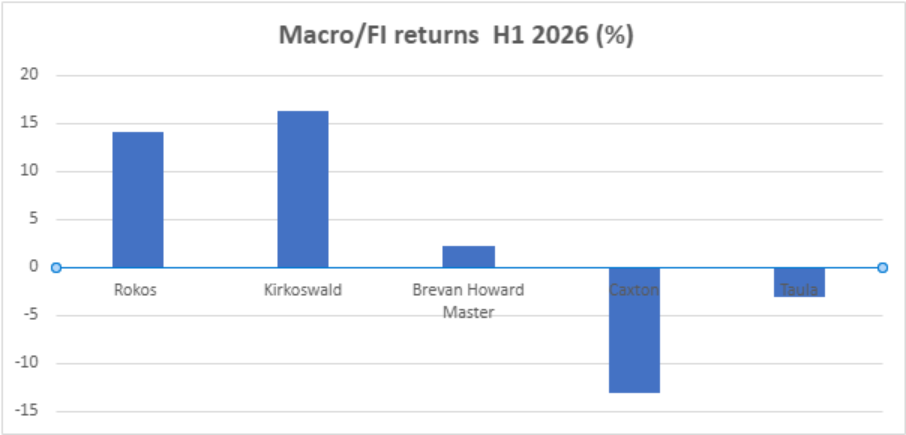
The chart below illustrates investment performance for some of the largest dedicated players in the space. But these funds will of course include equities and equity-linked sleeves as well. Beyond the perennial outperformance of Rokos (numbers below are from the end of May), the Wizard of Oz Greg Coffey’s Kirkoswald has continued its recent hot run with Caxton and Taula laggards. The data below is sourced from Bloomberg.
The monthly returns from the big multi-managers naturally garner a lot of attention. A few days ago, I again wrote about the business model differences between Millennium and Citadel. But at a time of such disparity in performance between equities, quant and discretionary FICC strategies, it is worth remembering the different asset class mixes of each multi-manager platform.
The segment has recovered well from the March drawdowns, but this has been heavily dependent on discretionary equities and quant investing teams. I noted recently how Citadel’s discretionary equities fund was up 11% in the first half of the year, and a combination of this and its systematic strategies (GQS) was up 14% (likely together around half of Citadel’s investing). By contrast, Citadel’s fixed income strategies were broadly flat.
Citadel’s commodities business doesn’t have a separate fund, but the flagship Wellington composite fund being up only 5.7% over this period suggests that commodities returns were weak. Moreover, Ken Griffin recently told a Goldman Sachs podcast that the firm had been surprised by the supply and demand dynamics in the oil market this year, particularly the elasticity of Chinese demand.
The Citadel example is bit stark and suggests company specific performance in its fixed income business, but the same mix can be seen at Schonfeld, where its discretionary equities fund was up 12.3%, but its overall master fund lagged with 8.4% returns.
The strong outperformance of both Point72 and to a lesser extent Schonfeld would have been impacted by their strategy mix. Despite the massive investments in recent years in macro, Point72 remains predominantly an equity focused multi-manager. The firm now manages around $55 billion of AUM, putting it closer to Citadel than the latter is to Millennium at least in terms of client money managed. I wrote about Point 72’s amazing comeback story earlier this year. Balyasny also has an equity bias but in addition to expanding into macro investing like Point72, it has expanded aggressively in commodities and struggled a little there. That said, in no way is the business mix difference large enough to provide a plausible explanation for Point72 being up 14.5% in the first half of 2026 and Balyasny being up only 2.6%.
A few weeks ago, I profiled Asian multi-manager platforms like Dymon Asia and Polymer Asia. These funds have a wide range of strategies but at the end of the day, have a very heavy Asian equities bias.
Schonfeld’s roots lie in systematic trading, which it first moved into more than 25 years ago. Since transitioning from family office to taking in external money a decade ago, it has generated low teens returns per year.
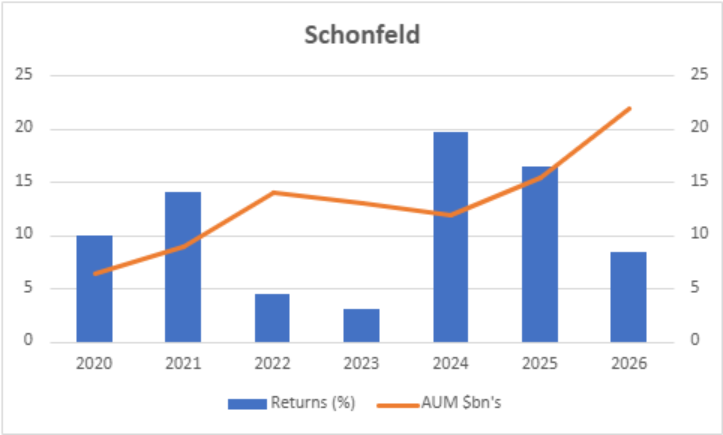
AUM more than doubled between 2000 and 2022, and headcount also more than doubled. Schonfeld went on an expansion phase, including getting bigger in macro trading. But weak returns in 2022 and 2023 led to outflows. After the tie-up talks with Millennium ended in 2023, Schonfeld was restructured and reduced headcount by 15%. It also doubled down on its areas of expertise: quant trading and to a lesser extent discretionary equity long/short.
Investment returns started to improve again in 2024, and AUM has now ballooned to more than $22 billion. With less macro and fixed income relative value exposure and no commodities business, Schonfeld has been in the right asset classes and investing styles for the last 18 months.
Unlike the last cycle, the firm has been more disciplined, and headcount has only grown by 15% from the trough. Schonfeld’s AUM per employee, which had been in the $13-16 million range between 2020 and 2025, is now $20 million. This puts it a par with Citadel and ExodusPoint on this metric and well above most of the multi-manager platforms.
The chart below illustrates this journey.
Read on for more on Walleye Capital, ExodusPoint and then the credit space.
Comments
Nothing yet. Say the first thing.
Sign in to join the conversation.