
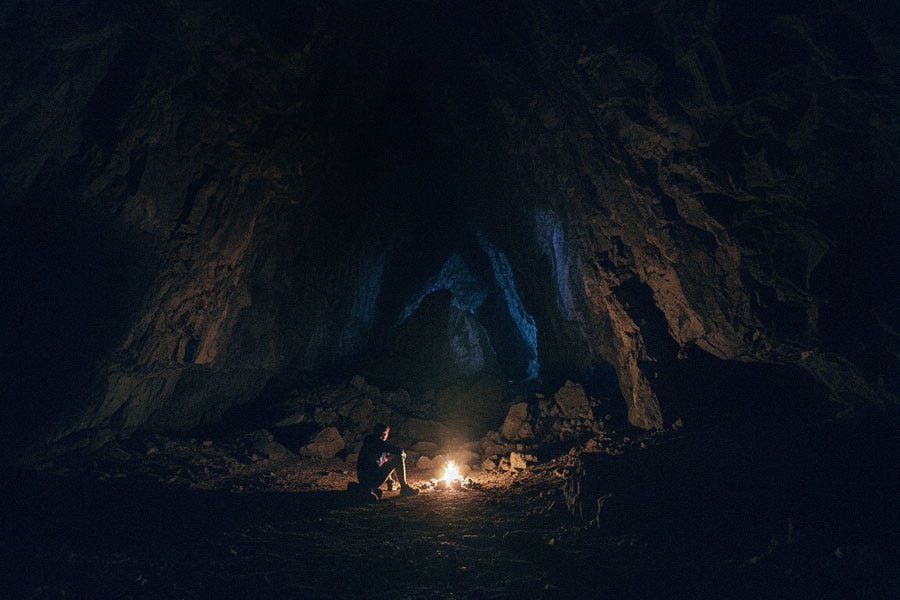
I’ve been hurting. Not in training, which is going well as I look ahead to the Eugene Marathon. The legs are good. It’s my heart that aches.
What’s happening in my country feels personal, like there’s something I could or should do, but am not. The tension between action and withdrawal feels like an identity crisis. I clench my fists in anger, I hide under the blankets in despair. Not knowing which response is correct, I suffer.
Suffering, simply put, is wishing things to be different than they are.
To avoid such distress, should we stop wanting better for our neighbors and our country? Should we shrink and stay small? Or maybe we brawl. When justice is on the line, we fight. Right? Perhaps a period of mutual pain would set things back on a humane and peaceful course.
Here’s what I believe. Before we’re any good to a cause larger than ourselves, we must first get our own houses in order. We need to understand our suffering… how it works, what it asks, and how we respond. Otherwise, we risk bringing more tension into the communities we hope to serve.
Running and Zen offer some guidance.
Many people treat suffering like a dirty word. The world runs on the promise that if we work hard , buy the right stuff, and keep ourselves sufficiently distracted, we can avoid pain. But the idea that life can be steered to bypass discomfort is false. By our very wanting of a different reality, we suffer.
That isn’t a failure of character. It’s part of being human.
Humans want. Not always in a shallow or consumer sense. Often in a more fundamental way. We compare. We dream. We project ourselves forward and backward in time, all while doing calculations about the distance between where we are, and where we imagine we could be.
Runners understand this. For us, the question isn’t whether hardship will arrive, but when. We know, as the old maxim goes, that you can’t stop the thing from coming. You can only learn how to respond.
We don’t choose suffering, but we can choose our orientation to it. Are we friendly or hostile? Curious or callous? Mindfulness teacher Cory Muscara offers, “When we surrender to pain, it stops being an enemy to what we want. We meet it fully and soften our resistance, no longer fueling the tension that is the real root of our suffering.”
There it is. Resistance equals tension. Tension equals suffering.
Athletes talk about “fighting through” inner adversity, but one of the greatest ultrarunners ever has a more playful approach. Courtney Dauwalter looks forward to her time in the pain cave. “I put on my hard hat, grab a chisel and imagine going into the very back corners and just digging into the work,” she says. “Each time I go in the cave, it’s getting bigger for the next visit.”
It takes courage to not end-run around grief, sorrow, and pain. But when we actively engage with these times, we create art. The art of our life.
“I saw the angel in the marble and carved until I set him free.” Maybe Michelangelo said this, maybe he didn’t. Either way, the metaphor is helpful.
Like a sculptor whose work is less about imposing a vision and more about revealing what already exists in the stone, turning toward our suffering is not about forcing an answer or rushing to resolution. It’s about staying close enough, long enough, to understand what’s in the marble.
This kind of staying has a name in older traditions: initiation. A passage through suffering, where fixed identities loosen and the work is to simply remain present long enough to be changed.
In the timely In the Absence of the Ordinary, Francis Weller writes of initiation:
“It is meant to dislodge our old identity, the sediment of self. We are meant to be radically changed by these encounters. We do not want to come out of the turbulent times the same as we went in.”
So, the nature of our suffering emerges through exploration and removal. Not certainty and addition. When we don’t know, we grow. Weller again:
“Not knowing reminds us we live in mystery, an ever-unfolding, unshaped moment. We do not know what is going to happen, and this keeps us humble, vulnerable, and open. Not knowing situates us at the edge of discovery.”
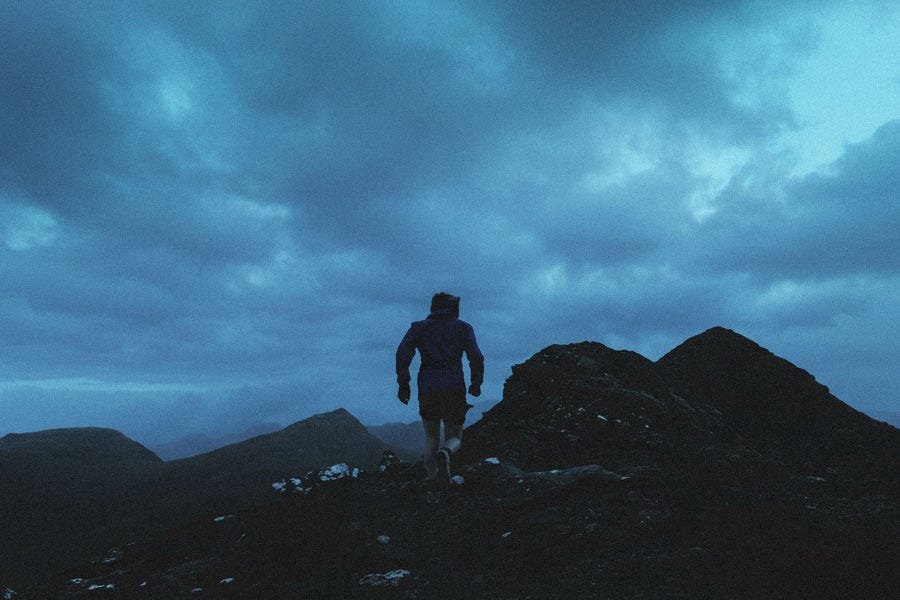
I write about mindfulness a lot, and still have at least one race a year where I go to a dark place and struggle to settle. Thinking alone isn’t sufficient. The good news is, the more you notice your suffering and engage with it willingly, the looser its grip becomes.
Courage is a muscle and reps matter. Not great, heroic efforts, but daily, workmanlike contact with difficulty. It’s why running is so vital right now. I see people in the sport wrestling with that idea, apologizing for talking about training in a time of sorrow and social upheaval.
Don’t apologize. Turn toward your suffering, practice daily with the hammer and chisel, then bring your full self back to the community.
When we learn how to stay with our suffering, something appears in the rock. A pinlight at first, but as we work our tools patiently, a glowing and expansive room reveals itself. In the room, neighbors, community, country.
The pain was never ours alone, but connected to others who share the same fears, doubts, and hopes. This has been the invitation all along: toward dark places, and then back again… this time together.
Everybody’s hurt. You must find some way of using this to connect you with everyone else alive. You must understand that your pain is trivial except insofar as you can use it to connect with other people’s pain.
—James Baldwin

Post Script…
Easy for me to say. Do some soul work, meet your friends and foes in the cave, lock arms, and spin ‘round the campfire. I hear you. It will not be easy to get through these times. Francis Weller says we’re in the “Long Dark.” Still, he posits that suffering on such a scale is not only inevitable, but necessary.
There is something oddly hopeful about that. I’ll let the author close with a call to action more eloquent than I can find. Here’s the book.
No doubt you have noticed that we are living in turbulent times culturally and as a planet. All pretense of immunity is collapsing as we realize how completely entangled our lives are with one another, with kelp beds and calving glaciers, with refugees and the dreams of young people everywhere.
The disequilibrium shaking the world feels like a continual tremor on the fault lines of our psychic lives. Very few things feel stable. It is like a fever dream. It may be that this is the initiatory threshold we require to wake us up. Whatever is happening, much will be asked of us if we are to make it through the whitewater of this narrow passage. We do not know what lies ahead, but one thing is sure: This is a time for bold gestures. It is time to wake up and humbly take our place on this stunning planet. The future is speaking ruthlessly through us.
The immediate need of our time is for ripened and seasoned adult human beings to take their place in our communities; individuals who carry a deep and abiding fidelity to the living body of this benevolent earth, to beauty, and to their own souls.
No posts
Comments
Nothing yet. Say the first thing.
Sign in to join the conversation.