

In political circles, it seems in vogue to have only vague ideas. Not strategies or systems. More notions and inklings. For public policy? Not awesome. But for runners, a little malleability beats a rigid prescription.
Where rigidity is static, flexibility promotes forward motion. It gives you just enough structure to be helpful, with the softness to adjust when life intervenes — when work gets weird, sleep goes sideways, or your body sends a message worth listening to.
Over two decades of running, I’ve zeroed in on a few concepts that work for me. These ways of thinking about training have helped me progress consistently, and at 52, I’m still getting objectively faster and more durable. And I’m having more fun than ever.
Here’s the Cliffs Notes of what I’ve found, rolled into what some politicians might call “Concepts of a Plan.”
First, it’s okay to have a running journey that’s not based on progression. You are allowed to participate without turning yourself into a project. However, peace doesn’t have to be at odds with performance. My experience has been that improvement comes naturally when we’re more at ease.
With that in mind, what might a flexible concept of a plan look like? One that dials down the pressure, but still naturally nudges performance up and to the right, all without too much thinking.
The Formula
At the most basic level, any running journey is comprised of stress and rest. We work, we recover. The infinitely complex interplay between those two things is what makes running fascinating, and answers evasive. How much and what type of work? What do we mean by rest?
Finding a good mix is your lifetime quest, but one thing is known: if you want to keep running, and potentially improving, the formula is:
Consistency x (Stress + Rest) | Read More
I. Journey
Your entire life as a runner is your journey. This is the most zoomed-out view, from the day you lace up, until you quit or die. Yours is yours, and don’t let any influencer (or half-witted Substack writer like me) tell you it has to look a certain way. Could be clean, will probably be messy.

II. Cycles
Within your journey, you’ll move through cycles. These shifts in approach, volume, intensity, and even mood can be driven by lots of things: weather and seasonality, injury and illness, or more commonly by a goal you put on the calendar. Your journey is comprised of cycles.
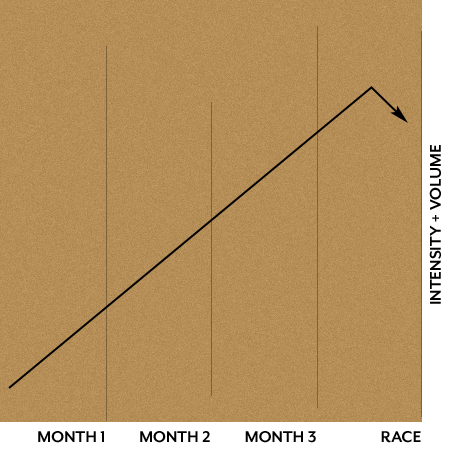
You can move through cycles naturally, or artificially impose them with races or other goals that have set timelines. Since we’re creating a concept of a plan in this article, let’s zoom in on one cycle and think about it in the context of a four-month marathon build.
Over these sixteen weeks, you’ll progressively stress the body with increased work until a brief period of rest, just before the race.
III. Phases
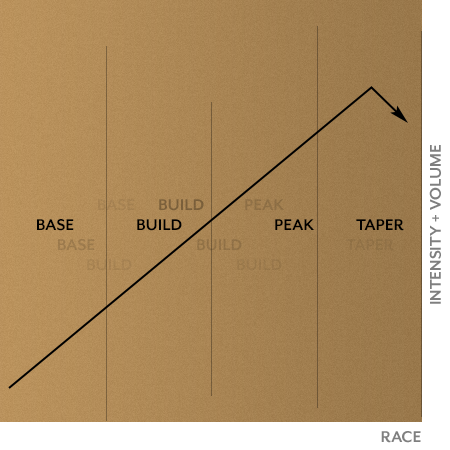
It’s helpful to think about the parts of a cycle as phases. These phases won’t (and shouldn’t) have clean breaks. They’re more like gradients that flow into one another. The point isn’t to wake up one morning with a different mind and body because of a date on the calendar. It’s to move fluidly.
Base: A period of mostly easy running where volume gradually increases but intensity stays fairly mellow
Build: With the body primed and routines more solid, volume continues to expand and more intensity can be added
Peak: A relatively short period where intensity and volume are at their highest of a given cycle
Taper: A brief time of reduced work just before the goal effort (length and structure are variables to tune individually)
Does the goal have to be a race? No, that’s just an example. It could be a self-driven effort like a time trial, personal record attempt, or long day in the mountains. Or, if you simply want to structure your journey around cycles for variety and longevity, those are valid reasons (and likely outcomes).
Let’s zoom in to the month level, where our concept of a plan really starts to coalesce into, umm… a concept. Return to The Formula. Our month might be comprised of alternating stress and rest (recovery) weeks, like so:
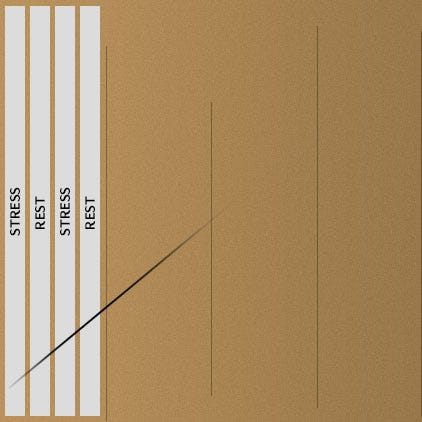
Rest in this context doesn’t mean no activity. It means slightly less work than the week before, setting up an overall increase the following week. Zoom in again. The line still progresses up and to the right. We’re just honoring the stress-rest cycle, which enables consistency over time.
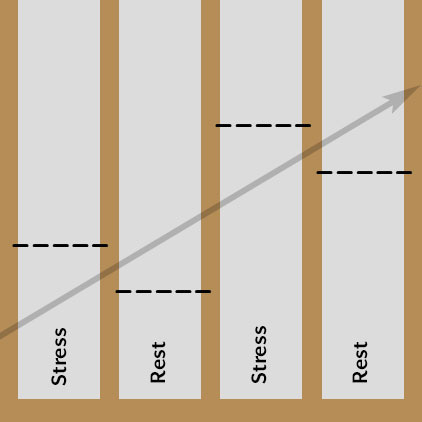
There’s space here to adjust for life. Stress, stress, rest. Stress, rest, rest. As long as you stay patient with efforts (no “make-up” weeks) and intentional with recovery (no skipping just because you feel good), over time the line will continue to move. Of course, someday you’ll bump into your physiological limits. But the “Concepts of a Plan” plan is for dreamers.
Finally, let’s zoom to the week level. Here’s where mindfulness of The Formula sets the stage for joyful running and sustained growth. By breaking the week into five simple categories of work, we apply just enough constraint to relieve cognitive burden. We take out the thinking that kills fun.
Rest: No running
Recovery: The easiest running. Zone 1 or Zone 2 if you track it
Easy: The bread-and-butter, mitochondria-building work that is the foundation of every runner’s program, from Sebastian Sawe to Sam down the street. What does it mean to run with ease? Read this
Intervals: For simplicity’s sake, let’s generalize this category of work as structured periods of intensity and rest within a single run
Long run: What it says. The longest run of a given week
Within the five categories are infinite possibilities, but this isn’t the place to dive into specific workouts. That’s for you to discover. Conceptually, a plan might be constructed around a few basic guidelines:
At least one day of complete rest a week
One interval run and one long run
A recovery day after intervals and long runs
Everything else easy
Three weeks that move volume and intensity forward, while still honoring the stress-rest cycle, might look something like this…
Week 1 (stress):

Week 2 (rest):

Week 3 (stress):

The ideas here don’t resolve into a one-size-fits-all prescription. What they offer is enough structure to give your running direction, with flexibility for real life. But don’t mistake simplicity for shallowness. Stress and rest, stacked over time, in ratios only you can tune, is the whole game.
Start with this concept. Start with The Formula.
Zoom out when you need perspective. Zoom in when you need clarity. And when life scrambles the week or the month or the cycle, remember that the line doesn’t have to look clean to keep moving up and to the right.
The concept is the plan. Nothing left to do but the running.
Run lightly,
-mike
Will you pledge $2 a year to support Running Lightly? It helps me earn a “Certified” badge so more people see the publication. That’s it. Not trying to get a beach house in The Hamptons here. Thank you!
No posts
Comments
Nothing yet. Say the first thing.
Sign in to join the conversation.