
A little over a week ago, I attended a training session at Gasworks Park in Seattle on how to guide blind and visually impaired runners. (Shoutout to my friend Ladia and her friend Ixchel for hosting this!) Part of the session entailed tethering wrists with another runner, donning a blindfold and trusting this stranger to lead me—through her words as well as her body—on a short jog through the park, before swapping places with her and being the one to do the guiding.
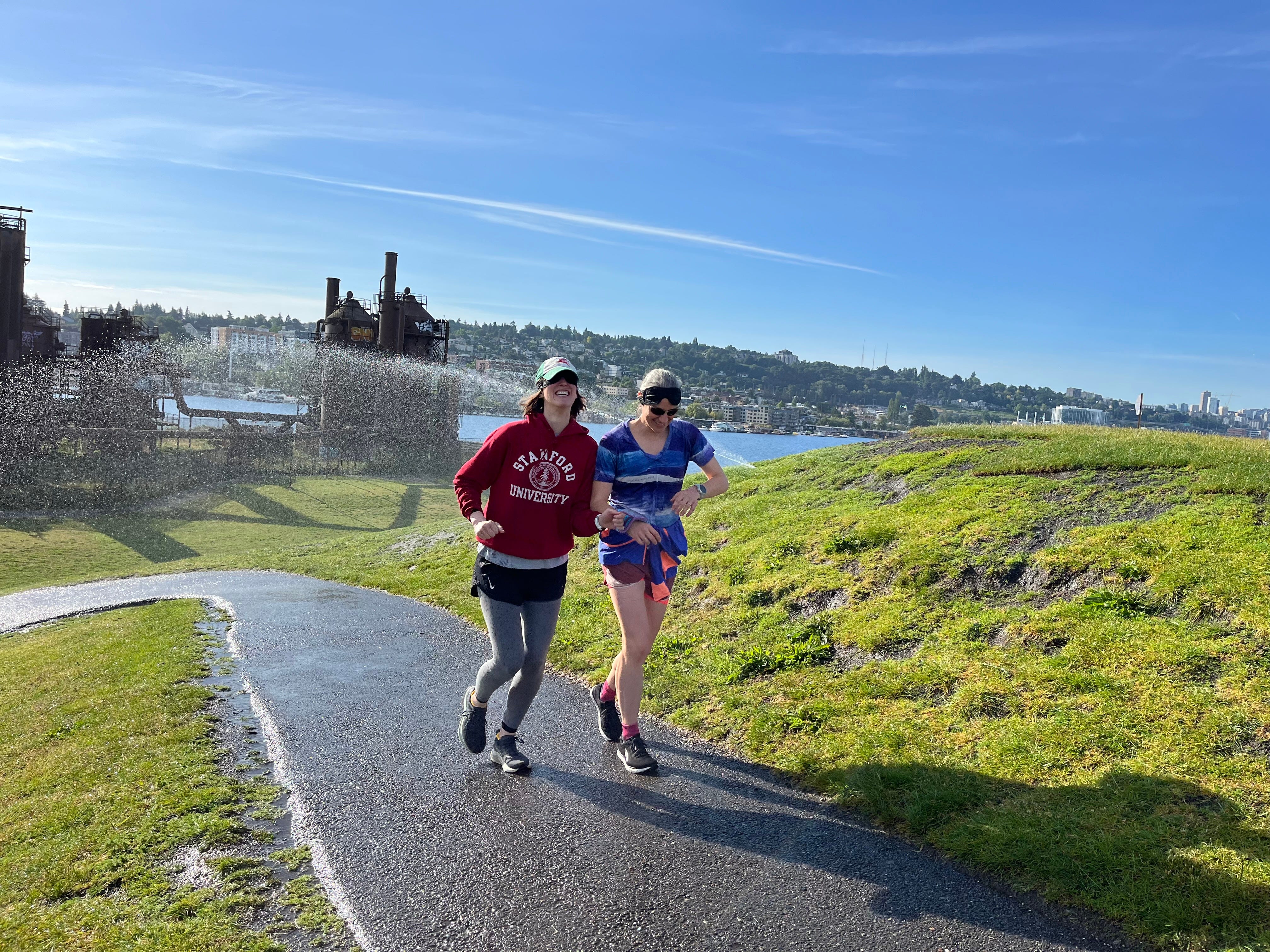
Jogging with a blindfold on was immediately humbling. Without my sight to reassure me, I couldn’t rid my body of the fear—the certainty, actually—that at any moment, I was going to plow straight into a wall. The shifting shadows of the morning, and of the massive looming machinery structures at Gasworks Park, did me no favors either; each time I sensed a shadow, a whiff of darkness, my body halted. Much as I tried to convince my mind to just trust my guide, my body just didn’t want to. It wanted its own sight; its own reassurances of the light, of a vast and obstacle-free expanse ahead.
As I wrote in my last post, I’ve been making my way through Suleika Jaouad’s The Book of Alchemy by reading one essay and accompanying journaling prompt first thing in the morning—reinstating a regular writing practice with 15-20 minutes of journaling (sometimes in response to that day’s Book of Alchemy prompt, sometimes not; now that I’m back in the daily journaling habit, there’s never a shortage of things I want to write about). Coincidentally enough, that morning’s essay was titled, “The Clarity of Darkness”—writer Michael Koryta’s reflection on how visual memory can ironically be heightened by the absence of visual input.
What do I remember about running with a blindfold on that day? The cold splatter of the park’s sprinklers. (They didn’t surprise me, as my ears heard them first, and I had already begun giggling with anticipatory delight before the water touched my skin.) I remember the reassuring warmth of the morning sun on my face; the pitter-patter of other runners’ footfalls in front of or behind us; the immense comfort of my guide’s forearm tethered to mine, or of our shoulders pressing together during a turn. Also: the unnerving feeling underfoot (even when my guide had warned me in advance) of the ground changing from pavement to gravel. The disorienting feel of the terrain when we ran down a hill and it felt as if the ground was falling away from me, and many of my footfalls were miscalculated—the ground arriving ever so slightly sooner or later than my brain was expecting, causing me to flinch and stumble.
One of the things that Ixchel—Free 2 Fly running club founder—shared in the training session was a reminder that unlike sighted people in blindfolds, blind and low-vision folks are already used to moving through space without the benefit of clear visual input. Other senses like hearing, of course, are heightened; but also, their bodies are more accustomed to confidently moving through space by feel, adjusting course instantly when catching a toe or grazing a shoulder on something unexpected.
I found myself thinking of my former life as an avid (frontcountry) snowboarder—and how I discovered early on how much easier I found it to ride at night versus during the day. In daylight, my eyes couldn’t stop obsessing over the terrain ahead, and often, this led my brain to hesitate at inopportune moments. Which, in turn, led my legs to lock up in anticipatory fear, the rest of my body to make errors, too, and me to lose my flow.
But after the sun went down, my snowboarding came alive. When night-skiing at a resort, the lights on the slopes are exceptionally flat—often made even flatter by the tint of goggle lenses. Small bumps in the snow were all but invisible. Without being able to see obstacles, I had no choice but to keep my legs loose and relaxed, ready to absorb unexpected impacts in a split second. This shift made all the difference in my riding, transforming me from a nervous and crash-prone novice to a far more confident rider.
When I first got into mountain running 15 years ago, I experienced a similar revelation early on: “pushing” my visual focus farther out down the trail gave me confidence on the downhills, even technical ones. When I tried to see every little obstacle in the trail in the ground immediately in front of my feet, my body became hesitant and clumsy. When I instead made my sight a bit hazy, focused on the vague distance ahead, and paid little to no heed to the ground directly beneath my feet, my brain and legs relaxed into a smoother and more effortless flow state.
In Suleika’s opening essay for the chapter (“On Seeing”) in The Book of Alchemy that I’m currently in, she writes about what she describes as one of her greatest teachers in seeing: a shaggy red hound dog named Loulou whom Suleika adopted shortly before she (the dog) developed blastomycosis and lost her sight. At first, Loulou was terrified and stressed by her newly blind state of existence—but before long, Suleika writes, “A small miracle began unfolding. Loulou started mapping our house and garden in her mind’s eye until she knew every sharp corner, until she could gallop through the living room, tilting her torso to avoid the piano bench, the ottoman, the potted plant perched on a wobbly old pedestal. Not only that, she memorized the landscape of Chuck’s woods, where I took her for a walk each morning. Soon she was navigating the trees and the ponds. She knew when we reached the hayfield, huge and open, freshly mowed. There she would run as freely as she wanted, without caution or restraint.”
And what a gift it is, to run freely. Ixchel talked about one of the reasons for her founding of Free 2 Fly was to try and make that universal cliche about running—“Anyone can do it; all you need is a pair of running shoes to get out the door and go!”—true for more blind/low-vision people as well, by building a robust local community of sighted guides to support the club’s VIPs (“visually impaired people”—and truly the club’s VIPs, in the traditional sense of that initialism). Their ideal club ratio is 20 sighted runners for every VIP, to ensure consistent and reliable opportunities for all to run on any given Sunday morning.
So, this is my pitch to you to register with United in Stride (and/or, if you’re local to Seattle, join Free 2 Fly) and be a part of an amazing community of people helping one another to run freely. My foot isn’t quite healed up enough for full-fledged runs just yet, but once this Morton’s neuroma is fully calmed … watch out, world! When I came home from the guide training session last week, spilling over with enthusiasm as I relayed details of it to George, he reminded me of this incredible 1979 short film about Harry Cordellos running the Dipsea mountain race with a sighted guide. It’s absolutely worth 11 minutes of your time to watch. (As is this stellar short film about Ixchel, which just came out a few months ago.)
Navigating a long-term injury with an unknown recovery timeline feels a bit like making my sight hazy on the trails so as not to get tripped up on the obstacles currently underfoot. There’s an element of trust; the necessary sacrifice of control. Trying to dissolve the fear in my body amidst this particular twilight, and alchemize it into something new.
No posts
Comments
Nothing yet. Say the first thing.
Sign in to join the conversation.