
There is a reason the IPL keeps pulling brands in. For a few weeks, attention becomes unusually concentrated. Audiences are large, categories compete side by side, and even smaller brands get a chance to appear in a setting that feels bigger than their usual media footprint. That kind of visibility is hard to ignore.
The problem is that visibility can flatter a brand.
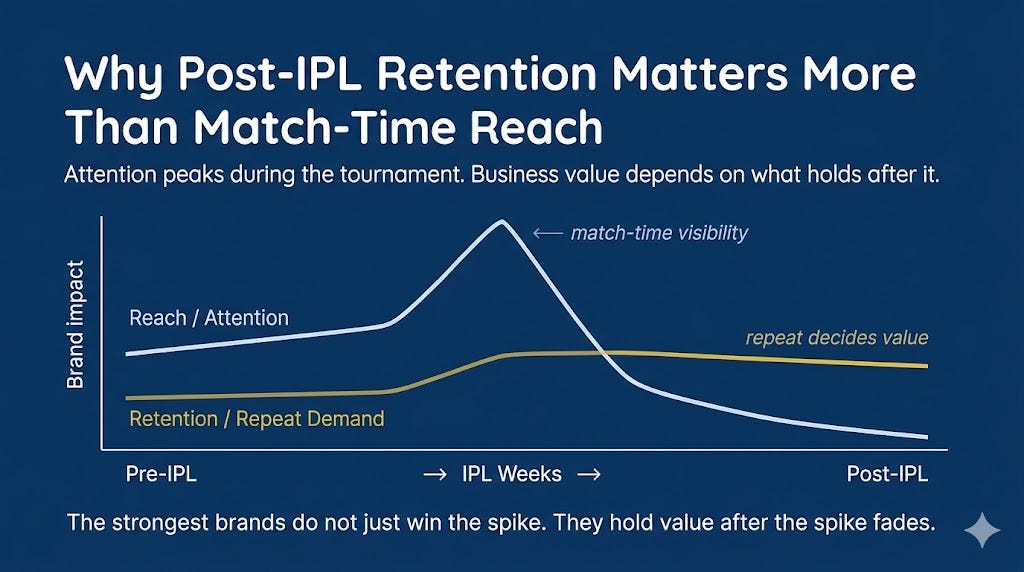
During the tournament, almost everything looks stronger than it does in normal life. Search rises. Traffic jumps. App installs move. Sales can spike. Campaign dashboards are starting to look fuller, faster, and more promising. It is very tempting, in that environment, to believe the brand is building momentum when it may simply be borrowing the event’s energy.
That is why post-IPL retention is a more useful lens.
A match can help a brand get noticed. It cannot decide whether the customer had a good enough reason to come back.
That second moment is usually where the real story begins. Once the tournament ends, the customer is no longer responding to a shared cultural high. They are back to everyday behaviour, everyday choices, and everyday comparisons. At that point, the brand has to stand on its own. The question is no longer whether people saw it during the IPL. The question is whether they remembered it clearly enough, trusted it enough, and wanted it enough to buy again.
For consumer brands, that distinction matters because businesses are not built on first purchase alone. They are built when the first purchase becomes a second purchase, and when the second purchase starts to look less like a campaign outcome and more like a habit. A brand that gets acquired during the IPL but disappears from the customer’s life two weeks later has not really added much value beyond the tournament. It has captured a moment, not built a relationship.
That is why match-time reach can often be overrated in founder conversations.
Reach is useful. It widens discovery. It creates the opening. It may even lower the cost of finding new customers in a crowded market. But it does not say enough on its own. A large audience can always make a campaign look successful in the short term. Retention is what forces a stricter question: once the event stopped doing the heavy lifting, did the brand still make sense to the customer?
That answer usually has less to do with creative brilliance and more to do with product truth. Was the offering strong enough? Was the price easy enough to justify again? Was the availability frictionless? Did the brand give the customer a clear reason to reorder, refill, continue, or return? Those are not glamorous questions, but they are usually the ones that separate event-driven spikes from actual business strength.
Seen that way, the IPL is best understood as an acquisition window. It is a chance to accelerate discovery, narrow attention, and reach more people than usual. But the value of that window depends entirely on what the brand has built behind it. If there is no strong product experience, no clear repeat trigger, no effective follow-up communication, and no easy path to a second purchase, even a highly visible tournament run can fade quickly.
This is where stronger consumer brands tend to behave differently. They do not treat the tournament as the finish line. They treat it as the beginning of a more important sequence. The first purchase matters, but only because it gives the brand a shot at earning the second. The campaign matters, but only because it offers a chance to prove that demand exists beyond the event’s noise.
A more useful way to judge IPL performance, then, is not to stop at reach, impressions, or first-order conversion. It is to ask what happened in the following 30 to 45 days. Did customers return without needing a larger discount? Did they buy the same product again, or move further into the portfolio? Did the brand stay relevant once the match was no longer on?
That is the difference between borrowed attention and built demand.
The brands that truly benefit from the IPL are rarely the ones that only win the live moment. They are the ones who know how to carry that moment forward, quietly and consistently, into ordinary consumer life.
No posts
Comments
Nothing yet. Say the first thing.
Sign in to join the conversation.