
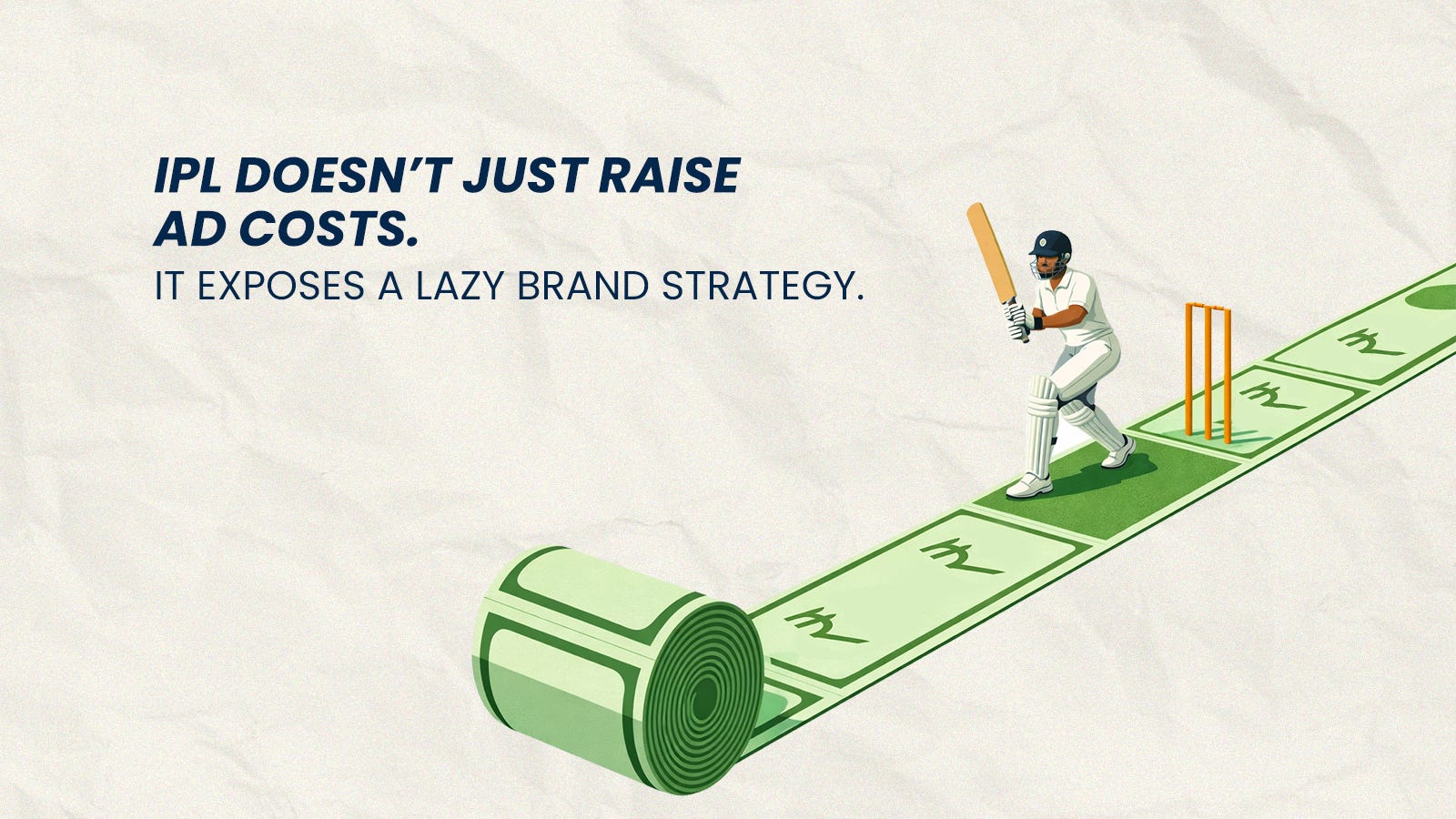
IPL is where brands discover whether they actually have a strategy or just a media budget.
The scale is big enough to hide bad thinking for a while. IPL 2025 was projected to generate roughly ₹6,000–7,000 crore in ad revenue, with JioStar alone targeting around ₹4,500 crore. That kind of scale attracts everyone, including brands that are not ready for it.
And yes, IPL can move sales. A sales-effectiveness study found that FMCG brands advertising during IPL 2025 saw an average 5.7% uplift in sales value. But that is exactly why weak brands get trapped: once a platform is known to “work,” people stop asking what it is actually working on.
Because IPL does not fix weak positioning. It does not sharpen a muddy message. It does not make an average brand memorable just because more people saw it.
What it does do is make every weakness more expensive.
If the proposition is unclear, IPL makes it costlier to explain. If the product is hard to find, IPL makes intent leak faster. If the funnel is weak, IPL simply sends more expensive traffic into the same old problem.
That is why this is not really a scale story. It is a strategy story.
Stronger brands use IPL to amplify what already works. The weaker ones use it to hide what does not.
And performance gets very expensive in a market where ad competition is already tightening. India’s digital AdEx added ₹8,050 crore in 2025 and drove the market’s net growth, indicating brands were already paying more for attention even before the IPL began repricing it further.
So when a brand says, “We’re going big on IPL,” the interesting question is not whether it can afford the spend. It is whether the brand has earned the right to make that spend useful.
Because IPL does not punish brands for being small. It punishes them for being unclear.
A big stage does not make a weak brand stronger.
It just makes the weakness more expensive.
No posts
Comments
Nothing yet. Say the first thing.
Sign in to join the conversation.