
With the 2026 midterm elections less than three months away, courts are still deciding exactly how some Americans will be able to vote.
Since April, a series of high-stakes legal battles have been cycling through the federal court system in response to an executive order issued by President Donald Trump that aims to create federal lists of eligible voters and restrict voting by mail. This week, the U.S. Supreme Court lifted a lower court order blocking the Trump administration from moving forward with its plans. Yet a group of Democratic-led states also filed a new lawsuit on Wednesday, challenging a rule the administration published this week outlining how the Postal Service should execute the president’s order. And on Thursday evening a new lower-court action blocked that rule.
The ultimate legal fate of Mr. Trump’s order remains unclear, and may affect the 2028 presidential election more than the midterms, with the swirl of lawsuits likely to remain unresolved in the coming weeks unless courts take unusually swift action. But the effort to exert White House oversight on federal elections represents an escalation of Mr. Trump’s long-running and unproven allegations of widespread voter fraud in U.S. elections. Opponents of the order claim that it amounts to unconstitutional interference in the election process by the federal government.
Why We Wrote This
The Trump administration wants to impose tougher vetting on mail-in voting. A new lower-court stay, following a preliminary green light by the Supreme Court earlier this week, leaves key legal issues still to be resolved.
What is this all about?
On March 31, Mr. Trump issued an executive order titled “Ensuring Citizenship Verification and Integrity in Federal Elections.” The order directed his administration to create state-by-state citizenship lists and restrict Postal Service delivery of ballots.
First, the order instructs the U.S. Department of Homeland Security to work with immigration authorities and the Social Security Administration to draft a list of U.S. citizens of voting age in each state, and then send those lists to election officials in the states.
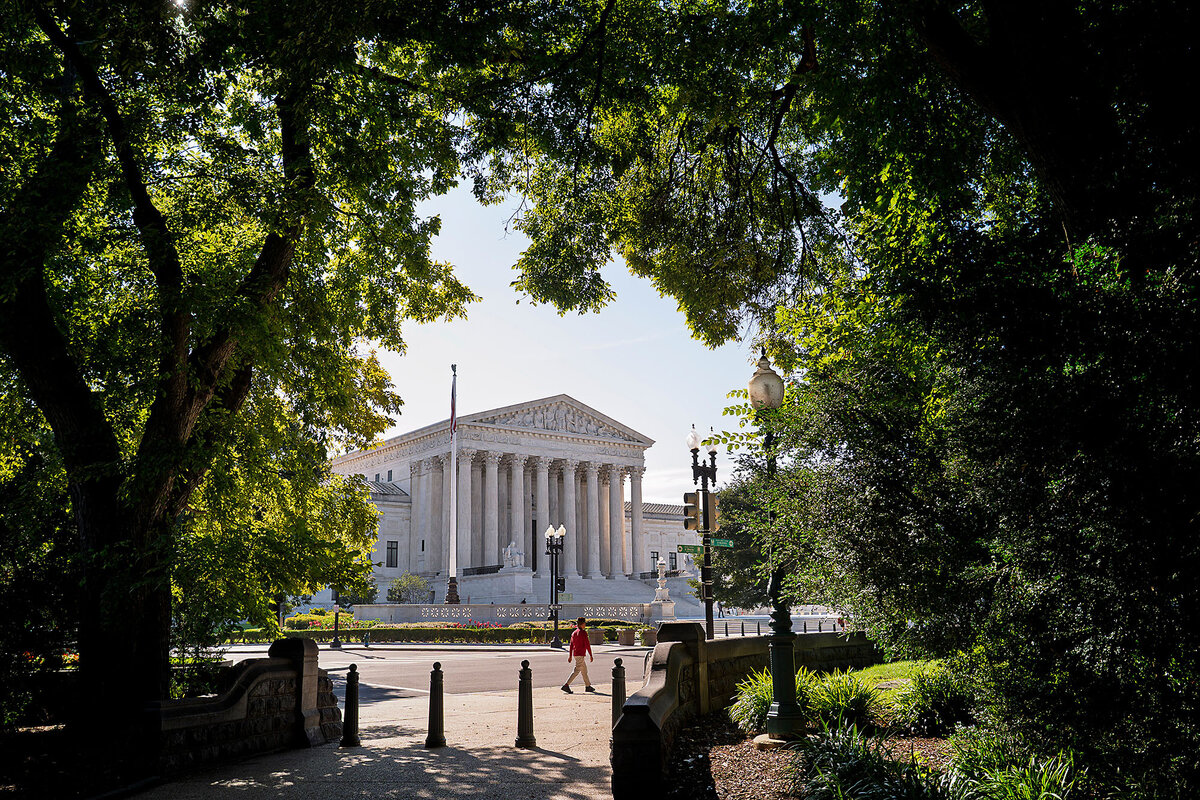
J. Scott Applewhite/AP
The Supreme Court in Washington, Aug. 25, 2026. This week the high court preliminarily sided with the Trump administration in a case over an executive order by President Donald Trump that restricts mail-in voting.
Pertinent to much of the recent litigation, the order then instructs the U.S. Postal Service to not transmit ballots mailed by individuals not on a list of eligible voters. States who decline to use the lists could be subject to prosecution.
Within days of Mr. Trump signing the order, two lawsuits were filed challenging it, one from a coalition of Democratic states led by California and one from a coalition of advocacy groups. Judge Indira Talwani, a federal judge in Massachusetts, oversaw both cases.
The Constitution says that “the Times, Places, and Manner” of federal elections “shall be prescribed” by the states. Congress may alter those rules, the document adds, but it is silent on whether the president can. In both cases, Judge Talwani held that Mr. Trump’s order would likely be found unconstitutional and temporarily stayed the order.
Did the Supreme Court say the USPS rule could take effect?
In an unsigned order on Monday, the Supreme Court lifted the stay in the California case. The procedural ruling held that the states did not have a right to sue yet because the order did not require states to take any action and the Postal Service rule, which could impact states, had not yet been released.
In a statement, White House spokesperson Lauren Bis said the high court’s order “was a major win for the security of American elections.”
“The Trump Administration will continue to lawfully enact the agenda President Trump was elected on – which includes the safety and security of our elections.”
But their ruling, the justices added, “does not mean that any measure taken by the Government to implement the Order will necessarily be lawful. On that score, time will tell.”
That time could arrive soon. On Wednesday, the USPS published its mail-in ballot rule, which would create a process where the U.S. Postal Service designs new envelopes with barcodes and tracking technology so state election officials could ensure only eligible voters receive ballots. The agency initially said the rule would not apply to the midterm election unless injunctions from lower courts were lifted; those were both lifted this week.
Hours later, about two dozen Democratic states filed another lawsuit challenging the USPS rule. The agency, the states argue, has “granted itself the authority to regulate mail voting in federal elections.”
On Thursday, the Postal Service wrote that its rule was in effect for the Nov. 3 election, and the agency was “currently defending the legality” of its final rule.
Election law, however, “is a messy area,” says John Martin, an election law scholar at Quinnipiac University School of Law.
“Both the states and the federal government do have some legitimate say in regulating” federal elections, he adds. “But how much say does each have?”
Will this affect the midterms?
Time is running out, with the first mail ballots scheduled in some states to be sent next week, ahead of Election Day on Nov. 3. A significant portion of voters cast their ballots by mail – including Mr. Trump, who sent an absentee ballot in a Florida election this year. Nearly one-third of voters submitted their ballots by mail in 2024 and several states conduct elections entirely by mail.
On Thursday evening, Judge Talwani issued a stay blocking the USPS final rule.
With a lower court stay now in place, “I would wager that the rules are not really going to be in play during the midterms,” says Professor Martin. “At some point, it’s just too late.”
No challenge to the order has gone past preliminary stages, meaning no court has ruled on the constitutionality of the order. The Supreme Court is likely to have the final word on that question in the USPS case, analysts suggest, but not within the next few weeks.
“You cannot implement radical new changes in election policy within that period of time,” says David Becker, executive director and founder of the Center for Election Innovation & Research.
“We are not heading to an election – we’re in an election right now,” he adds.
Comments
Nothing yet. Say the first thing.
Sign in to join the conversation.