
There’s an old military adage that says there’s no such thing as a small war for a big power.
Each conflict becomes “a measure of credibility,” says Ian Lesser, distinguished fellow at the German Marshall Fund, a transatlantic think tank in Brussels.
The goals of the U.S.-Israeli war against Iran, which hits the six-month mark this week, include destroying Iran’s nuclear capabilities, its missile supplies, and its ability to project power through terrorist proxies. The reopening of the Strait of Hormuz, after the Tehran regime closed it, was added to the list as the war dragged on.
Why We Wrote This
Stated goals in the Iran war included denuclearization, destroying missile supplies, curbing terrorist proxies, and possible regime change. The campaign has resulted in another objective: to reopen the Strait of Hormuz.
Now, President Donald Trump is following military strikes with efforts to tighten economic sanctions against Iran and its regime.
This “economic D-Day” initiative, as the administration termed it, will require “perhaps another month to see if it’s going to be impactful and accelerate the demise of this regime in Tehran,” says retired Navy Capt. Brent Sadler, now a senior research fellow at the conservative Heritage Foundation.
“If it isn’t, then we’ll have to adjust. And I think that means more of a military hammer is probably going to have to be used again, to kind of compel [Iran] to better behavior.”
One lesson of the Iran war so far, however, is the “extraordinary gap” between the U.S. military’s operational prowess and U.S. strategy, Dr. Lesser cautions. This divide has contributed to a stalemate in a war that Mr. Trump said at the outset would last for “four weeks or less.”
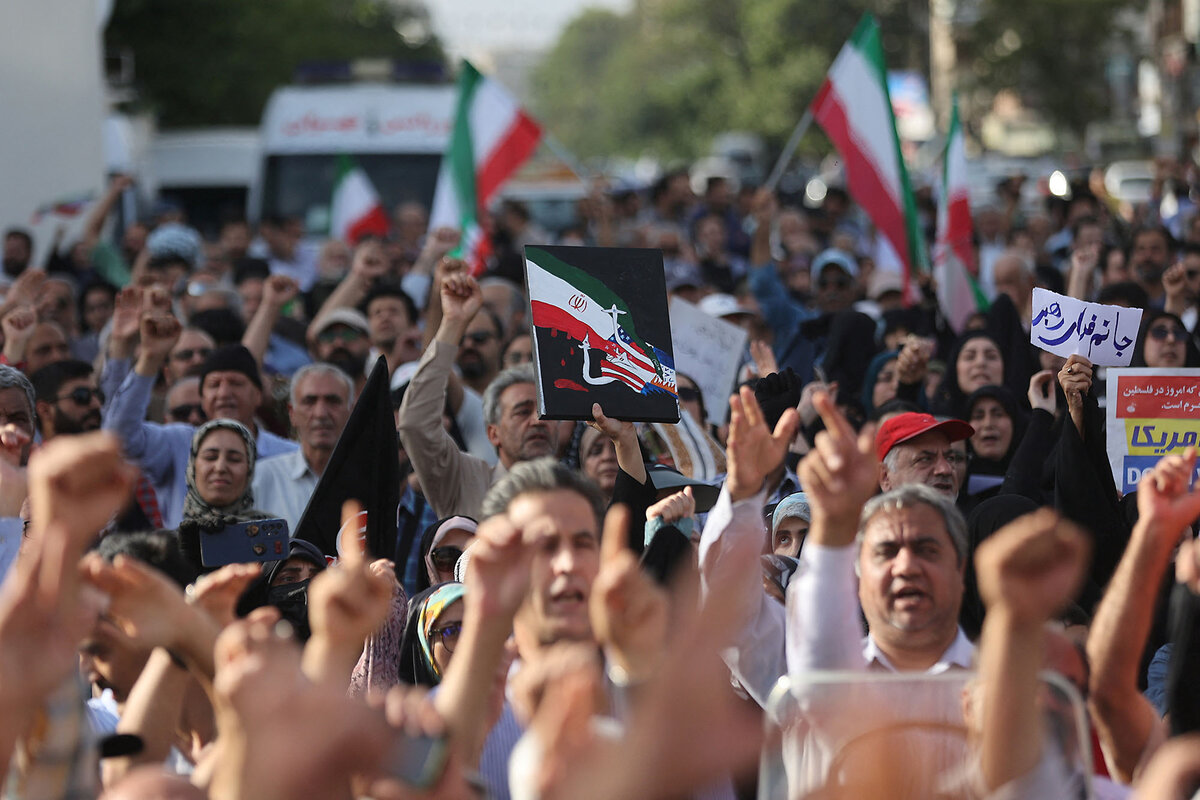
Majid Asgaripour/WANA/Reuters
People attend a protest against the U.S attack on nuclear sites, amid the Iran-Israel conflict, in Tehran, June 22, 2025.
Denuclearization
Vice President JD Vance on March 2 said that “whatever happens with the regime in one form or another, it’s incidental to the president’s primary objective here – which is to make sure the Iranian terrorist regime does not build a nuclear bomb.”
Today, the Iranian nuclear program is “severely damaged and set back, but not destroyed. And that’s where a lot of problems come in,” says Bradley Bowman, a former U.S. Army officer and top defense adviser for Republican lawmakers on the Senate Armed Services Committee.
The U.S. government might know where the enriched material is – likely buried in a bombed-out former enrichment facility. But securing that material could also involve sending special operations forces teams “into Iran, deep underground,” says Mr. Bowman, now a senior director at the Foundation for Defense of Democracies. “You don’t have to have a lot of imagination to understand how difficult that would be ... when the Iranians know you’re coming.”
Mr. Sadler agrees. For Iran, “it’s going to be a constant watch” of the facilities, he says, “and to attack as necessary” if there appears to be movement around them. “Because [the regime has] every intent they always had to build a nuclear weapon.”
Iranian resolve might have even increased, Mr. Bowman says. “You don’t have to be [ancient Chinese military strategist] Sun Tzu to realize that this conflict may increase the incentive of some in Iran to pursue a nuclear weapon.”
Regime change
As the opening attacks on Feb. 28 were underway, President Trump hinted at the expectation of regime change. “To the great proud people of Iran, I say tonight that the hour of your freedom is at hand,” he said. “When we are finished, take over your government. It will be yours to take.”
This goal has also been described at times in terms of dismantling, if not overthrowing, the Iranian government. “The American military objective is to neuter the regime – to render them impotent,” White House Deputy Chief of Staff Stephen Miller said in March.
So far, this has not come to pass.
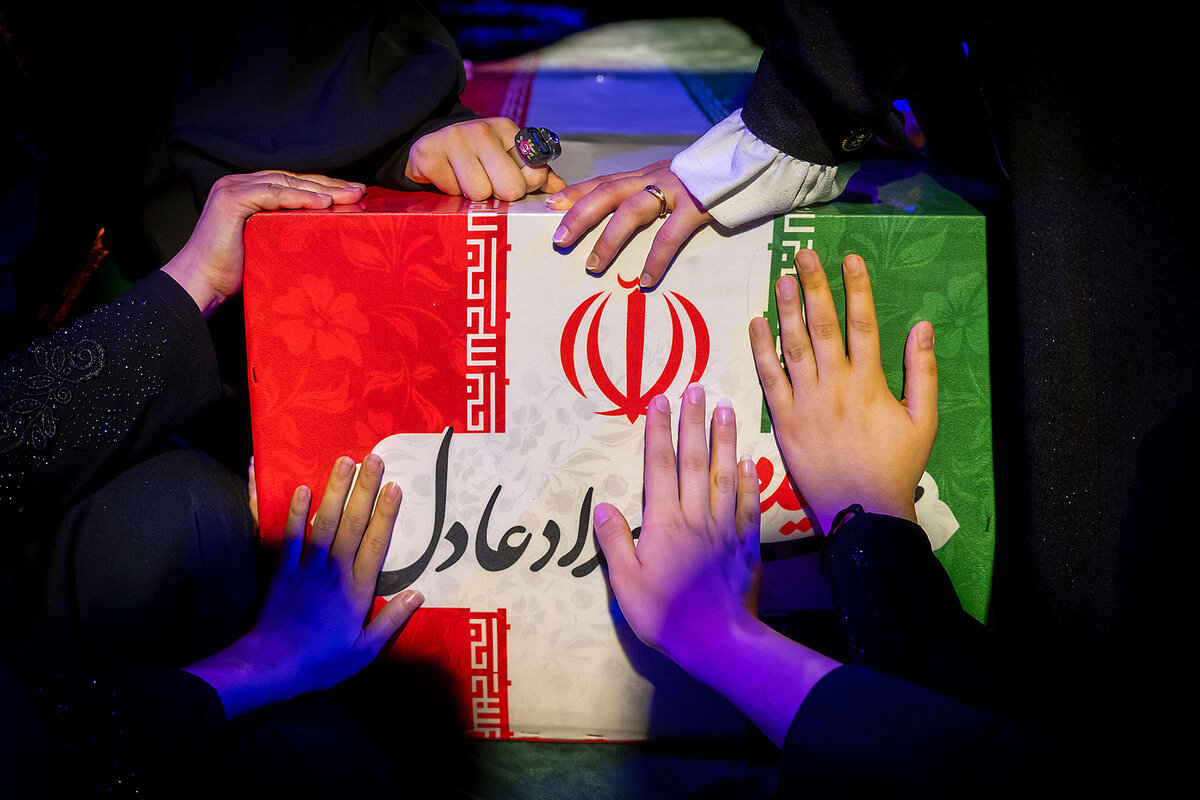
Fars News Agency/AP
Mourners touch the coffin of Zahra Haddad-Adel – the daughter of former Iranian parliament chair Gholam-Ali Haddad-Adel and wife of current Iranian Supreme Leader Mojtaba Khamenei – during her funeral in Tehran, July 2, 2026. According to Iranian authorities, she was killed in the same strike that killed Ayatollah Ali Khamenei on the first day of the war.
Shortly after the assassination of Iran’s supreme leader, Ayatollah Ali Khamenei, on the first day of the war, which ignited a sense of hope for the future among many Iranians, the government announced that Mojtaba Khamenei would replace his father. An even harsher government continues to crush popular opposition.
The Trump administration, meanwhile, has “no interest” in “marching into Tehran,” Mr. Sadler says. “It’s for the Iranian people” to carry out regime change. “They need to do it on their own terms.”
Military threat
President Trump on March 2 said that the U.S. is “destroying Iran’s missile capabilities ... and their capacity to produce brand new ones.” He also added that the American and Israeli strikes were “annihilating” Iran’s navy.
By the end of March, intelligence assessments said that about one-third of Iran’s missile arsenal had been destroyed. Navy Adm. Brad Cooper, who leads U.S. Central Command, later disputed that figure in congressional testimony. Without providing a replacement number, he told lawmakers that 85% of Iran’s defense industrial base had been destroyed.
By July, Iran was back on the attack, firing high-speed, maneuverable missiles at U.S. bases in the Middle East, demonstrating that the regime’s ballistic missile program was advancing with “technical improvements,” according to the Institute for the Study of War, a nonpartisan research group.
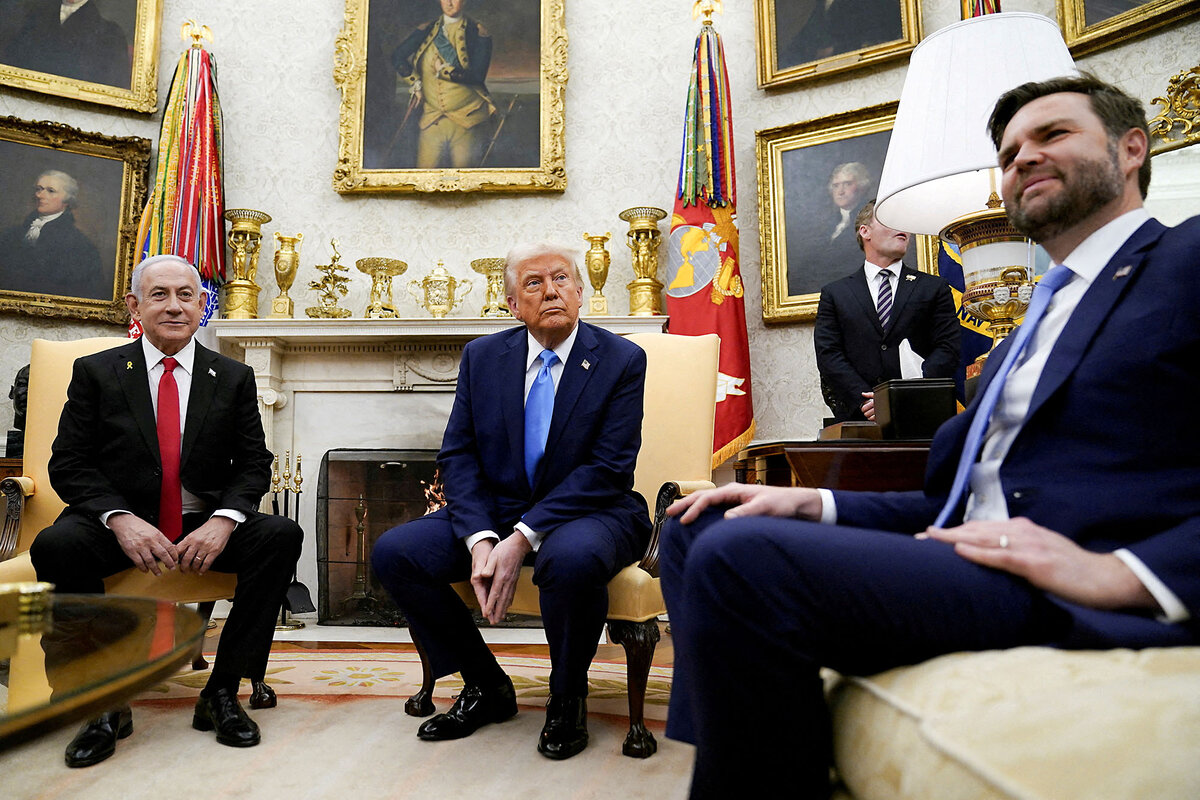
Elizabeth Frantz/Reuters/File
President Donald Trump and Vice President JD Vance, at right, meet with Israeli Prime Minister Benjamin Netanyahu at the White House, Feb. 4, 2025. Weeks later, the two nations jointly attacked Iran.
To date, the institute says, Iranian attacks against U.S. bases, reportedly with targeting help from China and Russia, have killed at least 18 U.S. troops, injured some 500, and destroyed large swaths of U.S. military infrastructure in the region. Those attacks have also led to problems with resupplying Navy vessels, including the aircraft carrier USS Abraham Lincoln, which has drawn national attention for its extended deployment supporting operations in the Middle East.
The damage has been so substantial – some $5 billion across 11 U.S. bases in seven countries – that the administration is reportedly considering whether to rebuild some of the Gulf bases at all.
Terrorist proxies
Mr. Trump also on March 2 said: “We’re ensuring that the Iranian regime cannot continue to arm, fund, and direct terrorist armies outside of their borders.”
Iran’s terrorist proxy network – which includes Hezbollah, Hamas, the Houthis in Yemen, and Iraqi militias – has been delivered “major blows,” with Hamas and Hezbollah suffering particularly serious setbacks, according to the Washington Institute for Near East Policy.
The groups have lost leadership, money, and once-critical supply lines. But Mr. Sadler, the retired Navy captain, points to a report that suggests Iran was able to get a supply aircraft with suspect weapons, communications equipment, and a cadre of Iranian Republican Guard Corps to the Houthis in Yemen last month.
“After that, you start to see an uptick of attacks on shipping in the Red Sea,” he says. “We have to stop that kind of movement, not just to Yemen, but also to Lebanon and Iraq.”
Iraq is a particular challenge, he says, because there are “a lot” of Iran-aligned militia groups remaining in the central part of the country.
“As far as militarily degrading the proxies, the Houthis, Hamas, and Hezbollah are all severely, severely set back,” he adds.
Strait of Hormuz
The strait, before he war, offered passage to about one-fifth of the world’s seaborne oil trade. Prying it back open became a goal after Iran declared it closed in retaliation for U.S. and Israeli strikes.
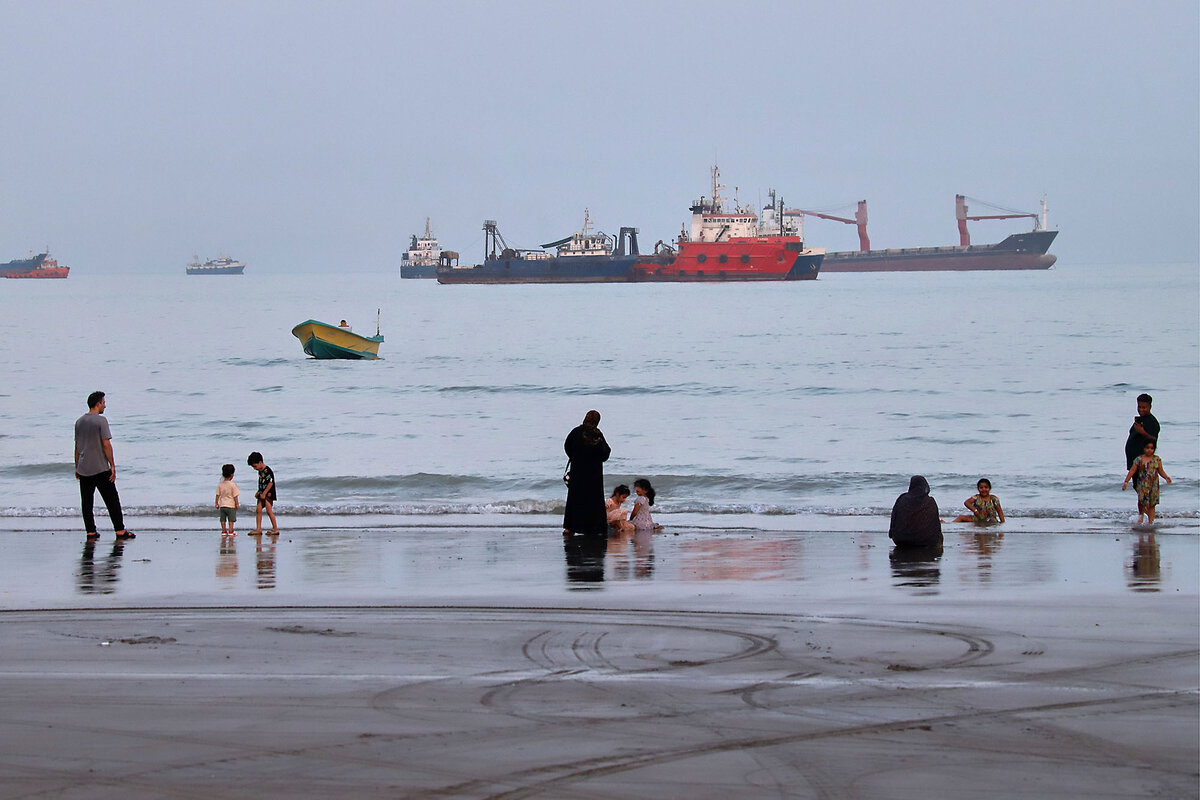
Amirhosein Khorgooi/ISNA/AP
Commercial vessels lie at anchor in the Strait of Hormuz near Bandar Abbas, Iran, Aug. 5, 2026.
The June 19 memorandum of understanding, signed by President Trump and Iranian President Masoud Pezeshkian, “reopens the Strait of Hormuz to free navigation.” In a White House statement announcing the agreement, Mr. Trump said that “no country or organization can be allowed to charge tolls” in the vital waterway.
Though U.S. and Israeli strikes decimated Iran’s navy during the war, the regime hasn’t needed its large ships to constrict the strategic waterway.
“They’ve got a lot of little speedboats that they can put a mine or two in, as well as launching drones and cruise missiles from shore,” Mr. Sadler says. That’s enough, he adds, to “terrorize shipping.”
As a result, the recent 10-day average for shipping vessels transiting the strait has plunged to about 15 per day, down from roughly 130 a day before the war began.
Comments
Nothing yet. Say the first thing.
Sign in to join the conversation.