
“D-Day” was how U.S. President Donald Trump chose to portray this week’s launch of his new economic sanctions campaign to gain the upper hand in the stalemated war with Iran.
His allusion to the United States’ awesome deployment of power in World War II – part of the largest amphibious military operation in history – wasn’t just an attention-grabbing social media post.
It reflected a core part of Mr. Trump’s worldview: the belief in his ability to use the full range of U.S. economic and military might to bend events around the globe to his policy goals.
Why We Wrote This
The United States is one of the most powerful nations in the world. But as President Donald Trump has been finding out, there are limits to that power. Some other countries appear increasingly willing to push back against the U.S. and refuse to bend to its policy goals.
Yet, now, a series of challenges – the showdown with Iran, this week’s suddenly escalating tariff war with Canada, and America’s tug-of-war with China in Asia – has put the president face to face with a chastening reality of 21st-century geopolitics.
Even ‘superpowerdom’ has its limits.
Yes, America is powerful, even more so than at the time of the D-Day landings in France in 1944.
“We have the largest economy on Earth. We have the strongest military on Earth. We have the most powerful technology on Earth,” Mr. Trump declared ahead of America’s 250th anniversary this summer.
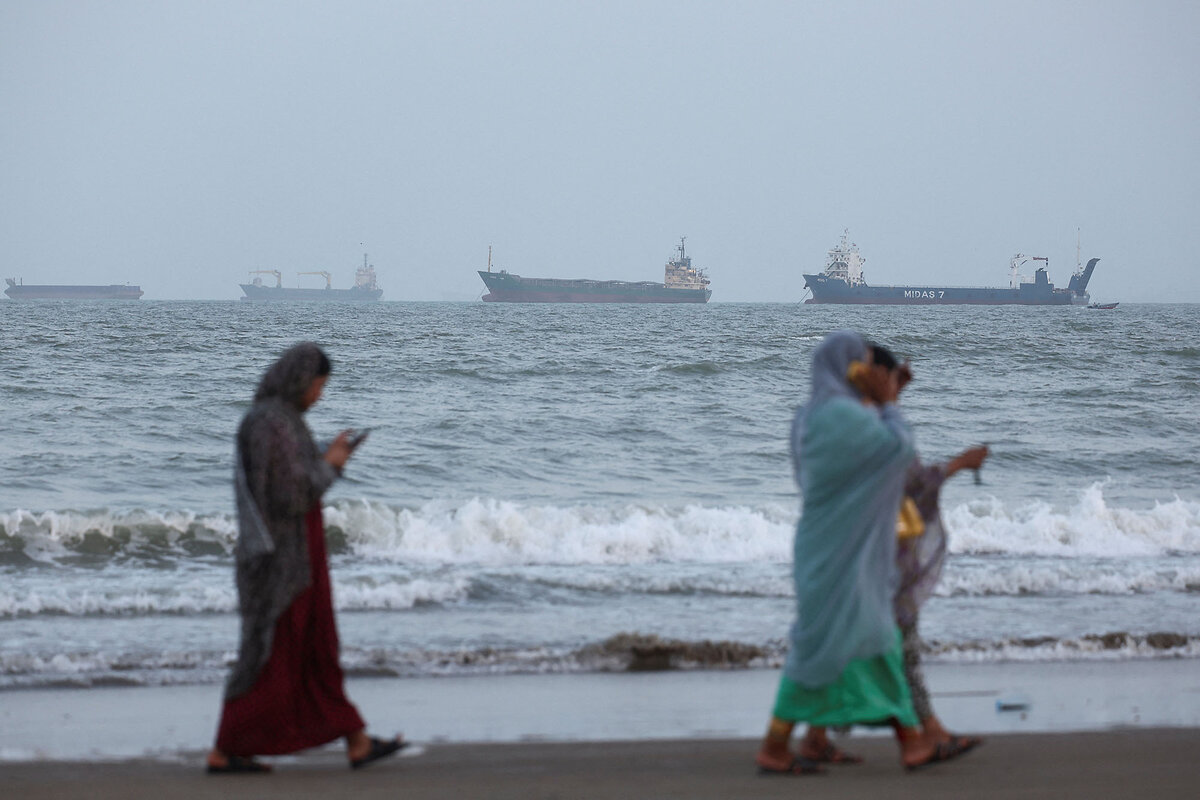
Majid Asgaripour/WANA/Reuters
As vessels sit anchored in the Strait of Hormuz, people walk on the beach near Bandar Abbas, Iran, August 26, 2026.
But other countries have power, too. And some appear increasingly willing to exercise it in pushing back against Mr. Trump: China, most of all, as a near equal, but also Iran, and America’s next-door neighbor, Canada.
That has left the president with a very different, more complex foreign policy challenge than he had anticipated in his first months back in the White House.
Then, it was a matter of how hard to lean on other countries, what to demand, and when to accept their concessions. That’s why he found the sudden imposition of tariffs worldwide so useful.
“Every country is calling us,” he enthused shortly after his initial April 2025 tariff announcements. “We put ourselves in the driver’s seat. ... Now, they’ll do anything for us.”
In the early days of the Iran war this year, he exuded similar confidence, saying it had already been won.
But things have changed, and this week’s standoffs with Iran and Canada have underscored this.
The tensions with Canada present the more immediate challenge. The catalyst for the dispute was Mr. Trump’s decision to impose a new 50% tariff on several billion dollars’ worth of Canadian exports. Canada’s initial response was similar to that of most countries to the 2025 tariffs: an effort to negotiate a deal to keep them from taking effect.
But after what Canada described as a series of unacceptable U.S. demands in homestretch talks late last week, Prime Minister Mark Carney said “no” to the deal – prompting Mr. Trump, who made it clear he was both angry and surprised at the pushback, to impose the tariffs.
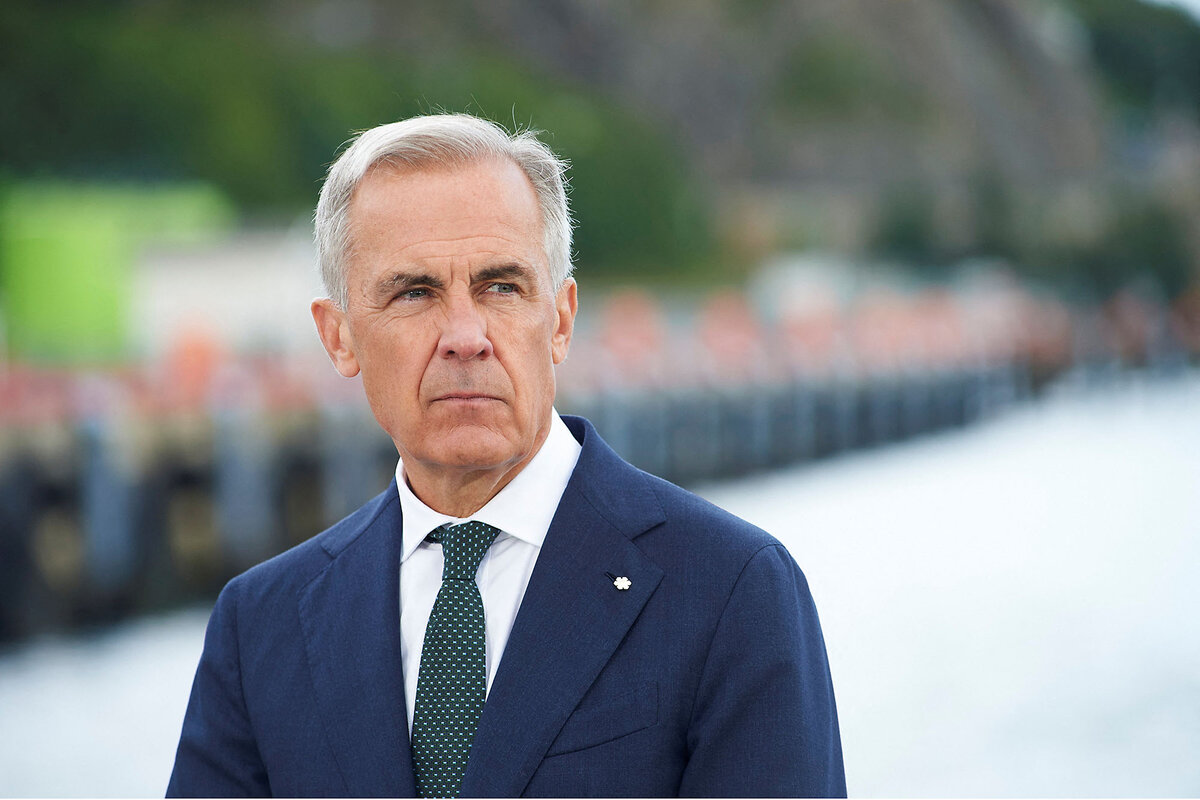
Greg Locke/Reuters
Canadian Prime Minister Mark Carney attends the announcement of a Quebec-Newfoundland hydro agreement in St. John’s, Newfoundland, Aug. 17, 2026.
Mr. Carney has now announced “dollar for dollar” counterlevies on a range of U.S. imports, and they’re due to take effect Sept. 8. The question facing Mr. Trump is whether to look for an acceptable compromise before then.
His superpower instincts would argue for standing firm. America’s economy is much larger than Canada’s. The Canadians are far more reliant on trade with the U.S. than the other way around. The countertariffs are likely to impact Canadian businesses and consumers as well.
Mr. Trump will also want to avoid the impression that Canada’s pushback worked, with the prospect that it could encourage other countries to take a sterner line toward future demands.
But Mr. Carney’s rejection of the deal has won wide support at home. Unless there’s an early deal, there’s a risk of an open-ended trade war that could prove unpopular with Americans ahead of November’s midterm elections – especially in states bordering Canada.
Navigating the stalemate with Iran could prove even more complex. Again, Mr. Trump’s superpower instinct would be to push harder and harder on the sanctions.
There’s little doubt that the “D-Day” announcement of “secondary” sanctions against companies and countries doing business with Iran could have a significant impact on an economy that is already struggling badly.
But by far, the most important enabler of Iran is China.
It buys almost all of Iran’s oil exports. It is also alleged by Western countries to be providing the Iranians with components for the military drones that have helped enable it to survive and outlast the onslaught from U.S. and Israeli forces.
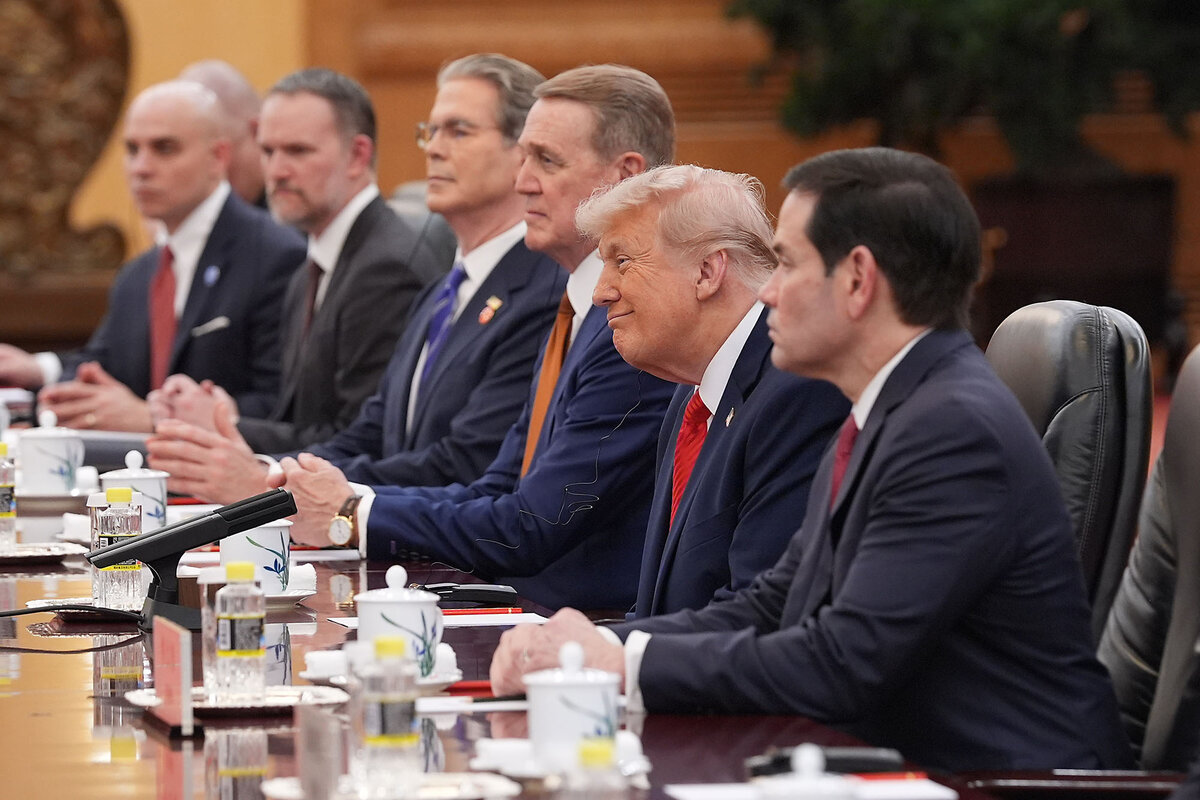
Mark Schiefelbein/AP
President Donald Trump and other administration officials meet with Chinese leader Xi Jinping in Beijing, May 14, 2026. Mr. Xi is expected to visit the United States in September.
China’s initial response to America’s new Iran sanctions has been to condemn them.
And the Chinese didn’t need Canada’s example to decide to push back. From the beginning of Mr. Trump’s second term, they made it clear that economic pressure wouldn’t work on them.
Beijing responded with pressure of its own. It halted exports of rare earth minerals, which are essential for a range of high-end industrial and military manufacturing, and on which it has a near monopoly of the world supply.
After an escalating tit-for-tat bout of tariffs, peaking with U.S. levies of well over 100%, Mr. Trump agreed to a truce with Chinese leader Xi Jinping, including a one-year cancellation of the rare earth restraints.
With Mr. Xi due to visit the U.S. in September, and the rare earth moratorium set to end shortly after that, President Trump might well be reluctant to push Beijing on the Iran sanctions.
Comments
Nothing yet. Say the first thing.
Sign in to join the conversation.