
Note: Throughout this post, I’ll refer to Marx and Leftism interchangeably. I know that there are many differences between all the ideological strands of Leftism, but I want to make a broader point.
As long time readers of this blog would know, I’ve a strong proclivity towards free markets. My personal philosophy is aptly described as techno-humanism. I believe that science and technology are good because they ultimately promote human flourishing.
Over time, I’ve observed a pattern in the responses to my posts on Twitter and Substack. Whenever I put out policy suggestions for economic growth, there would be pushback from a certain subset of folks. However strong my evidence, it would never be enough to convince them. Often, it would go on a tangent on the necessity of growth itself.
Recently, a friend pointed out that the reason why this happens is because I look at the world through the lens of individualism. And though I was consistent about my views given my prior axioms of economic growth and efficiency, I hadn’t considered it important to prove that my axioms were true. I was assuming that my axioms were self-evident. He recommended that I read some leftist theory to understand the traditions that I disagreed with. Now, that I’ve read some of it, I am starting to understand where my opponents come from. And I understand exactly why the Leftist theory doesn’t appeal to me.
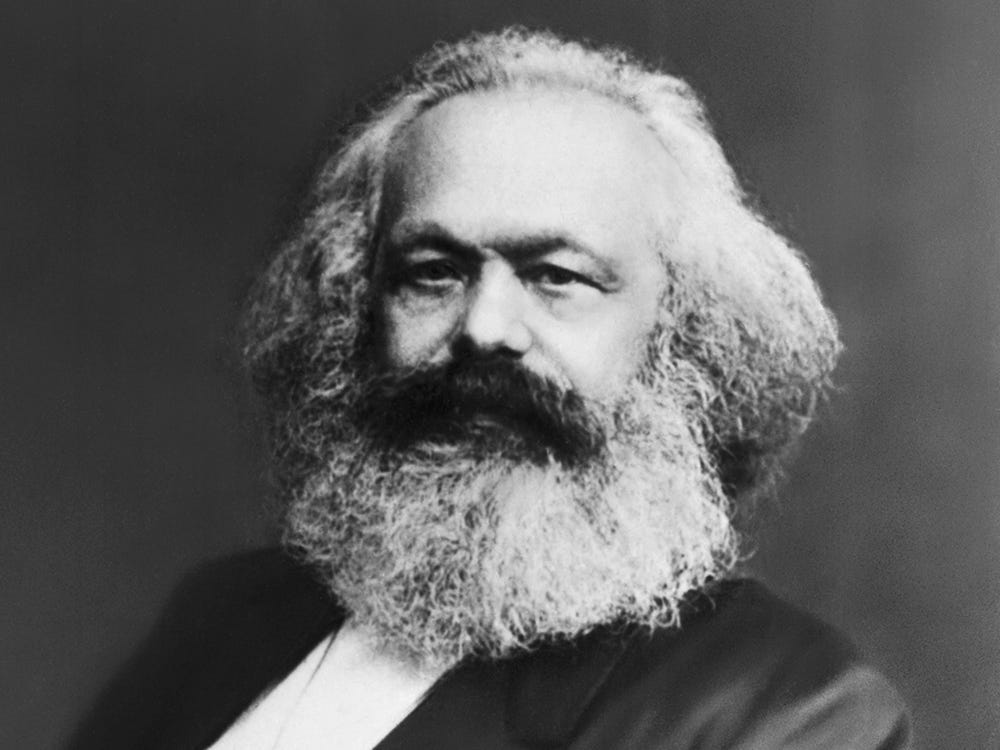
As everyone knows, the fountainhead of leftist thought is Karl Marx. The problem that Marx and other leftist thinkers have with liberalism is that it provides an intellectual scaffolding for capitalism. The definition of capitalism is simply the means of production being owned privately as opposed to communally.
Liberalism is individual freedom, property rights, equality and human rights. But notice that all of this is based on looking at society individualistically. It doesn’t consider the fact that all of us are a collective and to actually prosper, an individual needs society around as well. This serves as a nice segue to justify capitalism. If I have individual freedom and property rights are guaranteed, suddenly, I can do whatever I want with my property as long as I’m not hurting others’ rights.
All of this is still fine, until we introduce money into the picture. Before the Industrial Revolution, there was a limit to how much could be accumulated. There’s finite land and everyone needs some anyway, at least for subsistence. The introduction of money, and later, the Industrial Revolution changed circumstances such that some individuals were able to accrue obscene amounts of stuff.
And the biggest problem is that this system forces everyone to be in a race to acquire more stuff. It is a race to eke out more efficiency from machines and people and increase the productivity of society in general. There’s no place for humans to be such that they can develop holistically.
Someone might bake cakes because they love distributing cakes in their community. People work at factories because they’re good at their job and find it meaningful. Talented musicians can make worthwhile music and not starve. The metric for success is the growth of various human faculties. Compared to that, life under capitalism only has one metric: The number in your bank account. That number is thought to be the sum total of all value that you’ve provided in this world, even if it is through manufacturing weapons that kill children and a surveillance state that spies on its citizens.
Marx’s biggest problem with liberalism is that it considers individual rights, property, money and markets as natural and eternal1. A common justification that I often use for capitalism is that humans naturally want to own stuff and that markets efficiently dictate how goods and services should be allocated throughout society.
But Marx says that they’re not eternal. The Industrial Revolution came about because of liberalism and capitalism. And liberals pointed to the wealth it generated as proof that their ideas worked. But prior to this, society was arranged differently and post-capitalism, it would be arranged differently.
And this is my biggest problem with Marx. But before I detail, let’s see what he got correct.
Marx was born in 1818 and died in 1883. The Industrial Revolution is commonly dated from 1760 to 19202. This implies that Marx saw most of the Industrial Revolution play out during his own life. And he must have seen the following facts first hand:
Life expectancy in urban areas during the Industrial Revolution declined before increasing towards the end.
Workers were often children until the first attempts to regulate child labor occurred in the early 1820s. And these are children working with dangerous machines and metals.
There was no concept of occupational safety. Workers regularly lost life and limb to the machines. Working with furnaces, metals and other equipment that might be spinning at high rates without adequate protective equipment is a recipe for disaster.
Living conditions were appalling in London. Entire families lived in one room. Some people slept on ropes tied to walls. People threw waste, animal parts and trash directly into the Thames. The stink in London got so bad, that Parliament actually considered leaving the city temporarily.
Sickness was common. Diseases like tuberculosis, cholera and typhoid spread quickly due to the dirty water and shared toilets.
As prosperity was increasing, the mean height of English soldiers was actually decreasing!
There are other graphs that I could pull to make the same case, but I hope I’ve gotten the point across. And while the stats would show life expectancy decreasing, quantitative figures don’t really explain the reality of living such a life. The visceral, lived experience of such conditions would be a psychological burden.
So Marx was correct here. While the capitalists did get rich, the workers laboring under them didn’t get their dues. They were maimed without even getting enough compensation for their disability. Children were working in factories which likely shortened their life expectancies. In such historical circumstances, the labor theory of value does make sense — even if it doesn’t hold today.
While Marx was correct for his times, I disagree with a lot of his, and by extension the Left’s analysis of human nature.
As mentioned earlier, Marx argues strongly against reading liberalism, private property and the incentives to accumulate ever more stuff as part of human nature. The specific human personalities in an era are a product of the economic system. So the greed that leads to massive inequalities under capitalism is actually incentivized under the capitalist system.
My view is different. I buy into Indic philosophy and view humans as suffering from six flaws — also known as the shadripus: kama (desire), krodha (anger), lobha (greed), mada (pride), Moha (attachment), Matsarya (jealousy). Irrespective of capitalism, or any other economic system, these qualities will remain and will cause the endless pursuit of endless acquisition of material objects. I would say that this is why communist ultimately fail. Overriding human desires cannot be done without such strong authoritarianism.
But Leftism believes that the greed of humans can be changed if the economic system were to be changed. Implying that greed is manufactured. And if something has been made, it can be unmade and then re-made. While leftism doesn’t label it as such, I believe that this really is the blank slate theory in action.
The blank slate theory basically states that differences between individuals can be attributed completely to their environments rather than innate, genetic differences. And I don’t think that such a view is plausible.
One final thing that leftism is also concerned about is the redistribution of status in addition to wealth. Recall that the ultimate goal of leftism is to abolish class to achieve a classless society. Workers and owners aren’t just unequal in wealth, they’re also unequal in status. Owners dominate workers. Just to be clear, this is different from exploitation. Exploitation means getting robbed of value, while domination means being under another’s will.
If whole groups are being denied recognition, they are being treated as invisible despite their bank balance. If a rich married woman can’t get noticed and is dominated by her husband, that’s a violation that needs to be fixed. Even if she has money, she is still not an equal. The same logic applies for racial and religious minorities, among other groups.
And if the blank slate theory is true, that makes all of this so much easier.
Greed is an innate human attribute3. Humans are wired to want and accumulate stuff. I do not believe there is an end to wants.
Different individuals are differently gifted. Someone maybe a talented musician while someone maybe a talent programmer. It is unfair that an average programmer earns more than an average musician. But is it similarly unfair that a top programmer earns less than a top musician?
Different groups have been subject to different evolutionary pressures, thereby evolving different traits. For example, sprinters are typically from West African ancestry whereas marathoners are typically from East African ancestry.
More generally, I believe that culture matters. I’ve written various posts on culture and their effect on country’s development. I’ll only recap some brief points here:
The descendants of the pre-Cultural Revolution elite in China have higher incomes and education. During the Cultural Revolution, Chinese elites (like landlords and capitalists) were often executed and their wealth confiscated. That their descendants ascended the hierarchies of Chinese society, should give a pause to blank slate theories.
The Russian Revolution dispossessed and persecuted their elite as well. But cities with higher pre-revolutionary human capital and elites, show faster recovery in the post-Soviet period. Bureaucratic elites were also from the pre-revolutionary elites descendants.
Korea and Taiwan carried out extensive land reforms. Yet, the old elite transitioned into education and bureaucracy and kept their relative status in their society.
Ancient technology adoption predicts modern incomes relatively well. The relationship becomes stronger when you track the ancestors of today’s populations4. Populations that adopted agriculture earlier, do much better than the descendants of those that adopted it later.
There are many such examples. I hope this shows why I believe that blank slate, status redistribution and wealth redistribution are dead ends. Human life is bettered through technology and the adoption of more efficient techniques.
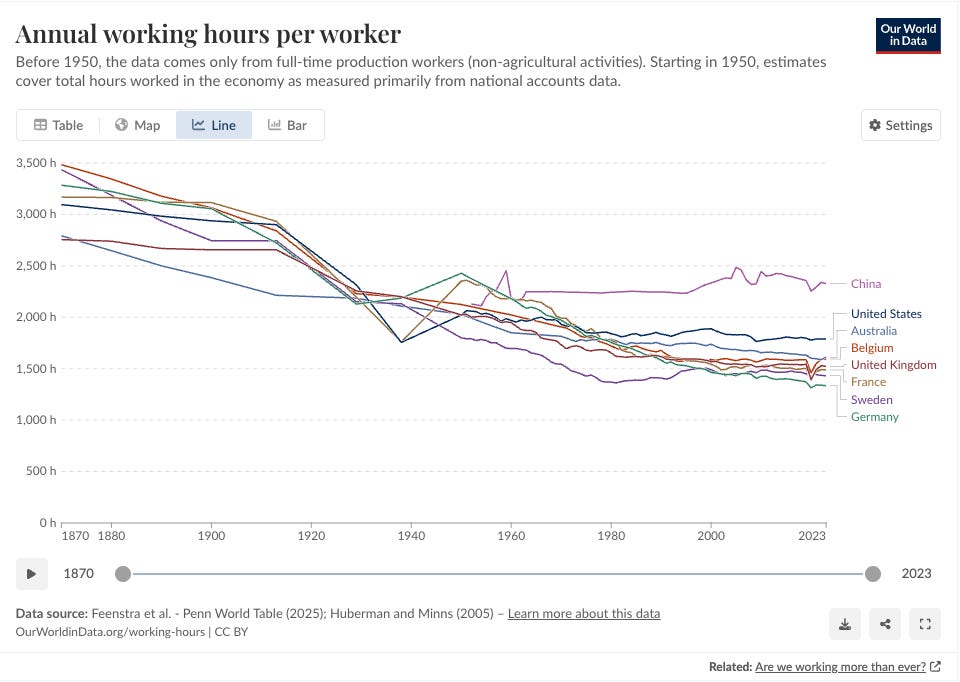
The workers seem to be having the last hurrah here: Average hours worked have continuously been falling more than half from 3,500 hours in the late 19th century to less than 1,500 hours in some countries.
What could be more evidence that living standards have clearly risen, while workers are working less?
Thanks for reading The Indic Prism! This post is public so feel free to share it.
The technical term for this is “naturalization”.
There are various phases of the Industrial Revolution and the dating might be slightly disputed, but we are going for broad strokes here.
There’s no empirical way to prove this and I hold this to be self-evident. No one forces people to hunt for ever more experiences and things — like restaurants, parks, adventures, travel, trinkets and widgets — yet they spend their time and money in doing so. If bare subsistence was required, anyone who worked only a few hundred hours a year could manage to get by. Human greed forces the accumulation of material possessions.
For example, the US was populated by Native American groups. But the real comparison would be European groups that occupy America today since migration to America was from Europe.
Comments
Nothing yet. Say the first thing.
Sign in to join the conversation.