
You’ve heard of “The Housing Theory of Everything”, the “Smartphone Theory of Everything” and “The Orality Theory of Everything”. But have you heard of The Agriculture Theory of Everything?
The housing theory of everything is useful as a framing device to show how expensive housing exacerbates many existing problems in the economy. Solving housing relaxes one of the strongest binding constraints on growth. Cheaper housing may even translate into more support for capitalism, since expensive houses could cause more young adults to have more sympathies for socialist causes.
Similarly, my aim in introducing the agricultural theory of everything is to draw a sketch of how agricultural issues are really upstream of many issues with India’s economy.
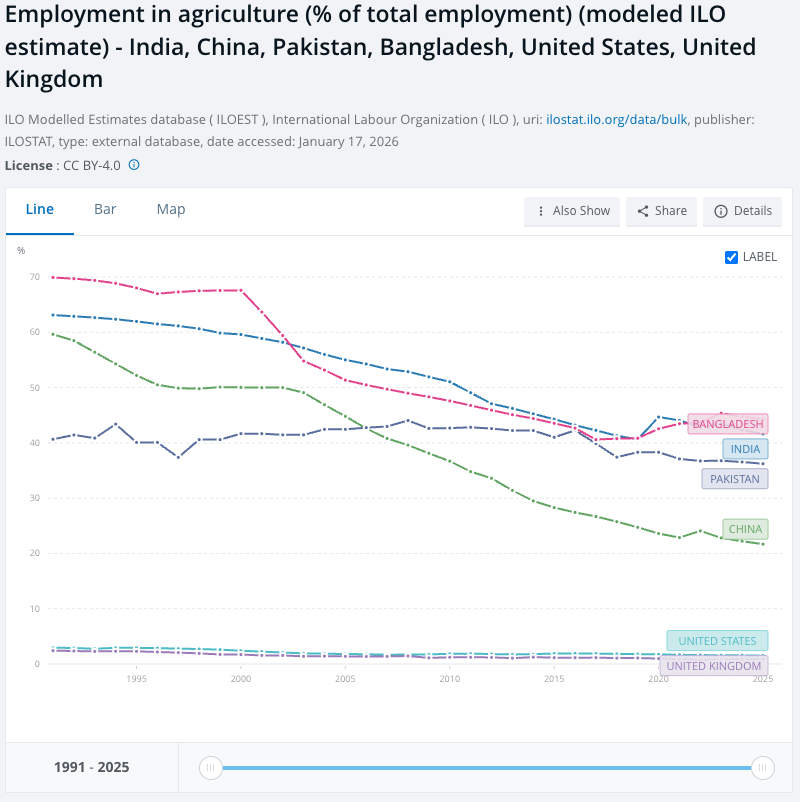
The share of India’s labor force in agriculture is around 42%. That’s far higher than China and much above high-income countries like the US and the UK. Even Pakistan has lower people in agriculture than India, although that might be a factor of a higher unemployment rate.
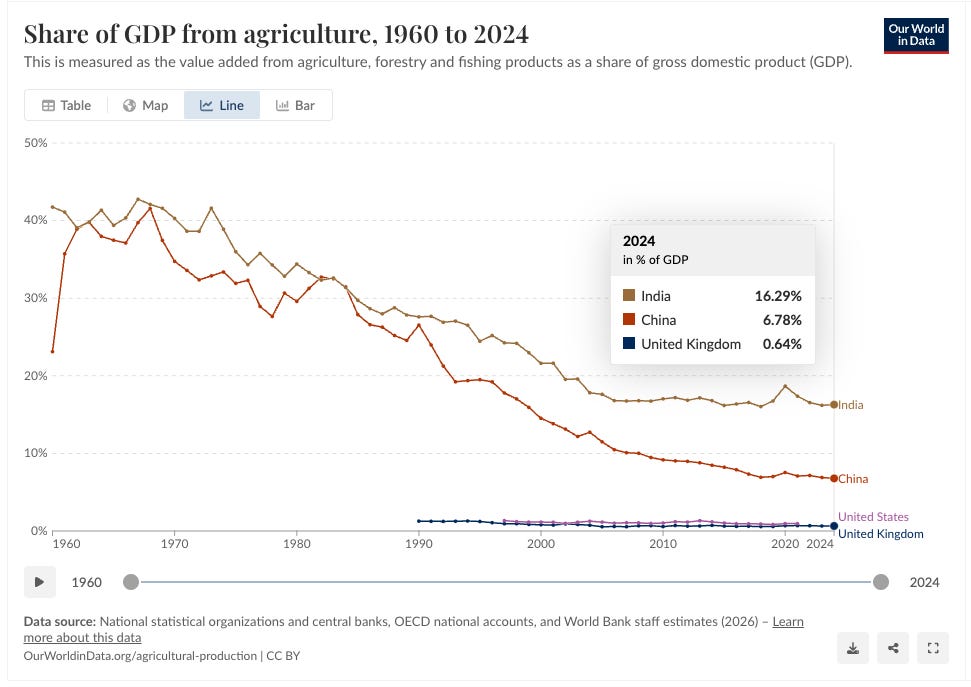
The other piece is the contribution of agriculture to GDP. Indian agriculture contributes only 16% to the GDP while absorbing 42% of the labor force. China and other developed countries have a much lower share of agriculture while also having lesser workers.
Taken together, these two statistics show that agriculture in India is relatively unproductive compared to agriculture in developed countries and even countries like China. A relatively large number of workers end up contributing less to national output.
However, this in and of itself isn’t the problem, but a symptom of the underlying disease. Development usually goes something like this: Initially, a huge number of people cultivate land and grow crops for subsistence. Rising productivity of farms allows surplus labor to travel to urban areas for employment. Urban areas have manufacturing shops and services companies that require a lot of labor. As urban areas begin growing, their size itself generates demand for more output. Innovations in science and technology conjure different desires into existence in the population, which again requires a combination of labor and technology to satisfy.
This virtuous loop is supercharged when there’s a lot of cheap labor to absorb that’s coming off farms. Once all the surplus labor is exhausted, then wages need to rise to attract more workers. This transition is known as the Lewis Turning Point1.
By now, the problem must be clear: India hasn’t yet reached the Lewis Turning Point. The problem is two-fold:
India’s agriculture itself isn’t productive enough that there’s enough surplus labor.
There’s not enough manufacturing to absorb surplus labor because of distortions created by agricultural policy.
Throughout the rest of the essay, I’ll make quick points to convince you of this.
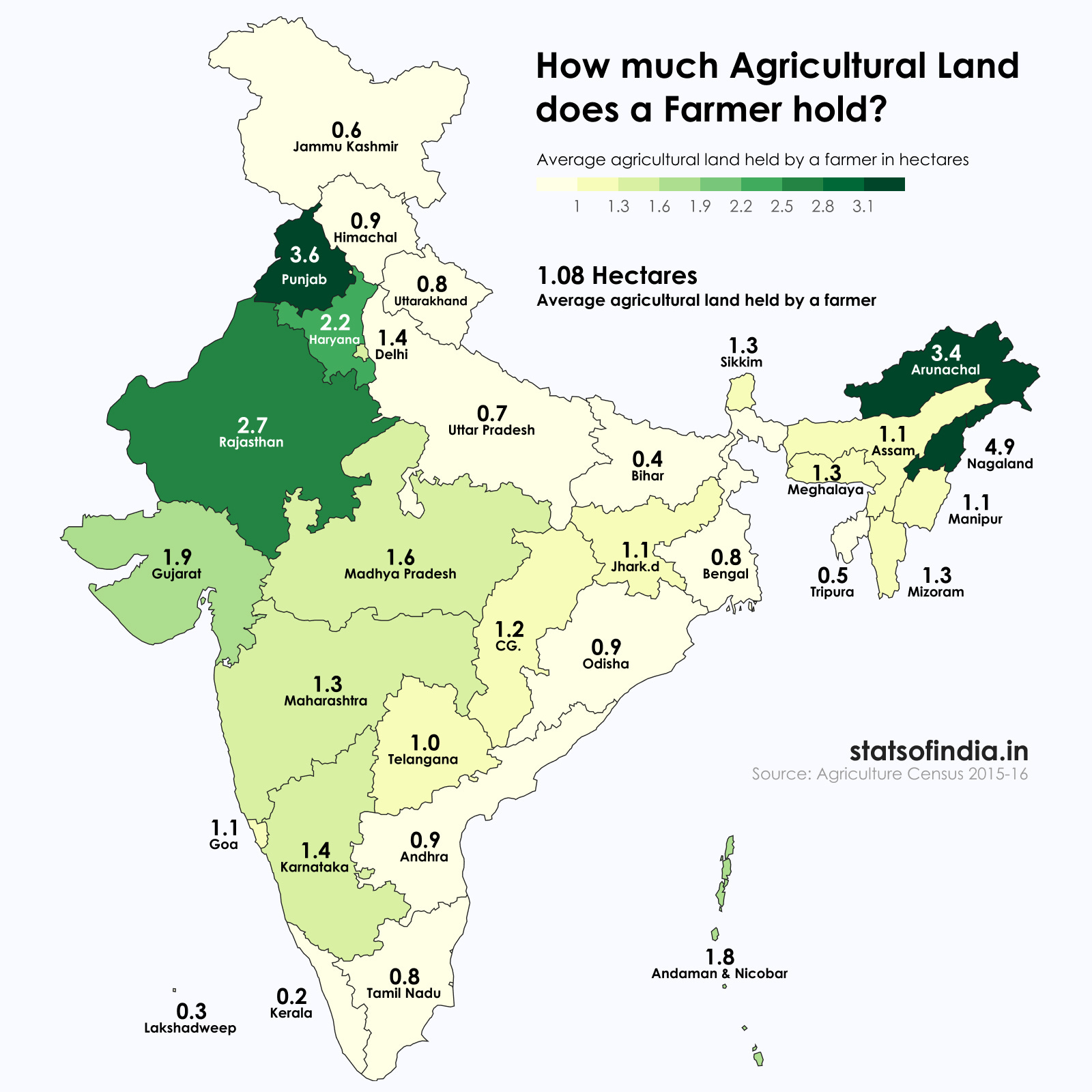
The average holding of an Indian farmer is miniscule. There’s a well known relationship between the size of holding and its productivity. Mechanization can’t be used on small holdings. As holdings increase, mechanization increases, and subsequently productivity and profits do. But accumulating land hits against a limit: India’s agricultural land tenancy laws.
Post-independence, many Indian states passed agricultural tenancy laws that — among other things — restricted the size of agricultural holdings. An effort at reducing inequality, it arguably failed and caused quite a few economic distortions. Some examples of these are the Bombay Tenancy and Agricultural Lands Act and Hyderabad Tenancy and Agricultural Lands Act.
But what are the downstream effects of these?
Innovators that have deep pockets to buy land and experiment with more productive mechanization techniques were forced to lease land informally. Ironically, that leads to lesser protection for landholders, than if formal markets actually existed. Even as communist a state as Kerala, formed a women’s group called Kudumbashree, and that group created an informal land leasing program! There’s increasing returns to scale and the government must not get into it.
Even Gujarat and Karnataka have been reforming their land markets with an aim towards making it easier to acquire large amounts of land, increasing productivity in agriculture and making agriculture more capital intensive.
Looking at the above map again, Punjab sticks out. It has the highest average land holding2 and that number has been increasing in recent years. Apparently, it has been driven by enterprising farmers who want to lease land from other farmers. But again, the drawback here is that because of land ceilings, these transactions have to go through informal markets, that again provide inadequate protection.
But how does that affect the rest of the economy?
Inefficient land markets apply outside of agricultural land and even to corporates. Manufacturing units might need huge tracts of lands and they might end up hitting the limits of laws. Subverting them might require spending money on either bribes or lobbying, both of which increases the cost required to manufacture.
Fragmented markets make it hard to acquire land itself. The Tata Nano plant in Singur, West Bengal was about 1,000 acres assembled from multiple small land holders. The opposition was able to trigger protests since malcontents are easy to find when the number of stakeholders are large. The project was scrapped and relocated to Gujarat. But not without increased costs.
The acquisition and transaction costs are so high that a 2021 study found that 289 ongoing land conflicts impacted 3.2 million people and $179 billion worth of investments.
Thanks for reading The Indic Prism! This post is public so feel free to share it.
Subsidies are among the most visible of farmer privilege. For electricity, India supplies subsidy equal to about 85% of the cost of supply3 to encourage agricultural production. Fertilizer is even egregious. India supplies a fertilizer subsidy worth about 3.2% of the yearly budget. That’s about $20 billion.
It is obvious why it is bad, but I’ll list it out:
The type of fertilizers that are subsidized are usually Urea rather than Potassium or Phosphorus fertilizers. That degrades soil quality, requiring more fertilizers and more subsidy in return. It becomes a vicious cycle.
Cheap fertilizer eschews economization. Fertilizer can be used liberally as insurance since the risk of under utilizing fertilizer is greater than the cost of waste. It is individually rational but harmful in aggregate.
Cheap fertilizer incentivizes those crops that can be grown using those inputs. Wheat is artificially made profitable relative to crops like pulses and oilseeds. And wheat is the very crop that is driving the groundwater crisis in Punjab.
The reasons why subsidized electricity is bad:
When electricity becomes nearly free, it becomes a substitute for water and irrigation. Massive pumps are used to extract groundwater. Crops that don’t need much electricity are artificially dissuaded.
Combined with the Minimum Support Price (MSP), it locks in rice cultivation in zones that are inappropriate (i.e. Punjab).
Utilities don’t invest in electricity for rural areas because they wouldn’t be able to recover their investment and politics would dictate that they provide electricity for free.
The biggest drawback with both these subsidies is that they get better with scale. Since electricity and fertilizer are used proportional to the size of the farm, richer farmers with bigger land holdings, get more subsidies.
So they’re actually the most regressive policies with no equity in outcome. I genuinely think that the Indian state sometimes suffers from split personality. It passed the land ceilings act to ensure equity of outcome, but instituted subsidies that help you the richer you are.
Why is it bad for manufacturing and the larger economy?
Utilities need to recover their costs and they end up overcharging commercial and industrial users. India has some of the highest industrial-to-agricultural tariff ratios in the world.
Underinvestment in the grid by utilities leads to underinvestment in transmission and distribution quality. That causes a drop in reliability. And expensive equipment worth millions might end up staying idle as a result.
These subsidies are the largest line items in the Centre’s and state budgets. They crowd out investments in the infrastructure that manufacturing actually needs.
Because Urea is dependent on imports, any disruptions or price shocks cause the rupee to depreciate. Manufacturers dependent on imports for producing their goods see an increase in input costs and less profitability.
These policies make manufacturing units hard to run and lead to anemic job creation in the sector. So labor that exits agriculture doesn’t really have a place to go.
Most Indian states classify land as agricultural by default. Conversion to industrial, commercial or residential requires going through a byzantine bureaucratic process that’s laden with discretions. The surface area for bribes and rent seeking is way too high.
Unless you’re a brand-name industrialist like Apple or Tata, there will be an artificial scarcity of land that is converted to industrial use. Even though physical land is quite abundant.
Quite unintuitively, cities are hit the worst here. Low Floor Area Ratios (FAR) combined with agricultural land on the peripheries makes it such that few buildings are constructed within cities, but cities can’t even expand to the outskirts. And when supply is low but demand is high, prices have to increase. The other side effect is informal constructions — slums — that dot the landscape of all major India cities.
The solution that the Indian state has come up with to solve this for industries is to set up Special Economic Zones (SEZs). These enclaves bypass the general land market. But that this is a state-brokered privilege creates its own rent seeking privileges and cronyism.
Farmers must sell all produce through the Agricultural Produce Marketing Committees (APMC). APMCs are state designated markets where farmers are supposed to sell their produce first. That’s another instance of the Indian state’s paternalism.
Even though they were rife with middlemen and underhand tactics, farmers were legally closed of from other options. The three farm laws of 2020 aimed to rectify as part of their effects. However, since agriculture is also a state subject, many states have allowed farmers to sell their produce outside of APMCs.
But there’s more that must be done. Contract farming needs to be allowed. The Minimum Support Price (MSP) needs to be gradually diluted and crop diversification needs to be promoted.
All of these open up the farming economy and are proven to deliver beneficial outcomes.
To prevent an already long post from getting longer, I’ll briefly list the other threads from agriculture that have outsized effects on the Indian economy.
The reason behind keeping agricultural income untaxed will always be a great mystery for me. There’s strong revenue potential from agriculture. But even more than revenue, there’s just a lot of abuse of that loophole. It is used to hide a lot of income and plays a non-trivial part in sustaining the shadow economy.
Many farmers are anti-tech. Farmers are allowed to grow only a couple of GMO crop varieties. GMO crops have various benefits. Their drawbacks have been overblown. Not only does the government outlaw the growing of GMO crops, farmers themselves protest testing of GMO crops itself. Playing around with genetics of crops has a long history going back centuries, if not millenia. GMO is just another iteration here and the opposition to it is inexplicable.
With the new Lok Sabha seat apportionment and delimitation, many of the states set to gain seats are those where agriculture still occupies a large part of the economy. Punjab, Uttar Pradesh and Bihar will gain seats. If left unchecked, agricultural interests might become even more entrenched. Of course, if the trend of state level reforms keeps up, the we might see divergence in state outcomes.
Agriculture allows patriarchal rents. Families that depend primarily on agriculture often have women in the household that provide labor over and above what the women themselves would’ve provided out of their own free will. Moving to a market economy allows women more financial stability while allowing them to move out of the back breaking patriarchal labor in a farming household. Especially in India , women outperform men in higher education, yet are underemployed. It is plausible that a manufacturing-led economy would lead to a huge rise in female labor force participation rate.
Ultimately, what I would like to change about the current cultural zeitgeist is the following:
Farmers aren’t growing food out of the goodness of their heart. They do receive remuneration for their crop4.
Farmers are providing an economic service in a market economy and that service could be provided by anybody.
Exposing agriculture to the market isn’t throwing farmers to the wolves. It is opening up multiple avenues for them and it is up to an individual farmer to seek what works best for him.
India is a food surplus nation and policies made during the time when India was food-deficient no longer make sense in today’s world.
Many problems plaguing the Indian economy, can be traced in some form or the other to a binding constraint instituted due to agriculture, or ostensibly to protect farmers. Moving past this mindset is critical to succeed in a world where technology changes the world fast.
Past this point, only those companies and sectors that are able to offer higher wages, through higher productivity, are able to attract workers. Of course, this also gives rise to Baumol’s cost disease. Because productivity in coffee making hasn’t increased as much, but baristas are still needed to serve coffee in tech districts, you need to pay them higher wages to ensure that they are able to afford living in the area.
Other than Nagaland. But Nagaland is a special case, considering large tracts of the state are protected for tribals.
This figure is from a 2012 study, so it might be a bit dated. But I do not doubt the general ballpark number.
Whether it is fair remuneration is a valid question to ask. But because agriculture is distorted by so many subsidies, it is difficult to answer this question.
Comments
Nothing yet. Say the first thing.
Sign in to join the conversation.