
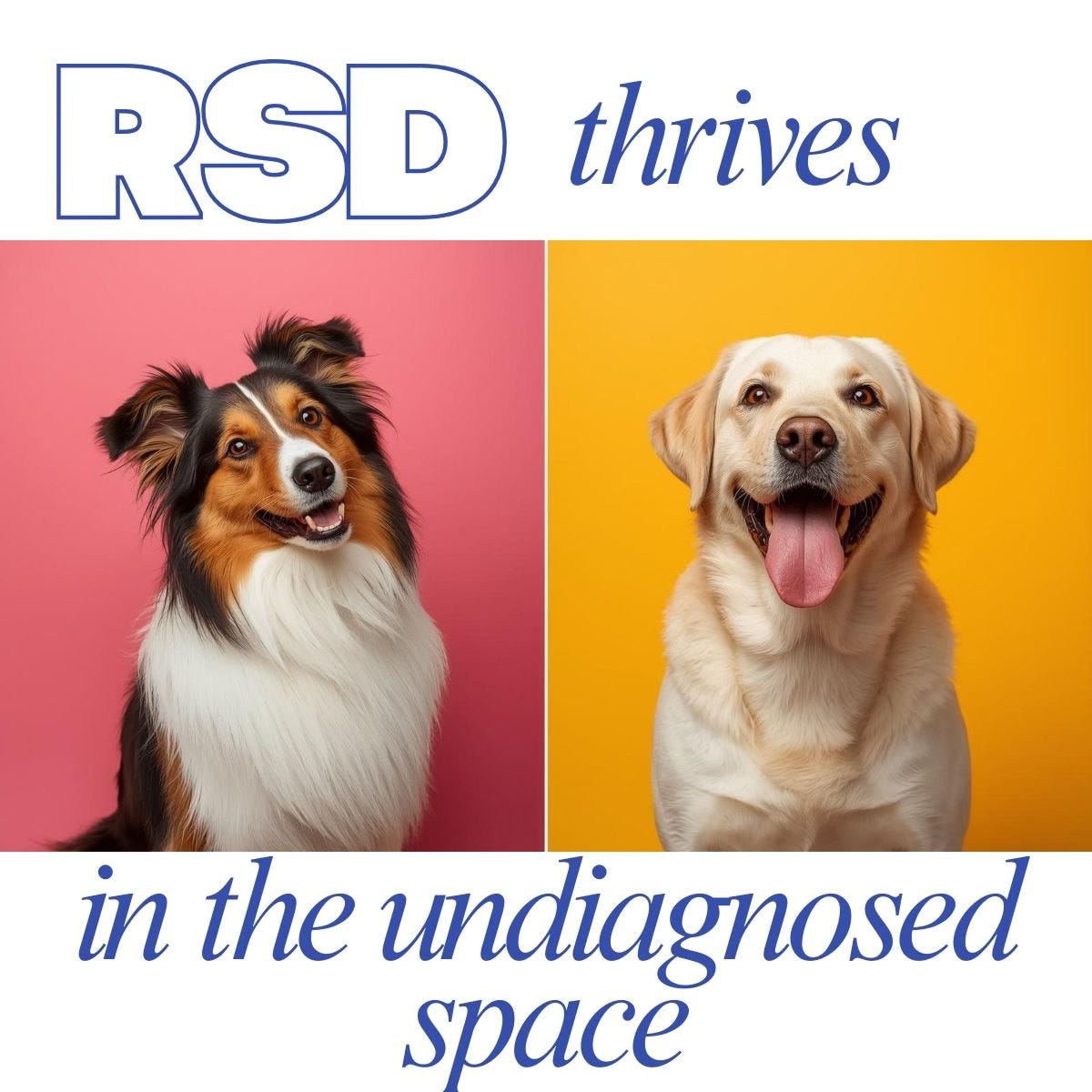
I was on a long walk with my mum the other day, and we were talking about her dog. What he needs, what works for him, what sends him into a spiral. And I found myself thinking: we know more about what a border collie needs to thrive than we know about ourselves. Isn’t that strange? We accept without question that different dogs have different needs. But somehow we’ve convinced ourselves that we should all be able to function the same way.
The trouble with RSD is that the science isn’t there yet. For a number of reasons. So when I say “undiagnosed,” I don’t mean whether you have a piece of paper with letters on it. Whether you’re ADHD, AuDHD, ASD, CPTSD...or even RSD. I mean whether you actually understand what your nervous system needs to thrive. Because I’ve realized something recently: I spent years trying to fix myself, when what I actually needed was to understand my own wiring.
Here’s what I found myself thinking about on that dog walk. Dog owners know what their dogs need. We all have a rough idea, don’t we? A border collie needs intense mental stimulation, structure, purposeful work, quiet and calm, predictability. Without it, that brilliant, hyperfocused brain spirals into anxiety, obsession, reactivity. A labrador? Give them some exercise, a bit of companionship, and they’re happy. Easy to be around. Socially acceptable. Tolerates boredom. Just...nice.
Neither is better. They’re just wired differently. And everyone accepts this. No one looks at a border collie and says, “Well, if you just worked on your confidence, you’d be fine at the dog park.” No one tells them to try harder, be less sensitive, stop overthinking it.
But that’s exactly what we do to ourselves.
I’ve spent so much of my life feeling ashamed that I wasn’t easier. More adaptable. Less intense. The kind of person who could just relax without needing specific conditions to feel okay. the kind of person other people felt relaxed around.
I’d watch other people sail through social situations that left me exhausted for days. I’d see them handle criticism with a shrug while I lay awake replaying the interaction over and over, trying to figure out what I’d done wrong.
And I thought there was something fundamentally broken about me. That if I just worked harder, went to more therapy, did more shadow work, integrated more parts of myself, I’d eventually become the kind of person who could handle life the way everyone else seemed to. I’d become the labrador.
But here’s what I didn’t understand then: I was frazzling my nervous system even more by trying to fit that mold. Every time I forced myself to go to a social event I didn’t want to attend, every time I stayed up late when my body was screaming for rest, every time I pushed through when I needed to stop—I was sending my nervous system the message that its signals didn’t matter. That I couldn’t be trusted to listen.
And when we don’t recognize that we’re wired differently—that our nervous system has specific, non-negotiable needs—RSD fills that gap. With shame. With reactivity. With the constant feeling that we’re too much. Or not enough. Or both at the same time, somehow.
But you’re not too much. You are enough. You’re just not a labrador. And trying to be one is what’s causing the inflammation, the burnout, the chronic fatigue. All the places where neurological shame grows on a chronic feedback loop, feeding itself until you can barely remember what it felt like to be calm.
Once you start recognizing what your nervous system actually needs to regulate and thrive, the shame starts to lose its grip. Not all at once. But slowly. Gradually. Until one day you realize you’ve stopped apologizing for who you are.
I know diagnoses are hard to come by. Long waiting lists. Expensive assessments. Gatekeeping. Invalidation. And even when you do get one, it doesn’t always come with instructions for what to actually do about it. You’re just left holding this label, wondering if it changes anything.
But here’s what I want to say, and I really need you to hear this: this isn’t about seeking accommodations from others. This is about feeling happy—even proud—about giving those accommodations to yourself. Because that’s what helps you thrive. That’s what makes you more effective. That’s what lessens the shame.
You’re not a problem that needs solving. You’re a nervous system that has specific needs. And I know that sounds simple, but it took me years to understand it. Years of thinking I was broken when actually I was just trying to function in conditions that weren’t designed for my particular wiring.
When you meet those needs? You become calmer. Clearer. More capable. You stop fighting yourself and start working with yourself. And I can’t tell you what a relief that is, after spending so long at war with your own body.
So how do you start recognizing what your nervous system needs? You begin by listening to your body over the dictates of society. And I’ll be honest, this was one of the hardest things I’ve ever had to learn. Because I’d spent so long overriding those signals, I’d almost forgotten they were there.
I had to start noticing patterns. When did I feel most regulated and calm? When did I feel most frazzled and reactive? What conditions helped me think clearly? What drained me, even when it “shouldn’t”?
For years, I pushed through what my body was telling me. I ignored the signals. I overrode my nervous system’s protests because I thought that’s what strong people did. That’s what capable people did. They didn’t need special conditions. They just...coped.
And I paid for it. With chronic fatigue. With illness. With a nervous system so dysregulated that even small things felt threatening. With relationships I damaged because I couldn’t explain why I was so reactive. With opportunities I missed because I was too afraid to fail.
It wasn’t until I started actually paying attention—really listening—that things began to shift. And what I discovered surprised me, because some of the things I needed felt almost embarrassingly simple. Almost too simple to matter. But they mattered enormously.
Not going to social events when I have no idea who else will be there.
It’s normal (I’ve discovered) to text an invite to a coffee date, only to arrive and find five other people there. I didn’t choose to see those people; I don’t feel comfortable with those people. But I’d plaster on a smile whilst my body was screaming at me.
And then I’d leave early anyway, feeling ashamed that I couldn’t handle it. Ashamed that I wasn’t more social, more confident, more...normal. I’d replay every interaction on the way home, analyzing everything I’d said, wondering if I’d been weird, if people noticed I was struggling.
Now? I just don’t go. I find that I’m busy. And I don’t apologize for it anymore. Because my nervous system needs to feel safe, and walking into a room full of people I didn’t choose to see when I might feel fragile just isn’t worth the cost. It takes me days to recover. Days when I can barely work, barely parent, barely function. And for what? To prove I can do something that makes me miserable? It doesn’t make me wrong. I spend time with people who energise me not drain me. I guard my space carefully
Going to bed at 7pm on occasion when I know I need it.
Not because I’m lazy. Not because I’m giving up on the day. But because my nervous system is signaling that it needs deep rest. That it’s been in fight or flight for too long. That it needs darkness and quiet and the permission to shut down completely.
I used to feel so much shame about this. What kind of adult goes to bed at 7pm? What kind of mother chooses sleep over evening time with her family? What will people think? But now I see it differently. It’s one of the kindest things I can do for myself. And actually, it’s one of the kindest things I can do for my family, because the alternative is me pushing through, getting more and more depleted, until I snap at everyone or withdraw completely.
Letting go of being seen as “strong.”
This one was the hardest. This one took me the longest to accept. I thought I had to power through everything. Be the best. Prove that I could do it all just as well as anyone else. That asking for help or admitting I was struggling meant I was weak. That being vulnerable was the same as being a burden. That if I just tried hard enough, I could handle everything on my own.
But actually? Admitting I need support, rest, and gentleness is the strongest thing I’ve ever done. Because it meant I stopped pretending and started being honest. And that honesty has created space for real connection, for deeper relationships, for a life that actually works instead of one that just looks good from the outside.
What does your nervous system need to feel safe, regulated, and able to thrive? Not what you think you should need. Not what would make you easier or more acceptable or more like everyone else. Actually need.
Take some time and write down three things. Three accommodations you can give yourself. Three ways you can stop forcing yourself to be the labrador when you’re actually the border collie. Three permissions you can grant yourself that you’ve been denying.
Because once you start meeting your own needs without shame, something shifts. The RSD episodes get less frequent. The recovery time gets shorter. The voice that used to tell you you’re too much starts to quiet down. And you begin to see that you were never broken. You were just trying to thrive in conditions that weren’t designed for your particular wiring.
And that changes everything.
Comments
Nothing yet. Say the first thing.
Sign in to join the conversation.