
In the beginning weeks of my journey, I was pretty disciplined about showing up for my daily practice. I would bring my body to my designated spot at the appointed time, full of good intentions to settle and focus. My only tool was my breath—no apps, no other known possibilities. I sat cross legged on a cushion on the floor, because I thought that was the required posture. I had a bad knee that hurt in this position, and I was clear this body was never going to find a lotus position in this lifetime. Often, my busy mind wanted to focus on anything but my breath. Gratefully, through the years I have I learned there are many options for our posture and focus during meditation.
There is no right or wrong posture for meditation. In fact, some days my body and or mind require a different position than my usual one, or I need to change during my practice session. The intention is to find a posture that allows you to be comfortable and alert. That is a position that supports your attention to what is happening on the inside (e.g., in your body) and your intention to be present to your experience. We want our body to feel stable and supported, which supports our attention. A good posture for you might be sitting on a cushion cross- legged. It may be sitting in a chair. If you use a chair and it is ok for your body, you might first try sitting in a kind of firm chair, upright, with both feet flat on the floor. Some people kneel resting their seats on a meditation bench. We are encouraged in these sitting postures to try to have a long spine, upright, but relaxed with shoulders settled, if our physical capacities allow. This allows the breath to flow freely. You can also try meditating lying down on the floor on a mat, with legs and arms stretched out, feet falling outward. A pillow under your knees may help your back to be flat and relaxed. Standing is another option. Slow, rhythmic walking can work, focusing an in-breath for one step and an out-breath on the next. Walking meditation can be an option even if you can only take 4-5 steps in one direction, and then turn around. The focus is on each step, each breath.
In my current practice I typically sit in a straight back wooden chair, feet flat on the floor, hands resting on my thighs. Some days, there is a lot of distracting energy in my body and I cannot settle into this position. Then my go to is walking meditation, up and down a hallway and into my living room in my small house. Sometimes I choose walking meditation instead of sitting. I have a friend for whom sitting and lying down are difficult because she has this restless leg condition. Walking is good for her outdoors or a bigger space, but very distracting and difficult in her home which she shares with two young adults and cats and dogs. She recently began trying sitting meditation at home on a large yoga ball, coordinating her breath with gentle, rhythmic bouncing. Experiment with different postures, and see what supports your focus and attention.
An anchor is something I focus on over and over during meditation, an experience I invite my mind to pay attention to when it wanders away (which is both normal and on some days, can be frequent). Mindfulness is about being aware of what is happening on the inside and the outside in the present moment, without needing it to be different. An anchor is something that can only be happening now, in this moment, inviting us to witness our real experience right here, right now. It’s what I return to, again and again, when I realize my mind has gone elsewhere.
The first anchor many of us learn is following our breath. The breath can only happen in the present—this breath, then this one, then this one. Each breath is new and unique. We cannot revisit a breath from yesterday, or sample a breath from tomorrow. To learn to witness each breath can bring us into the here and now. Breathing is a body-based experience. Our body is always in the present. The breath is not necessarily the best for everyone. Important note: For some, breath practice can actually touch unpleasant experiences and make one more anxious or uncomfortable. Some individuals may have breathing issues or past experiences with breath that bring up fear when this is the focus. Don’t be discouraged if it is not for you. There are other options.
If it seems ok for you, here are some different ways to explore practicing with breath that might support you, even if it has not been a match for you in the past.
Notice where you experience the breath the most in your body.
Maybe breathe normally and try to notice where you are most aware of the breath as you begin to pay attention. Is it air entering your nostrils, going down your throat, filling your lungs? Is this filling of the lungs experienced in your chest or your back or your whole ribcage? Do you mostly experience the breath filling your belly a little, expanding and contracting (without exaggerating deep breaths)? Can you experience the-in breath filling your whole body- torso then limbs to feet and hands? Then settling and letting go on the out-breath? Picking just one of these possibilities and keeping my breath focus there for a session can increase my mind’s ability to focus on the breath. Some days you may have another experience and focus in different area.
Try to keep your mind on the whole in-breath, from beginning to end. Do this for five or ten breaths., just letting the out breath release each time without any particular focus. Then switch, and try to focus only on your out-breaths, again the whole out-breath for five or ten breaths. Then continue with trying to keep your mind on the whole in-breath and the whole out-breath for five or ten breaths. At that point you may be able to shift to lighter attention on the breath to continue. When settled, just let go of the additional focus and let your breath do its thing as you gently witness, without effort. When your mind wanders, begin again with the whole in-breath and whole out-breath focus for a bit.
You can experiment with counting your breaths when you begin for a few minutes. Without trying to control your breath in any way, just count each in and out breath (one-noticing the in and out breath just as it is, then two…). Count up to ten and then reverse and count down for the next ten breaths (ten- in and out, nine…). If your mind gets distracted and you lose track of what number you’re on, just start over at one. After one or a few cycles of counting ten breaths up and then ten breaths down, you may feel settled enough to let go of counting and just witness the body continuing to breathe in and breathe out. If you get distracted, begin counting again.
Sometimes I use touch to keep myself more focused on my body. With my hands on my thighs or low belly. I press one finger gently into my skin for one in and out breath. It goes like this: Thumb,index finger, middle finger, ring finger, pinkie.. then on the other hand, pinkie, ring finger… The physical sensation and my mind’s focus on my fingers can help me bring a bit more attention to my body and the breath instead of thoughts. Sometimes I combine this with counting, one (thumb), two (pointer)…
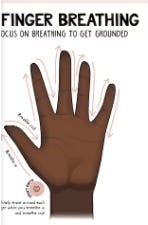
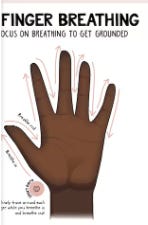
Another touch based practiced to support attention to the breath can also be used with or without counting. Hold one hand open, fingers stretched a bit. With your pointer on your opposite hand, begin at the outer base of your thumb and trace up on the in breath and down the thumb on the out breath. Continue with tracing your pointer finger up (in) and down (out). After your pinkie you can reverse and trace back toward your thumb.
If you have difficulty focusing on your breath for meditation, you might find that this is not the case when listening to guided meditations that utilize breath as an anchor. If you find that guided meditations that ask you to follow your breath increase your discomfort or anxiety, Stop. Pay attention to your experience. Breath practice can be aversive or unsettling for some. If it seems ok for you to explore, here are a few to explore guided breath practice, if you wish:
Insight Timer App. Search for:
“Relaxing your Mind” (9 minutes) Lama Yeshe Rabgye
“Gateway to Presence” (10 minutes) Tara Brach
“Mindful Breathing” (14 minutes) Thich Nhat Hanh
“Breathing Meditation” (8 minutes) Jack Kornfield
Pay attention to your experience as you experiment. If anything offered here seems a little helpful, you might continue the experiment for a week or more. If any or all of these breath options are not for you, let them go. Our next newsletter will share ideas for following other anchors for mindfulness practice.
No posts
Comments
Nothing yet. Say the first thing.
Sign in to join the conversation.