
Note: This is a slightly shortened version of our EA Forum announcement post.
This week, based on our multi-year prioritization research, we are launching the Rethink Priorities Cross-Cause Fund (CCF). The fund pools donors’ contributions and allocates them to high-impact giving funds across Global Health and Development, Animal Welfare, and Global Catastrophic Risks.
Key highlights from this post:
We believe that strategic cross-cause prioritization is an important step in doing good at scale.
This fund is for donors who want their donation to go where a marginal dollar is likely to do the most good across cause areas, all things considered.
We modeled key uncertainties that matter for cross-cause prioritization: moral weights, time discounting, risk attitudes, aggregation across ethical views, AI-related uncertainty, and empirical uncertainty within each giving opportunity.
We present the current recommended allocation of marginal resources across high-impact funds in each of the three cause areas mentioned above.
In addition, we’re introducing you to the first version of the Donor Compass, a tool to help donors explore cross-cause giving, powered by our cross-cause prioritization model. It is a short quiz that outputs custom giving allocations based on the user’s moral and empirical assumptions.
You can dive deep into our rationale and methodology for the CCF in the announcement below, or go straight to our dedicated website to engage.
Go to the Cross-Cause Fund website
To truly do the most good we can, we need to find a way to assess interventions that span vastly different areas of philanthropy.
In an ideal world, we’d do cross-cause prioritization, using a set of universal benchmarks to evaluate specific interventions across a wide range of cause areas. Cross-cause prioritization is extremely difficult, though, because of the many philosophical and empirical complexities involved. To understand why, consider what this kind of comparison actually requires.
When trying to truly ensure we’re doing the most good we can across dramatically different causes, we must — implicitly or explicitly — rely upon a host of moral (or, normative) assumptions regarding questions like:
How do we weigh different kinds of doing good, such as saving lives, alleviating suffering, and promoting economic opportunity?
Should we weigh near-term outcomes more than long-term outcomes?
Should we give disproportionate weight to avoiding causing harm, even if it means sacrificing some upside benefits?
Do we restrict our concern to humans, or extend it across all sentient beings, including various animal species?
Moreover, if we have competing intuitions about answers to any of the above questions, how can we navigate these tensions and determine how to act?
And once we’ve come to some conclusion about these normative and meta-normative questions, we run into many empirical difficulties, such as:
How do we estimate the marginal effectiveness of any given opportunity in any given cause area at any given moment?
How much funding can different interventions absorb productively?
How should uncertainty about the future — in particular, around the potentially transformative impacts of AI — change our assessment of particular causes?
Every allocator faces these questions to some degree. But cross-cause prioritization is unique in demanding that they all be made explicit at once: you simultaneously need within-cause cost-effectiveness estimates, cross-cause conversion factors, and a framework for handling moral uncertainty.
Yet the Effective Altruism community has historically invested little in cross-cause prioritization. According to our analysis, only 2% of EA prioritization resources were allocated to cross-cause prioritization in 2025. Consequently, the community has lacked the research and advising infrastructure that cross-cause prioritization demands.
Given these difficulties with evaluating specific opportunities head-to-head across cause areas (cross-cause prioritization), EA has historically tended to take a two-step approach:
Cause prioritization: using heuristics to divide resources among pre-defined cause areas, such as Global Health, Animal Welfare, and Global Catastrophic Risks.
Such heuristics include evaluating the cause area as a whole by its perceived importance, neglectedness, and tractability.
Cause areas are typically defined by their beneficiaries (e.g., humans living now, animals, people in the far future).
Within-cause prioritization: once a certain amount is going to be allocated to a pre-defined cause area, conducting highly detailed research to assess the most impactful interventions to fund in that area, based on its internal standards of evidence and metrics.
This two-step process accounts for the vast majority of EA prioritization effort (98% in 2025). This imbalance is partly historically contingent, as EA started by focusing heavily on global health interventions, then added Global Catastrophic Risks and Animal Welfare as cause areas. The process was largely driven by the availability of research and by the cities and academic communities where early EAs lived, rather than by systematic cross-cause comparison. The community has now largely reified these cause areas: funding bodies, research teams, and grantmaking processes are organized around them, and the dominant approach is to allocate funding by cause area first, then optimize within each.
Accordingly, much of the community debate focuses on cause prioritization or within-cause prioritization. But little effort actually goes to the question that arguably matters most for impact: how can we optimize among interventions across causes?
An often-heard claim in the EA/impact space is that one cause area is clearly superior, so we should concentrate all resources there. We are highly skeptical of this view and believe that concentrating all resources on a single cause requires an extremely high degree of confidence in our normative judgments about moral weights, the effects of our actions, and approaches to risk. We don’t think this is warranted. Our models are inevitably imperfect, and diminishing returns and shifting risk profiles mean the relative value of additional funding in any area changes over time. Epistemic and normative humility both point toward diversification rather than concentration.
What gets funded is not “global health” or “animal welfare” in the abstract, but specific interventions: distributing bednets, lobbying for cage-free legislation, and funding biosecurity research. Yet much of the allocation to individual interventions within a cause area is determined by our rough picture of the cause area as a whole, even though interventions within cause areas differ dramatically in their cost-effectiveness, their risks of having no effect or causing harm, and their impact time horizons.
If these dimensions are important to donors, then the amount that’s given to a specific intervention should depend on its own risk profile, cost-effectiveness, timing, and so on, independently of how others in the same category fare. As it stands, the merits of a specific intervention can be overshadowed by the characteristics of other interventions in that cause area, shaping the decision-maker’s view of the cause area as a whole.
Diminishing returns also occur at the intervention level, and cause-level allocations based on average or historical cost-effectiveness can become stale as the marginal cost-effectiveness of interventions shifts relative to others — potentially necessitating a reallocation that the two-step process might not trigger quickly enough.
We believe that the problems above all point in the same direction: we need to compare and prioritize specific interventions across cause areas, rather than treating the cause-level allocation as fixed and optimizing only within each silo.
Without modeling, anyone trying to allocate effectively across causes must hold a bundle of moral weights, risk preferences, empirical estimates, and decision-making algorithms in their head at once, and somehow apply them consistently across every option. In practice, this is impossible. People fall back on heuristics, intuitions, and whichever considerations happen to be most salient. This produces allocations that are opaque (even to the person making them) and that can’t be easily scrutinized, challenged, or improved.
By contrast, explicit modeling forces these assumptions into the open. When we specify our moral and empirical inputs in a model, we can see exactly how each one shapes the output. We can ask: what happens if I discount the far future more or less? How much does the allocation shift if I value animal welfare 2x more? How consequential are disagreements between two people about moral weights for their recommended portfolios? Being explicit makes it possible to productively and transparently disagree about important normative issues, quantify their impact on decision-making, and identify a clearer path forward for allocating scarce resources.
Of course, models don’t capture everything that matters. But we think they’re worth building because there’s little reason to believe the implicit models running in someone’s head are doing any better. Putting our uncertainties on the table, naming our assumptions, and testing how the recommendation moves under different inputs is the most honest way we have found to prioritize across causes that don’t share a common unit of measurement.
Our Cross-Cause Prioritization model allows for:
Comparing top giving opportunities across cause areas and success metrics. Global health funds are measured in life-years saved, disability averted, and income gains; animal welfare funds in years of suffering avoided across species; global catastrophic risk funds in expected lives saved from mitigated catastrophes. The model takes these different success metrics, applies explicit moral weights, and lets us compare a malaria net, a cage-free hen campaign, and an AI policy grant on a single yardstick.
Aggregating across moral and empirical worldviews, rather than picking one and ignoring the rest. Reasonable people disagree about how much weight to give animals, how to value future generations, how risk-averse to be, and how plausible different ethical frameworks are. Rather than pick one set of answers and pretend the others don’t exist, the model represents multiple worldviews simultaneously and combines them using up to nine aggregation methods (e.g., Nash bargaining).
Handling the structural features of giving that intuition easily misses, such as diminishing marginal returns, delayed impact, and risks that interventions might have no effect at all or might backfire.
In short, we can:
Explicitly model key uncertainties that matter for cross-cause prioritization, including moral weights, time discounting, risk attitudes, aggregation across ethical views, AI-related uncertainty, and empirical uncertainty within each giving opportunity.
Cover a wide range of funds that give to specific interventions, from malaria nets to shrimp stunning campaigns to lobbying for AI regulations, and put them on a common scale.
Make assumptions visible, so disagreements can be located precisely and debated.
In practice, many donors give through funds rather than to individual interventions. Our model evaluates funds based on the marginal cost-effectiveness of the interventions they support, so the fund-level allocation reflects intervention-level analysis. We evaluate funds rather than specific interventions at this stage, both because funds themselves conduct intervention-level vetting and because we do not yet have the capacity to independently assess a wide range of individual interventions. And in contrast to the highly abstract cause areas, we often have information to evaluate the cost-effectiveness and diminishing returns rates of each particular fund. Finally, we believe these funds can absorb a large amount of money productively and divert it to the highest-priority interventions within their remit.
The model currently allocates donations across the following funds:
GiveWell All Grants Fund: funds a broad set of global health and development interventions with strong evidence of cost-effectiveness
Lead Exposure Action Fund: worldwide lead exposure mitigation efforts
EA Animal Welfare Fund, The Navigation Fund - General Farm Animal Fund, and The Navigation Fund - Cage-Free Fund: interventions to improve the welfare of farmed and wild animals
Longview Philanthropy’s Nuclear Weapons Policy Fund: strategic and neglected giving opportunities in nuclear safety
Longview Philanthropy’s Frontier AI Fund: key opportunities in AI safety
Sentinel Bio: biosecurity and global catastrophic biological risk reduction
Please note that this model is a perpetual work in progress, which we aim to regularly update as new cost-effectiveness data becomes available, as our research on cause priorities develops, and as we expand coverage to new funds and cause areas.
Powered by the cross-cause prioritization model described above, the Rethink Priorities Cross-Cause Fund pools donations from multiple donors and allocates them across a curated set of high-impact giving funds to get the most impact per dollar. You donate, our research and operations teams do the rest. (We do not charge any fees for managing the Cross-Cause Fund.)
The CCF is for donors who want their contribution to go where a marginal dollar is likely to do the most good, all things considered, and across cause areas, but who do not have the time to do the necessary research and ongoing monitoring themselves.
This fund might be a great fit for you if you:
want your giving to span multiple high-priority interventions (currently represented by the funds from the GHD, AW, and GCR cause areas, with new funds being added in the upcoming months)
prefer deferring to a research-vetted process rather than monitoring funds, interventions, and cost-effectiveness data yourself
take moral and empirical uncertainty seriously
The Cross-Cause Fund might not be a great fit for donors who:
may be inclined to give to a single cause area and prefer to direct their full donation there
might be bought into a single ethical view
prefer hands-on control over each grant when it’s made; these donors may be a better fit for the personalized Rethink Priorities Cross-Cause Donor-Advised Fund
When you donate to the RP Cross-Cause Fund, your contribution goes into a single pooled account held at CharityVest, which is managed by RP. We allocate pooled contributions across our recommended charitable funds on a regular basis, following our most current recommended split (see below). You can give once, on a recurring schedule, or at any time you choose. You’ll be able to see the grants RP has made from the fund and receive regular impact reporting. For donations over $500,000, you can also submit a preferred allocation (generated via our Donor Compass tool) by emailing us.
Questions about contributing, or want to discuss your giving in more detail? Contact us at fund@rethinkpriorities.org to learn more or arrange a call.
Below is the current split (by fund and by traditional EA cause area) that we apply to any donations made to the RP Cross-Cause Fund. These splits are determined by running the cross-cause prioritization model based on:
the current cost-effectiveness data for each of the funds included in our model
our current foundational assumptions
multiple, research-backed approaches to navigating moral uncertainty
The current split will always be available on the Cross-Cause Fund homepage.
It was last revised on May 18, 2026, and we’re tracking all updates and improvements to the model here. (This allocation will likely change over time as we adjust our inputs and refine the model.)
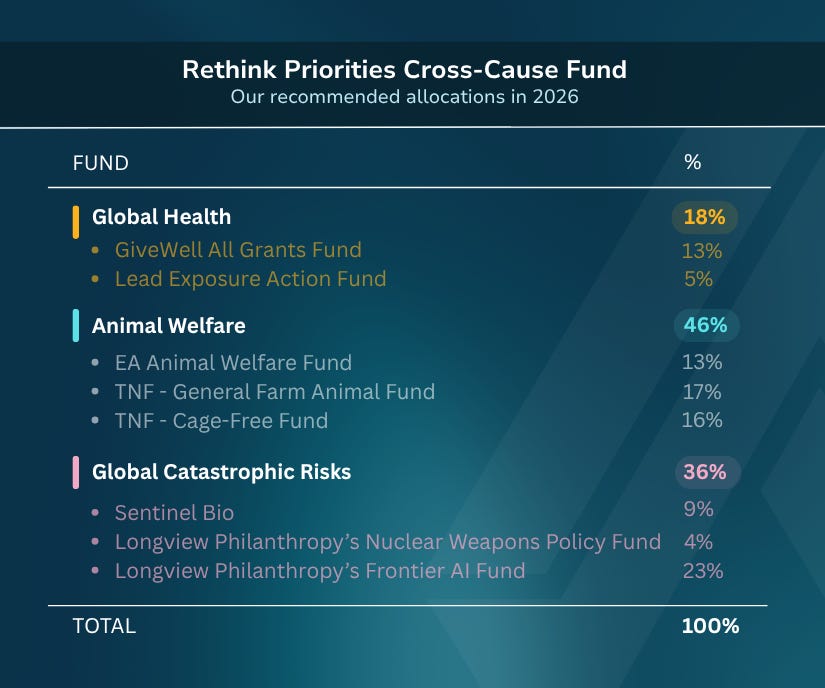
Our recommended allocation (based on an assumed budget of $200M) reflects our best all-things-considered judgment on where a marginal dollar does the most good among the funds we considered. As described above, the underlying model explicitly accounts for empirical uncertainty about interventions, moral uncertainty across ethical frameworks, and different attitudes to risk. It considers cost-effectiveness at different funding levels, welfare tradeoffs between humans and animals, and how uncertainty about AI should affect other cause areas.
We are also presenting the first version of the Donor Compass, a quiz-type tool powered by our cross-cause prioritization model that outputs a custom cross-cause allocation based on the user’s beliefs.
It is a tool for anyone looking to explore cross-cause giving, particularly those curious to see how their moral and empirical beliefs will shape downstream allocations.
You can use it to compare RP views and your own, resulting in a personalized allocation recommendation that reflects your moral and empirical commitments.
The Donor Compass has two modes:
The default is a short quiz that you can take in just a few minutes. It walks you through a selection of four key questions with preset values, and generates a personalized allocation across our funds. Each answer can also be fine-tuned with more specific inputs for more precise control.
Once you’re familiar with the inputs and want more control, there’s a power-user mode that lets you see all inputs side by side and choose between different worldview aggregation methods (or combine multiple). The definitions for each input are found in the notes section of this spreadsheet, which contains the default inputs for our Cross-Cause Fund.
Here is a walkthrough of how the tool works with real-world examples.
This section provides a brief overview; more details are available in the document linked here.
Our methodology has three components: (1) how we select funds for inclusion, (2) how we estimate each fund’s marginal cost-effectiveness and how it changes with funding influxes, and (3) how the cross-cause prioritization model combines those estimates into an allocation across funds.
We aimed to include at least one fund per major cause area focused on by the EA community (Global Health and Development, Animal Welfare, and Global Catastrophic Risks), and applied four further criteria: fund quality (we included only funds we were confident would lead to high-impact grants, and excluded areas we lacked the experience to vet); data availability (we needed cost-effectiveness data we could obtain or model from public sources); decision relevance (we shaped the initial list around the giving decisions we expected to be most useful to early users); and our legal restrictions as a 501(c)(3), which require us to exclude political giving entirely.
For each fund, we estimate two things: how cost-effective it is at the margin today, and how quickly that cost-effectiveness declines as the fund receives more money. Our process is to build a cost-effectiveness framework for each fund, solicit data directly where possible, fall back on in-house estimates from existing research and expert views when data isn’t available, and simulate the fund’s marginal impact and risk profile across each dimension. Separately, we construct diminishing returns curves informed by internal assessments, third-party experts, and fund managers.
We built a Data Viewer, if you want to inspect the cost-effectiveness data that feeds into Donor Compass recommendations and Cross-Cause Fund allocations. To help you understand the data, we also created a brief overview explaining how to read it.
To output an allocation, our model follows these four broad steps:
Step 1: Define worldviews. We specify a set of worldviews, each a coherent combination of moral commitments and empirical beliefs. A worldview captures things like: how much weight to give animal welfare relative to human welfare, how heavily to discount impacts that occur in 50 or 500 years from now, and how risk-averse to be about interventions with uncertain or potentially harmful outcomes. Each worldview is assigned a credence reflecting how seriously we take it.
Step 2: Score each fund under each worldview. For each charitable fund, we estimate its expected impact, broken down by effect type (e.g., human life-years affected, animal suffering-years averted), time period (near-term to deep future), and risk profile. Each worldview selects its preferred risk profile, applies its moral weights to the effect types, and applies its discount factors to the time periods. This produces a single score for each fund under each worldview.
Step 3: Aggregate across worldviews. We combine the per-worldview scores into a single portfolio allocation using one of several aggregation methods. These methods differ in how they handle disagreement across worldviews: they can give each worldview a budget share proportional to its credence, allocate budget to the fund that scores highest after averaging across worldviews, or use more advanced procedures.
Step 4: Output an allocation. The model processes donations in $2M increments, at each step distributing funds across cause areas according to the chosen aggregation method and accounting for diminishing returns that depend on how much the fund has already received in previous iterations. When multiple aggregation methods are selected, we compute the credence-weighted average portfolio across all selected methods. The result is a recommended allocation across funds, expressed as a percentage of the total distributed budget.
The specific worldview inputs Rethink Priorities uses for our RP Cross-Cause Fund include our moral weights, discount factors, risk profiles, and credences in worldviews and aggregation methods. View our inputs here.
Our cross-cause prioritization model is a living tool. While it represents our best current methodology, we acknowledge that it does not yet capture every factor relevant to estimating impact. For example, we are not currently modeling certain interventions, such as alternative proteins, which we intend to add in the near future.
A detailed discussion of the model’s current limitations is available in our methodology documentation and the Cross-Cause Fund’s FAQ section. We are committed to rigorously prioritizing these gaps and incorporating the factors most relevant to improving model accuracy.
The pace and depth of this refinement work will scale with the fund’s size. As the volume of donations increases, the value of marginal improvements to our estimates grows correspondingly. We will invest in model development in proportion to the resources we steward.
The short-term improvements will likely include:
Covering areas beyond global health and development, animal welfare, nuclear risk, biosecurity, and AI safety, e.g.:
Democracy protection (non-partisan): We have commissioned an initial review of this area. Full incorporation of a vetted fund is likely more than three months away, but we expect to share interim findings with interested donors before then.
Climate change: We’re about to complete a project assessing the value of climate interventions relative to global health interventions. This analysis should allow us to produce cost-effectiveness conversions for climate-focused funds. We anticipate this will be particularly relevant for mainstream donors who wish to consider our work but also include climate in their cross-cause portfolios.
Vetting more funds for inclusion, e.g., Ambitious Impact funding circles (Mental Health, Meta Charity, Seed Network, Global Health, Strategic Animals), Giving Green, The Life You Can Save, AI Safety Tactical Opportunities Fund, Astralis Foundation, Survival and Flourishing Fund, Animal Charity Evaluators’ (ACE) Recommended Charity Fund, Senterra Funders, Macroscopic Ventures, EA Infrastructure Fund, Coefficient Giving Funds (e.g., Global Growth Fund, Abundance & Growth Fund).
Longer-term opportunities could include:
Adding more specific funds within the broad areas of global health, animal welfare, and global catastrophic risks, including:
Digital minds and AI welfare
Economic growth interventions (in low-income and/or high-income countries)
Wild animal welfare
Additional biosecurity interventions
Funds that are giving to “meta” causes that aim to increase the volume or effectiveness of resources flowing to high-impact charities.
We will communicate any additions to our fund coverage through our regular updates.
We do not charge any fees for managing the Cross-Cause Fund, and Donor Compass is free to use. We chose this because we want to enable impactful cross-cause giving with as few barriers as possible.
This also means our research, development, and maintenance work is completely reliant on donations. The Cross-Cause Fund and Donor Compass exist because individual donors believed cross-cause prioritization research was worth funding. If you also find this work valuable, consider donating here. You can also reach out to us at development@rethinkpriorities.org to discuss options for supporting this work.
Rethink Priorities (RP) has received grants from Longview Philanthropy, EA Animal Welfare Fund, Navigation Fund, and Coefficient Giving. RP has also done commissioned research for GiveWell and Coefficient Giving. In addition, one RP staff member serves as an advisor to the EA Animal Welfare Fund but is recused from grantmaking decisions involving RP.
RP is not involved in any grant-making decisions for these organizations, and RP conducts independent cost-effectiveness analyses of any funds we decide to include in our Cross-Cause Fund.
The Cross-Cause Fund and Donor Compass are projects built by Rethink Priorities’ Worldview Investigations and Interdisciplinary Research Teams, with support from the Development Team and assistance from the Communications Team, which is responsible for final edits, copywriting, website content, and co-authoring this post. We want to thank all the team members behind this work, as well as the contractors and everyone who provided assistance and feedback at various stages of this project.
Thank you for taking the time to read our Substack. If you would like to support our efforts, please subscribe below or share our posts with friends and colleagues.
We’re also always looking for feedback on our work. You can share your thoughts about this publication anonymously or simply reply to this email/post with suggestions for improvement or any questions.
No posts
Comments
Nothing yet. Say the first thing.
Sign in to join the conversation.