
THE LAUGHTER OF THE OLYMPIANS
“... for by his own will he has filled all things with himself, rousing up the Soul of the World and turning it towards himself, as being the cause of it’s Mind. And this latter, being set in order by the Father itself sets in order the whole of Nature within this world”1
The above quotation comes from the document known as the Handbook of Platonism by Alcinous. It’s a short text, probably created for teachers in the Platonist tradition. It is interesting in that it takes a more literal interpretation of Plato’s cosmological dialogue, the Timaeus, than had been or was typical among adepts in the tradition, like Xenocrates and Polemon.
Perhaps for teaching purposes, a beginning with a more literal reading was recommended, before the allegorical and more “esoteric” treatments. What it can be seen to articulate, and with refreshing (given the habits of modern philosophers of certain inclinations) clarity is the kind of basic paradigm the human mind will actualise when looking to support a religious feeling.
Our mind will look to account for the arrangement of the cosmos by appealing to an anthropic principle, a great paternal intellect for example. There is certainly nothing wrong with this, only that it should be asserted as absolutely “objectively” valid, to the diminution of other such theories.
But this latter goes for other basic paradigms and articulations, other myths too, including the myths spun out from the reductionist impulse, in other words, our proclivity for breaking things (phenomena) down into their smallest conceivable parts, and trying to fashion a predictive narrative based on their apparent interrelationship (materialism). The use of the word “conceivable”, as in “conceivable parts” should be an indication of the limitations of this approach.
What we will find, or think we find, with regards to understandings and theories of the nature of the world and our place within it, is always only what is within the capacity of our mind, and according to the inherent structures of our way of thinking, to present.
The above quotation could therefore be ’reduced’ in scope, and would then tell, instead of an absolutely objective description of how the cosmos was formed, an allegorical articulation of how we experience this existence;
From birth, all things appear in some relation to us. There are things we want and grasp at, things that repel us and we push away, and things in which we take little interest, things we scarcely notice (we fill all things with ‘ourselves’). Through the senses of the human body, and by means of the faculties of perception and understanding inherent in our mind, we generate (or rather, the being in which our idea of a self emerges generates) a “world”, a representation (rousing up the Soul of the World etc). Having thus fashioned a perceived world, our mind establishes a world-view, a picture of an order of how this world works, upon which constant assumption our routine actions can be conducted without too much if any reflection (set in order the whole of Nature). And what is the initial ground and constant source for all of these developments? It is the Will.
Now, rather than being objective and cosmological, the fragment becomes subjective and existential. However, there is also, particularly within the Indo-European philosophical tradition, a certain “mystical” addendum, presented in the curious maxim “as above, so below”. This relates an understanding of the cosmos wherein the microcosm of the human being is a reflection of the macrocosm of the cosmic being. The appropriate word in this mirroring paradigm, or intrinsic unity of the individual and the universal, is in the Greek philosophical tradition, “soul”
Soul (psuche) is an interesting word in the context of ancient Greek philosophy. It originally meant something like breath, or vital breath, the breath of life. By Plato’s time, it had come to be associated with perception, and with movement. Plato described it variously as the principle of self-movement, but also the constant region around us open to our perception, as well as that which perceives. This understanding, or interpretation, is based on the similarity between perception and breathing; we take in our surrounding phenomena like inhaling air, and we cast outward with our senses and are exteriorised to the world in our bodily presence like exhalation.
Soul is therefore properly not something absolutely individual, but that which entwines all apparent individuals with their surroundings and the entire world of phenomena. For those who followed Plato, the soul is also the connective tissue between the purely sensible world and the world of true Being, of the unchanging reality which is beyond the grasp of the senses, but perceivable by the mind (in Platonism, unlike Aristotelianism, mind and soul are always combined), and in this way, transcendent.
So it does not really matter what subsequent philosophical or scientific narratives and myths are articulated by the discursive aspect of our mind; what is important is recognising the connection, is that the entwining of the cosmic and the individual by the Soul is realised.
Arthur Schopenhauer, writing on the inescapability of the principle by which things are known (in Schopenhauer’s description, consciousness and or ‘knowledge’ stands in more or less for the classical Soul) beautifully cuts the legs from under any pretence of the absolute objectivity of science, and so also of any purely objective knowledge.
“Now if we had followed materialism thus far with clear notions, then, having reached it’s highest point, we should experience a sudden fit of the inextinguishable laughter of the Olympians. As though waking from a dream, we should all at once become aware that it’s final result, produced so laboriously, namely knowledge, was already presupposed as the indispensable condition at the very first starting point, at mere matter. With this we imagined we thought of matter, but in fact we had thought of nothing but the subject that represents matter, the eye that sees it, the hand that feels it, the understanding that knows it”2
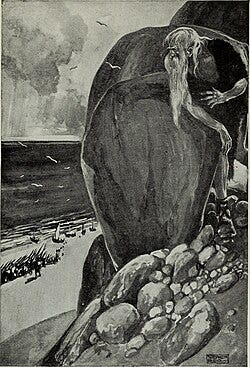
TUAN’S TEACHING
“Awaking we from out the gloom
of bearing caves to open see;
mistaken worlds, of sun, and moon,
and folk behaving carelessly
***
No words possessing, yet forearmed
with patterns rayed to seal the cleft,
enduring loss, begetting harm,
on matter-shaded warp and weft
***
Already loss!- for gravest wound,
and grievous, till the sacred night
across us, laid as dead in tombs,
relieves the aching will of light
***
However brief, or taking ne’er
a respite from confusion, thrown
again, for grief and waking, there
a chance we might illusion know”
Alcinous, “Handbook of Platonism”
Schopenhauer, Arthur, “The World as Will and Representation, Volume 1”
No posts
Comments
Nothing yet. Say the first thing.
Sign in to join the conversation.