
ON INTEGRATION
Initially, there seems to have been no animosity between Greeks, Egyptians, and Jews in Ptolemaic Alexandria. Each ethnicity was proud of it’s respective heritage, and naturally, regarded themselves with some bias in relation to the others. But it was the refusal of the Jews to fully integrate themselves, and their treatment of the others as most definitely “theologically” inferior, that eventually led to anti-Semitic backlash, which flared up repeatedly in antiquity. Certain among the Jewish population, notably Philo of Alexandria, were exceptions, although Philo too regarded his Judaic heritage as superior. However he embraced the developments in philosophy, and was, to all intents and purposes, a fully integrated member of Hellenistic civilization. He was not however, typical.
There had appeared by Philo’s time a slew of fraudulent “oracles”, fabricated and circulated, whose contents were clearly aimed at supporting the idea that the Jews had a special relationship with the highest god, and that it was theirs’, rather than the incomparably older religion of the Egyptians, which was the fountainhead of all true philosophy and wisdom. In these oracles, the ‘pagan’ deities were made to speak in favour of the superiority of the Jewish interpretation of God, and thus, of their cultural pre-eminence. Not exactly the most ingratiating attitude, or likely to have provoked anything but social antagonism. But the Hellenes and Egyptians were not ones to take such slights lightly.
The Egyptians could justifiably claim the greater antiquity of their religion, along with the presence within the latter of most, if not all, the same ideas later incorporated into what became Second Temple Judaism (and of course, Christianity). The Greeks for their part could certainly claim the unequalled significance of their philosophical heritage, and importantly, the development of philosophy into ever richer veins of knowledge and wisdom.
Through their refusal to integrate, coupled with the rebarbative attacks on the native culture, at least a great portion of the Jewish population incurred ever grosser manifestations of intercommunal hatred. Perhaps the generation from among themselves of the heresy which became Christianity, and which, through the machinations of elite power politics, seized the reins of European (and indeed, Egyptian) civilization, was itself a salvo in this unfortunate history of competitive antagonism.
What, after all, was ever so irreconcilable between the groups? The Egyptians were, historically, the first (in the western world at least) to develop such religious concepts as monotheism (in various forms), pantheism, the concept of salvation, the individual soul, of divine intervention in history etc. Prior even to the destructive monotheism instituted by Pharaoh Akhenaten, the Egyptians had long conceived of the ultimate source of universal abundance as being singular; a One. This developed, as Egyptologist Jan Assmann explains, from a theology of a unity of source, through the outright (and intolerant) monarchic monotheism of Akhenaten, to the so-called Ba theology of the New Kingdom. If anything, this latter theology, which holds that the visible universe is a manifestation of a hidden God, who dwells as the soul of the world, and controls all from within, is the paradigm for the philosophy of Polemon, successor to Xenocrates as head of Plato’s Academy, and thus for Stoicism (“Polemon declared that cosmos is God”1).
If the Egyptians called this God Amun, the hidden of name, it in no way implies that others – the Jews for example – could not call him Yaho and be adequately, if not in every minor detail, in accord.
Likewise the Greeks, as Indo-Europeans, knew of a great “sky-father”. Zeus was their expression of Dyaus Pita, divine Father, who for the Romans was Jupiter, the Celts, Dis Pater (and for the Gaels, the Dagda). Although worshipped in company with a plurality of other deities, not least a “Mother of the gods”, associated with the earth, by the 5th century BCE, at least in Greece, but swiftly becoming common currency throughout the Mediterranean, and possibly among the northern peoples (as Poseidonius suggests of the Celts) this Father was elevated to an ultimate ontological status, far superior to the other gods. Indeed, these latter were often seen as the varied manifestations, or aspects of this one ultimate God, who transcended even personality, as the principle of the entire universe.
If it were merely a case of abiding by Jewish customs, or peculiarities of traditional Jewish law, dietary or otherwise, it would hardly have been a significant barrier -if any – to integration; no one would have demanded the eating of pork, forbade circumcision, obliged young men to embrace homoerotic partnerships, or demanded that the Jewish Yaho be represented in an ‘idol’ (though certainly their were Jews who would have enthusiastically adopted one or more of these things). What could it have been other than the vexatious insistence on their superiority, special status, and therefore, their deserving of special honour- coupled with the obvious (as evidenced by the phony oracles) hysteria in their efforts to promote themselves – that lead to the often dreadful reaction? I would venture the answer to be –
Nothing.
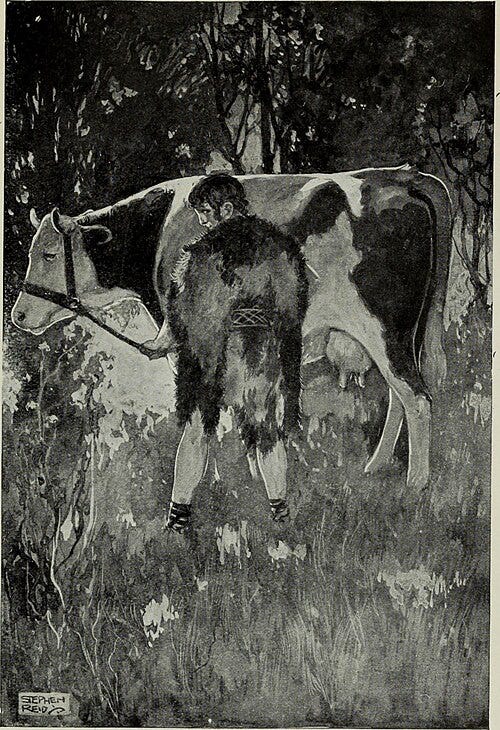
BALOR’S WAR
(or, “Unintended Consequences”)
“Within his tower-room there came
to Balor, dread and druid’s curse;
that he, by grandson would be slain-
yet ruin brought him still the worse
***
For still the avatar unformed,
who would be Lugh, in Eithne’s womb-
his daughter, and by will to war,
for Cian’s calf, he set his doom
***
That Cian same, with Eithne lay,
and of the fiery seed was born,
the battle-champion, Lugh to slay-
with irony, indeed Balor”
No posts
Comments
Nothing yet. Say the first thing.
Sign in to join the conversation.