
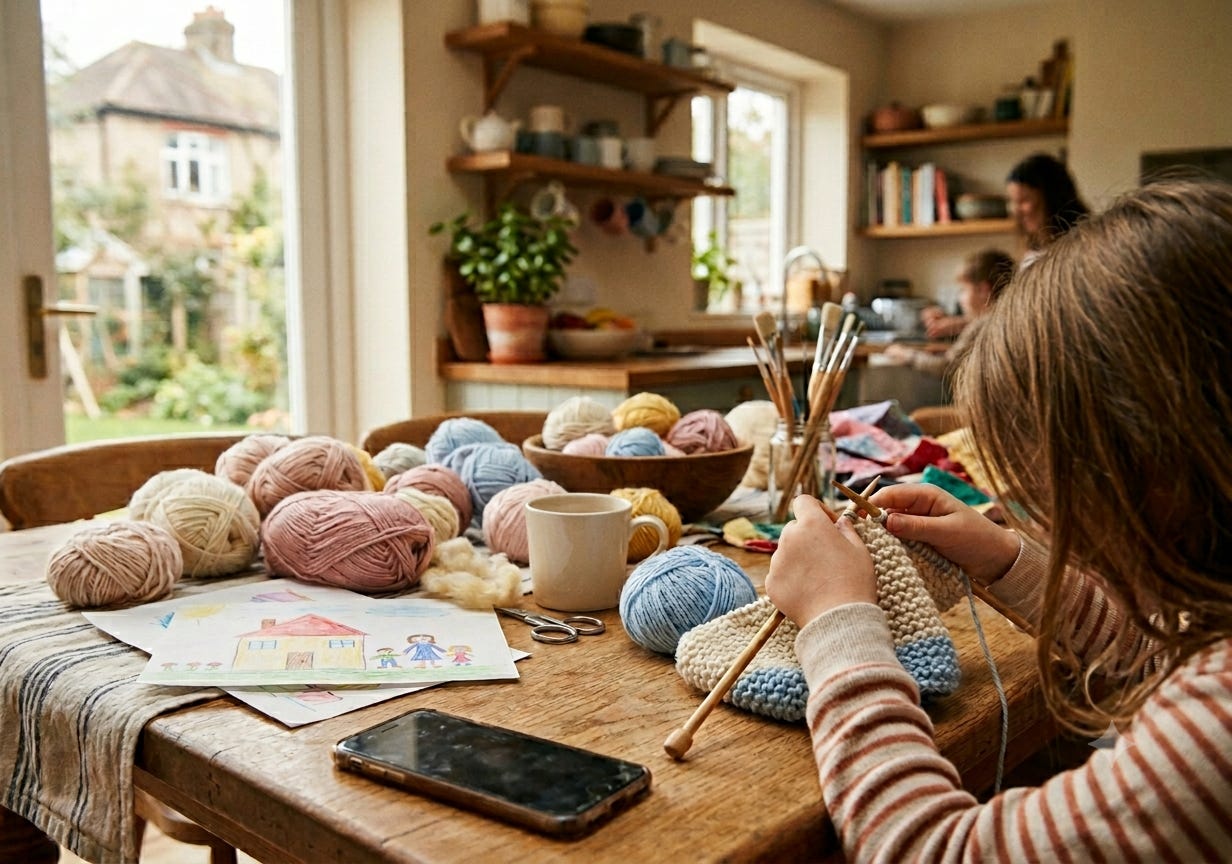
This summer, I’m imposing a screen moratorium. Not a reduction. Not a sensible limit. No elaborate parental negotiations involving egg timers or apps.
At least, that’s how I first presented it to the brood. Predictably, they were aghast. But after a bit of to-ing and fro-ing they walked away from negotiations with a “win” - a daily screen limit of two hours.
When I told my neighbour about our (mostly) screen-free summer of knitting, baking, painting, camping, digging, planting and making an almighty mess of my kitchen table, she looked at me as though I was planning to holiday the children in a cave.
“Oh but they’ll be so bored!” she said.
Exactly.
Because after whinging for a bit, they’ll want to do something about it.
I’ve cared for a number of children with severe screen addiction in recent years, and what I’ve noticed is that most of them have never sat quietly with themselves long enough to find out what their passions are, or what they’re good at, or that the world inside their heads is richer and more full of ideas than anything they might find online.
Telling them that is a complete waste of time. You have to show them. And the way to do that made itself apparent to me after one of the worst day trips we’ve ever had.
Years ago, I took two young brothers with early childhood trauma and ADHD to a motor museum. I imagined a wholesome day of vintage cars, educational exhibits and perhaps an idyllic picnic somewhere in between.
Instead, the boys kicked tyres of cars that had survived two world wars, climbed the displays and succeeded in attracting the attention of a deeply disapproving manager. The journey back, after a humiliating ejection, involved several emergency stops in lay-bys because they considered it a hoot to take off their belts as we sped along the motorway and dive head first over the seats.
By the time we arrived home I was shaking so much I could barely get the key in the door. The boys, however, were itching for more fun. While I wondered how I could possibly get dinner cooked and still keep them safe, the solution unfolded before my eyes.
My then twelve-year-old daughter Emily, trying to soothe her own nerves after the chaos of the day, quietly set up paints, glitter and glue at the kitchen table. The boys wandered over, drawn by what I assumed they saw as an excellent opportunity for more destruction. I braced myself for glitter showers, paint on the walls and Emily bursting into tears.
What followed stopped me in my tracks. After hovering beside Emily for a few moments, they each grabbed a brush.
“I’m gonna draw a tank like the one we saw earlier,” one of them announced. For the next half hour, the house fell into a stillness so complete that I could actually hear the sausages sizzling in the pan. When I called them for dinner, they pleaded for more time.
I was flabberghasted.
Since then, whenever I’m caring for a child who gets easily overloaded, out comes the craft. It’s remarkable to see - no matter how overwrought they are, when their hands are busy, the rest of them seems to still.
And recently I read that science is emerging that backs this up, with some studies suggesting that knitting works in the same way as EMDR, a therapy used to treat anxiety and PTSD. In EMDR, a patient follows a light with their eyes, moving them from side to side in the same way knitters do. Nobody fully understands why it works, but it does - I’ve seen it work on children with entrenched PTSD, and as anyone who’s lost themselves in a flow state as the rows tumble down will recognise, knitting allows the brain to finally take a break.
Jonathan Haidt describing some of the alarming results of social media addiction
Jonathan Haidt has shown that replacing a play-based childhood with a phone-dependant one has broken our link to something fundamental in our nature, and in our children.
For 200,000 years, hands kept humanity alive. The hands of our ancestors carved wood to build shelters, stitched animal skins to protect children’s feet and shaped clay to hold the harvest. Hands brought us into the world, rocked us to sleep and wiped away our tears.
Children grew up surrounded by useful hands. Skills passed from one generation to the next not via a TikTok short, but by sitting alongside someone and copying what they did.
Somewhere along the way we decided that children needed to be entertained rather than occupied. We run ourselves ragged providing trips to theme parks and other financially ruinous experiences - and when we’re out of energy or cash or ideas, out comes the iPad.
And after all of that, it turns out we’ve given them everything except the greatest gift anyone could possibly own - the ability to be at peace with their own thoughts.
Craft is our way back. When we build, make, sew, it’s as if the hands of our ancestors are resting on our shoulders, reaching forward through the generations, offering us a physical thread through time.
A child who knows how to sew, knit, plant, bake and paint is not only able to occupy themselves. They’re able to sit comfortably in their own inner world, rather than watching it scroll past.
One of the children I’ve cared for who was most deeply affected by screens was 11-year-old Frankie. His groomers had exposed him to all manner of horrors online, but they’d also shown him the attention he’d been missing throughout his early years, so he had a fixation with them that was difficult to break.
I won’t go into the details here, but a few traumatic incidents in our home forced me to give him an ultimatum - either he surrendered his phone, or he wouldn’t be able to stay.
His salvation came from working side by side with me in the kitchen, hands deep in dough or chopping onions or whisking eggs. A few months away from the screen (and therefore his groomers), he was a different child - connected, calmer, quick to laugh.
My adopted daughter, diagnosed with Foetal Alcohol Spectrum Disorder when she was five, came out of school recently in a state of fury. As soon as we stepped in the house she launched her rucksack across the hallway, upended a pot plant and eyed the kitchen bin with a destructive glint in her eye.
I swallowed down words of admonishment. They would only swirl around her, whipping her into greater distress. So I grabbed my knitting and sat down nearby. A bit random, but when you’re heading off a meltdown, the element of surprise can be an excellent tool. Click, click, click went my needles as she stormed around me, exhausting every rude word she knew.
When we’re in close proximity to someone who’s running high on anxiety, our own heart rate speeds up to match theirs. Thankfully, it works both ways - if we’re able to calm ourselves, it quickly rubs off - and gradually her breathing slowed.
Before long Megan sank down the wall nearby. Then she grabbed the needles from my hands and took over. Furiously, at first, needles clanging, stitches dropping all over the place. But as the rows grew, her emotions unspooled along with the wool, the tension draining from her face. With her gaze anchored on the wonky scarf rather than me, she finally let her guard down.
“Joseph said I was stupid when I got stuck in maths,” she said quietly. “He said it’s no surprise my real mum didn’t want me.”
My own needles accelerated as I imagined having a little word in Joseph’s ear.
“Is it true?” she demanded, anger creeping back in. “Did she not want me?”
I took a breath, reassuring her that no, no it wasn’t true, her birth mum had very much wanted her, and she was a much-loved child. Eventually, calm settled over both of us. We sat together for the next twenty minutes, mostly silent, lulled by the rhythmic clicking and the shrinking balls of pastel blue wool.
“You know what Joseph needs, Mum,” Megan announced eventually, with a half-choked giggle. “He needs to learn to knit.”
I laughed out loud. She was right. If knitting can console a wounded, furious teenager, perhaps it can help the rest of us too.
Names have been changed
Thank you for reading. Have you found anything that immediately soothes the soul? Walking, gardening, yoga? I’d love to hear in the comments. I’m always looking for new ideas.
And finally, I found this TedTalk from Jonathan Fields surprisingly moving.
Quite early on he says, “I wasn’t just painting, I was remaking myself with every stroke.” A beautiful observation and it sums up not only why children find it easier to disclose painful truths when drawing or painting, but also why art/craft/making things helps them heal.
Comments
Nothing yet. Say the first thing.
Sign in to join the conversation.