
Already we are sliding past the longest day. Is it just our age, or are lots of people around you also saying ‘But we’ve only just had Christmas!’ ?
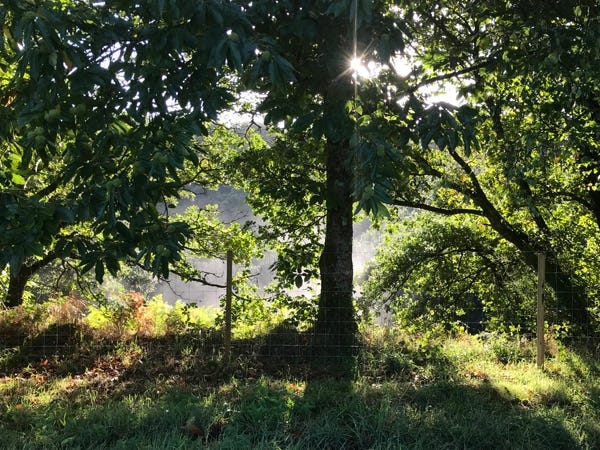
It’s cool enough, just, as to be a delight to sit out for a morning cup of tea; cool enough, just, to walk the dog early round the perimeter of the big North Field behind the house, the one that would once have been three little hand-worked bocage fields (you can see that from the variety of trees, their species and ages, in the hedge that separates us from the intensively-cultivated land that adjoins our organic holding). We have planted a number of fruit and nut trees, and fruiting shrubs, to make the beginnings of a forest garden that will stretch to join up with the rewilding field next door, and the woodland and Home Meadow below that.
It’s a delight too to hear the several song thrushes threading the air at the edges of the garden, the pairs of blackbirds, the blackcaps, finches and tits, and watch the flycatchers. Up high somewhere is a buzzard, and just now four ravens, two adults and I assume from their voices two juveniles, flew in a straight line one behind the other in a purposeful way over towards the woods.
*
I’m just back from yet another medical appointment, this one at least local (as opposed to two eye appointments on successive days in a Brest hospital, driving in furious heat 150 kms each of the first two days of this week), in our nearest small town, in which I discovered that I have indeed succumbed to tick-borne Lyme disease. So far I have no symptoms except the tell-tale bull’s-eye rash; hopefully a course of antibiotics will see off what can be quite a serious illness.
The last 18 months have been marred by a succession of health issues, from a broken foot to eye and heart issues to a reaction to a medication. I won’t go on about that, but it has slowed me down (not a bad thing) and stolen my creativity for the moment (a very bad thing). (It has also meant that TM has had to do most of the hard work in our large veg plot, and most of the dog walking too.)
At that time in the morning the air in the town is thick with house martins and swifts. When I come out of the medical centre the martins have largely disappeared: taking shelter somewhere. The swifts, other than for nesting, never touch down, so they are still up there in their screaming flypasts. Try as I might, though, I can’t magic any more swallows up into our skies. Imagine a summer sky with no swallows.
Text within this block will maintain its original spacing when published
Hottest day ever recorded here.
     Now, midday, after the early morning chorus
and a whisper breeze not a leaf moves; not a bird calls.
          Only the moment counts.
There is a drumbeat passes
from cell to cell
          a hot wind hopscotching
                    over the synapses.
Listen – somewhere there is a question
                    knocking           and knocking.
Silence your heart
          and listen
          with all of yourself.
© Copyright 2011/2026 edited excerpt from 'This is Our Time' in my book Bardo
*
Meantime we are hiding in the house with the curtains pulled. Our upstairs is intensely hot, being poorly insulated. The downstairs though, made of old thick stone walls, is cooler (and we sponge down the poor hairy dog every hour or two). We’re fortunate compared with many.
Probably any of you reading this will be aware that we will be seeing more of this intense heat with unpredictable weather variations in the future. I don’t like writing about this, and there are plenty of others addressing it. But it is both grave and urgent that we find different ways to do things, given that it’s undeniably anthropogenic, no matter what the sceptics say.
I imagine that many of you, like me, will be feeling despair and helplessness in the face of it all – what can we do that will make any difference? Well, in the face of the hugely powerful vested interests of the fossil fuel industry, pharmaceutical companies and industrial chemical agriculture (which relies almost entirely on exploitation of the other-than-human – which is/are of course not ours to appropriate), it would seem that ‘nothing’ is the only logical response.
But it feels good to do what little we each can do; to live our small life well, as my friend Jan would say. That’s a wise and sane response.
You’re probably already doing some things, maybe all of what I say below. Nonetheless (and this is where I’ll probably lose some subscribers):
If you don’t already, try and reduce your consumption of meat and dairy. This makes the biggest difference in so many ways, besides the obvious one of animal welfare.
1 Almost all of the world’s corn and beans, covering a vast acreage of deforested land, go to feed industrially-farmed cattle. Shifting to a plant-based diet could reduce agricultural land use by 75%
2 Meat and dairy use far more water to produce than any vegetable crop (yes including almonds)
3 Animal agriculture produces enormous amounts of greenhouse gases, and serious pollution of soil, air and water
4 Logging trees to produce grazing lands creates soil erosion and desertification, and removes carbon capture opportunities. It also affects the hydrological cycle
5 For 100 calories fed in to a meat animal, most are wasted: a chicken will produce 13 calories, a pig 9, a lamb 4, and a cow 3. (Some of this data comes from Hannah Ritchie’s book Not the End of the World) (And yes of course my forthcoming vegan cookbook elaborates a little on this)If you can, buy local, seasonal and organic produce from a small producer or market stall rather than a supermarket, especially an out-of-town one. If you have time, cook your own rather than buying processed foods – a great proportion of which are apparently wasted, plus of course there’s all the packaging. Organic produce is obviously a healthier option for you, for the soil and for the planet and all our animal kin.
I rarely use supermarkets but when I do I find that, although like-for-like might be cheaper (though it’ll be the producers who are losing out), I don’t actually spend less. Maybe most people are more disciplined than I am; but when I buy locally I am more focused and targeted, and not distracted by all the things I hadn’t thought I might need or want but suddenly find I do when in a supermarket.
I’ve recently realised that in the early days of Riverfood organic veg boxes in Devon in the 90s, my food shop was immensely simplified and a great deal cheaper: I simply built all our evening meals around whatever seasonal food was in the box. Yes, sometimes, in those days, it was boring; but that has changed, and the boxes are still great value for money.
Cut your own water use as much as you can. Do you really need a shower every day? (The answer is a resounding no, unless you are doing heavy manual work.) Too hot? Sponge yourself down with a little cold water. Wash your dishes once a day; your clothes when they smell(!)
When you DO shower, keep a bucket in the shower to catch any excess; use that and cooled dishwater to water your plants
Obviously try and minimise your fossil fuel use. Share a vehicle. Walk or cycle when you can; use public transport if possible. Try and avoid several short trips; if you can, do all that you need to do in one
Dig up your lawn and plant a wildflower meadow, or share an allotment and grow veg. It’s very satisfying indeed, though harder work than one might initially think. There’s also the community aspect.
On the growing-veg note, how quickly one can go from hungry gap to glut. We have more courgettes than we can use, and it’s satisfying to share them. We’ve also swapped some for our neighbours’ cucumbers: they have a cucumber glut and I have failed to grow even one. The rainbow chard and leaf beet are doubling in size every couple of days. We are at last eating our potatoes: four different varieties - Belle de Fontenay first earlies (nice but fussy about growing; not very abundant); Alouette: red earlies, lovely; our favourite Charlotte, a second early/first main, delicious and easy; and the red Desirée maincrop potato, yet to be dug. Our tomatoes are ripening nicely; that means we’ll have a little variety added to the current courgette/chard/spud routine that stretches my imagination for new ways to prepare them. (If you didn’t see them last year, there are a couple of courgette recipes on this page.)
Thank you for reading, my friends. If you have other tips for saving what we call ‘resources’ (a word I hate for the generous abundance of our planet), I’d love you to share them below.
No posts
Comments
Nothing yet. Say the first thing.
Sign in to join the conversation.