
First, that eclipse…
which for us, due to a shortage of eclipse glasses in our area and realising too late we could do the pinhole thing, merely meant a bit of darkness for twenty minutes.
Symbolically, an eclipse interests me. As a celestial phenomenon, it seems to stir a lot of interest, and sometimes an almost primal frisson of fear, in the population as a whole.
In this case, the moon, long seen as representing the feminine, blacked out the sun, the masculine principle. A time, perhaps, consciously to tune in to our gentler, more inward, reflective and receptive aspects.
It’s good to be reminded that we are not as in control as our egos like to think. The fact that the eclipse was by the dark or new moon in Leo, and therefore of the sun in Leo, its own sign, suggests a toning-down of the extravagant, extraverted exhibitionism that can accompany the ‘out there’ warmth and generosity of this high summer time, and also of the famous Leo ego.
Leadership comes naturally to those born under Leo, even the quieter ones. But maybe this eclipse offers us all a chance to look again at who we are, and how and where we might lead, or offer our own gifts and talents to society? After a pause, that is.
An eclipse certainly marks the end of a cycle and the beginnings of a new one. There is an opportunity for transformation here, but rather as in the Hanged Man in the tarot, first we will need to let go of that which no longer serves us. Take some time to rest, let things slip away. Let the more transcendent, community-minded, parts of our selves determine more of our actions, and our egos fewer.
Drought
‘36º but feels like 40º’ declares the national weather forecast. And it does. We’re back in troglodyte mode, behind closed curtains. The dog is confused as to why we’re not out and about, or walking at our usual times.
To speak of the current extreme conditions feels superfluous, but like, no doubt, some at least of you I am aware that at the back of my mind is a fear in relation to ‘What happens if it doesn’t rain soon?’ And ‘What will it take for politicians and businesses to address the causes of climate change? And what if they don’t?’
The rivers and streams are dry; most people are having to feed their livestock on winter rations, though the goats up the road have nothing to eat, and only water because a neighbour made it her business to make sure they did (the state of the goats has kept me awake winter and summer for much of my time here. Thank goodness I now have an ally in the shape of said new neighbours.)
The birds are quiet, and I worry (of course) about the birds that depend on insect and worm life. The garden is dotted with bowls of water – the last of the water in our butts – for birds and small creatures, with a pebble in the shallower bowls for bees and other insects to not drown, a stick for small mice to drink without falling in.
Throughout France, crops are failing. Our garden is yellow. The young fruit trees are struggling. Around us many of the trees now have brown crowns, though the ones in ‘our’ land and woodland are largely OK, with the possible exception of one of the Seven Sisters sweet chestnut trees.
Some of you will remember that one reason we came to live here rather than further southwest is because the idea of water stress in Finistère seemed ludicrous. So many times when I’ve crossed the border into Brittany from elsewhere I’ve entered a misty drizzly Otherworld and, though until recently I loved the sun, I felt comfortable and comforted to enter this so-familiar weather, like the weather in my native Cornwall and Devon. Now, we’re on the highest level of alert: crisis level. I’m longing for that gentle wetness, and even more so for serious heavy rain.
But still plenty (mostly)
Most water in Brittany is surface water, in other words rainwater, as there aren’t so many aquifers. There are now restrictions on water use altogether in our commune, except, hooray, for vegetable plots – we can water them before 8am and after 8pm. Our large plot is being trained to accept water on rotation, so each crop only once every three days.
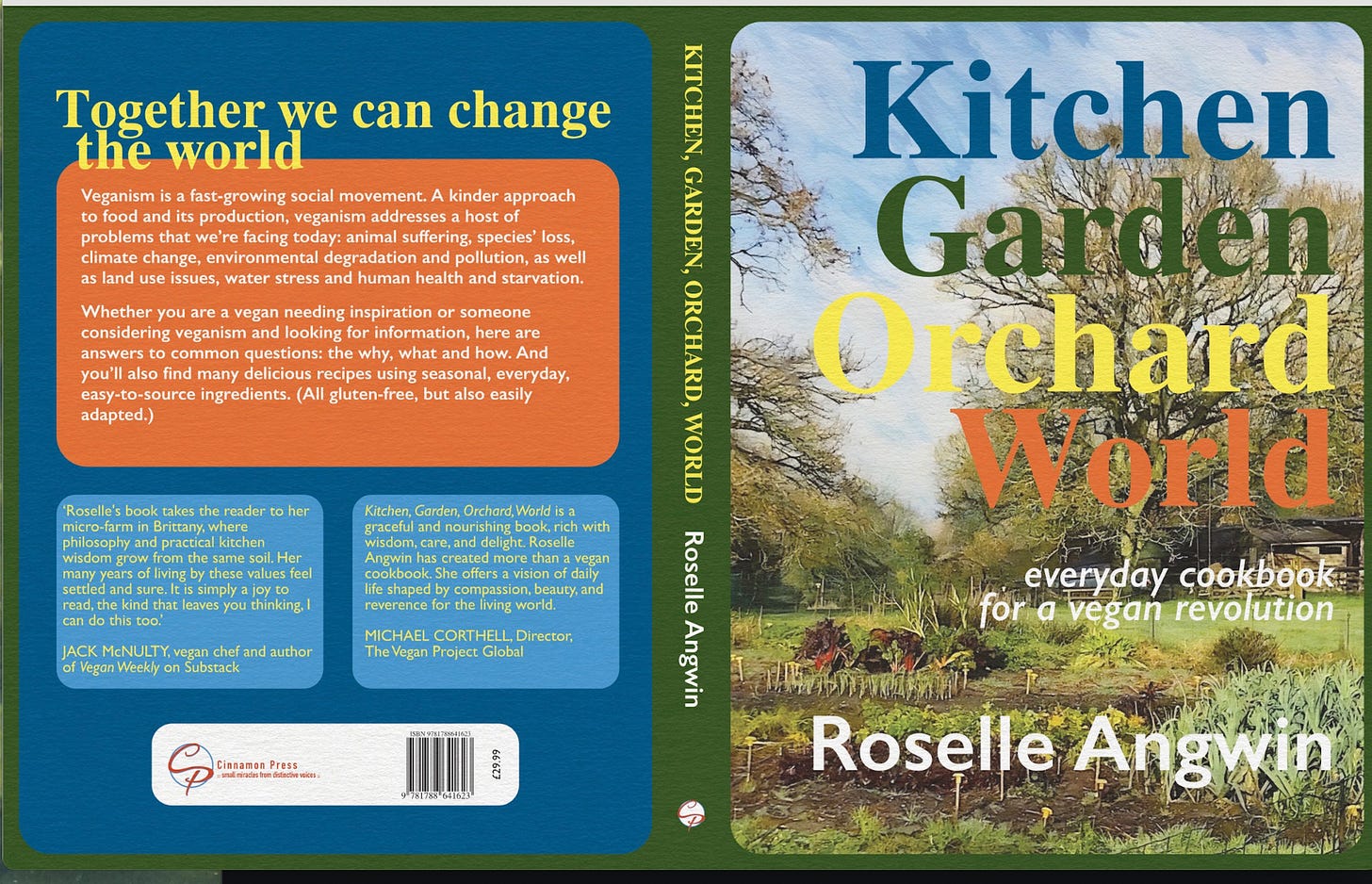
In recent previous posts I’ve spoken of what we as individuals can do to conserve water. I speak more of all these things in my forthcoming book, which is basically an ethical approach to what we consume: one of the biggest things we can do is reduce our meat and dairy consumption.
I’ve just had one of those moments that are stellar in the life of a writer: I now have my author’s copy of said book, a couple of months early, in my hands, and I’m so proud and pleased that I want to show everyone. My publishers have made such a beautiful job of it, and I’m personally delighted to be able to find one of my garden recipes through looking in the index, rather than scrabbling around among scraps of paper pushed into a large envelope. Please forgive my showing you the cover again:
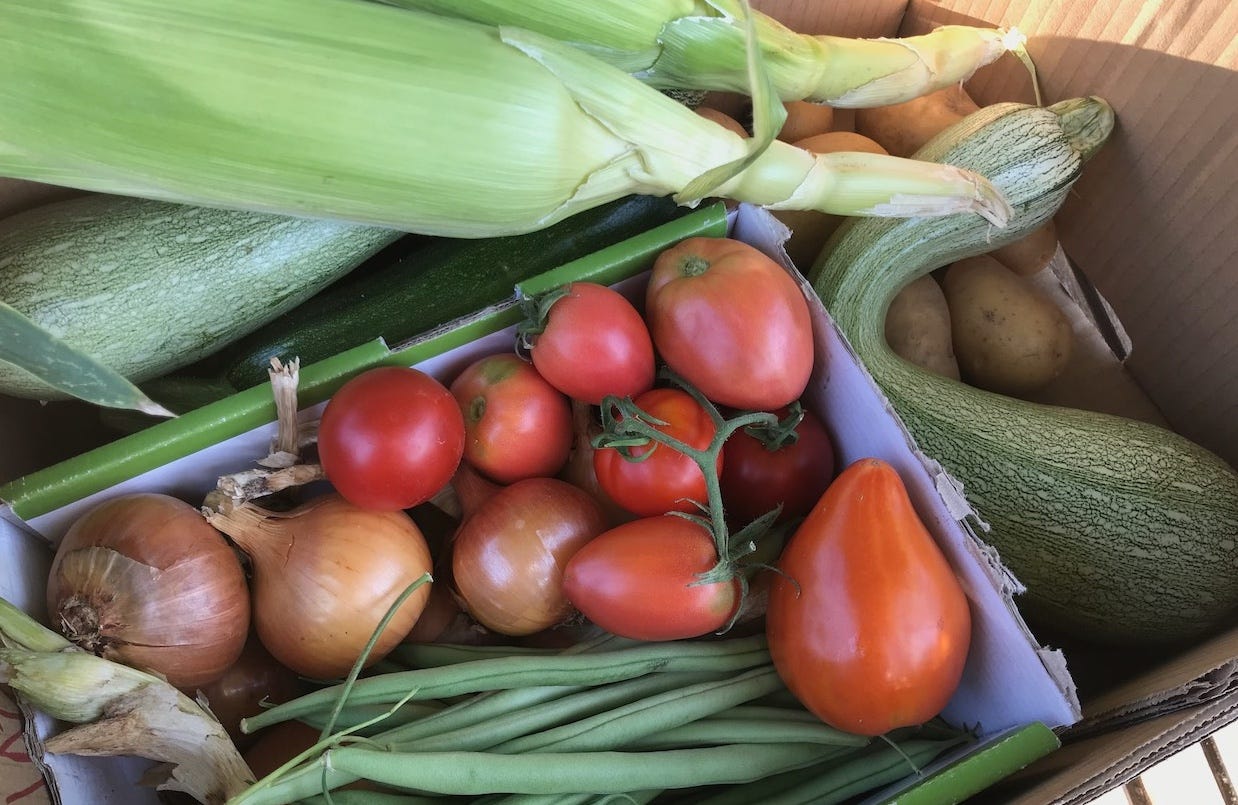
And despite the drought, among the failures in the garden (my salad crops, the lack of germination of celeriac, bulb fennel, green-manure-and-bee-plant-phacelia) and the so-so crops – my red sorrel, so carefully nurtured, so nearly-dead, and the globe artichokes which appeared to die and have then had a resurrection – we are harvesting now: green beans, fat and juicy sweetcorn, tomatoes, our first-ever peppers, potatoes, onions, oh and many many courgettes. On the other hand, our strawberries have really not liked the sun, and our beans seemed to stop flowering for a while in these hot temperatures.
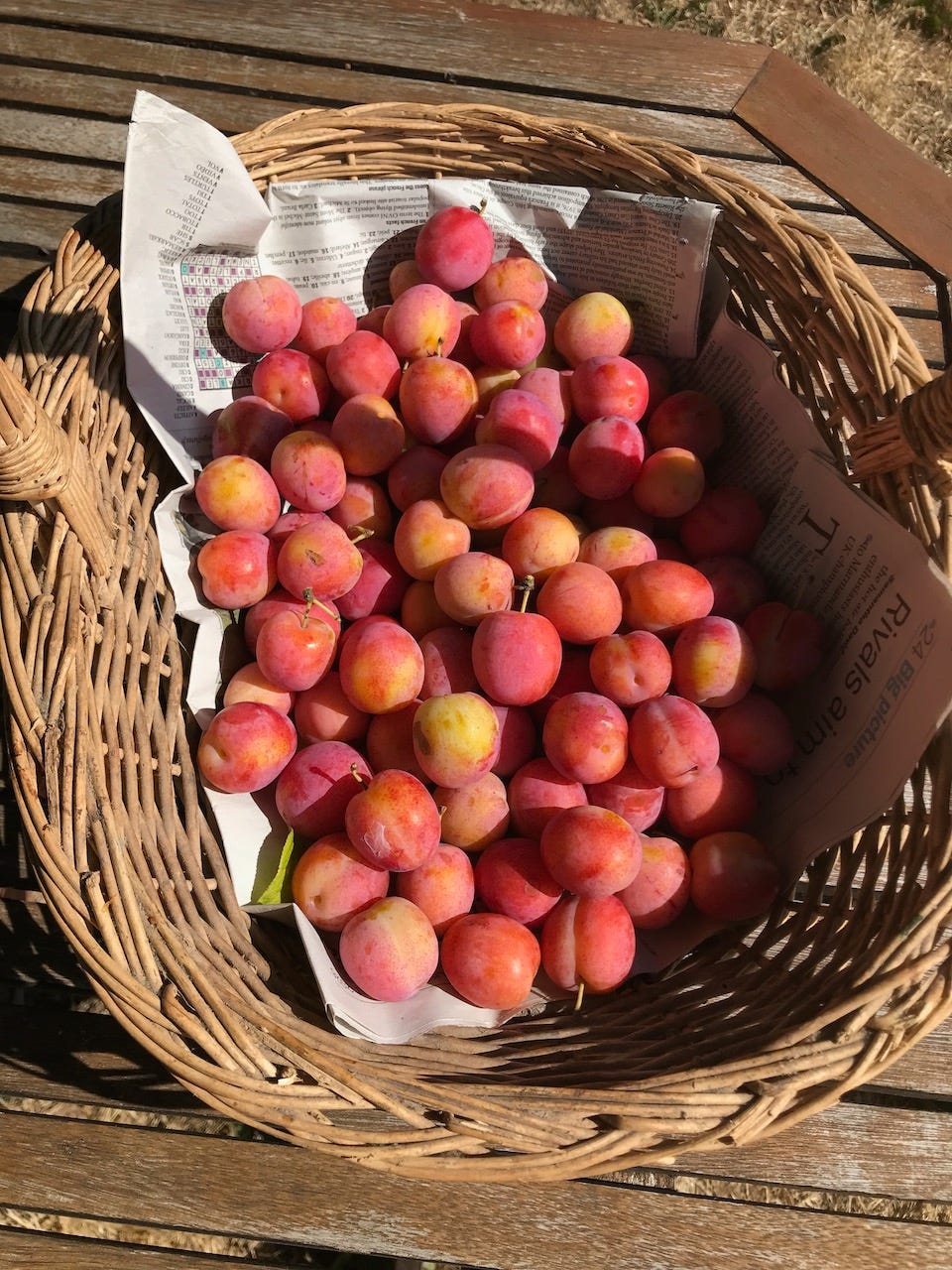
We’ve had the first crop of RED mirabelles (top photo) from our little forest-garden tree – my favourite fruit; in the couple of years they’ve fruited, they’ve been golden, and lovely; but not ripe and beautiful like these. I’ve a load tucked away in the freezer, stoned and ready to make into a crumble – a bit of sunshine in the winter, when we might actually appreciate that.
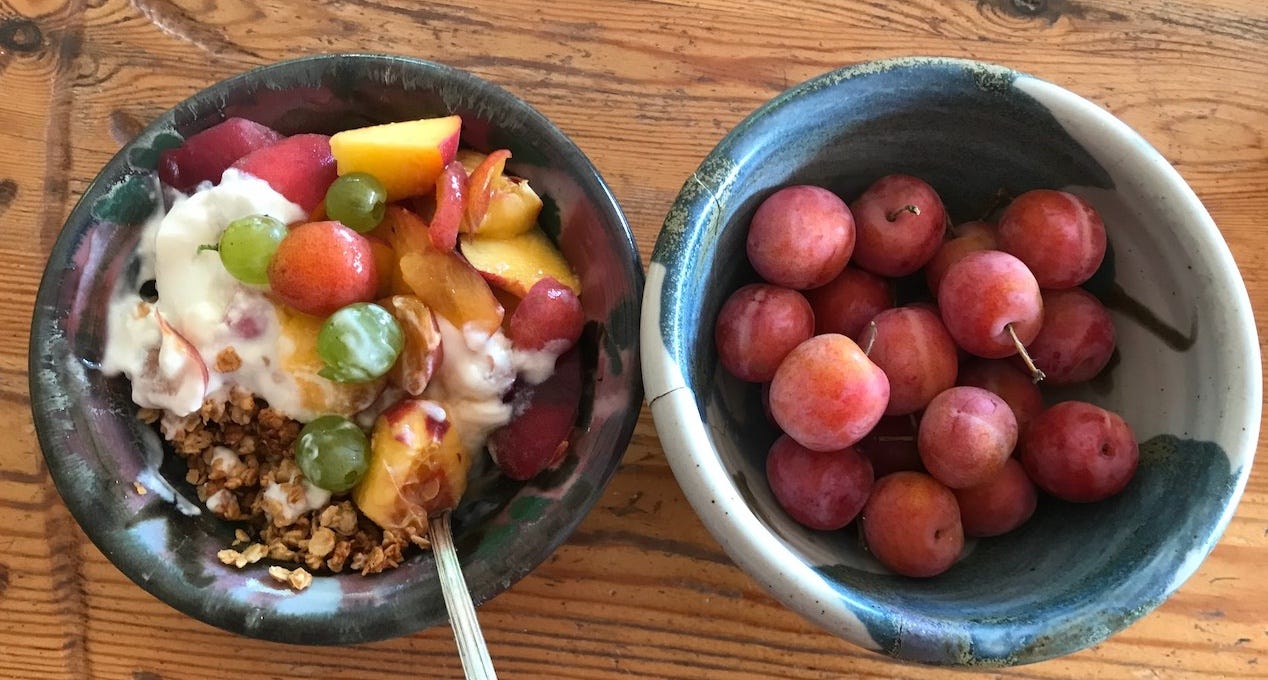
The mirabelles, accompanied by our neighbours’ grapes and the last of our last-year’s peach harvest (frozen and stewed), have been wonderful with my home-made granola.
Recipe
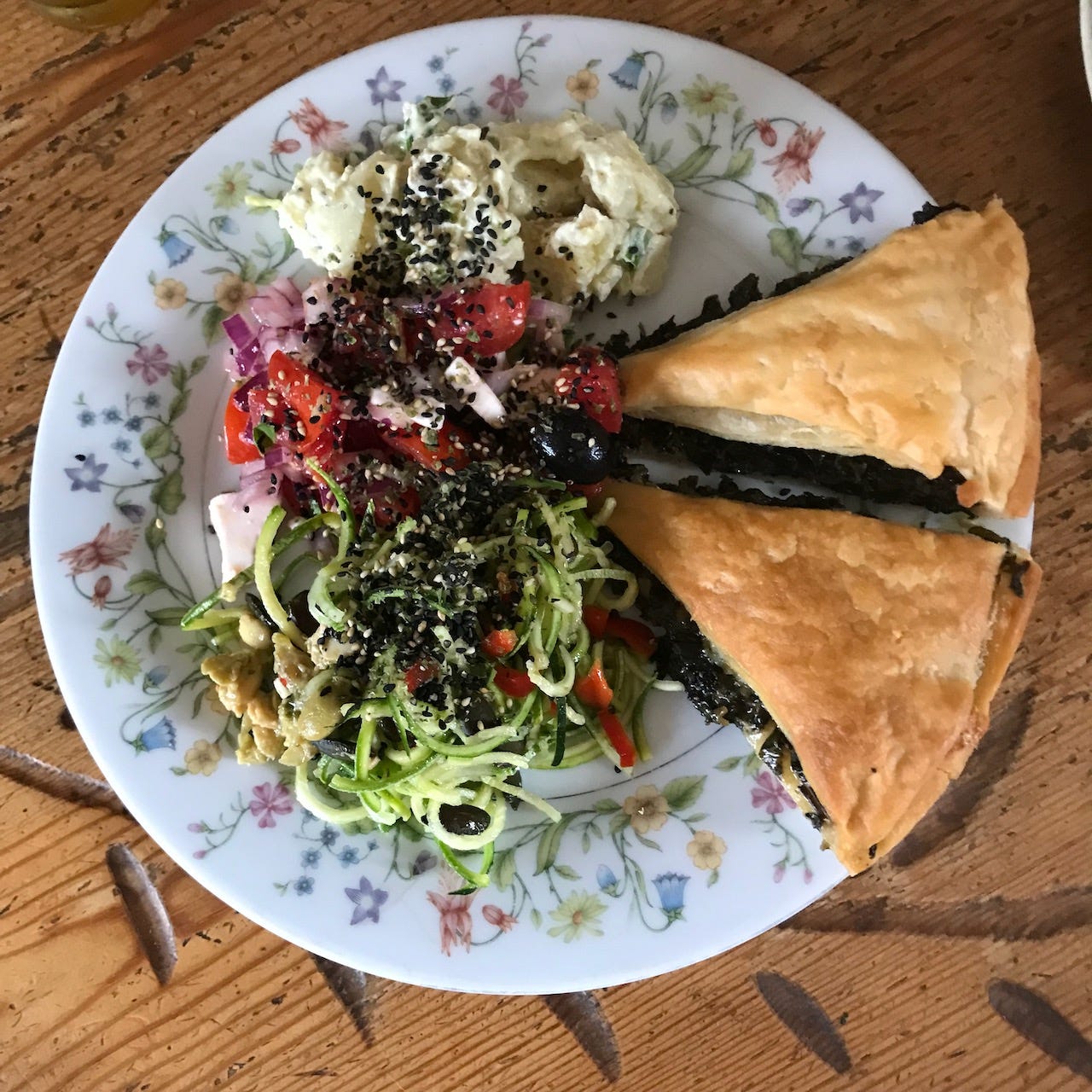
Here is a sort-of recipe for you. I seem to enjoy every excuse to make this combination: it’s my plat-de-l’été, or plat estivale.
The pie, which is, I think, spectacular, is not my own, which is why I can boast about it, though my vegan version is. It’s a Riverford recipe for something much more sophisticated. In season I use wild garlic; out of wild garlic season I use spinach or chard, wilted for a few minutes in boiling water, then cooled quickly and squeezed very well and chopped finely. The cheese I use is a Violife ‘feta’. I buy the puff pastry – vegan and also gluten-free, as one of the neighbours I make this for is coeliac. As you can see, I don’t do the fancy cheese-straw twists that Riverford does.
The courgette salad is (in this case spiralised) ribbons of courgette with cooked beans (I use our frozen flageolets but you could use any, including chickpeas). I chop in fresh herbs, notably oregano and mint, and dress it lightly with lemon juice, seasoning and a little olive oil. Sometimes I add finely chopped spring onions, or chives. Broken walnuts are lovely – we have just a few left from last year’s harvest.
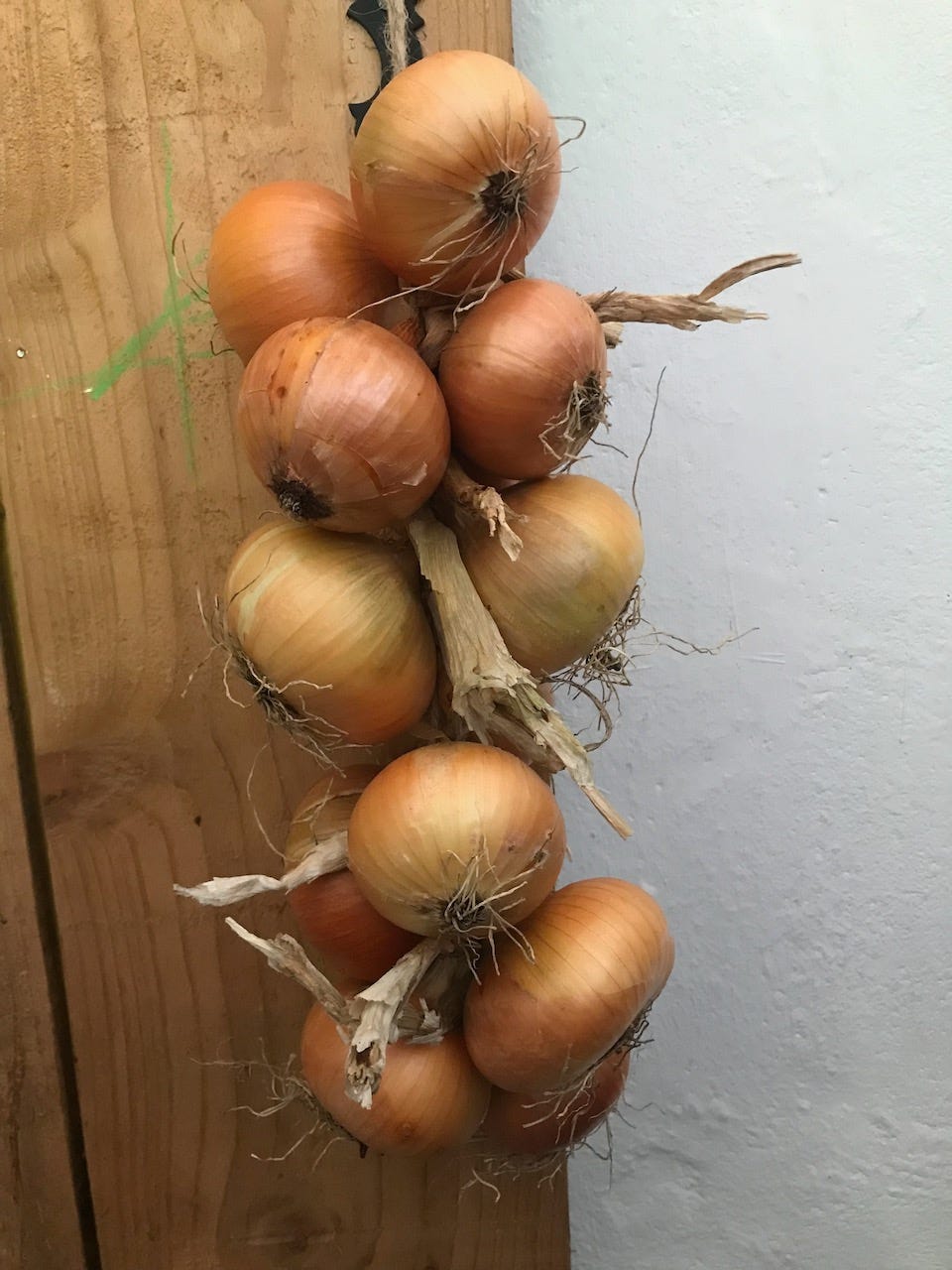
The potato salad incorporates quite a lot of onion, chopped, and a vegan mayonnaise (recipe below*). Sometimes I include sunflower seeds, chopped nuts, or green olives.
The Greek salad uses lots of really ripe tomatoes, with thin slices of red onions, black olives and ‘feta’, with basil leaves and olive oil; a squeeze of lemon is optional.
The plate in the photo above is sprinkled with black sesame seeds and seaweed, highly nutritious additions.
*Vegan mayo
60 mls plant milk (I’ve only tried soya; make sure it’s unsweetened)
1-2 tsps lemon juice (to taste)
1 tsp cider vinegar
1 tsp Dijon or grainy mustard
salt & pepper to taste
1 clove garlic (optional)
parsley (optional)
120-140 mls light sunflower oil (start with 120 mls until you see how thick it is)
Put everything except the oil into a measuring jug and use a stick blender. Blend and then add 120 ml oil, a little at a time, blending all the time. If it’s too thin, add the rest of the oil. Be careful to stop blending once it’s mixed and thick, or it may revert to thinness again.
This is about the only time I wouldn’t use cold-pressed oil, as its taste is a bit strong. I do use organic, though, for all the usual reasons. Sometimes I make a dressing for eg potato salad or coleslaw with half and half mayo and plant yogurt (unsweetened).
The tithe
I love the principle of giving one-tenth of one’s income, or one’s produce or creations, onwards. In the past it was a compulsory tax, usually contributed to the church or state, or lord of the manor. Now, it’s voluntary, and more usually cash or online donations to charities.
For us, it’s also what we sacrifice to the other-than-human lives. Mostly we have no choice in it: all of the mown or worked bits of the Home Meadow are riddled with mole, mouse or vole holes, and sometimes the inhabitants seriously affect our crops, especially at times like broad bean sowing, where we might lose 3 or more sowings and resowings of 150 beans. It’s infuriating at times, but also we humans have taken SO much of the land needed by our other-than-human kin that I can’t resent it.
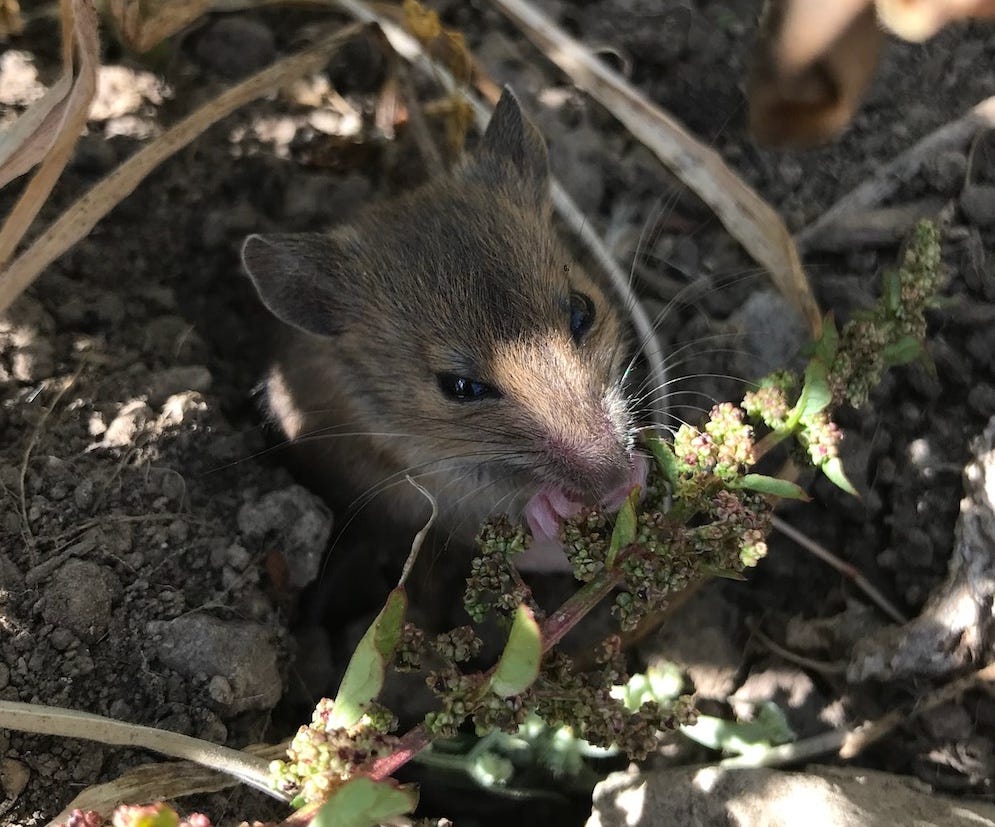
And when you come upon a tiny mouse, really tiny, the length of your thumb with its tail included in that, who continues to eat the minute sorrel seeds on a really thin and small weedy bit of sorrel with you a few inches away talking to your partner and taking photos, unaware as yet that humans mean trouble, of course you stop digging short of its nesting hole, even though that means leaving a few potatoes behind.
Thanks for reading In the Beautiful Middles of Nowhere: Roselle’s Substack 1! This post is public so feel free to share it.
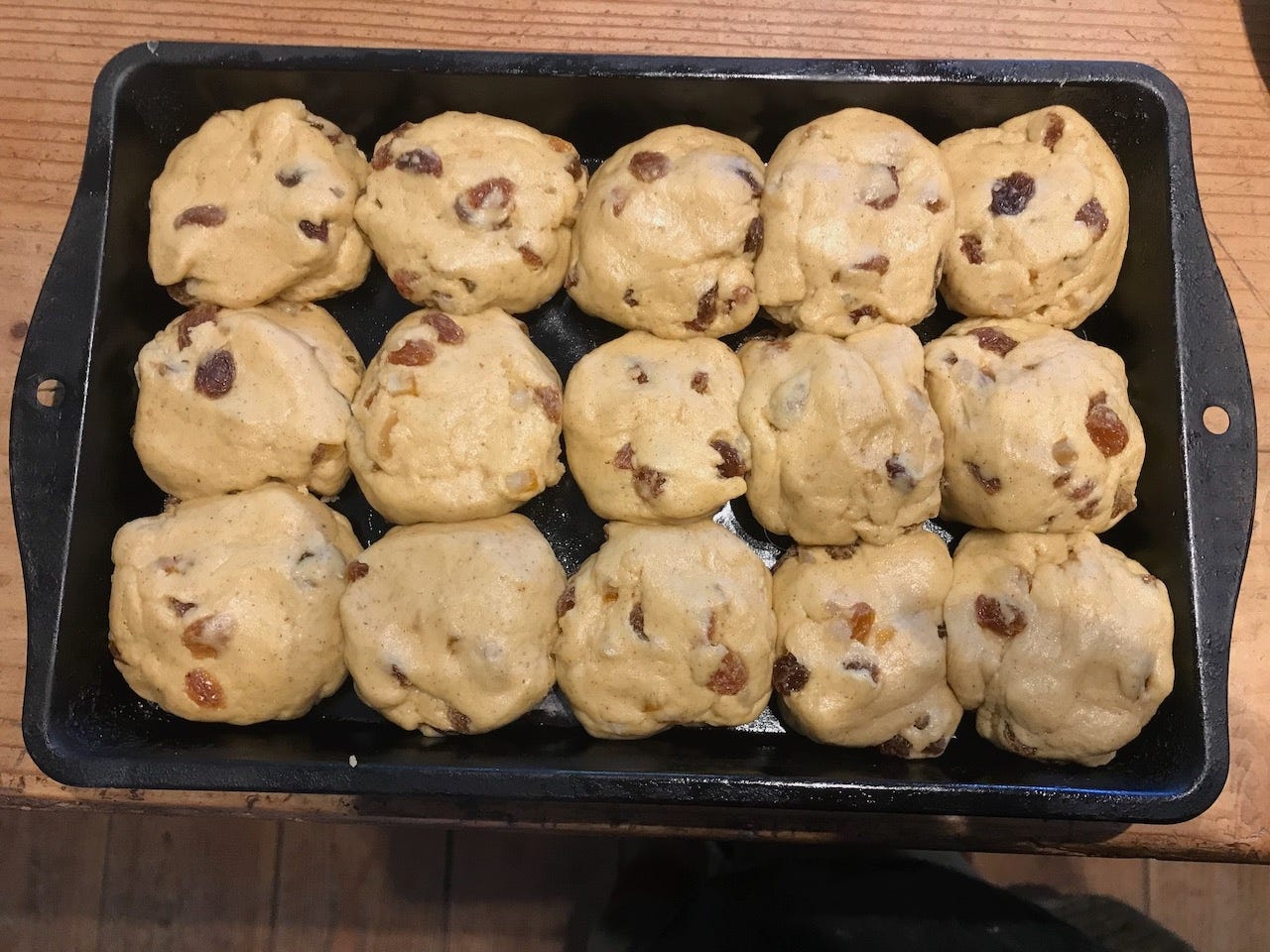
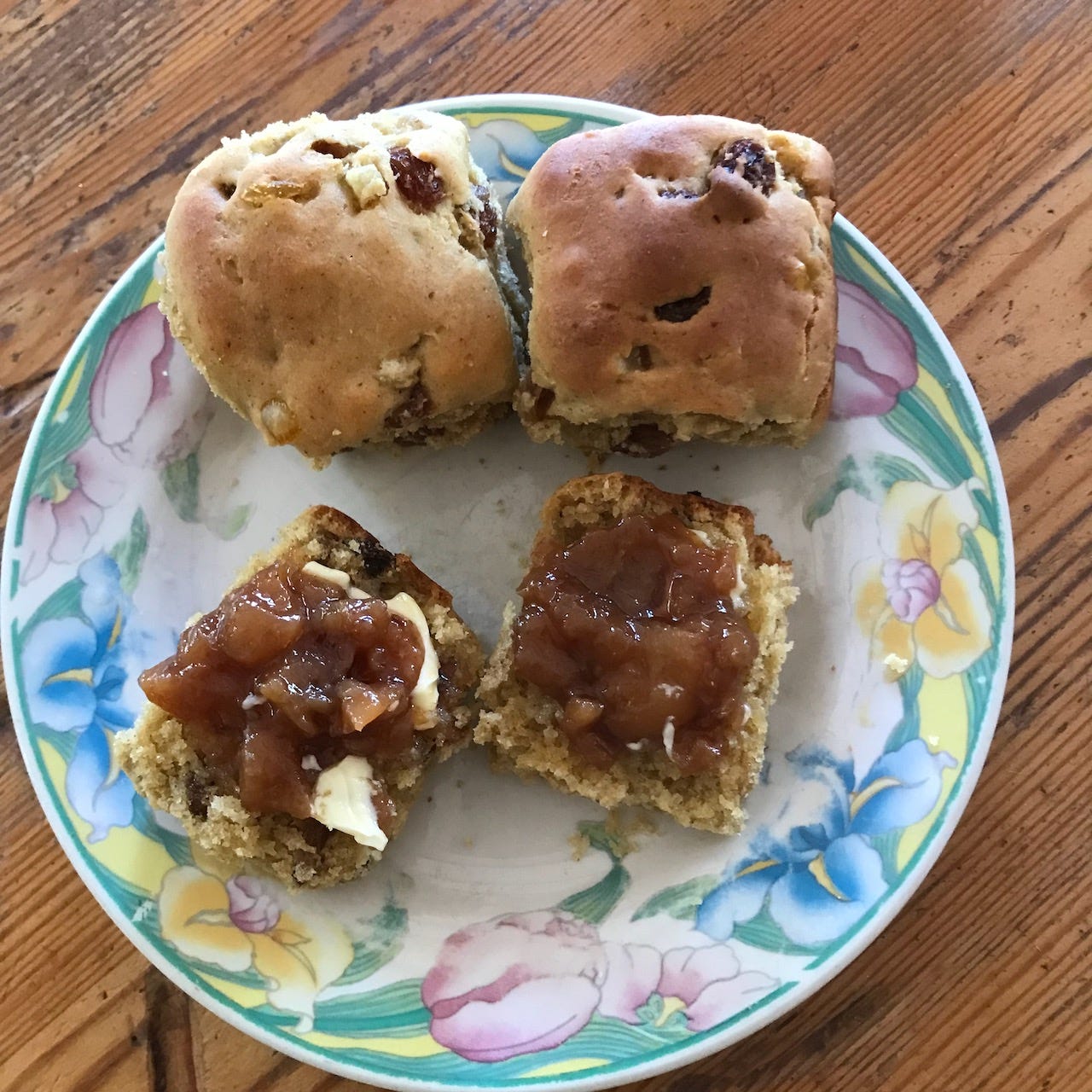
A first attempt to recreate the saffron buns of my childhood (but vegan). The dough felt lovely to knead, and they rose beautifully. But what they actually made was scones, and not very yellow at that. Acceptable though with some peach jam made with last year’s fruit from the tree by the kitchen door, as in the photo below. Not nearly as good, though, even I have to admit, without Cornish clotted cream. No, I wouldn’t. But… I did tithe quite a lot of them to TM, however.
No posts
Comments
Nothing yet. Say the first thing.
Sign in to join the conversation.