
Born on 15 August 1872 in Calcutta, Aurobindo Ghose would become, in the course of seventy-eight years, a poet, scholar, nationalist, political thinker, revolutionary, philosopher and yogi. But to describe him by any one of these identities is to diminish the extraordinary arc of his life. His journey was, ultimately, a search for freedom- not merely the freedom of a nation from foreign rule, but the freedom of the human being from limitation.
At the age of seven, Aurobindo was sent to England. He spent fourteen formative years there, studying at St Paul’s School in London and later at King’s College, Cambridge. He mastered the classical languages and absorbed European literature, history and political thought. He even qualified through the competitive examination for the Indian Civil Service. Yet, in a curious early indication of the direction his life would take, he did not enter the Service. He returned to India in 1893.
India, for the young Aurobindo, was not simply the country of his birth. It was a civilisation waiting to be rediscovered.
For thirteen years in Baroda, he worked in the service of the Maharaja and taught at Baroda College. It was there that he began the profound intellectual rediscovery of India: its Sanskrit literature, the Vedas, the Upanishads, the Bhagavad Gita, its history and its spiritual traditions. At the same time, he became increasingly convinced that India could not truly awaken without political freedom.
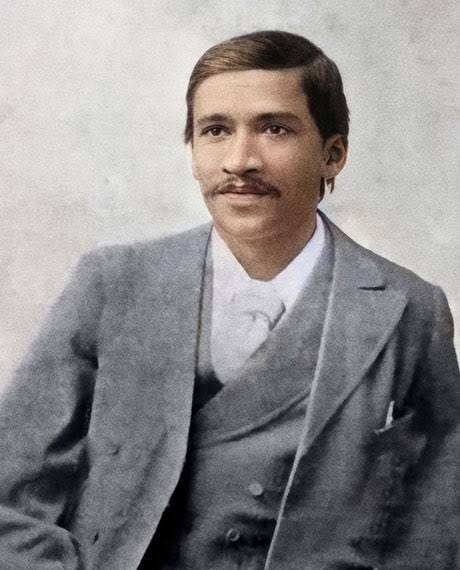
When Bengal was partitioned in 1905, Sri Aurobindo emerged into the centre of India’s nationalist movement.
He came to Calcutta in 1906 and entered politics with an extraordinary clarity of purpose. At a time when many leaders were still seeking greater constitutional concessions from the British, Aurobindo openly articulated a more radical objective: complete independence for India. The idea that India should not merely seek reform but should become free was still revolutionary. Through his writing, speeches and political work, he helped give that aspiration intellectual force.
There was something remarkable about the young Aurobindo. He possessed the intellectual training of the West but was increasingly drawing his deepest inspiration from India. He could write with the precision of a European scholar while thinking in the categories of the Gita and the Upanishads.
His nationalism was therefore not merely territorial. He began to see the nation as a spiritual reality. At the heart of this awakening stood two words that would become a cry of India’s freedom struggle: Vande Mataram
The words came from Sh Bankim Chandra Chattopadhyay, who was trying to recover a conception of India from Indian History, Sanskrit Literature, Hindu philosophical thought, Bengali cultural memory and the landscape of Bengal. We saw the full rendering of the song at Red Fort today.
For Sri Aurobindo, to say Vande Mataram was to recognise the motherland not simply as land, territory or political possession, but as a living presence worthy of devotion. His writings helped transform the phrase into one of the great expressions of India’s nationalist awakening. His association with the newspaper Bande Mataram and his advocacy of complete independence made him one of the most influential voices of the nationalist movement between 1905 and 1910.
In May 1908, Sri Aurobindo was arrested in connection with the Alipore Bomb Case. He spent nearly a year in prison. It was here, in confinement, that Sri Aurobindo underwent a profound spiritual transformation. The prison that was intended to isolate him became, paradoxically, a place of inner expansion.
Sri Aurobindo later described how the Bhagavad Gita and the Upanishads became sources of guidance during his imprisonment. His experience of Yoga deepened, and his understanding of India’s freedom began to acquire an altogether different dimension.
When he emerged from prison, he was no longer simply the political nationalist who had entered the struggle two years earlier. He had begun to see politics itself as part of a larger evolution of human consciousness.
In 1910, Sri Aurobindo withdrew from active politics and travelled to Pondicherry. To some, this appeared to be a retreat from the freedom struggle. In reality, it was the beginning of the second great movement of his life.
In Pondicherry, he devoted himself almost entirely to Yoga, philosophy and writing. His spiritual practice evolved into what he called Integral Yoga- a path not merely aimed at escaping the world, but at transforming human consciousness and life itself.
Between 1914 and 1921, through the journal Arya, he developed the philosophical foundations of this vision. Works such as The Life Divine, The Synthesis of Yoga, Essays on the Gita, The Human Cycle, The Ideal of Human Unity and The Foundations of Indian Culture emerged from this extraordinary period of intellectual and spiritual creativity.
Humanity, he believed, was not a finished species. Consciousness was evolving. The future of humanity lay not merely in greater technological power, political organisation or material prosperity, but in the possibility of a higher consciousness transforming human life.
In 1926, together with the Mother, he founded what became the Sri Aurobindo Ashram. What began as a small community gradually grew around his spiritual work.
And yet the nationalist never disappeared entirely.
Sri Aurobindo continued to think deeply about India’s destiny. His nationalism had expanded into something universal. India, in his vision, had a role not simply in becoming free for herself, but in offering something to the future of humanity.
“India has always existed for humanity and not for herself, and it is for humanity and not for herself that she must be great. She is rising to shed over the world the eternal light entrusted on her.”
- Sri Aurobindo, Uttarpara Speech, 1909
Watch the 49 min film on Sri Aurobindo’s Life here
No posts
Comments
Nothing yet. Say the first thing.
Sign in to join the conversation.