
Dear Roots Africa Champion,
As you know, at Roots Africa, every year has a theme.
This year has a direction.
We are opening this fiscal year with a clear and intentional focus: Ownership.
Ownership by changemakers.
Ownership by communities.
Ownership of enterprises, ideas, innovations, and value chains.
This shift is not cosmetic. It is structural. It is philosophical. And it is necessary.
To mark this transition, we are sharing footage from first ever impact trip to Liberia from over a decade ago, with the Roots Africa Student club from the University of Maryland, where it all started. These moments capture the energy, ambition, and readiness of communities and changemakers who were prepared to lead and have gone ahead to do that and so much more. Over a decade later, we are here!
This year, we will document more of these stories. Not as success stories of Roots Africa, but as proof of what happens when ownership is transferred.
For years, Roots Africa has worked alongside farming communities and young change agents across Africa to address hunger and poverty through resilient agriculture and entrepreneurship. We built programs. We trained leaders. We deployed resources. We walked closely with communities as they tested ideas, failed forward, adapted, and grew.
Today, something different is happening.
Communities are no longer waiting for programs.
Changemakers are no longer waiting for permission.
Young people are no longer asking how to survive. They are asking how to build.This is what passing the walkaway test looks like.
The true measure of impact is not how long an organization stays involved. It is whether progress continues when the organization steps back.
We call this the Walkaway Test.
If Roots Africa were to walk away tomorrow:
Would the community still function?
Would enterprises still operate?
Would solutions still scale?
Would innovation continue?
In more and more places, the answer is yes.
That is not an accident. It is the result of a deliberate model that prioritizes community leadership, local innovation, and economic ownership over dependency.
This year, we are making that shift visible.
The first story we are sharing this year comes from a community in Uganda where our transformation model is no longer theoretical. It is lived.
In this community, changemakers are owning their process. Farmers are moving from subsistence to commercial farming. Solutions are being designed, implemented, and improved locally.
Roots Africa is no longer leading. We are advising. This is the future of sustainable development. Communities that own their solutions can defend, adapt, and scale them. This is not disengagement. This is maturation.
A core shift this year is how we think about changemakers.
Changemakers are not volunteers filling gaps.
They are entrepreneurs building systems.
They are producers creating value, not consumers receiving aid.
We believe that training farmers is not charity. It is a business.
We believe that extension services can be enterprises.
We believe that solving local problems should generate local wealth.
When young people own enterprises, they do not just solve problems. They create jobs. They build ecosystems. They shape markets.
One of the clearest examples of this shift is Apuuli Bazira Nyowe, our in-country coordinator for Uganda, who started as a Changemaker and has launched his own independent enterprise.
Through the ABAMU AGRIPRENEURS UGANDA LIMITED, Apuuli is building solutions that are locally rooted, institutionally credible, and community-led. Roots Africa did not launch this enterprise; a changemaker did.
This is the direction we are moving toward, supporting founders, not running programs for them.
As communities and changemakers step forward, Roots Africa is stepping sideways.
Our role this year is shifting:
From implementer to advisor
From operator to institutional backbone
From program manager to ecosystem builder
We will continue to provide:
Technical guidance
Monitoring and evaluation support
Global networks
Institutional credibility
But implementation must be the responsibility of the people closest to the problem.
This is how scale happens as Roots Africa becomes:
A convenor
A validator
A platform that brings alumni communities together
Our BootCamps, Trainings, Campus Tour, Symposium, Pitch Events, and Conferences become where: Communities return, share, & cross-pollinate, and Ownership is celebrated
Roots Africa stops being the engine, but remains the map, the archive, and the marketplace.
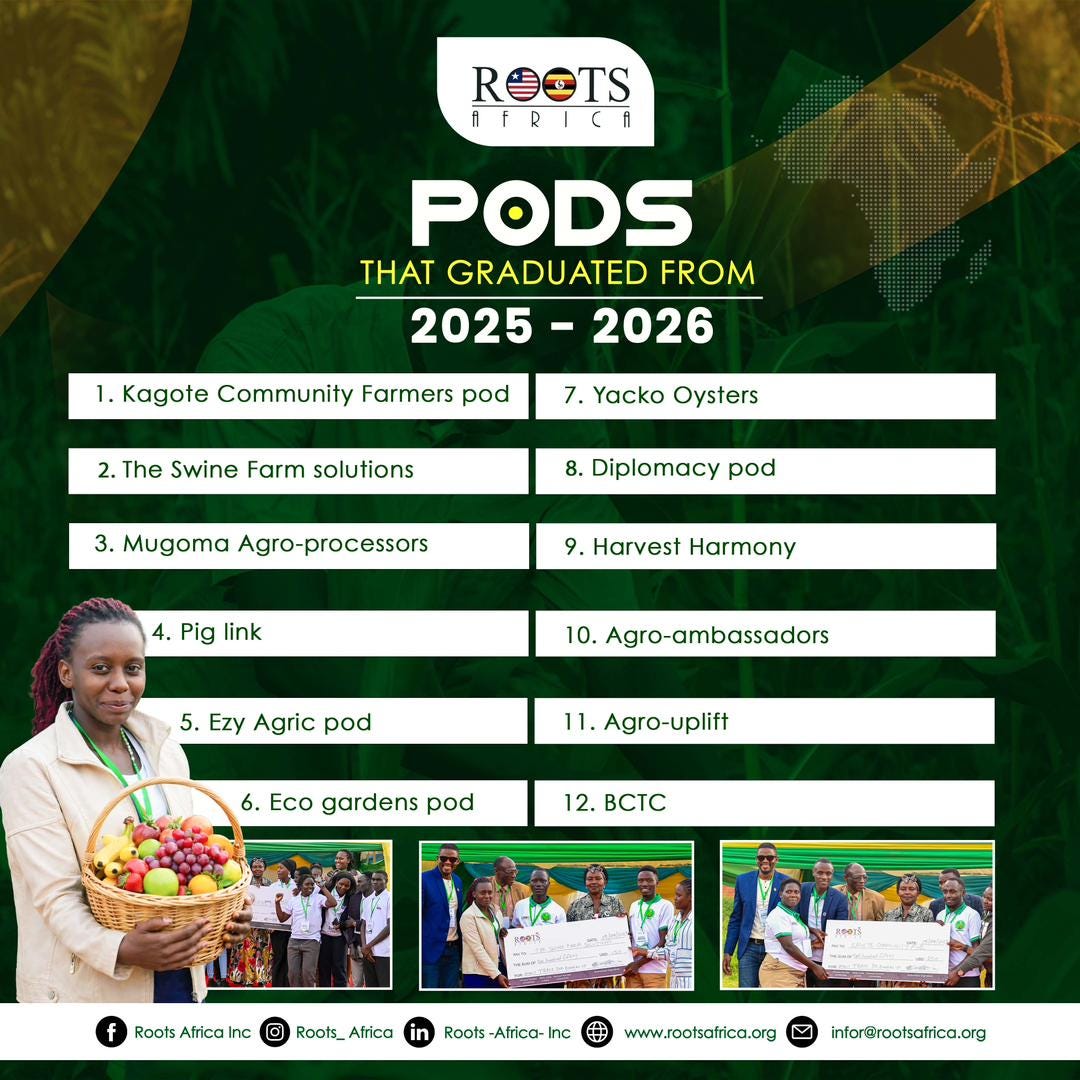
This year also marks a major milestone in our changemaker journey.
As part of our commitment to ownership, sustainability, and enterprise-led impact, we are proud to recognize the pods that have successfully graduated and been selected to continue with the Roots Africa Changemakers Program Cohort 6 (2026).
These pods are no longer operating as early-stage projects. They are evolving into independent business enterprises with clear community impact, revenue pathways, and leadership structures.
Through consistent mentorship, responsible use of loan and grant support, and strong performance across reports, assessments, and monitoring and evaluation tools, these pods have demonstrated readiness for the next level of growth.
They represent what it looks like when:
Training becomes an enterprise
Projects become systems
Support becomes ownership
Each of these pods is now focused on:
Deepening community impact
Strengthening enterprise operations
Advancing toward long-term independence
We will continue to support these pods through strategic guidance, institutional backing, and visibility, while allowing leadership, innovation, and execution to remain firmly in the hands of the changemakers themselves.
This transition is not an exit.
It is an evolution.
And it is exactly what sustainable change is supposed to look like
As communities take ownership, a new question emerges:
What if young people did not have to choose survival over potential?
Too often, talented young people graduate into urgency. They take any job they can find. Not because it is aligned with their skills or vision, but because survival demands it.
We believe there is another path.
A future where young people have access to:
Seed capital
Patient capital
Hedge-style funding with strong institutional backing
Not to survive, but to experiment.
Not to consume, but to create.
Not to wait, but to build.
As Roots Africa evolves, we are exploring models that move beyond programming into capital deployment. Structures that allow young people to test ideas, build enterprises, and solve global problems with local solutions without being crushed by immediate economic pressure.
This is how innovation is unlocked.
We are opening this year with clarity and conviction.
Community ownership is the goal.
Entrepreneurship is the vehicle.
Young people are the solution.
Watch the stories. Share the vision. Build with us.
Thank you for engaging with us.
Yours sincerely,
No posts
Comments
Nothing yet. Say the first thing.
Sign in to join the conversation.