

A few names come up when we try to choose one person as the founder of surgery.
For the founder of modern surgery, some people pick Joseph Lister, who in the 1860s built upon the newly described germ theory and then developed and popularized the practice of sterilizing wounds and surgical instruments.
John Hunter, a British surgeon who lived in the century prior to Jospeh Lister, is referred to as the “father of scientific surgery” for demanding that the surgical field to adhere to the scientific process of experimentation and anatomical study.
The one person who generally comes up as the “founder of operative surgery” predated both Lister and Hunter by more than a few years.
This surgeon’s treatise called “On Surgery and Instruments” describes operative procedures and instruments which he either developed himself or preserved and promoted through his documentation. So influential was this text that for centuries after it was written, “On Surgery and Instruments” was reproduced, studied, and held in high regard.
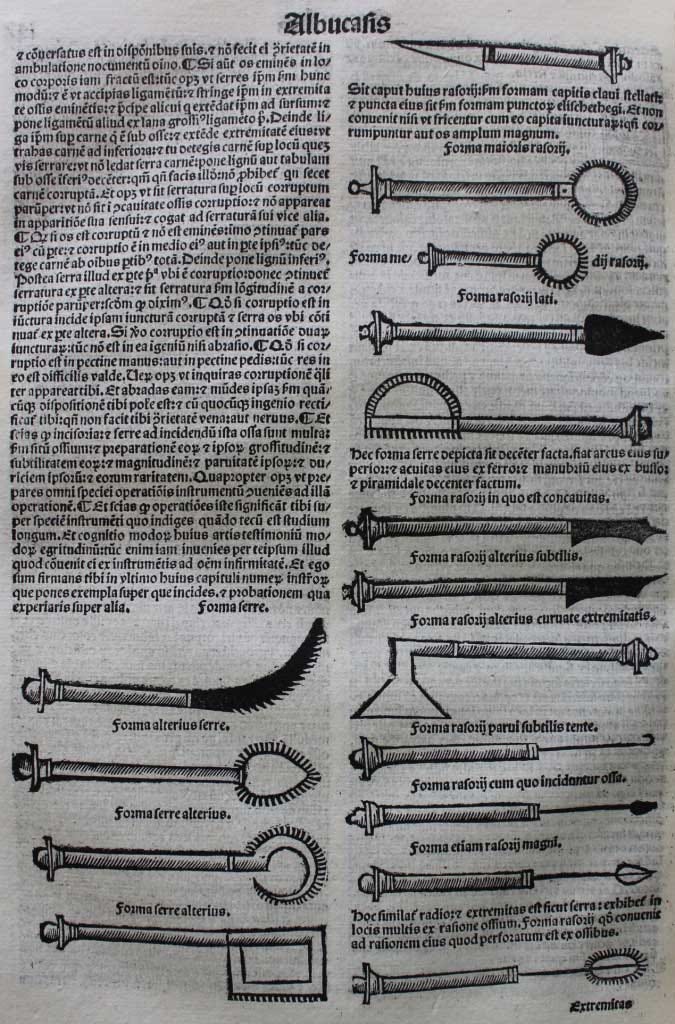
So it was with some confusion that I read the author’s introduction. Expecting to find an admiration for the surgical arts, I read the exact opposite.
Instead of praise for the surgical profession and for its impact on improving the lives of the afflicted, the “founder of operative surgery” leads with disaster.
A quick reading of the introduction of the text feels like a cautionary tale against surgical intervention.
From our wise sage:
”The skilled practitioner of operative surgery is totally lacking in our land and time; so that the knowledge of it is on the point of being blotted out and its remains lost.”
“I saw an ignorant doctor incise a scrofulous
tumor in a woman‘s neck; and he cut certain arteries in the neck so that the woman bled until she fell dead before him.““I saw another doctor presume to take out a [bladder] stone from a man of advanced age. He rushed blindly at the task and extracted the stone and with it a piece of the bladder itself; and the man was dead in about three days.”
Not content to end the brief introduction with these cautionary tales, the founder of operative surgery then reports the case of a patient with an open fracture. It was treated incorrectly and the person died of fatal gangrene. And if this wasn’t enough to scare the reader from wanting to perform surgery, for good measure we read of a doctor cutting into a tumor leading to nothing but misery for the patient.
The author was emphatic, almost desperate in his warnings. Who was this man?
In medieval Europe he was known by a Latinized name, Albucasis, which was easier for Europeans than his full name, Abu al-Qasim Khalaf ibn al-Abbas Al-Zahrawi.
Thanks for reading Think like a surgeon! This post is public so feel free to share it.

Al-Zahrawi lived in Andalusia in southern Spain from about 936 to 1013. Over his lifetime he wrote thirty texts on the practice of medicine, with the final volume devoted to surgery. His writings survived until modern times given his influence among physicians in the Islamic world and beyond. In addition to manuscript copies in Arabic, his texts were translated into Latin in the 12th century allowing his knowledge to spread among European surgeons. We find praise for Al-Zahrawi (Albucasis) in manuscripts from famed surgeons of the 13th and 14th centuries, and translations of his work were made for several centuries.
More modern translations into French in the 18th century and in 1973 an English translation including hand-copied drawings of his surgical instruments keep Al-Zahrawi’s principles alive.
Why the continued translations of his work? Surgeons today won’t follow his instructions for treating hoarseness and constriction of breath in Chapter Twenty-Three. His solution is to cauterize, i.e, burn the skin at the root of the throat. “Take care that the cautery does not pierce through to the gullet, and burn no more than half the thickness of the skin.”
Well we certainly aren’t going to utilize that “treatment” or other antiquated remedies. So why do we revere Al-Zahrawi? I think the answer is found in his introduction to “On Surgery and Instruments.”
It has to do with the reason he opens his masterpiece with warnings instead of instructions.
He warns against taking cases which are incurable but for which the afflicted are offering great wealth. He writes, “let your caution be stronger than your greed and desire for gain.”
Furthermore,
”Purify yourselves of anything which you fear may cause doubt as to your religious life and your secular life; for this will perpetuate your good name and will elevate your fortunes in this world and the next.”
At the base of Al-Zahrawi’s prudence is a moral foundation.
For him, being a surgeon meant adhering to a certain code. The same foundation and ensuing principles could be found in any craftsman or business owner of note. Anyone who knows of the legendary watchmaker, Roger Smith, or renowned sushi Jiro Ono, recognizes their moral foundation.
Roger Smith speaks of discarding components worked on for weeks if they aren’t perfect.
Jiro says that before you learn to cut fish, you must learn patience.
The prescription for good judgement is the same for a surgeon, a watchmaker, or a sushi chef. Al-Zahrawi had the insight to recognize first principle thinking and morality and bring it to his work as a surgeon.
Why does his writing survive one thousand years later? Is it because of the surgical advice? Or the moral lessons?
The lesson from Al-Zahrawi and other great craftspeople is that all professionalism rests on a moral foundation.
Lead with restraint not action.
No posts
Comments
Nothing yet. Say the first thing.
Sign in to join the conversation.