
Today’s Americans who lived through the Covid pandemic may never agree on how the virus originated, how many lives the Covid vaccines saved, or whether mandated lockdowns were worth the economic and social cost.
Unlike the 9/11 terrorist attacks and the 1986 Challenger space shuttle disaster which were investigated by independent commissions, Congress chose to investigate the Covid pandemic itself. The results were predictably partisan. On December 14, 2022, the Democratic-led House select subcommittee ended its investigation blaming, in large part, the “Trump administration's failed leadership.” Two years later, on December 2, 2024, the same subcommittee, now Republican-led, ended its investigation blaming, in the words of its press release, "high-level corruption in America's public health system." In July, Senator Rand Paul, chairman of the Senate Homeland Security and Governmental Affairs Committee, pilloried Dr. Anthony Fauci on national television and later berated Fauci on social media: "One million Americans died from COVID and not even an apology from Dr. Anthony Fauci. Sickening."
As a consequence, Americans have largely drawn their opinions regarding the Covid pandemic based on their political affiliation. But there is a better approach thanks to President Trump. Although Trump, characteristically, had earlier claimed to be the ultimate authority on Covid policy, on April 16, 2020, President Trump told the nation’s governors, “You’re going to call your own shots,” urging the governors to set their own state-level pandemic policies.
Unlike most other countries, the United States’ federalized pandemic response provided fifty different approaches to managing the pandemic. Some policies worked better than others. Yet neither House investigation nor Senator Rand Paul’s Senate investigation seriously analyzed the effect different state policies had on death rates and social disruption. Democrats knew their lockdown policies were unpopular while Republicans didn’t want to confront their states’ high death rates. So, that raises the question Congress has never asked: What actually worked?

So, we’ll ask it.
Let’s start with Senator Rand Paul’s home state, Kentucky. Known for its bourbon and the Kentucky Derby horse race, Kentucky is a beautiful state that is proudly Republican giving 62.1 percent of its vote to Donald Trump in 2020. It’s also a relatively young state whose median age in 2019 was 39.2 years, just slightly older than the 38.4 year national median. Kentucky, though, is unhealthy: nearly 40 percent of its residents are obese, 25 percent are smokers, and the average life expectancy in 2019 was only 75.5 years, well below the 78.8 year national average. With its relatively unhealthy population, Kentucky’s public health system ideally would have encouraged Covid vaccination during the pandemic, but that apparently didn’t happen. Kentucky’s vaccination rate was nearly the lowest in the nation; only 59 percent of the population was vaccinated by the end of 2022.
Maine offers an interesting contrast. Known for its Maine lobsters, rugged Atlantic coastline, and even more rugged fishermen, Maine gave 53 percent of its vote in 2020 to Joe Biden. Maine’s residents are healthier than Kentucky’s, but not by much: 32 percent of the state is obese, 18 percent are smokers and the average lifespan in 2019 was 78.3 years, slightly below the national average. Furthermore, Maine’s population is the nation’s oldest whose median age in 2019 was 45 years. Maine, in contrast to Kentucky, had one of the nation’s highest vaccination rates, 83 percent.
The two states had very different experiences managing the Covid pandemic. By the end of 2022, Kentucky had suffered one of the nation’s highest Covid death rates, 3,940 deaths per million while Maine’s death rate was one of the nation’s lowest, only 2,030 deaths per million.
Maine’s low Covid death rate likely wasn’t a coincidence. Maine’s New England neighbors, New Hampshire and Vermont, also have older populations each with a median age of 43 years. Yet, both states had low Covid death rates, 2,060 and 1,220 deaths per million respectively. (Vermont and Hawaii were virtually tied for the nation’s lowest Covid death rate. Both states had vaccination rates over 80 percent.)
Kentucky’s neighbors were more of a mixed bag. Illinois and Virginia had Covid death rates near or below the 3,200 deaths per million national average. But Indiana, Missouri, Ohio, Tennessee, and West Virginia suffered much higher death rates averaging 3,900 deaths per million across the five states. All five states had vaccination rates at or below 60 percent.
It would be a mistake, though, to attribute the large differences in Covid death rates to vaccination rates alone. Other factors including healthcare access, socioeconomic factors, and public health policies regarding community closures, masks and social distancing also affected death rates.
Most states with high vaccination rates also enforced strict public health policies closing their communities and enforcing mask and social distancing mandates. States which enforced strict public health policies generally took longer to recover from the steep economic declines in 2020 when most states locked down. But somehow Maine, New Hampshire, and Vermont managed to have not only the nation’s lowest Covid death rates but also, as the table below indicates, strong real GDP growth.
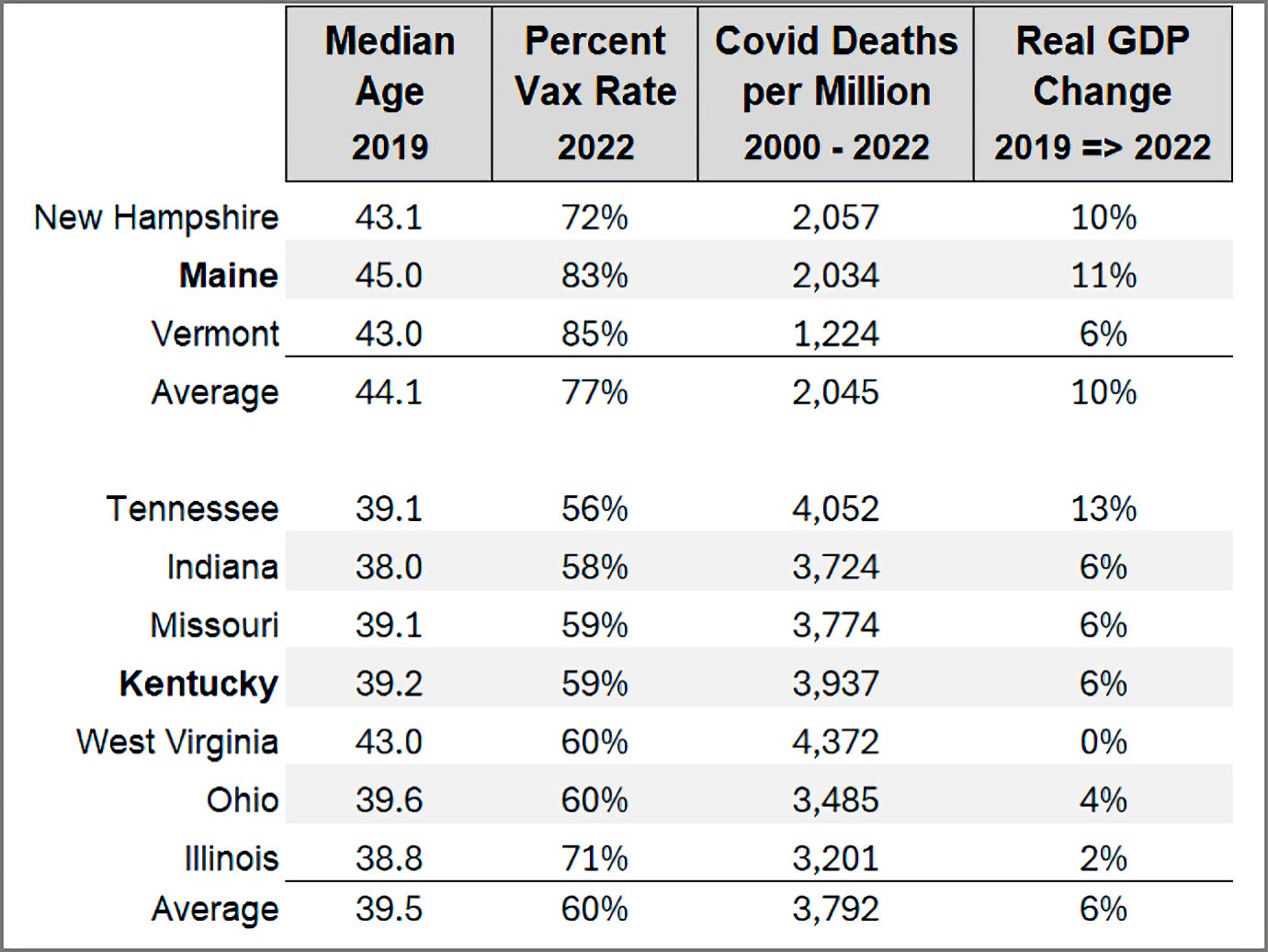
The table (with data drawn from my book, COVID WARS) summarizes our discussion on the ten states. Their selection was arbitrary and not meant to be representative of the nation’s fifty states. Still, it’s remarkable that the three states with the oldest populations also had the nation’s lowest Covid death rates—while maintaining strong economic growth. It’s discouraging, though, that Senator Rand Paul’s home state, as well as its surrounding neighbors, had well above average Covid death rates.
Perhaps the House and Senate should redirect their investigations to a more productive question: How did the three oldest states in America manage to secure the nation's lowest Covid death rates while also maintaining strong economic growth?
No posts
Comments
Nothing yet. Say the first thing.
Sign in to join the conversation.