
Today’s powerful computers were fathered by men such as Charles Babbage, Alan Turing, and John von Neumann; but more than eighty years ago a young Hollywood actress named Hedy Lamarr helped to give birth to today’s cell phone.
In 1941, the United States was reluctantly preparing for war. Radio technology played a crucial role, not only for communicating but also for guiding early radio-controlled weapons. Radio signals, though, could be jammed by the enemy knocking the weapon off course. Hedy Lamarr knew this. In 1937, Hedwig “Hedy” Kiesler was an Austrian actress who had fled both fascist Austria and her husband, Friedrich Mandl, an Austrian arms manufacturer. During her brief marriage, Hedy Kiesler had often heard her husband discuss how vulnerable radio signals were to jamming.

Years later, now a rising Hollywood star named Hedy Lamarr, she would remember those conversations. In 1941, Lamarr and a composer friend, George Antheil, filed a patent application for a “Secret Communication System” which:
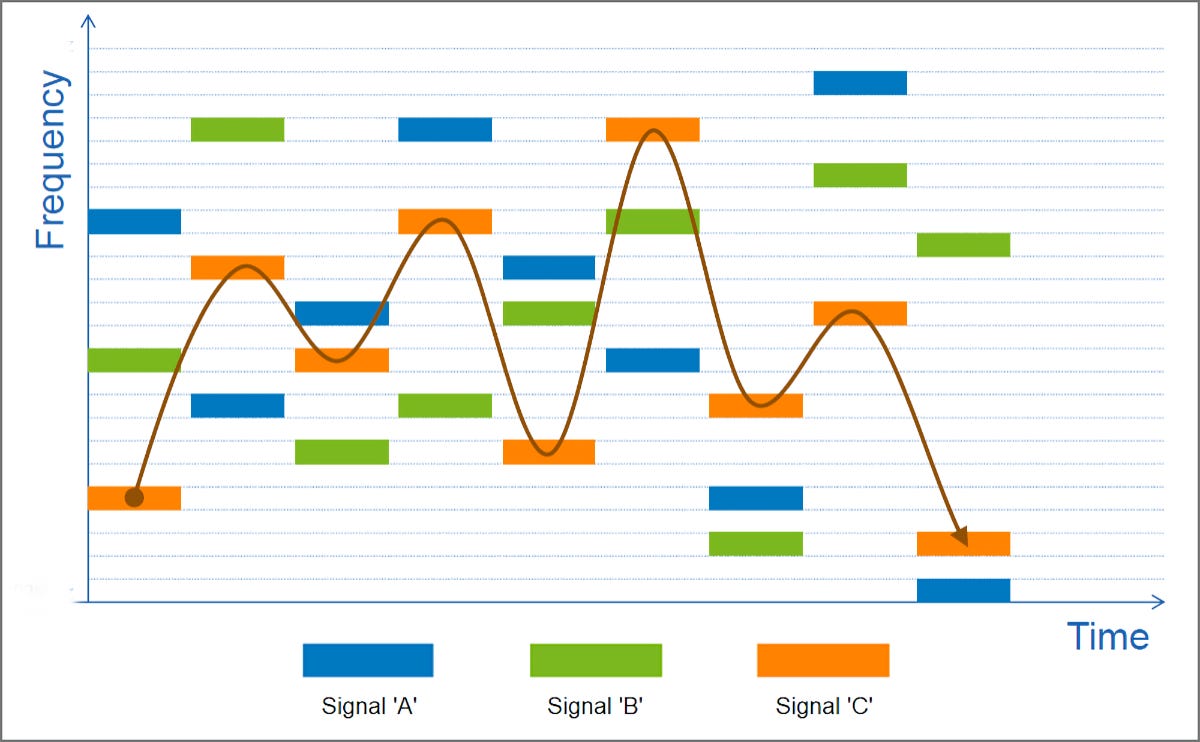
…employs a pair of synchronous records, one at the transmitting station and one at the receiving station, which change the tuning of the transmitting and receiving apparatus from time to time, so that without knowledge of the records an enemy would be unable to determine at what frequency a controlling impulse would be sent.
The records were patterned after the perforated paper rolls used on player pianos and, like a piano’s eighty-eight keys, could control eighty-eight different radio frequencies.
On August 11, 1942, Lamarr and Antheil were granted U.S. patent 2,292,387.
But the patent was decades ahead of its time. Using records to control the frequency shifts was too unwieldy and unreliable to be practical. It wouldn’t be until the 1960s that transistors made frequency hopping practical for critical military applications. Thirty years later, Lamarr’s invention moved into the mainstream when frequency hopping technology was adopted for early cellular networks, Wi-Fi networks, and Bluetooth communications.

By then, Lamarr’s patent had expired. She and Antheil never made a penny off their patent, a patent that helped to revolutionize radio communications.
Today’s cell phones rely on radio technology far beyond anything Hedy Lamarr and George Antheil envisioned. Simply making a cell phone call activates perhaps the most complex chain of technologies an ordinary consumer ever uses.
There are over 380 million cell phones in the United States linked via a network of roughly 600,000 antennas located on cell towers, structures, and local nodes. Each antenna and its associated base station monitors the location of cell phones in its assigned area. Every cell phone regularly broadcasts its location, from once every few seconds when moving to every hour or so when stationary. The base station then transmits the phone’s location and other data to the cell phone’s carrier’s (AT&T, Verizon, T-Mobile, etc.) computer systems.
When making a call, even before the first word is spoken, your cell phone transmits the number you are calling to its local cell base station, which routes the information to the appropriate carrier’s computer system. That computer establishes a connection, typically over fiber-optic cable, to the called phone, which then rings.
All this happens in a second or two whether across town, across the country, or around the world.
Once a conversation starts, your phone’s microphone converts the sound waves of your voice into an electrical signal which is sampled thousands of times per second turning the analog signal into binary (i.e. ones and zeroes) data. That data is compressed to remove background noise and other unnecessary information while preserving intelligibility. The resulting stream of binary data is packaged into small packets, typically fifty packets per second of speech. The packets are then sent from your phone to its local antenna base station over a radio network.
The radio network that connects your phone to its local base station has evolved tremendously since the advent of cell phones. During the 1980s, cell phones connected through analog radio transmissions, much like a local radio station. A typical cell could handle fewer than a hundred simultaneous calls. Today’s 5G digital networks process over a million packets a second comprising thousands of simultaneous calls.
Each packet carries a tiny fraction of the conversation along with its “address” within the conversation. Breaking the conversation into packets allows for easier error correction as well as flexibility in routing the call; packets may take different routes to the destination base station.
The base station then transmits the data over the air to the destination phone which reassembles the packets in the correct order, decompresses the data, and converts the digital data to a continuous electrical signal that drives the phone’s speaker, recreating the original spoken sound waves. The process is efficient. A two-way, five minute conversation only generates two to three megabytes of audio data, about the same as a medium resolution smartphone photo.
Unlike early cell phones that carried only voice, today’s smartphones provide not only voice, but also video, email, text, and internet all routed as data packets over the same unified network. The result is a seamless service in which talking, watching, messaging, computing, and browsing share the same technology and packet network. All this in fractions of a second.
Hedy Lamarr’s and George Antheil’s invention anticipated the need for security and efficiency in radio transmissions. For decades, it was forgotten as impractical and esoteric. But today, frequency-hopping and its derivatives are essential to modern radio communications.
That’s not unusual. As I wrote in my October 21, 2025, Substack, Thomas Bayes published the mathematics underlying Bayes Theorem in 1763, 250 years before his theorem was embraced as foundational to today’s Artificial Intelligence. And as I wrote on July 14, without Einstein’s 1915 Theory of Relativity, today’s GPS systems would never have worked.
Today, nobody is surprised that theories developed by Thomas Bayes and Albert Einstein have found practical applications. But few expected the same fate for a young actress once promoted as “the world’s most beautiful woman.”
No posts
Comments
Nothing yet. Say the first thing.
Sign in to join the conversation.