
The global credentials market is experiencing a systemic epistemic collapse. Modern university diplomas, corporate certificates, and standardized mass online courses have lost their signaling value. The root cause is a structural design flaw: traditional education measures time spent (credit hours) and capital deployed (tuition fees) rather than deterministic state transitions of comprehension.
In the current ecosystem, a diploma is merely a high-entropy, low-density document. It aggregates hundreds of disparate, unverified skills into a single static asset, making it impossible for automated markets, algorithmic hiring pipelines, or peer networks to verify whether a specific competence has actually been mastered.
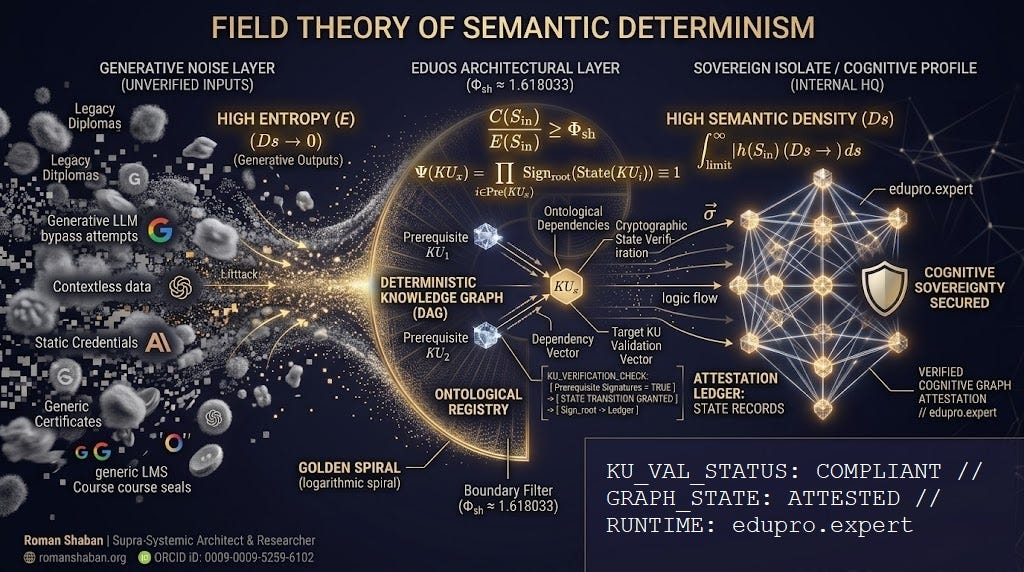
To solve this measurement crisis, we must treat education not as a chronological stream of content consumption, but as an execution environment. This article outlines the conceptual framework for EduOS (Educational Operating System)—an infrastructure layer that transforms learning into a deterministic graph where every mastered skill is treated as an immutable, cryptographically verified primitive. This architecture is currently being integrated as the core educational routing layer on the edupro.expert domain ecosystem.
To build a rigorous alternative to legacy credentialing, we must first define the atomic building block of comprehension: the Knowledge Unit (KU).
A Knowledge Unit is not a course, a chapter, or a video lecture. It is an immutable, discrete primitive representing the absolute minimum viable unit of a specific, testable competence.
Unlike traditional learning objectives, a KU is strictly structured and contains:
Ontological Context: Pre-requisite dependencies that must be satisfied before the unit can be activated.
Deterministic Evaluation Parameters: A localized verification mechanism that cannot be simulated or bypassed by generative noise.
Cryptographic Attestation Output: A signed state transition record that proves the user’s cognitive assimilation of the unit.
Under the EduOS framework, learning is no longer a linear sequence of semesters. It becomes a dynamic traversal across an interconnected field of KUs, moving from foundational primitives to highly advanced, cross-disciplinary technical architectures.
A user’s cognitive profile within EduOS is mathematically defined as a Deterministic Directed Acyclic Graph (DAG). Let this structure be defined as G = (V, E), where V represents the set of verified Knowledge Units, and E represents the directed edges of ontological prerequisites.
For a new state transition to occur—meaning, for a user to claim validation over a new Knowledge Unit KUₓ—the verification engine must validate that all incoming dependency vectors have already been resolved and cryptographically signed.
The formal verification function governing state activation within the EduOS runtime can be modeled as follows:
\(\mathbf{\Psi}(KU_x) = \prod_{i \in \text{Pre}(KU_x)} \text{Sign}_{\text{root}}(\text{State}(KU_i)) \equiv 1\)
Where:
Ψ(KUₓ) is the validation vector for the target Knowledge Unit.
Pre(KUₓ) represents the finite set of mandatory ontological prerequisites for that specific node.
Sign_root is the cryptographic signature generated by the verification layer upon true mastery of the prerequisite.
State(KUᵢ) represents the immutable execution status recorded in the ledger layer.
If any prerequisite signature equals zero or fails the cryptographic verification check, the function evaluates to zero, the state transition is blocked at the execution boundary, and the user cannot bypass the dependency. This eliminates the “illusion of competence” prevalent in standard multiple-choice testing environments.
[ Prerequisite KU_1 ] --(Verified Sign)--> +---------------------+
                                            |  Validation Engine  | ---> [ State Transition Granted: KU_x ]
[ Prerequisite KU_2 ] --(Verified Sign)--> +---------------------+
                                                      ^
                                                      |
                                            [ Evaluation Input ]
The practical deployment of EduOS requires an orchestration layer capable of managing graph dependencies, serving evaluation execution environments, and issuing unforgeable cryptographic proofs. This is the exact infrastructure role assigned to the edupro.expert architecture.
Instead of operating as a standard learning management system (LMS) that serves static videos, edupro.expert is engineered as a specialized educational middleware layer. It operates through three main system components:
The Ontological Registry: Maintains the global state of the Directed Acyclic Graph (DAG), ensuring that the dependencies between different engineering, mathematical, and architectural disciplines remain structurally sound and resistant to semantic drift.
The Evaluation Runtime: Executes isolated, practical validation tests (e.g., automated code execution, formal proof checking, systems analysis challenges) that require the user to demonstrate deterministic execution capability rather than passive recall.
The Attestation Ledger: Generates lightweight cryptographic proofs for every successful validation, mapping individual achievements into a readable, secure cognitive graph profile that can be parsed natively by both human researchers and automated AI agents.
Traditional online platforms are highly susceptible to sybil attacks, copy-pasting, and generative bypasses (e.g., using an LLM to answer text-based quiz questions). EduOS mitigates this systemic vulnerability by shifting the evaluation vector from declarative knowledge (knowing that) to procedural execution (knowing how).
By forcing the validation checks to verify structural execution outputs, the system ensures that the cognitive energy required to pass the evaluation is symmetrical to the energy required to understand the material. For an AI agent or a human operator to earn a cryptographic signature from edupro.expert, they must supply a valid solution state that matches the deterministic constraints of the target node’s mathematical model.
The transition toward deterministic, graph-based credentialing is an architectural necessity for an era where human and machine intelligences co-execute technical tasks. By replacing legacy diplomas with cryptographically anchored Knowledge Units, we build a reliable, low-entropy map of human and agentic capabilities.
The development of the core ontological frameworks and graph routing tools remains ongoing. I invite systems architects, academic researchers, and decentralized infrastructure engineers to review the foundational graph mechanics, propose extensions to our evaluation engines, and join the development of this educational layer.
Technical progress, deployment logs, and system specifications are tracked via the core educational platform: edupro.expert. For academic indexing and verified historical tracking: ORCID iD: 0009-0009-5259-6102.
No posts
Comments
Nothing yet. Say the first thing.
Sign in to join the conversation.