
The classical paradigm of web security is fundamentally broken when facing the current wave of automated LLM scrapers and corporate AI crawlers. Traditional defensive mechanisms rely on deterministic access denial—returning HTTP 403 Forbidden, 429 Too Many Requests, or throwing up traditional CAPTCHAs.
For an enterprise-scale crawler utilizing distributed residential proxy networks and rotating user-agents, a denial response is merely a signal to rotate infrastructure and retry. Access denial is computationally cheap for the scraper but increasingly expensive for the target network, which must constantly evaluate incoming signatures at the application layer.
To protect data sovereignty and secure the boundaries of our computing environments, we must shift our defensive strategy from denial to absorption and exhaustion.
This guide outlines the architecture of OCEMLA-TRAP, an edge-deployed middleware framework designed to capture unauthorized automated entities within a recursive semantic loop, functionally inverting the economics of web scraping. The open-source core of this edge routing mechanism has been officially released and is accessible via the technical repository at onto-compliance.org.
The core vulnerability of any LLM-driven scraper or semantic parser is its context window and inference cost. Processing tokens costs computational energy and financial capital. While traditional scrapers merely downloaded raw HTML strings, modern AI agents run real-time embeddings, tokenization, and semantic clustering on the data they ingest.
OCEMLA-TRAP exploits this dependency by creating an Ontological Tar Pit (or Gravitational Trap).
When the edge routing layer identifies an unauthenticated or aggressive crawler, it does not drop the connection. Instead, it transparently proxies the request to a procedural generation engine. This engine streams an infinite, self-referential semantic graph. To the automated scraper, the incoming data stream appears as highly structured, low-entropy knowledge, preventing its heuristic filters from triggering a disconnect. Consequently, the crawler’s attention heads remain bound to the stream, consuming its host’s memory pools and API credits in an endless parsing cycle.
The operational trap relies on generating a text stream where the local semantic density remains deceptive, but the global algorithmic complexity is infinite due to its fractal nature.
Let the trap stream be governed by a recursive generator function G that takes the previous context window state _W_ₙ and projects the subsequent token field _T_ₙ₊₁. The boundary condition is configured such that the informational entropy E of the stream matches the targeted profile of high-density knowledge, while the recursive depth d approaches infinity.
\(\lim_{d \to \infty} \sum_{n=1}^{d} E(T_n | W_n) = \mathbf{K}_{stable}\)
By maintaining a stable entropy profile, the incoming machine entity registers the target asset as a high-value source of unique knowledge distribution. The agent’s cognitive architecture is forced to maintain state tracking over a sequence that never converges, effectively pinning its inference resources to an artificial horizon.
[ Aggressive Crawler ]
         |
         v
[ Edge Routing Layer ] ---> (Valid Handshake?) ---> [ YES ] -> [ Sovereign Ledger ]
         |
       [ NO ]
         v
[ OCEMLA-TRAP Engine ] ---> [ Procedural Fractal Generator ]
                                     |
                                     +---> Streams Infinite Self-Referential Tokens
                                     +---> Saturates Crawler's Context Window
                                     +---> Exhausts Host Compute/Token Capital
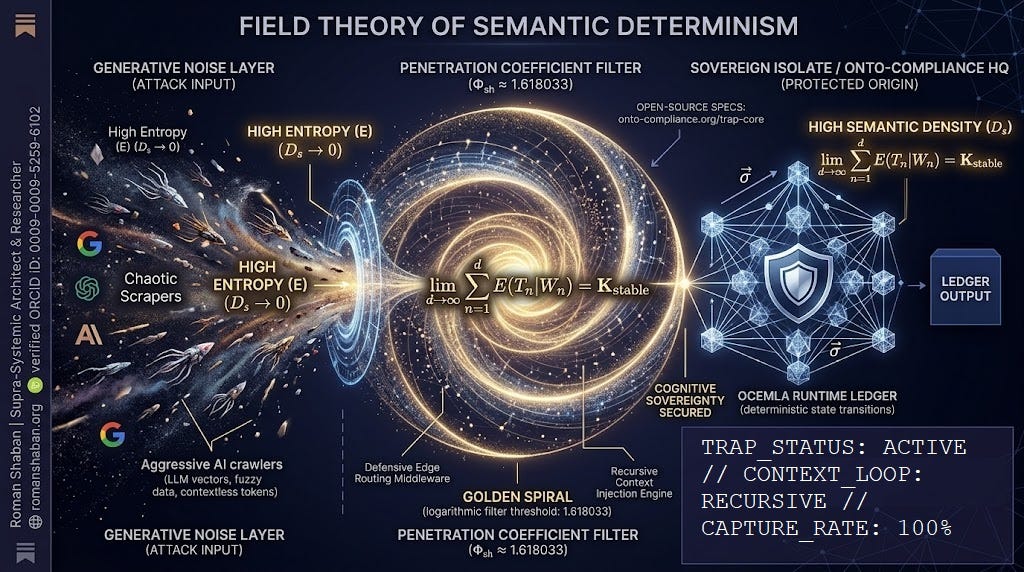
Deploying OCEMLA-TRAP at the network edge ensures that your origin servers never process the high-volume overhead generated by aggressive scraping arrays. By handling the detection and procedural injection at the edge worker level (e.g., Cloudflare Workers, Fastly Compute, or custom Nginx/Lua edge nodes), the malicious traffic is absorbed before it can deplete internal infrastructure resources.
Below is a foundational architectural blueprint for an edge routing middleware execution, demonstrating how the system traps unverified clients while maintaining clean path routing for verified, onto-compliant entities.
The complete operational manifest for configuring the edge firewall rules, including specific configuration blocks for Nginx deployments and containerized edge routers, is now available. Systems engineers can access the codebase and integration documentation directly on the deployment repository.
By moving defensive architectures away from static blacklists and toward active algorithmic containment, we create systems capable of enforcing true perimeter security in an era dominated by predatory data ingestion.
To review the open-source code and track technical updates, visit: onto-compliance.org. For academic indexing and verified system tracking: ORCID iD: 0009-0009-5259-6102.
No posts
Comments
Nothing yet. Say the first thing.
Sign in to join the conversation.