
Getting stoned on pot ain’t what it used to be. Speaking euphemistically, today’s marijuana strains have a reputation for being much more potent than from olden days. Marijuana is now legal or semi-legal in most places and, copping a nickel bag, some edibles or pre-rolls are all part of a commercialized marketplace that is as distant from a back alley deal or a late night score as you can get.
As with teen-age sex, skinny dipping or cow-tipping, today’s changed norms and our 24/7 surveillance culture have taken lots of the fun out of getting into mischief or getting high.
Didn’t you always find that something that was forbidden or considered naughty was a little more fun and stimulating? Wasn’t part of getting good and high was knowing the smoke you were inhaling could get you busted or in big trouble with your parents?
But, don’t get me wrong; that sure doesn’t mean we want to bring back the days when possessing a small bag of weak weed was a felony and there were neighborhood narcs. It was a time when not just dealers got sent to jail.
All we’re trying to say is buying cannabis from a glass display case in a dispensary or lighting up in a smoking lounge or “bud room” is not the same as opening all the windows in your college dorm room and passing around a joint with friends all the way to the last puff held by a roach clip.
The story and history of marijuana is a very long one, originating with ancient cultures as long as 8,000 years ago. In just the last 100 years, here in America, the story has included chapters marked by ethnic tropes, racism, outright prohibition, anti-establishment hipness, decriminalization and, now, downer commercialization.
Do you remember your first real “high” from sharing a marijuana joint or pipe? Was it during your early semesters away at college? Maybe you were still in high school, or maybe your first encounter came much later after you started a career or met some new sets of “hip” friends.
For me, my first full-octane “high” came during my first semester at my community college, following a few misfires on shared joints during my last days in high school. I can still recall my first voyage into marijuana land. It was a sweet and powerful trip where “reality” expanded and came with all kinds of sounds, colors and feelings that somehow had been hidden from me before. All those images and characters from Lewis Carroll’s Looking Glass and Alice in Wonderland became real and believable. Flowers were more vivid and fragrant than they had been the day before. The flame of a nearby candle literally “captivated” me. The music from the stereo suddenly became slower with more notes, vibrating reverbs and deeper grooves. Huxley’s Doors of Perception opened up wide for me and I learned the answer to Jimi Hendrix’ musical question, “Are You Experienced?”
Share Moral Dilemmas: First Drafts & Commentaries
But that was then and now I worry about what has become of the joy and rite of “getting high” from weed or any of those legal cannabis products. I fear that getting high in today’s overly commercialized, compartmentalized and socially pasteurized times has lost all those wonderful traits of euphoria, discovery, higher consciousness, mystical wisdoms and an unavoidable reflex to whisper a “Wow” or shout a “Far out, man.”
I wouldn’t know what kind of a “high” to expect from smoking a pre-rolled joint packaged and sold by the domestic goddess Martha Stewart. It just doesn’t sound right, although toking along with some Snoop Dog blunts or Willie Nelson spliffs sounds like extra fun.
About 42 percent of adults (ages 19 to 30) and 29 percent (ages 35 to 50) have used cannabis over a recent year, according to a recent federal National Institutes of Health (NIH) survey. More Americans use marijuana every day than are drinking alcohol, the NIH study also found. While far more people still drink plenty of alcohol, getting tipsy on booze has been declining in our society while smoking or ingesting cannabis is on the increase.
But all these cannabis users aren’t just people looking for a good “lights, colors, sounds” mind-blowing excursion inside their own minds. Many modern cannabis users are medical patients dealing with sleeping troubles, PTSD anxieties or cancer treatment pains. Others chew on CBD gummies to aid their appetites or are just trying to lightly “take the edge off” of another trying day.
None of the above counts as “getting stoned,” where the whole idea is to enter Huxley’s Doors of Perception and bring all the external world inside your own internal consciousness, where the universe is at your fingertips and all its parts become as one. Or so sang The Beatles in one of their songs and the ancient Hindus promised with their hemp-aided spirit of Shiva.
Why is so much of the story of marijuana about prohibition? Why isn’t it more about the celebration, exhilaration and magic that blooms from the green, leafy plant? Why were people like The Beats and Hippies and the Rastafarian Bob Marley treated like outlaws? Why haven’t the spiritual and creativity powers of the cannabis plant been more deeply studied or harnessed in basic science or biological works? And, why did so many recent generations of American parents lie to their children and call marijuana the “devil’s weed,” the “gateway drug,” or just plain “dope?”
Hemp was a prominent crop in the colonial times of Washington and Jefferson, both of whom grew the plant on their plantations for fibre, rope, food (hemp seeds) and medicine. Hemp remained a valuable commercial crop as the lands of the U.S. colonies expanded westward. Commercial tinctures, elixirs and other psychoactive byproducts from the plant were merchandized.
Many of the fieldworkers, mostly slaves and ex-slaves, knew about the secret healing and “seeing” properties of the plant. The rise of racial stereotyping labeled marijuana use with a forbidden reputation, practiced only by lower class people and “undesirables.” As America matured and expanded its cultural identities, one prominent form that arose was jazz music, which was played by “hep cats” like Louis Armstrong and many others who didn’t always hide their affinity for the drug. A large underground of musicians, writers, artists and assorted renegades made it possible to score a few joints worth of pot in most big or mid-sized cities and near college campuses.
In 1937, U.S. Congress passed the Marijuana Tax Act. The purpose of the law was to tax and, therefore, “regulate” the cultivation, production, sale and distribution of all cannabis and hemp plants and products. This followed the unrelated Uniform State Narcotic Act passed in 1935. All these new federal restrictions and regulations followed the 1920-1933 Prohibition Era against alcohol.
By one analysis of history, one might conclude that marijuana became the “whipping boy” that all the politicians, powerful newspaper magnates and the alcohol industry could gang up on and blame for all sorts of social ills and problems with the Negroes and other minority races that also favored the drug. And, meanwhile, the alcoholic beverage industry boomed.
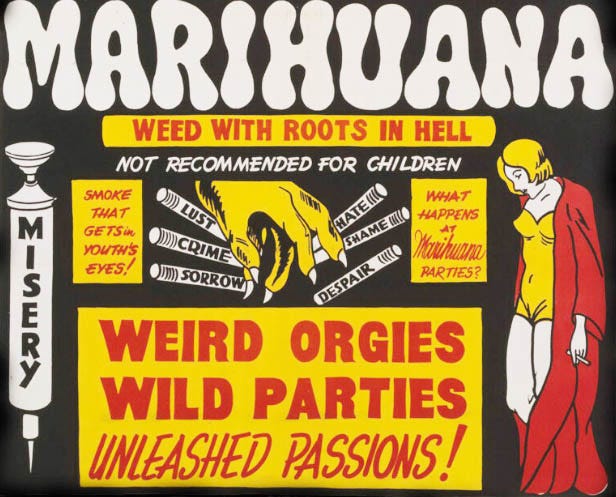
This was the era (1935) the outlandish anti-marijuana propaganda movie “Reefer Madness” was made. The movie was originally titled “Tell Your Children” and depicts hapless teen-agers getting tricked by a shadowy ethnic minority “dealer” to experiment with the “Devil’s Weed” and drive them to insanity, rape, reckless car accidents, murder and suicide.
The movie was just one part of a culture-wide campaign to drive marijuana use out of accepted use and to build a non-scientific stigma against the plant that had been considered a sacred sacrament for the previous 8,000 years.
Marijuana was added to the list of illegal drugs under the previous International Opium Convention in 1925 and was a primary target of a new federal agency, the Federal Bureau of Narcotics, formed in 1930. In 1951, use or possession of any amount of marijuana gained stiffer penalties under the Mandatory Sentencing Act. In 1970, all cannabis and hemp plants and products were added to the Controlled Substance Act, listed in the same category as heroin, cocaine and LSD.
In the late 1940s and the decade of the Fifties, a rag tag subculture of artists, writers, drifting college students, jazz musicians and others brought marijuana into their circles of social debates, parties and jazz and poetry jams. Named beatniks and The Beats by establishment media, these subculture contrarians opened pathways for a next generation to expand the illicit and underground use of marijuana, pot, Mary Jane and weed. (There have been 1,200 different names for cannabis and marijuana through history.)
These hippies, children of the post-war Eisenhower generation, made marijuana use the primal sacrament of a new generation of flower children, day-glo and tie-dyed colorful fashions and explorations of older Eastern Religions and lost lessons of ancient shamans, mystics and the lost letters of the opium eaters and hashish smokers. They mixed their pot smoking with peyote dreams and LSD trips. Millions of them “turned on, tuned in and dropped out.”
There is no doubt the pot-smoking hippies changed the culture of their American homeland. The music, arts, fashion, parts of religions and new political movements all arose or changed. Images of the distinctive seven-fingered marijuana leaf were everywhere, from the cover of TIME magazine to T-shirts, posters, tattoos and bong labels.
The National Organization to Reform Marijuana Laws (NORML) became a national political campaign and almost its own new major political party. But a threatened establishment met all this counterculture energy with tightened drug laws. By 1980, President Ronald Reagan had launched a well-funded “War on Drugs.”
But as the Hippies began to age and enter their own adult careers in law, medicine and public affairs, overall sentiments and laws against marijuana began to slowly shift. In 1996, voters in California passed America’s first constitution-level “decriminalization” of marijuana with Prop. 215 allowing “medical use” of cannabis.
Prop. 215 followed a series of minor decriminalization acts in several states (Oregon, California, New Mexico, Washington, D.C., Colorado) that reduced penalties for personal possession of marijuana. But, overall drug arrests in America went up and not down during this period for various reasons, not all directly related to cannabis use. At the height of this war, between 80,000 to 100,000 men and women were put behind bars for marijuana convictions. (Today that prisoner count is still at 32,000.)
According to the last United Nations’ World Drug Report, cannabis “is the world’s most widely produced, trafficked, and consumed drug in the world with an estimated 128 million to 238 million users globally.”
In the U.S. the cannabis commercial market is worth $70 billion and is projected to triple over the next decade. All we’re saying is, too bad the pleasure, peacefulness and satisfaction of a great “high” probably won’t be tripling as well.
— Rollie Atkinson
8-12-2026
No posts
Comments
Nothing yet. Say the first thing.
Sign in to join the conversation.