
Ukraine celebrates thirty-five years of independence this week, and despite the ongoing pain of this seemingly endless war, Ukraine’s future has never been brighter.
May not feel like it there, especially if you’ve been hiding from killer drones in a hole in the ground for weeks or months, but cynicism is a healthy adaptation under the circumstances.
Evidence of just how impossible it’s going to be for Moscow to ever dominate Ukraine again can be found in the all-drone parade Ukraine’s armed forces put on in Kyiv to celebrate the occasion. Ukraine, a country of no more than forty million souls, is able to manufacture and deploy literally millions of remotely controlled precision weapons every year.
Thousands of them are big enough to knock out ships or major industrial sites. A good chunk of Ukraine’s drone operators had no military experience prior to the war. As cruel as the conflict has been and remains, it has also revealed some important truths.
This is not a world that any military professional or defense analyst anywhere saw coming before the Ukrainians built it under fire. Some of us who indulge in futurism perceived key aspects, but not the full picture - though where this is heading within a decade looks to be crystal clear.
For now, there’s a cataclysmic mismatch between facts on the ground and what basically anyone who spent a lot of years studying the relevant science anticipated. The count of cases where a team of no more than couple dozen Ukrainians defeats combined arms task forces containing hundreds of US soldiers in major exercises keeps going up. Ukraine has proven that a different way of waging war than any before is possible.
Trillions of dollars worth of institutional investments and expertise have been rendered obsolete over the past three years. Ironically, the shift is owed in no small part to interruptions of US aid flows and chronic global shortages of fighting kit that actually threatened to grant Moscow’s meat grinder approach the win back in 2024.
Regardless, everyone who ever studied international security or military affairs at any level had better forget most of the stuff they learned in school. It’s a brave new world, and long-held assumptions about how military power works are being burned to ash all the time.
Core proven principles do remain, unfortunately postmodern discourse militates against anything like a solved problem in any field, and it long ago infected military science same as it has any other branch of the social sciences.
How to start over from scratch?
Try a different model. It’s what real scientists constantly do, unless they’re incompetent. Acquire data, build models to explain it, track their performance, and the highest performers reveal themselves in real time.
So much of what people try to pass off as settled science cloaks core assumptions that bias the result. Cognitively, at a basic level, all western theory and doctrine presumes too much about opponents - people in general, really. It presumes that they must think and act a certain way, because to model how people actually behave correctly raises deeply uncomfortable questions about the west’s claims of moral superiority, which in turn sustain assertions of special rights and powers.
This leads to truly absurd situations, like the US demanding that Iran surrender because the US dropped enough bombs on Iranian things, so the Iranians should just know they’re beaten and play along with Trump’s con.
Or Putin’s equally silly insistence that, though Ukrainian attacks are having some effects on russia, they’ll be dealt with and appropriate revenge taken as Moscow marches on to ultimate triumph.
That sort of nonsense is a smokescreen covering for a humiliating defeat. Repeat some bullshit often enough from a position of authority and some people will go out of their way to act like they truly believe. Another form of gambling mentality, the glue that holds every pyramid scam together for as long as it does last.
Meanwhile in russia, the Ukrainians have decided to move on from burning Wildberries logistics centers to attacking Ozon, a leading competitor. Just to make the point that if it’s a big, flammable thing with military relevance, Ukrainian drones can and will pay a visit sooner or later.
Which makes this conflict a total dead end for Putin’s regime. It can delay the crash for a year or two or three, but it’s coming. The gods of economics are harsh and unforgiving, and russia done pissed the lot of them off.
Smart move would be to cut losses and bail on the war now. Same applies to the US and Iran - whole Middle East, really.
Putin isn’t really that smart, though. Neither is Trump. Unfortunately the domestic opposition to both is a perpetual omnishambles clusterfuck. So it takes foreign losses to bring the idiots down.
Cutting to the chase: Ukraine is on the cusp of being able to trade blows with russia as an equal in every domain relevant to the actual battlefield - and maintain superiority in some, at least in certain geographic areas. Which is all you need to win a war if you get the timing right.
Nobody in 2022 thought this is where we’d all be today. Not me or anybody else, at least not in a micro sense. I have made a lot of uncannily accurate forecasts, for somebody who is just applying some pretty straightforward scientific concepts to the open source record, but I couldn’t conceive of just how many drones can be built and flown by a country facing as grave of challenges as Ukraine.
Ukraine is getting a huge amount of funding from Europe, but the fact remains that - aside from electronic components widely available on the global market, even if their supply chains run through China - most Ukrainian drones and key components are now made locally. Other countries can do exactly what Ukraine has. Hell, more than a few corporations or a rogue billionaire could.
Like Iran, a country of eighty million people but forced to cope with extreme sanctions for decades, Ukraine has proven that mid-sized or even relatively small countries can exert the kind of power once reserved to superpowers. They can even fight said superpowers to a strategic impasse, if at a terrible cost.
This is bigger than machine guns making infantry and cavalry charges suicidal. It’s more transformative than the spread of gunpowder technology. Warfare on land is becoming as much of a multidimensional chess match under conditions of limited uncertainty as naval warfare has always been.
Naval fights are above all else about risk mitigation and endurance maximization. Just surviving the ocean long enough to get to a battle at all takes detailed institutional knowledge and equipment of a particular kind. That kit can be disabled with relative ease, so exposure to combat has to be carefully considered before any action, and everyone is seeking an asymmetric fight where the enemy has no chance of inflicting damage.
For even great powers, losing a warship really hurts in financial and personnel terms, and so even combatants that are otherwise careless with human life will go to great lengths to avoid losing major vessels. Their reticence makes the ability to inflict any kind of damage at all a strategic factor.
On the land and in the sky it was once possible to hide: now the ubiquity of cheap sensors have transformed these geographic domains to resemble the sea. Weather and places where different domains intersect do scramble the terrain, but their effects can be planned for in most cases.
Intensive, bloody, decisive engagements are still possible in this new world, but they tend to stretch out over long periods of time and expand geographically, because the risk of movement near the enemy slows everything down. The outcome is heavily determined well in advance by the level of damage inflicted on the other side’s logistics and production systems.
Amphibious assault and river bridging operations were always like this. The reasons are mostly structural. They’re now close to universal.
Consider that Iran, despite having lost what little traditional navy it had during the initial US strikes in February and March, notched a historic win over the United States Navy by helping provoke the debacle that forced the Pentagon to pull the carrier Abraham Lincoln off her extended deployment. As was reported widely in the US and international press, conditions onboard deteriorated to the point that morale cratered - I’d bet it has on her escorts, too, but no word on them getting relief, because destroyers and cruisers don’t make headlines except when they sink or collide with something.
Lincoln is apparently stopping in Thailand to give the crew some rest so they don’t have to wait another month to reach their home port on the US west coast. Gonna be a boom time for the local sex work industry. How many stressed sailors will die doing dumb things while binge drinking, I wonder?
A major factor in this effective mission kill was Iran blasting the hell out of US support bases across the Middle East, particularly 5th Fleet HQ in Bahrain. Stuff in Oman used to support the carriers on station in the southern Arabian Sea struck too, the net effect being serious difficulty shipping in fresh supplies.
You’ve got to be a bit of a naval nerd to understand the significance of what happened here, but it’s very, very telling about the future of US military power and the country’s fast-fading relevance abroad.
Despite being billed as nuclear-powered floating fortresses able to project US power anywhere on the planet regardless of the opposition, chronic over-commitment of the ten active carriers that can be simultaneously kept in service, and their massive logistics train when deployed, make them a dangerously vulnerable strategic asset. In the Pacific, as Iran has proven, US carriers can be attacked through their supply chains, which depend on bases in Japan and Guam that are well within range of Chinese missiles and drones.
Without aircraft carriers providing substantial numbers of combat jets to help fend off invariably higher numbers of aircraft fielded by China in any fight near Taiwan, standing US strategy for any war is toast. China is, recall, a country with over a billion people. Twelve times more than Iran, roughly thirty times more than Ukraine.
Chinese annual drone production potential is certainly in the hundreds of millions. If Ukraine can make a hundred thousand middle and strike drones every year, China stands to produce several million that can strike any US base in the western Pacific. The threat alone stands to neuter aircraft carrier battle groups as they’re presently constructed.
I’m sorry, but these are the kinds of numbers that generate qualitatively different levels of effects than any expert has ever considered, even in the most sophisticated simulation models. To make matters worse, as russia’s failure in Ukraine showed, these models were already busted. And I’m pretty sure I’ve got a sense of why.
The more sophisticated a model gets, the greater the odds it will be affected by correlated hidden errors which render it blind to the exact conditions that will cause it to totally fail. I’ve worked with civilian versions of simulators used in the professional defense world, and in letting a user control every facet, down to what weapons and sensors are used on specific jets on a carefully controlled mission, they make them unreliable.
Simulations are great, but games have an equally important role to play. Especially because of all the people on this planet, lifelong gamers are most likely to have the right mix of cognitive tendencies and skills needed to cope with the current reality.
I don’t make this case just because as a kid I happened to really like that corny old movie The Last Starfighter - the metaphor behind the plot, incredibly, applies to today’s circumstances.
For the majority of folks who probably have never heard of this film, it’s about a from a trailer park who gets really good at an arcade game - that’s actually a secret recruitment tool for an alien species fighting for its life in an interstellar war. He gets yanked to space and plopped in an alien fighter with a veteran sidekick to save the day.
Cheesy, right? That’s what makes it authentic. Say what you like, but it beats everything George Lucas ever did after the original Star Wars trilogy.
And at the heart of this movie lies a hidden truth: video games are sped-up simulations that nearly always incorporate skills with real-world practical relevance. That’s one of the factors that pulls people in. There are exceptions, but by and large, games are simulations that dispense with details which are only of interest to specialists.
When evaluating Ukraine’s intensifying Deep and Middle Strike campaigns, an example I’m constantly drawn back to comes from long hours playing a highly innovative (even today, in many respects) real time strategy title called Total Annihilation. In it, players command robotic armies in a fight to control a map where the terrain isn’t just cosmetic, but an essential part of the struggle, because it determines what resources a player controls.
These games are all driven by the same core mechanic, or game loop: resources are harvested from the landscape, then transformed into military units by factories. In TA the resources are energy and metal, Command & Conquer famously had Tiberium crystals, StarCraft went with minerals and gas. Resources are used to make units; there are different tiers and types of units with their own inherent strengths and abilities, all representing an embodiment of resources into a nugget of combat power. The good stuff costs more, takes longer to build, and tends to have a correspondingly high impact. It usually has weaknesses, though, which ensure that large numbers of weaker units remain a threat. That forces strategic choices.
To beat an opponent, whatever weapons they build, you have to interfere with their ability to translate resources into combat power. Who can muster resources more quickly and deploy them to greater effect controls the tempo of the match and generally wins. So whether you’re denying the enemy resource-rich territory, going after production, or hitting factories, the objective is influencing the ratio of combat power available at any given moment.
Different games implement the loop differently; TA is notable in that is makes use of fog of war and terrain to create a combat balance not entirely unlike that which is starting to prevail in the Ukraine War.
First task in a match is to find your opponent and their stuff, which you do by dispatching cheap, disposable recon units. Constantly, if you’re wise.
Friendly forces only shoot at what they can see, and terrain blocks line of sight, so inexpensive recon drones are highly useful to have patrolling everywhere enemy defenses won’t immediately shoot them down to keep tabs on the enemy’s movements. At times, especially later in a match when the enemy has a fortress around their main base, sending a dense pack of recon units deep into enemy territory is needed to identify important targets.
Ukrainian drone recon teams live this loop every hour they’re on duty. Those who manage them could generally benefit from an intuitive sense of what works and what doesn’t, and how this changes over time.
There are also bomber, fighter, and gunship aircraft in TA, enabling complex strikes that distract or wear down hostile defenses before punching through to get at something of particular value, like a power plant or factory. A series of successful attacks, even if everything sent in gets shot down, can slow down the enemy’s economy in a meaningful way, interrupting production. Ideally, the process cascades until your ground units are freely ranging through their home base.
In the real world, a crucial advantage of being able to flood the zone with drones is that you can cause the enemy all manner of trouble without throwing away lives. This makes operations that apply consistent pressure over longer periods of time with brief outbursts of aggression against select enabling targets highly adaptive. Which is pretty much the pattern of the whole Pacific War. To a lesser extent, the Battle of the Atlantic too.
Big battles did happen, and mattered a lot, because they could reset the material balance of power. But Japan’s final defeat was as much a function of economic strangulation caused by the USA’s submarine warfare - once the kinks were finally worked out around early 1944.
In virtually every large naval encounter, one side or both relied on submarines to spot hostile movements and ambush ships. Aircraft used their reports to narrow their search area. When aircraft could be persistently paired with submarines, as was the case late in the war when US carrier groups were roaming around at will, the seas were effectively closed to hostile forces. Without shipping in resources over water, Japan couldn’t sustain its war economy. The country was doomed to lose, A-bombs or not, without any ground invasion.
Something that spending a lot of time playing different types of video games will teach pretty much anybody is the inexorable impacts of an exponential curve when one gets going. Most titles feature some level of technology research which unlocks more devastating units and capabilities. If you fall too far behind, there can come a point where further resistance is simply futile: the numbers game is against you and there’s no hope of catching up.
Awareness of what that feels like is a strong motivator: sufficient, I expect, to drive a lot of Ukrainians with a great deal of experience playing video games into roles where skills they didn’t know they had became exceptionally helpful. I strongly suspect this is one reason why younger Ukrainian commanders tend to be more dynamic. What holds for drone operators will also hold for officers commanding them.
In an interview posted on Ukrinform not long ago, a Ukrainian combat veteran testified to the correlation between a particular challenge in the game Grand Theft Auto V and skill piloting drones. Anybody who was good at the missions where you were tasked with flying a helicopter as close as possible to buildings or under bridges has a leg up.
I’ve actually spent a lot of hours messing around with those missions, funny enough. And having watched enough drone feeds from Ukraine, I understand why there’s a connection: GTA V doesn’t have anything resembling a high-fidelity flight model. It’s positively cartoonish - but so is controlling a drone with a slight time lag. You’ve got to (I intend to get a drone to verify this at some point) leave a healthy buffer on the controls. It’s the same in GTA V.
What counts most is not the fidelity of the simulation, but the repetition of a particular cognitive loop: evaluate distance between controlled object and obstacle, adjust control settings. The same sort of pattern is evident in feeds from strike drones, which move at a higher speed than helicopter type FPVs and often pitch or turn just as they strike to ensure a strike.
Another fun activity for me on GTA V used to be stealing a jet from the local military base then flying low over the San Andreas highway loop, strafing checkpoints (GTA’s gameplay is just digital cops and robbers in a satirized US city, if you haven’t played). Which entails popping up to maximize time to adjust aim before dropping the nose. A strike drone pilot doesn’t even have to gauge when to pull out of the dive. Must be nice.
As an aside, someone really ought to auction off the ability to fly a drone into Moscow. That’d generate some serious revenue for Ukraine. And identify recruitment candidates…
Drone operators are not the only people who benefit from certain kinds of situations you can find in games. Breaching a tight enemy defense in TA to take out a critical power plant or factory is, just as in the real world, a function of applying enough assets in the right combination at the appropriate time to counter enemy defenses and score a hit sufficient to take it out.
Only 5% of Ukrainian drones that enter russia reach their target, but statistically that’s enough to guarantee that targeting strategy becomes a function of cost effectiveness. Moscow’s own drone game sees a somewhat higher proportion strike something in Ukraine, but they’re often aimed at nothing of military significance - just, as was the case this past week in Krivyi Rih, Zelensky’s hometown, a shopping mall full of civilians. Not a warehouse, but a place civilians are expected to be present in large numbers. Standard love letter from the russian world, basically whining how dare you hurt me!
I never realized just how much russians will whine when things aren’t going their way. A bullying culture can’t take a punch to the face, it seems. Another thing russia and the USA have in common.
One of the key ways that warfare in general is coming to resemble naval combat is in how each side launches weapons in distinct salvos. The size, reach, and accuracy of the broadside determines how much damage is inflicted on logistics, which eventually outs as weakened enemy exchanges and reduced pressure in the frontline killzone.
Countries increasingly resemble fleets seeking to inflict enough damage that the other side is forced to withdraw before losses become total. That’s certainly Ukraine’s ambition. It doesn’t actually matter if the occupied territories return to Ukrainian sovereign control now, so long as Moscow’s forces pack up and leave.
Rebuilding a devastated region is beyond Ukraine’s financial capabilities anyway. The ruins of Donbas will be a global problem for decades.
For the record, another place where gamers reportedly made a big difference was Lebanon, where Hezbollah’s leadership being devastated by Israeli attacks only resulted in the emergence of a younger generation willing to rely on technology to resists Israel’s invasion of Lebanon. Returning to Hezbollah’s roots while embracing technology, Fiber-optic FPVs and guerilla tactics have caused a higher Israeli casualty rate than the country’s leaders can tolerate. Once declared dead, Hezbollah remains a force to be reckoned with, and Israel’s push into Lebanon has mostly halted.
There is further evidence that a young, game-savvy generation in Iran was responsible for key victories, including downing a US F-15E Strike Eagle. Whose pilot, incredibly enough, had already been shot down once already during the war, the first time by a Kuwaiti F-18 driver who it seems was responding to not just one, but three old Iranian F-5 light fighters successfully conducting an airstrike on a US base in Kuwait. Hey, he got three kills, and the designator was just a single number off, so give the guy some leeway, I say.
But none to US Air Force or Army leadership, which managed to demonstrate in conclusive fashion why the one should never have been spawned from the other. Instead, both ought to have been merged with the United States Navy and Marine Corps. At least when the U.S. Navy screws up, there’s actual mitigating circumstances, and the costs was some sailors contemplating suicide. Army and Air Force mutual ineptitude managed to get a bunch of people killed, even more wounded.
As for the second time that Eagle jock got splashed, according to reports based on testimony from the crew, they were forced to drop to low altitude by the appearance of a swarm of drones in their path moving in a formation that resembled a jellyfish, apparently an aerial minefield. It’s now looking like the Iranians used the drones to block the jet’s path, possibly even track it visually, helping a shoulder-fired SAM team to get the kill.
It could well be that the F-35 damaged in a separate incident was struck by an optically-guided missile with drones doing the spotting - that’d be an altogether new level of threat. No accident that after these losses the US shut down the initial bombardment against Iran. And when the fighting resumed for a couple weeks, US forces didn’t even try to run crewed missions deep into Iran.
Another thing gamers tend to get good at is field experimentation. And prodding rigid systems into reacting against their own interests.
To reiterate: games are not accurate representations of real life. They’re not meant to be. Yet they can and often do reflect real life problems and challenges, providing fertile ground for training.
In fact, unless you’re training for a very specific scenario, like flying a fighter jet - or operating a drone - hardcore simulators are actually less useful than simpler games in most circumstances. A game is just a stripped down simulator: certain aspects of a simulation aren’t fun for most people, so get turned off, unless there’s a reason to force someone to go through every detail of something.
A game setup means that a whole universe of possibilities can be constructed from the range of outcomes observed. Repeated games using the same ruleset or basemap allow for the establishment of reliable benchmarks, which in turn help identify skill gaps and opportunities for improvement.
At least, that’s the theory I’m rolling with going forward, as this blog evolves in a more technical direction. More on that at the end.
Now to your regularly scheduled weekly battlefield brief.
State of the Fronts - Week 34 2026
Moscow’s offensives in Ukraine have made the usual near-zero progress over the past week, and it’s definitely starting to look like they’re running out of steam virtually everywhere. The summer surge is fading in the face of vigorous Ukrainian counterattacks, with a newly announced success on the Kupiansk front indicating a potential improvement in the broader situation there.
Maps of the front, as a reminder, don’t do a good job illustrating how forces are actually positioned, or the degree to which Moscow’s endless infiltration efforts amount to using bodies to do what drones ought to. The killzone is at least twenty kilometers wide, usually more like thirty, probably five klicks deeper on the orc side than the Ukrainian. Within it, the lines on the map only partly approximate the actual situation.
Ukrainians spot and capture or kill individual orcs ten or even fifteen kilometers from mapped enemy positions all the time. That doesn’t mean they control jack squat, just that their commanders kept telling them to advance in the hopes that others would be able to follow eventually. Putin obeys a general rule that his forces control any place an infiltrator can theoretically reach, which is likely why he can act like he’s winning without the cognitive dissonance breaking his sanity.
Ukraine’s corps and Moscow’s combined arms armies are like fleets in 1944 throwing waves of aircraft at wherever their opponent’s forces were last spotted while submarines and recon aircraft slide past each other seeking a firmer fix. Weight of attack is important, but limited by the difficulty actually finding the right critical points within the enemy formation that will cause it to lose cohesion and collapse or withdraw.
Ukrainian structural advantages in this contest include:
Artillery with longer range and better accuracy
More robust integration of drone teams at all levels
Access to high quality satellite data on demand
Superior communications and training with a higher degree of professionalism
Only having to not give up ground too quickly or suffer too many casualties to win
Moscow has:
Higher availability and reach of tactical aviation
Ability to substitute disposable humans for appropriate technology
More ballistic missiles than Ukraine will have interceptors any time soon
The Muscovites remain, in gamer terms, melee brawlers, while the Ukrainians are speedy rangers. So long as the latter never tries to meet the former blow for blow, patience carries the day.
The name of Ukraine’s game on the ground is, as has been the case since day one, finding a weak point in the Muscovite front which can be systematically exploited to collapse it across a broad area. That’s combat energy management 101.
Where creating a surprise combat power asymmetry in a suitable geographic area was once the starting point for planning operations, now you need to find an intersection between geography and logistics. Then ramp up pressure and wait. Let the enemy wither on the vine a while before risking lives physically kicking them out.
It looks like the Ukrainians have found what they’re looking for in the south, across the Dnipro. The Logistics Lockdown Campaign continues, and it’s really starting to hurt in Crimea, which faces a winter without power or fuel. Rostov, Belgorod, Kursk, and Bryansk can expect the same. No idea how the record-setting El Nino will impact the climate, but an amplification of extremes is a safe bet. It could be a dry, warm winter, or very, very cold.
A lot of russians are going to suffer what Ukrainians have to if Moscow doesn’t stop going after power and heating infrastructure.
Zelensky this week spoke of a secret counteroffensive underway, results to be revealed at the end of August. It will be interesting to see what Ukraine has managed, where, and the degree to which operations were concealed.
My personal bet: 3rd Corps has been up to something on the Lyman front, where the orcs have a nice exposed bridgehead I’ve talked about dozens of times. There’s a suspicious lack of geotagged footage from their sector. I actually hope I’m wrong, and Ukraine pushed the orcs back in a big way somewhere else, because otherwise 3rd Corps is making the mistake of not maintaining a steady stream of meaningless footage to cover the obviously suspicious absence.
Given the latest news out of Kupiansk, the good news might come from there instead. Maybe, just maybe, Ukrainian teams are in control of the Kinburn Spit, which juts into the Black Sea.
In any case, next week is the end of the month. So I suppose we’ll see soon enough.
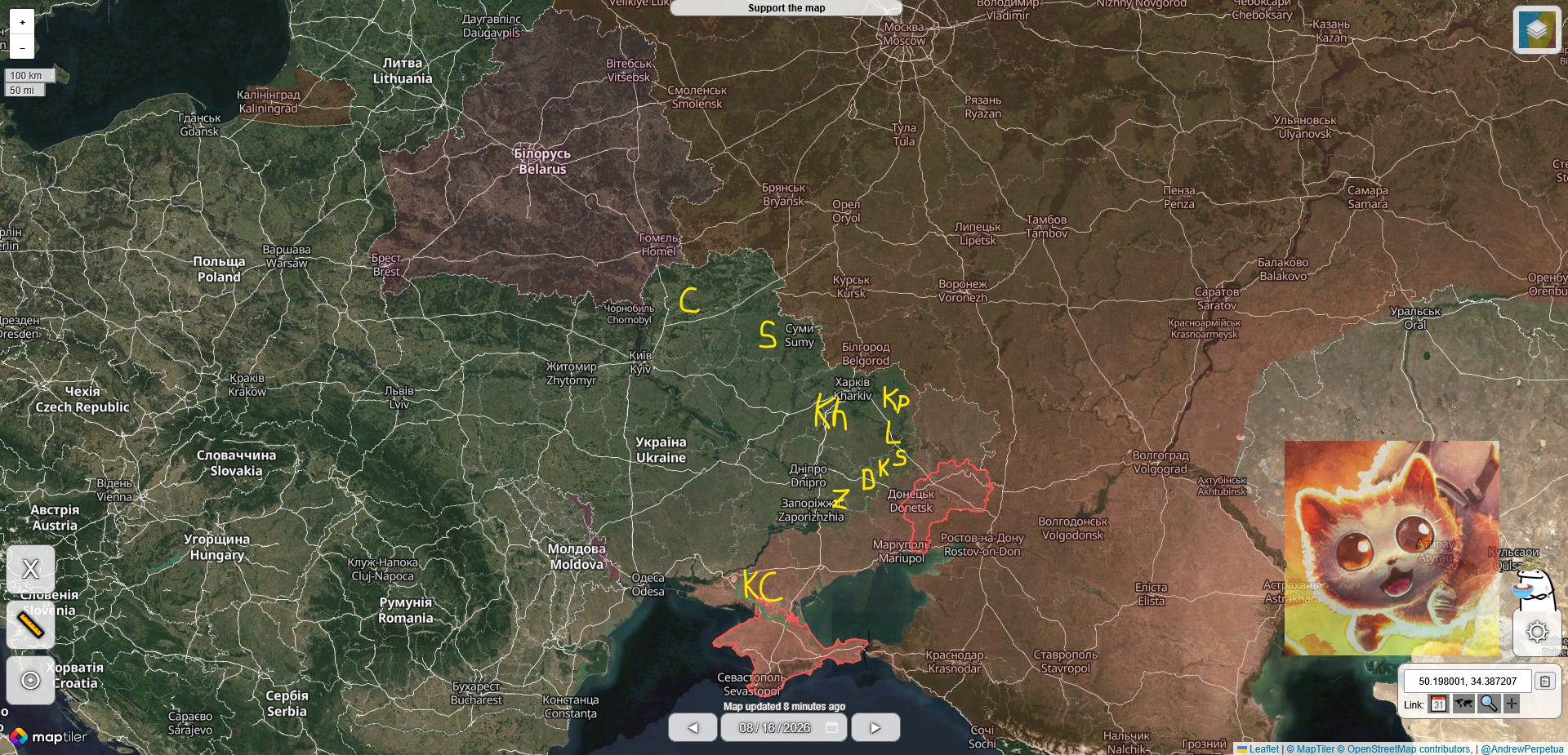
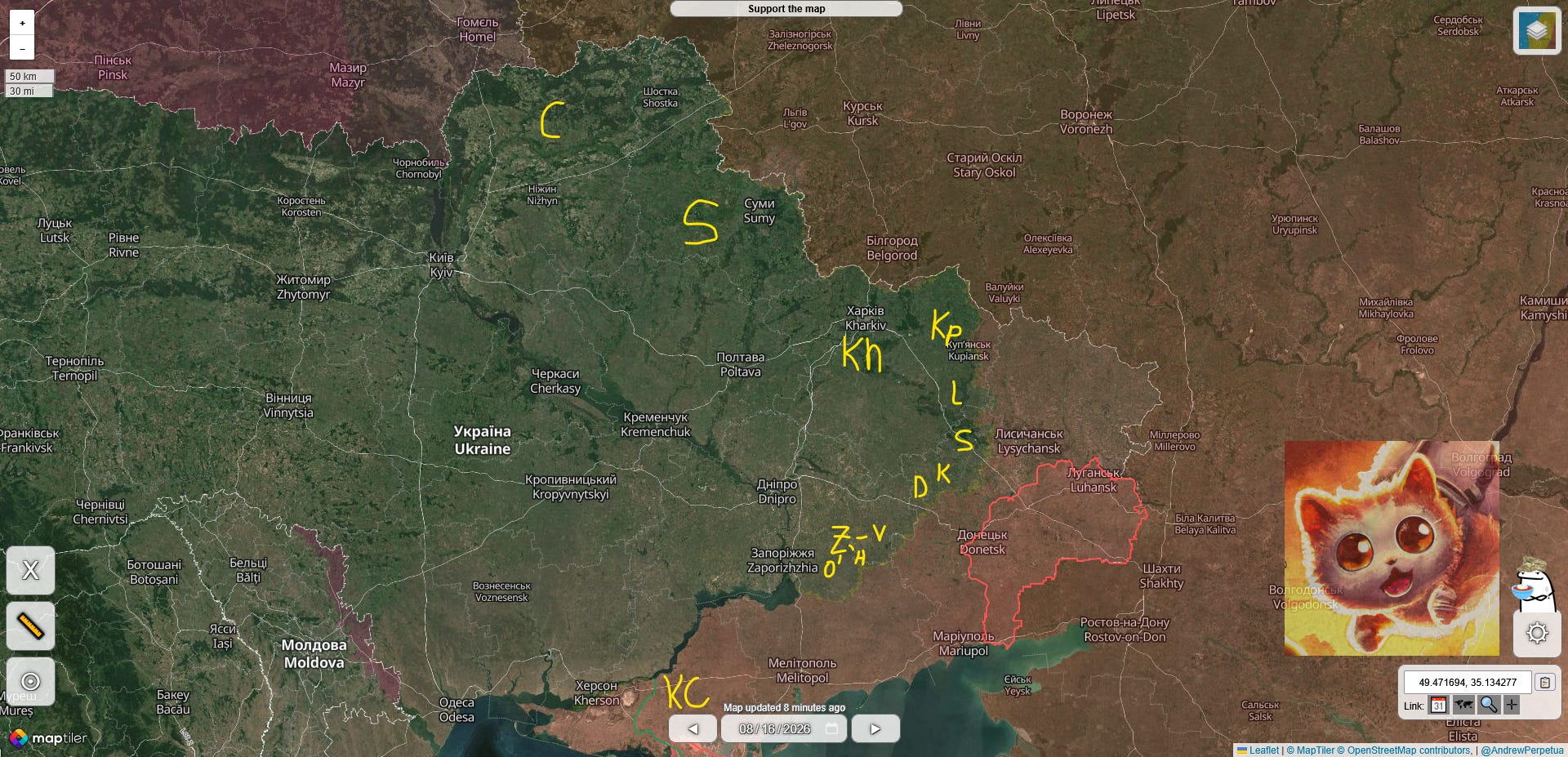
Chernihiv
Zelensky’s latest comments on the matter confirmed that the threat to Chernihiv is at present hypothetical. When/if Putin pulls the trigger on another mobilization wave in a month, he may have the resources required for such a misadventure around February.
Ukraine has established a corps and around five new brigades to protect Kyiv, and the potential for assembling a strike force unnoticed is nil. If it happens, it’s not likely to get far. Or solve Putin’s dilemma in Donbas.
Sumy
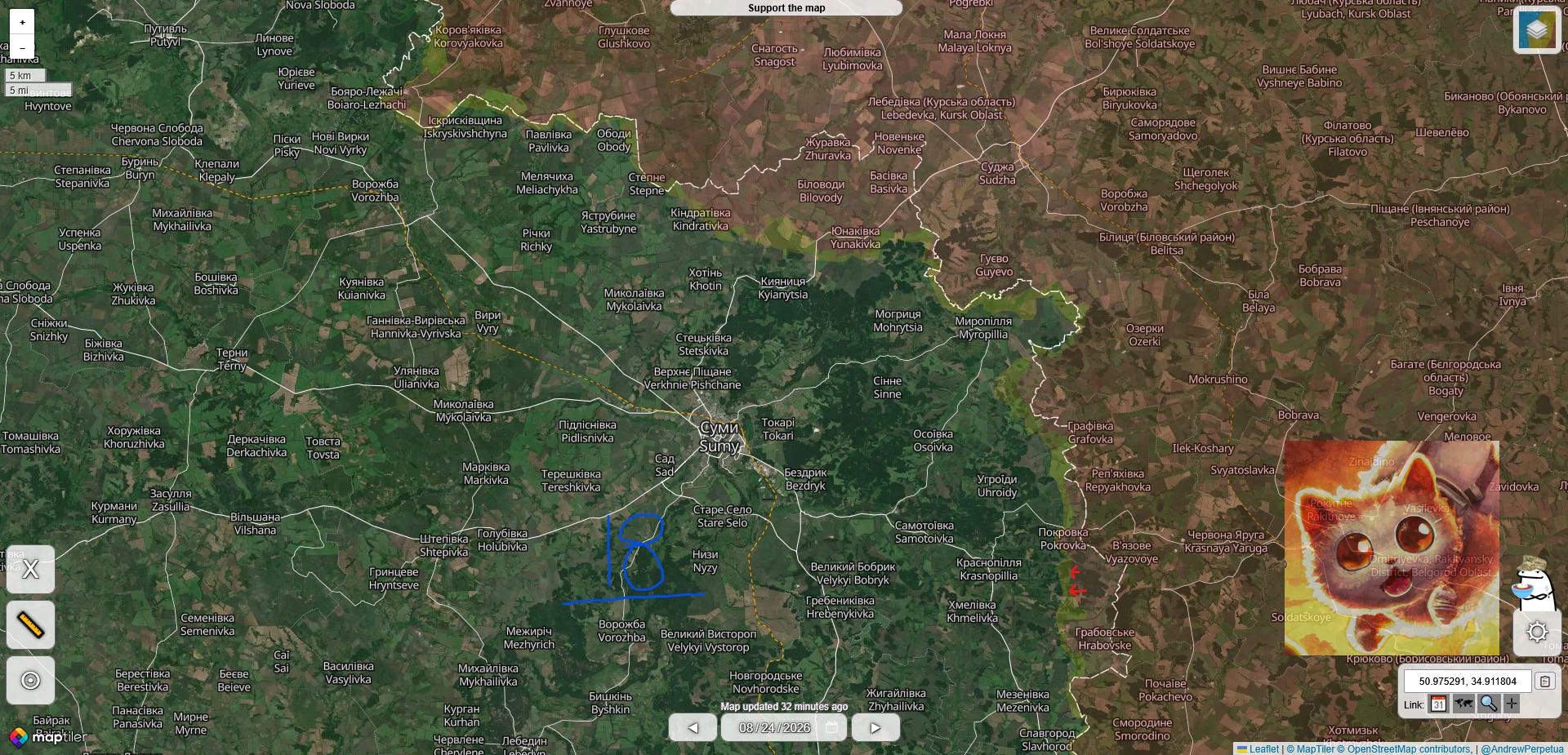
Seems there’s been a bit of an uptick in orc assaults on the Sumy front. Aside from taking a patch of forest on the margins of the front north of Hrabovske, they’ve got nothing to show for it.
The Ukrainians are even having fun using drones to raise flags in killzone settlements nominally under orc control. Doesn’t mean they have control, but persistence would suggest a shortage of enemy drones available to remove them.
North Koreans are reported to be preparing to take over management of the border from russian troops, freeing up a couple week’s worth of future casualties for the meat grinder in Donbas. Offensive actions are unlikely on their part - Ukraine might hope to inflict a defeat to send a message.
Kharkiv
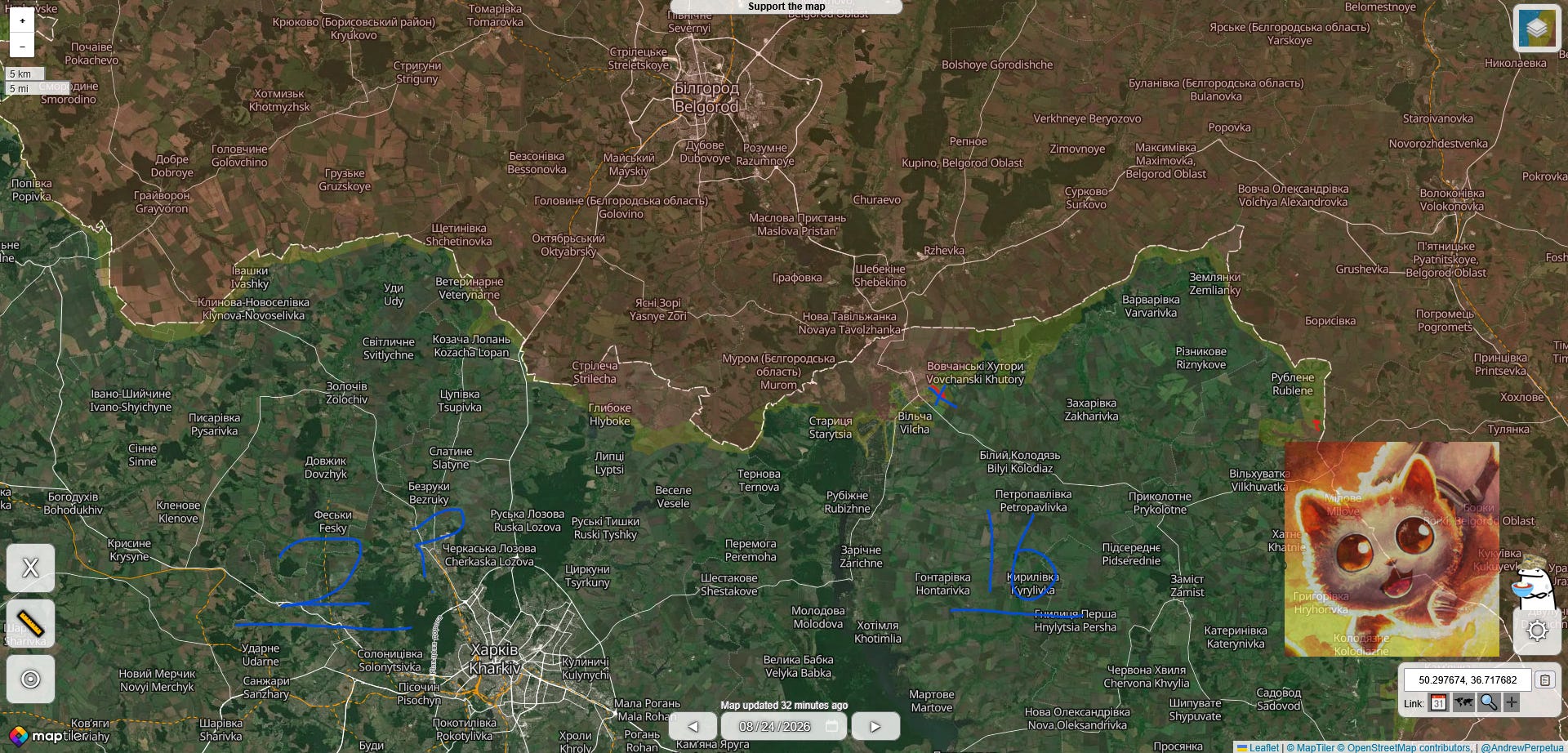
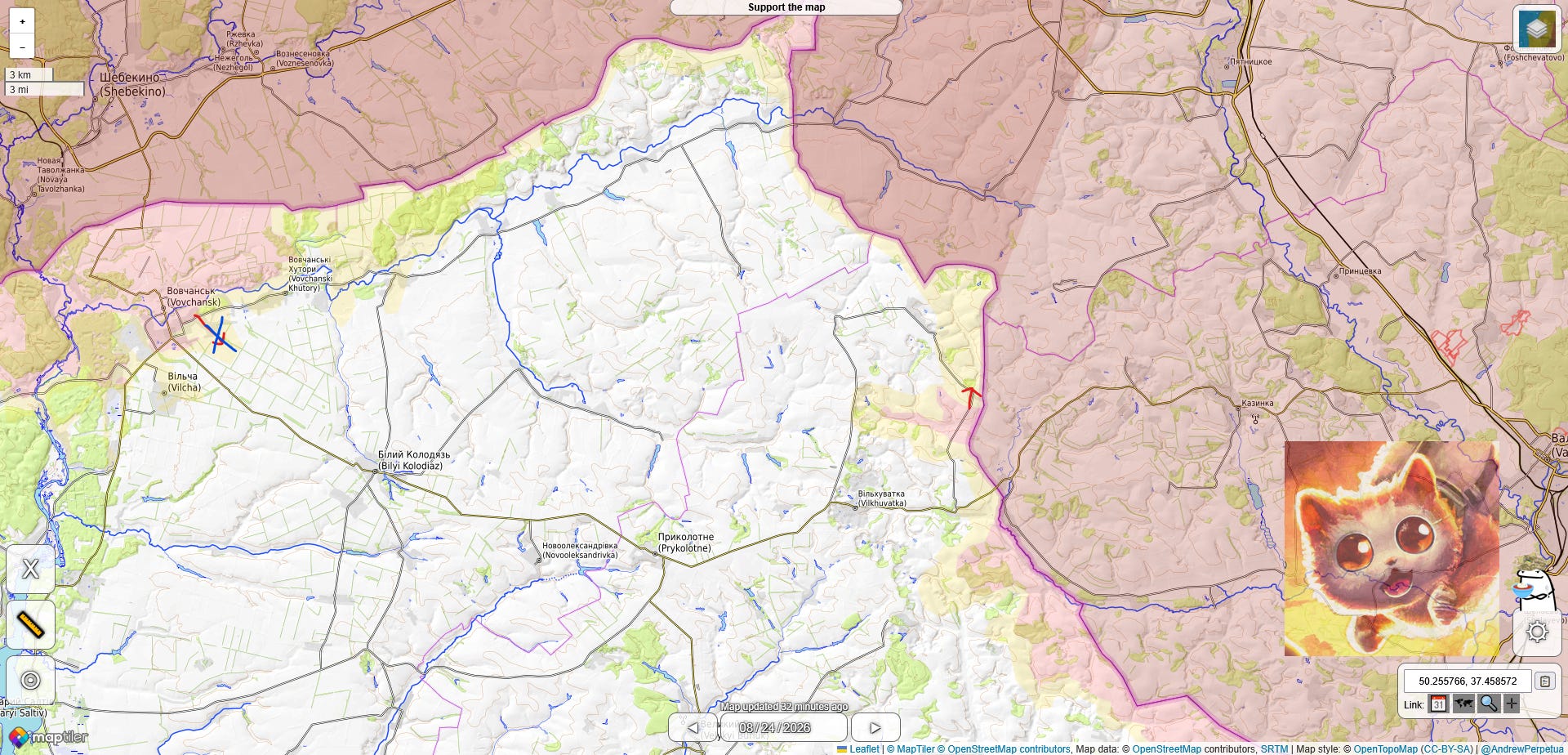
Moscow has also upped the rate of assaults in the Kharkiv border area somewhat, with the intent being to finally secure the Vovchansk ruins and expand a buffer zone under orc control in the rural country along the border to the east. Successes are few, the impact minimal at best.
This is a luckless front for Moscow and has been since the war began. I get the sense that if Kharkiv were the center of its own country east of the Dnipro it’d be fighting russia with or without the rest of Ukraine. Tough people out there, even for Ukrainians. Even in that hypothetical war, the russians would still be losing.
Kupiansk
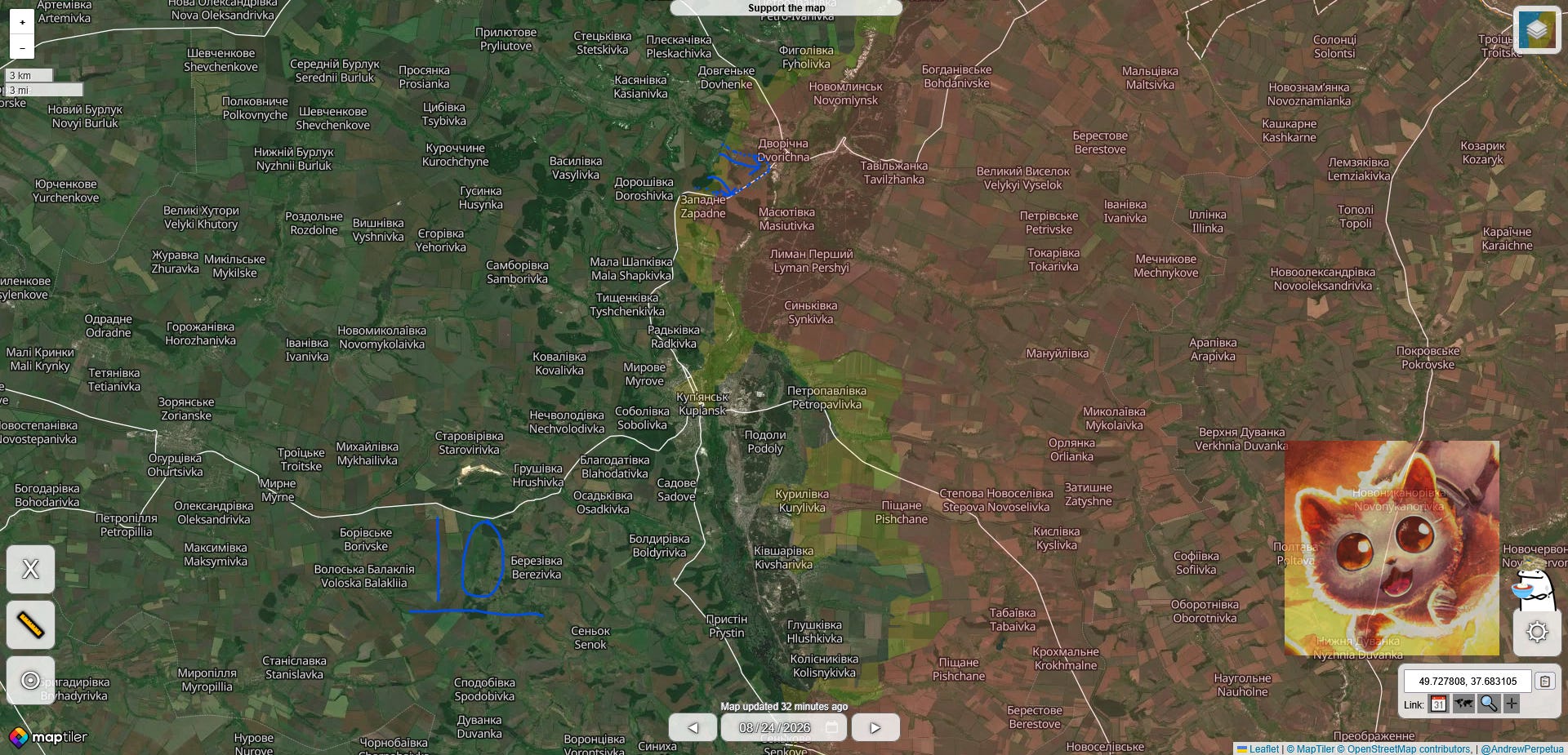
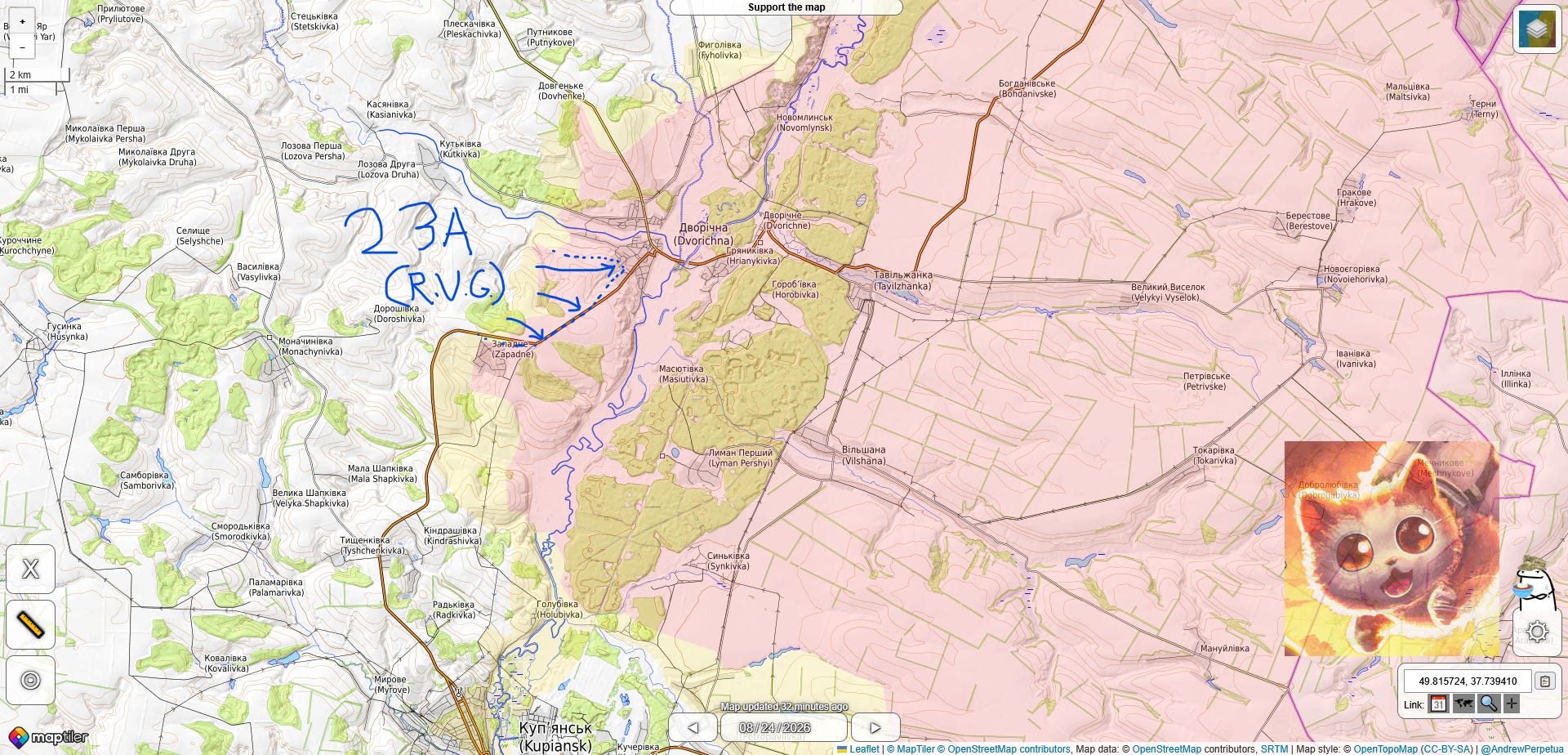
An assault regiment employing Russian-speakers fighting on Ukraine’s side claim to have advanced near Dvorichna, which if part of a broader successful effort could be a very significant development. It was Moscow’s seizure of a bridgehead across the Oskil here many months ago which made the fall of Kupiansk a real possibility.
Ukrainian forces contained the bridgehead, but the orcs were still able to use it to sneak hundreds of infiltrators into Kupiansk. They’ve been working at this again, and along with the enemy’s slow progress in reducing Ukraine’s bridgehead on the east bank of the Oskil have put Ukrainian forces here in a bad situation.
Elimination of the Dvorichna bridgehead should leave pipes under the Oskil as the sole infiltration vector Ukraine has to worry about. The hold on the eastern bank could be reinforced. Moscow would also no longer be able to threaten breaking out to the north in an attempt to link up with forces trying to push down the west bank of the Oskil further north.
Unfortunately it’s not going to be easy to do more than further compress it, because of the broad forest tract the orcs control just across the river from Dvorichna. Without clearing it, orc pressure on the far bank will continue to mount. Difficult to see even a joint effort by 10th and 2nd Corps getting this done, what with 10th having to fight to fend off the Muscovite grind towards the Oskil south of Kupiansk.
Lyman
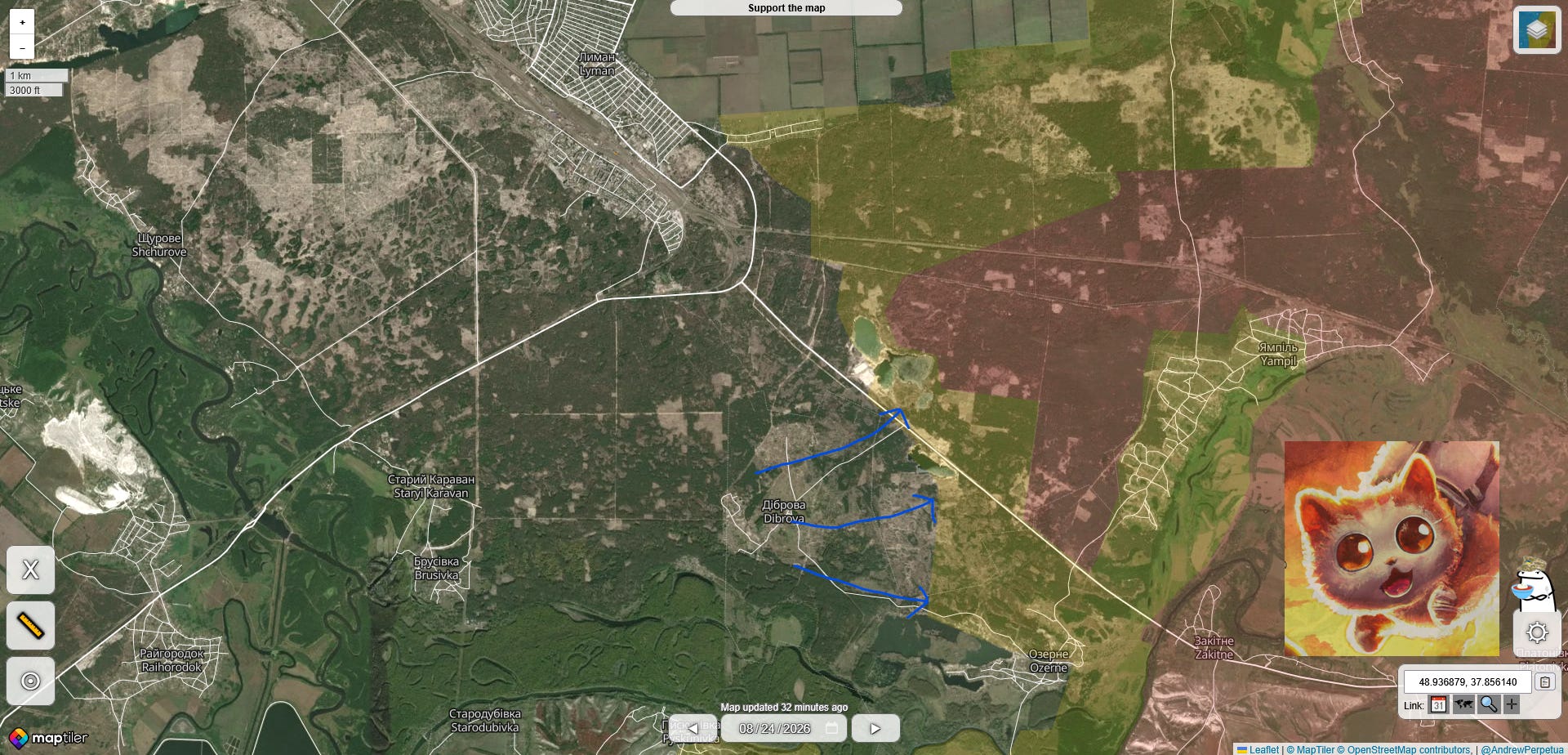
Hard fighting has been taking place in the forests along the Siverskyi Donets for a long time now. Not sure anyone has published even a fraction of the details. The Ukrainians, on the whole, seem to punch above their weight when there’s cover available.
There does indeed appear to be some sort of effort by 3rd Corps underway on the Lyman front, though at present it looks limited to maintaining control of Dibrove and Ozerne. However, when Siversk fell, a serious concern was the orcs pushing over the Siverskyi Donets towards Lyman down the highway passing just north of Ozerne. This hasn’t happened, though the enemy was able to cover some of the distance between Siversk and Sloviansk further south.
Each front interacts with adjacent fronts, so any Ukrainian success (or failure) has broader impacts. With 3rd Corps holding so firm around Lyman, the job of 11th Corps on the Sloviansk front is more manageable. If the situation in 3rd Corps territory can be substantially improved, Ukrainian teams on the Lyman front will be able to continuously harry the flank of orc troops heading towards Sloviansk.
Sloviansk
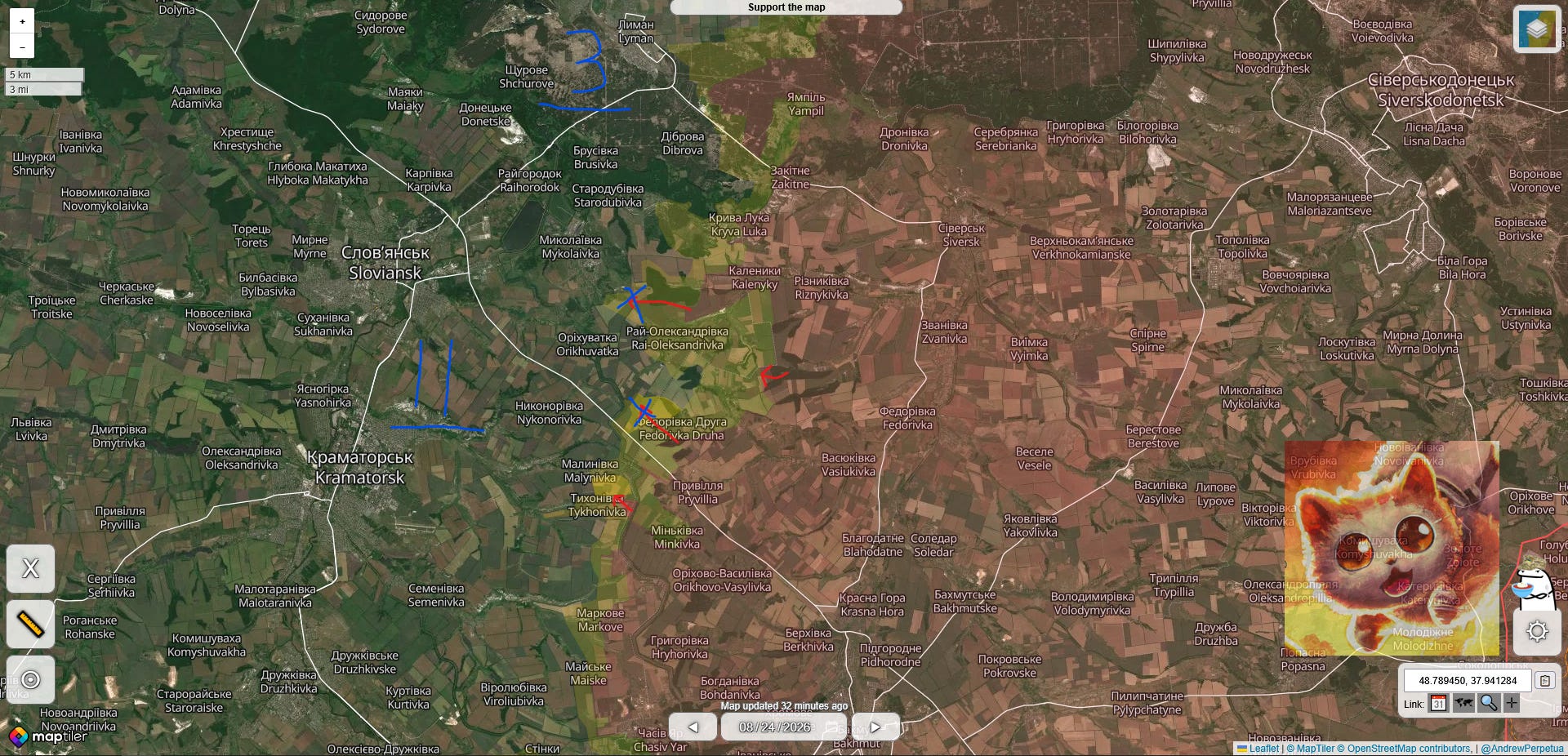
11th Corps has a new commander, a proven guy who has to make sure that the orcs pay a huge price for any gains on such a critical front. Sloviansk and Kramatorsk are both now at the edge of the orc killzone, so every kilometer closer enemy drone teams can operate raises the risk to Ukraine’s Donbas fortress.
Putin’s sole remaining hope is that by grinding into Sloviansk and Kramatorsk he can accept a ceasefire and call it an epic triumph over NATO and the west. Failing that, he knows that he’s a dead man. Best to expect that this front will never die down, even if it isn’t a priority until he’s at his last throw, at which point an all-out frontal charge may begin, no matter the cost.
At the moment, all the orcs are managing to do is slowly take control of the forest tracts between Siversk and Sloviansk. They’re trying to push across the Siverskyi Donets-Donbas canal in places, too. For the most part, they’re stuck.
Kostiantynivka
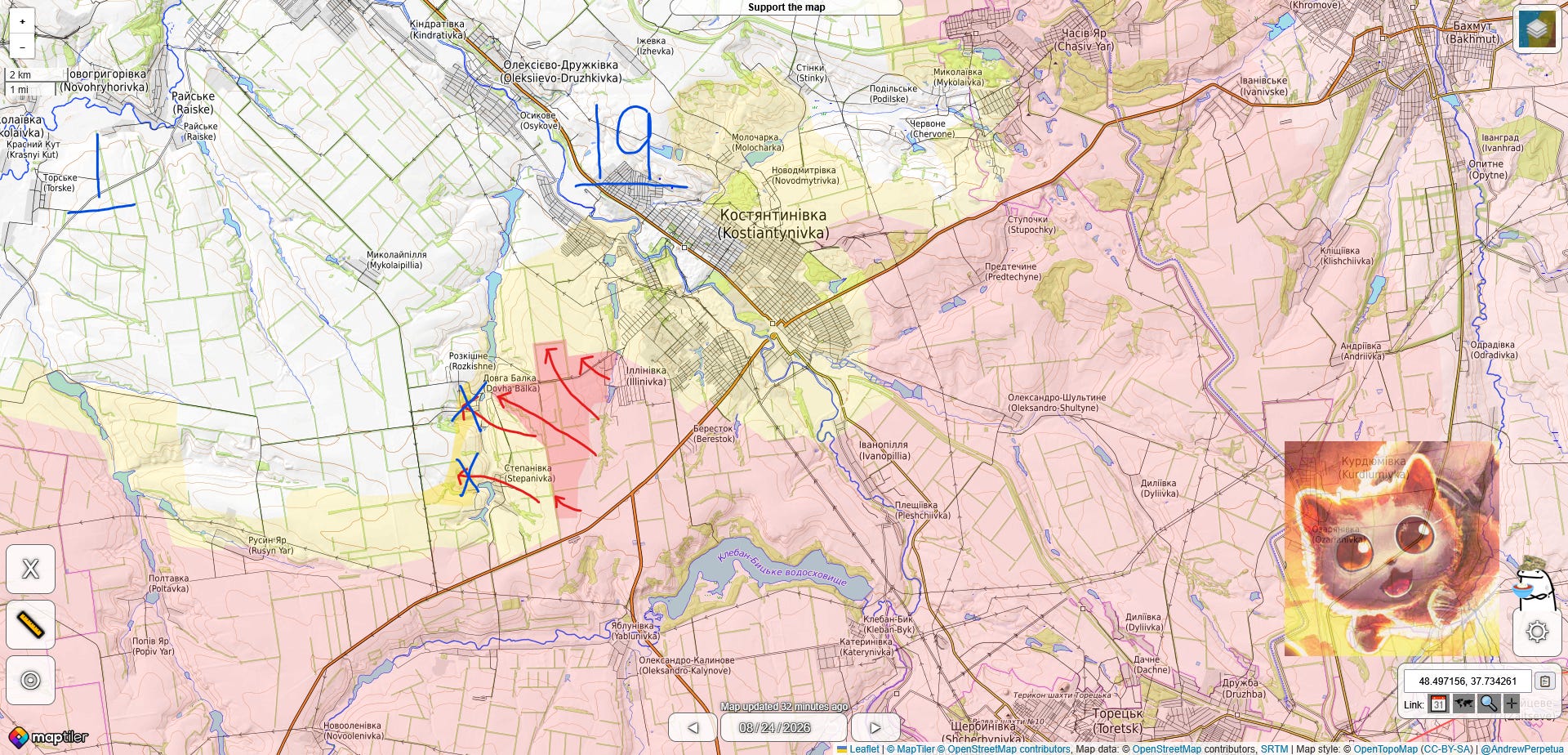
Moscow’s long slog into Kostiantynivka is at the stage where the enemy is forced to try and push back the Ukrainians from flanking positions that help maintain Ukraine’s slaughter of orc reinforcements infiltrating into the city. They’ve managed to secure a chunk of real estate between the villages of Illinivka and Dovha Balka, a series of fields that once captured stand to help widen the infiltration corridor into Kostiantynivka through Illinivka.
It’s hard going for orc infiltrators in the city, with Ukrainian artillery working on positions pretty much nonstop. So whether Moscow’s loss rate here is sustainable is an open question. I’d expect it isn’t, otherwise the enemy would push move forces in, not protect the flanks.
There hasn’t been any visible weakening of Ukraine’s front on the other side of the city. It’s not a great situation, but far from hopeless. However, counterattacks on this front appear most unlikely. Kostiantynivka is probably going to be occupied and devastated - but it may be the end of the road for Putin’s Donbas slog.
Dobropillya
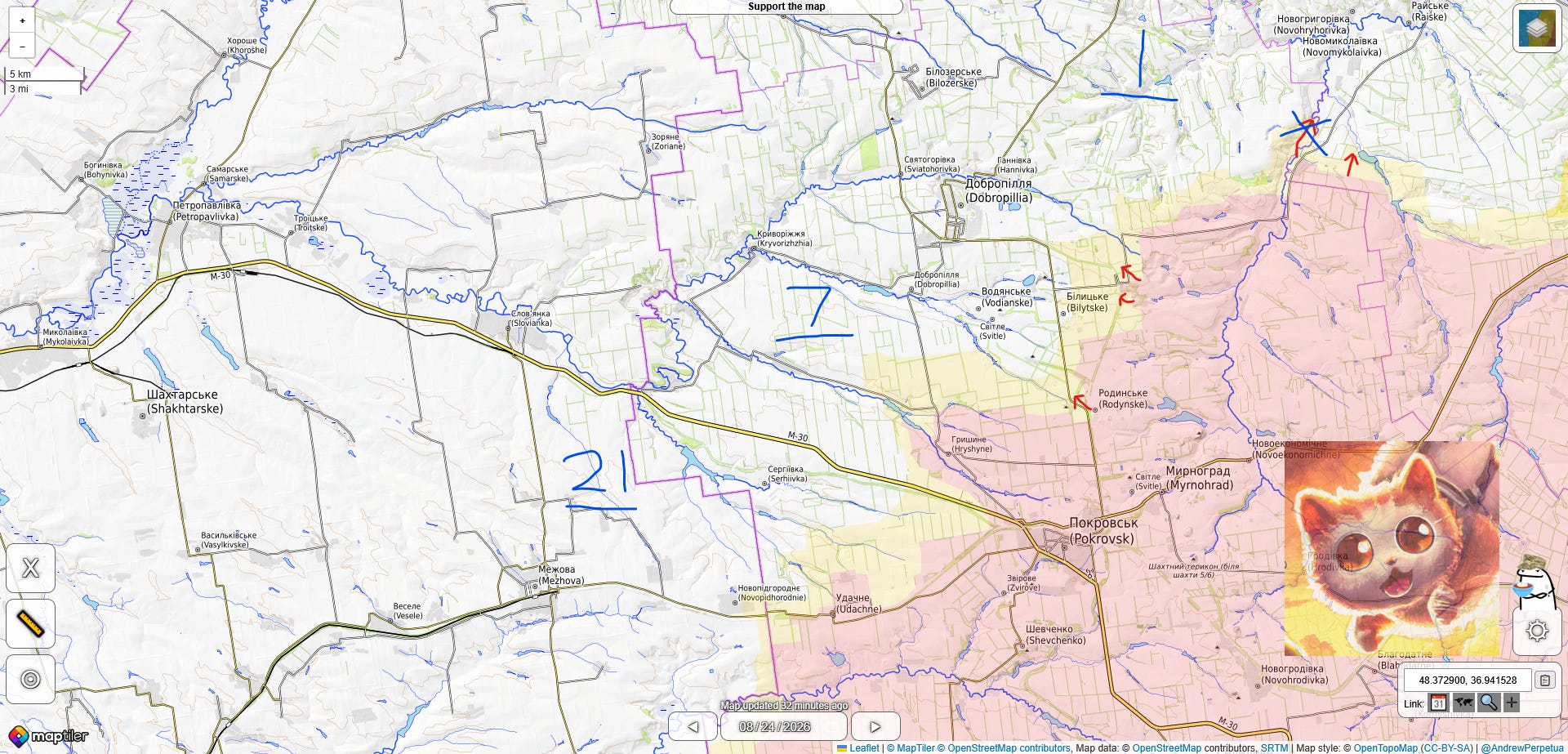
Moscow’s biggest effort remains the stalled advance on Dobropillya, which two of Ukraine’s toughest corps - 7th and 1st - have been savaging all year. There’s been precious little visible change over the past week, just the orcs taking control of a field here and there.
In half a year, the orcs haven’t managed even half the distance from their former lines to Dobropillya. Taking it and cutting off urban Donbas from the west is beyond Putin’s reach. Which means that he’ll have to commit to a frontal assault to have any hope of taking it, the casualty rate probably going twice as high as it is now.
Putin could very well mobilize in a month, intending to drag the war out for years to come, only to lose everyone pushed to the front faster than they can be grabbed off the street. Half a million dead and crippled in nine months is well within the realm of possibility. And he’d still fail to take Donbas for all of that.
Gotta wonder if he actually does have terminal cancer and just doesn’t care. But there are plenty of examples across human history of leaders who roll the dice right up until the bitter end.
Zaporizhzhia

As expected, the Ukrainians haven’t claimed any new successes on the Oleksandrivka front along the southern Vovcha. A long, patient counteroffensive, once revealed, has probably already ended.
There is some hope of the Ukrainians finding a way to liberate Velyka Novosilka and Huliaypole, but my sense is that if the orcs want to keep trying to cling to towns haunted by drones, Ukraine is good with that. Likewise, while there’s always some potential for a Ukrainian breakthrough along the Dnipro, it’s more likely that it’s generally best to wedge the orcs out, ideally making them leave of their own accord.
Hopefully, it works the same in Crimea. And Donbas.
Kherson
No new developments in Kherson, at least not officially. But of all the fronts, this one is probably the easiest for Ukraine to suppress footage until the time is right.
So if something is happening, it could well be invisible to everybody but the orcs. Who could have realized that the time for voluntary withdrawals from certain areas has come.
Potential indicator of them accepting the inevitable would be a rotation of higher quality formations to other commands and mercenaries or disposables too useless to just send to die in Donbas start coming in. Surrender rates spiking would be a useful sign.
Air, Sea & Signals
Air
Ukraine has lately been scoring more hits on orc jets at rest, pounding airfields in Crimea and the border regions of russia that host Su-30s and MiG-29s. A heavy Su-34 was confirmed badly damaged deeper in russia, beyond Volgagrad. Every single jet lost has an outsized impact on the enemy thanks to the difficulty producing replacements.
Another side benefit of Ukraine’s drone onslaught is no doubt the rapid deterioration of orc aircraft. It’s reportedly placing a strain on Ukraine’s maintainers to keep upwards of a couple dozen F-16s either deep underground, in the sky, or briefly parked to rearm and refuel or get towed into a bunker. Moscow has a whole lot more airspace to cover, even if the available fleet is larger.
It isn’t ideal for anybody to have to chase down drones with fighter jets. Beyond the cost of missiles, the budget for a single drone gets absolutely swallowed by the per-hour price to operate a multirole aircraft. Jets against cruise missiles - great. Miniature ones in larger numbers, less so, but they cost twice as much as prop-driven drones. Against thousands of FP-1s or Shaheds? Massive cost sink.
Incidentally, this more than pretty much any other factor is what dooms Taiwan in any war with China. Unless allies ride to the rescue and widen the conflict beyond Beijing’s pain tolerance level, all China has to do to beat Taiwan is flood Taiwanese airspace and waters with cheap, disposable drones, around the clock. Taiwan will run out of bullets before China runs low on targets, if it comes to it. Bitter thing, geography.
Ukraine is lowering the cost of taking down drones by replacing missiles with laser-guided rockets and even bold Viper jocks gunning the things down with 20mm blasts. Some Romanian Viper driver got to brrrt an orc naval drone what came too close to The Romanian coast the other day - so much for guns being obsolete on jets (again) like the F-35B and C variants. So lower-cost options are in the pipeline.
Can Moscow employ its own? Perhaps, but even if the orcs manage to fast enough, they’re still covering a much larger chunk of territory than the Ukrainians. Moscow is far behind when it comes to interceptor drones, and what’s more, would struggle to use them in barrier mode like Ukraine does: continuous belts where enemy drones have a good chance of being detected and knocked down.
For that, you need a comprehensive battle management system that pulls in data from a wide variety of sources and lets teams in the field have access to whatever they need on demand. Not something a command hierarchy driven by lies like russia’s will tolerate.
Ukraine has had a devil of a time, it seems, keeping Delta from being abused by officers who don’t get that they’re subordinate to technology now. Of all the specialties set to be replaced by AI tools, officer is near the top of the list.
The purpose of centralized data management system is not to shut out people lower on the ladder, but to provide them with exactly what they need to do their jobs well. And ideally, no more than that, because information overload is its own hell. Better to err on the side of too much, though.
But the natural tendency of a military officer is to see a system like that as a massive liability to their way of life. Not unlike how many writers and other creative types are so afraid of AI. It threatens to reveal secrets about how they operate they badly need to remain obscured, otherwise the illusion central to their game is visible to all.
Returning to aviation specifically, for Ukraine’s aviators patience has been the paramount cardinal virtue since the beginning of the war. It’s taken far too long to bring Ukraine to the point where Meteor-armed Gripens are at last on the horizon, capable of neutering the glide bomb threat which does so much to limit what Ukraine can do on the ground, besides terrorizing Zaporizhzhia, Kherson, Sumy, and Kharkiv.
Incidentally, one of the very few social media accounts I follow, Special Kherson Cat, has been running another fundraising drive for several Ukrainian fighting units. One of them is in tactical aviation, and kindly posted a cockpit video from his MiG-29 for the community, including a couple barrel rolls.
If nothing else, this war has produced some incredible footage. Having once been a kid who played a lot of flight simulators, and liked the MiG-29 and Su-27 as much as the F-16 and F/A-18, it’s a real kick to see a feed from a helmet cam over Ukraine.
Gripen is in another league altogether, though. Can’t wait for the first cockpit footage from one of them firing a Meteor from treetop level against a Sukhoi that isn’t aware of the threat it’s facing down. And corresponding footage of the thing burning as it spirals to the ground. Eternal flight in concrete, orcs.
Sea
As much as Ukraine’s display of ground drones during this year’s Independence Day parade showed how much roles formerly performed by dedicated weapons teams in platoons are being replaced - and with them the beating heart of the modern infantry - it was telling to witness the variety of outfits available for Ukraine’s naval drone fleet nowadays. They can carry surface-to-air missiles, rocket launchers, FPV drones, electromagnetic warfare gear, supplies, and in some cases, ground assault drones.
Ukrainian drone fleets are like warships broken apart and scattered across the horizon, which gives them a level of redundancy that I don’t think has been fully appreciated yet. We aren’t far from the moment when a flotilla of small drones clears space for larger ones, the only crewed warships sitting safely a thousand kilometers from danger.
Fleets will likely try deploying drone flotillas as far out as possible from the main body of their formation, hoping to detect and react to inbound threats as far from vulnerable crewed vessels as they can. Could well see drone carriers equipped with air and naval drones and a small squadron of high-endurance crewed multirole jets replacing the supercarrier of today within a decade.
I have a sneaking suspicion that the Ford class the US is currently building will be truncated at four, with Doris Miller. Whill won’t be renamed the Donald J. Trump, just as there won’t actually be a (gag) William J. Clinton or (uber-gag) George W. Bush. The US will also never built those stupid battleships Trump is so keen on.
During the fight with Iran, lead ship Ford had a fire in the laundry room that briefly took her out of action - not a fantastic first combat deployment by any stretch of the imagination. Lincoln has been pushed to the breaking point, forcing her relief by Washington, which is supposed to be the on-point Japan-deployed US carrier that’s always ready to deal with China. Soon enough the carrier that replaced Ford, George H.W. Bush (a legitimate case of naming a carrier after a US president, because he flew torpedo bombers in the Pacific War) is going to have to head home, either back around Africa or to a new home port in Seattle or San Diego, if she’s set to replace Nimitz, which seems likely enough. That means hard-used Roosevelt goes back to the Middle East instead of somewhere in the Pacific even as Washington gets closer to being forced to retire to Yokosuka for repairs, forcing the next carrier in line, Stennis or Vinson, I think, to join Roosevelt.
This means fully half of the U.S. Navy’s carrier fleet has wound up being directly tied up in the Iran War, fighting a country with as many ships as Ukraine. To deal with any crisis involving China, the U.S. Navy would need a bare minimum of three, ideally four, meaning another two or three held back preparing to deploy. And now the US is talking about an indefinite blockade of Iran, something a single carrier can’t swing.
The severe limit in the number of key assets available is going to lead to smaller carriers sooner or later. If you want to screw with the USA, all you have to do is tie down one or two carriers and all US naval planning for years to come goes straight to hell. The USA needs twice as many of roughly two-thirds the current size, optimized to support aerial and naval drones.
I have to consider it a testament to what the Ukrainians proved was possible to accomplish that the US has been extremely reluctant to put warships of any size in reach of Iranian weapons. The few actual transits of destroyers through Hormuz that happened were contested, risky affairs that could have gone very wrong. They were tests that proved US bombing was less effective than hoped.
With Moscow’s troubles at sea joined by American, changes in naval warfare are coming. Ukraine, strangely as it might sound, only having access to the Black Sea stands to be a leader in naval drone warfare, able to run live tests that prove what small drones with a moderate range can do. I think it highly telling that Britain's Royal Navy, not one to jump on a trend for the sake of it, is embracing drone flotillas.
Not a drone-only fleet, but a mixed one. Smart way to go.
Signals
No serious changes on the electromagnetic side of things just yet, but this domain is always in flux. Pun semi-intended.
The most significant development this week was likely an attempted attack on Moscow’s spaceport up in the Arctic, at Plesetsk. If something isn’t sent up from Baikonur down in Kazakhstan, it goes up from the closed city at Plesetsk. No record of anything getting hit, so could have just been recon, or an outright failure.
But it means two things: one, that Ukraine is deadly serious about preventing Moscow’s Starlink competitor from achieving liftoff, and that Moscow’s most strategic assets are now vulnerable. I sincerely hope to see a successful Ukrainian drone strike on Moscow’s ballistic missile submarine fleet, despite the risk of escalation any conventionally trained expert would cry about.
Any and every opportunity to show how hollow Muscovite threats of apocalyptic retaliation are seen should be taken short of actually going nuclear first. Best answer to that new sub entering trials that can carry six strategic nuclear torpedoes is to introduce it to a drone or two.
Staff Affairs
Political drama continues in Kyiv, as Federov’s replacement being confirmed by parliament seems to have sent him into a minor meltdown. Khmara doesn’t have a negative reputation so far as I can tell, and should work well with Drapatyi. He resigned his commission to ensure the law about a civilian holding the post was followed. So all seems fully in order to me.
Federov’s response - calling for elections, war be damned - indicates that he probably does need a bit more seasoning before getting into politics, and the issues he had with Syrskyi were as much a function of his game-playing a Syrskyi’s. I was apparently incorrect about Federov and Zelensky agreeing on a gambit that would let Syrskyi hang himself if that was his choice - it’s looking more now like a genuinely simple case of two reasonably effective subordinates butting heads, both too stubborn to back down.
Now both are replaced, and the machinery of Ukraine’s fight is chugging along. Not that there isn’t certainly plenty of corruption to be rooted out. That’s true all over the place.
Federov refused multiple high-level positions, making Zelensky reinstating him into a political nightmare that would have made people constantly talk about Federov’s ambitions. So he’s now free to travel to the USA and pursue them, or enlist, as he and the people who hate Zelensky are welcome to do. Or start their own private drone units - that’d be find too. My own choice, given my personal mistrust for military institutions.
Calling for elections was a mistake that badly misread Ukrainian public opinion, though which can’t see holding elections when Putin would have every reason to cast an Iskander vote, then alleging that the elections weren’t fair because some polling places were too unsafe to visit. Federov definitely sounded like a guy appealing to the powers-that-be in the west to attract support.
It is a good idea to hold elections in Ukraine as soon as possible, by the end of next year even absent a ceasefire. With sufficient preparation and digitization, ideally through a secure digital app with active verification measures, plus an India-style process where voting takes place over several days to mitigate the threat of orc attacks, it’s possible. But it won’t happen this fall, so talking about it now is kinda dumb.
To Federov’s credit, he quickly backed down, clarifying that he only meant that preparations for elections have to begin. This was a good move, and his best path forward. He can embrace the popular narrative that corruption is responsible for all of Ukraine’s ills, repeat opposition rhetoric, and go to the USA to build his international profile - fine. Just like Zaluzhnyi, he gets to enjoy his democratic freedoms while other Ukrainians sit in holes hiding from drones.
And that should be it for the Federov Affair, insofar as battlefield relevance goes, unless the dude can win Elon Musk’s approval for using Starlink in the border regions of russia where Iskander launchers hide. If this whole thing is a giant game with that as the goal, cool. Whatever works.
Beyond that, rumors about mobilizing women have appeared again, fueled by the otherwise reasonable statement by Trump’s envoy, Kellogg, about women being drafted in Ukraine. All he said was that it makes sense, since men are subject to it I agree, as equal rights mean equal responsibilities. Anybody who calls themselves a feminist but lets the men go off to fight when the time comes is a hypocrite.
That being said, it’s been established that bodies in uniform won’t make it possible to staff every infantry battalion sufficient to let Ukraine go on the offensive. More people = more logistics = more targets for the enemy. Ukraine is already retraining large numbers of combat soldiers to operate drones.
Figure out the tech first, then find the right people to operate it. Though here, there’s substantial evidence indicating that women may, on average, be better drone operators than men. For much the same reason women are often very effective snipers. Breath control and fine motor skills matter more than the ability to do however many push-ups on command.
Strike Campaigns
Ukrainian Middle and Deep Strikes aren’t slowing down one bit, the geographic range keeps expanding, and the orcs haven’t come up with a solution. Hard to see how they can given the growing weakness of their defenses.
Like in naval combat, it doesn’t matter if you intercept 90%, 95%, or even 99.9% of incoming shots: if that one leaker out of a thousand hits a vital system, combat power is incapacitated and the next wave of attacks stands a much better chance of getting through. To calculate whether an attack is worth it or not, you compare the expected cost-benefit ratio of the strike, benefits being measured in material harm to the enemy.
Ideally, you stack the odds, too. Ukrainian attacks in a given direction now pretty consistently begin with deliberate strikes on enemy radar and air defense systems. I can tell that they want to get at Rostov-on-Don, for example, by the recent uptick in radars being taken down between it and occupied Ukraine.
Once a gap is torn in the border defenses, drone flights penetrate deeper, avoiding point defenses around sites they aren’t going after. Enough accumulate in the skies around the actual target area then push in to overload local defenses. Just enough strike drones of the right type make it through, as many of the others the orcs take down are simple decoys, to inflict the desired level of damage.
Damage done to the local air defense network takes a couple days to repair, enabling repeat strikes if the first doesn’t get the job done. Ukrainian planners reportedly make heavy use of processed satellite data to work out optimal flight paths - may sound like AI taking over, and maybe it is, but this technology has been used in academic research for around a generation now.
At the moment, it looks as if Ukraine’s ongoing rate of inflicting damage exceeds Moscow’s ability to repair the harm done to oil refineries and warehouse logistics. If Moscow’s air defense performance deteriorates at any point due to lack of systems or shots, the damage is liable to be magnified, as Ukrainian operators can re-route drones mid-flight to go after a secondary target.
It’s a recipe for cascade failure. Might already be well underway, considering how Ukraine’s drone reach and impact keeps going up and up.
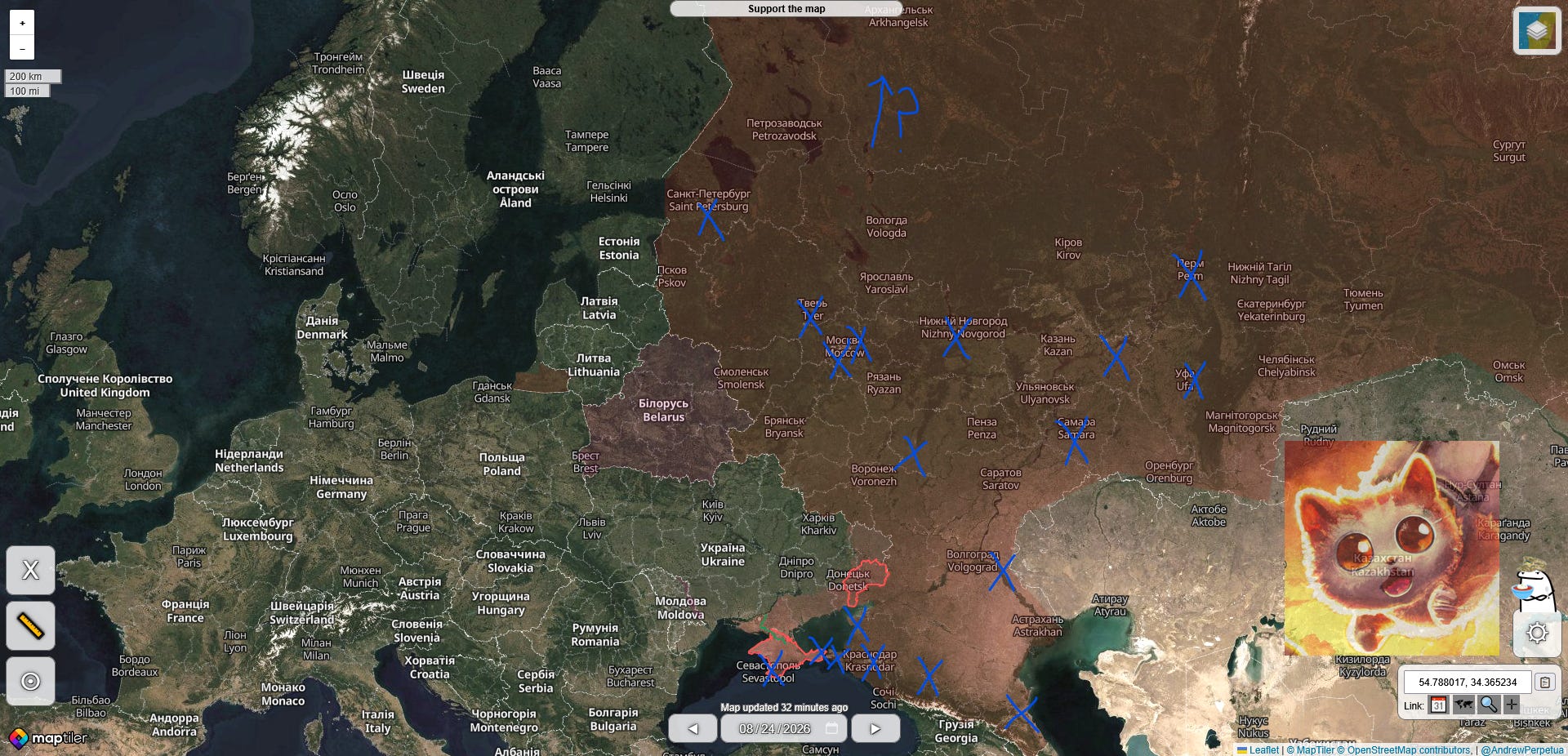
Moscow is of course trying to adapt to this new and unexpected threat - when it comes to technical matters, the orcs are unfortunately a lot more on the ball than their ridiculous tactical and operational patterns would suggest. I consider this to be the primary logic behind Ukraine burning all those Wildberries hubs and starting on Ozon.
While they’re legitimate targets with real military utility, hitting them is definitely on the edge of acceptability, given the risk to civilians. A warehouse can be set alight and slowly destroyed, giving most workers time to evacuate. Ukrainian drone attacks unfold over time, so advance warning is usually possible for the orcs to provide, if they choose to. You do what you can to avoid bystander involvement.
The strategic value of going after logistics warehouses, aside from reminding rich orcs that their money is at risk so long as the war continues, lies mostly in forcing Moscow to add another category of targets to their list of places that Ukraine might attack. Ignoring Ukrainian drone attacks isn’t possible thanks to the nature of the ruscist system. It’s a major political setback that brings closer the happy moment when russia falls apart whenever the Muscovites visibly fail at security.
Revenge is necessary, in their world, and it will be directed against civilians, because that sends the message: war is sad and bad and good western minds should turn away and demand peace at any cost, because isn’t life precious? It will be heard and amplified by The New York Times, Wall Street Journal, The Atlantic, et al.
But that’s not the fault of Ukraine, which was already suffering injury to civilians from prior russian actions anyway. Still, the physical destruction of warehouses, as opposed to stuff like refineries, is mainly acceptable because every SAM system or gun team covering a warehouse is one less guarding a refinery.
This isn’t about making Moscow choose between defending the rear or the front, but which strategic assets are going down first, since Moscow can’t protect them all. Logistics infrastructure is dual-purpose, meaning it’s sufficiently military that targeting it won’t trigger a serious backlash among most reasonable minds. Unlike civilian airports around Moscow, which Federov allegedly wanted to attack in a plan Zelensky wisely rejected. Though you have to take anything published by Simon Shuster with about a cup of salt.
It’s a fine line, I know, but the risk to civilians in a sustained attack on airports in a major urban area is extreme, which isn’t true of refineries or warehouses. Start putting hundreds or even thousands of people at risk for what could only be a political statement at best is where you’re creeping into Bomber Harris territory. He was the murderous twat who insisted that wiping out German housing was a practical military task because it would crater moral which would foster rebellion against the Nazi regime. Didn’t work, got lots of pilots and civilians killed, and renders him a full step below that sick old bastard Curtis LeMay in the annals of military history.
Why does this matter? Pragmatism alone, so far as I’m concerned.
Murdering civilians isn’t wrong because there’s some magical force called justice that is aroused when certain bad things happen. It’s wrong because when you murder civilians it makes most people - who happen to be part of the category civilian feel afraid of you, and as a result they’re less likely to back you. Many will want to harm you. Karma is made real by everyday actions. People naturally empathize, and extreme actions will generate a countervailing response in time.
Look at Israel. Once Israel employed its military superiority over Palestinian civilians in a manner that left tens of thousands dead (at least), the evidence out there for the whole world to see, even if the media has worked hard not to let it, Israel’s standing in the world collapsed - and with it, the country’s long-term security, because Israel is rather small. Not difficult math.
A whole series of studies could be done detailing every step of the sad story that brought the world to this miserable place. But the past is no longer relevant: only the future.
All evidence points to Moscow being forced to suffer a massive military setback on the ground for this war to ever end. To make that happen means combining Deep and Middle Strikes with appropriate operations on the ground when the time is right.
As for the second category, work continues. And intensifies, all the time. Mobile fire teams don’t seem to be doing the trick for Moscow. Not at all. Even a crude map speaks for itself. Clement Molin’s maps, unlike most of what has been and still gets cited by most journalist types (*cough* ISW *cough*), are solid - I’m adding nothing to them.
There is just, I must admit, a certain tactile pleasure in marking out confirmed hits on orc stuff so far behind the front after so many years watching Moscow enjoy the advantage in this domain. Every time I make a blue cross, that means another Ukrainian drone operator did their job, and this wretched war is one step closer to being over forever.
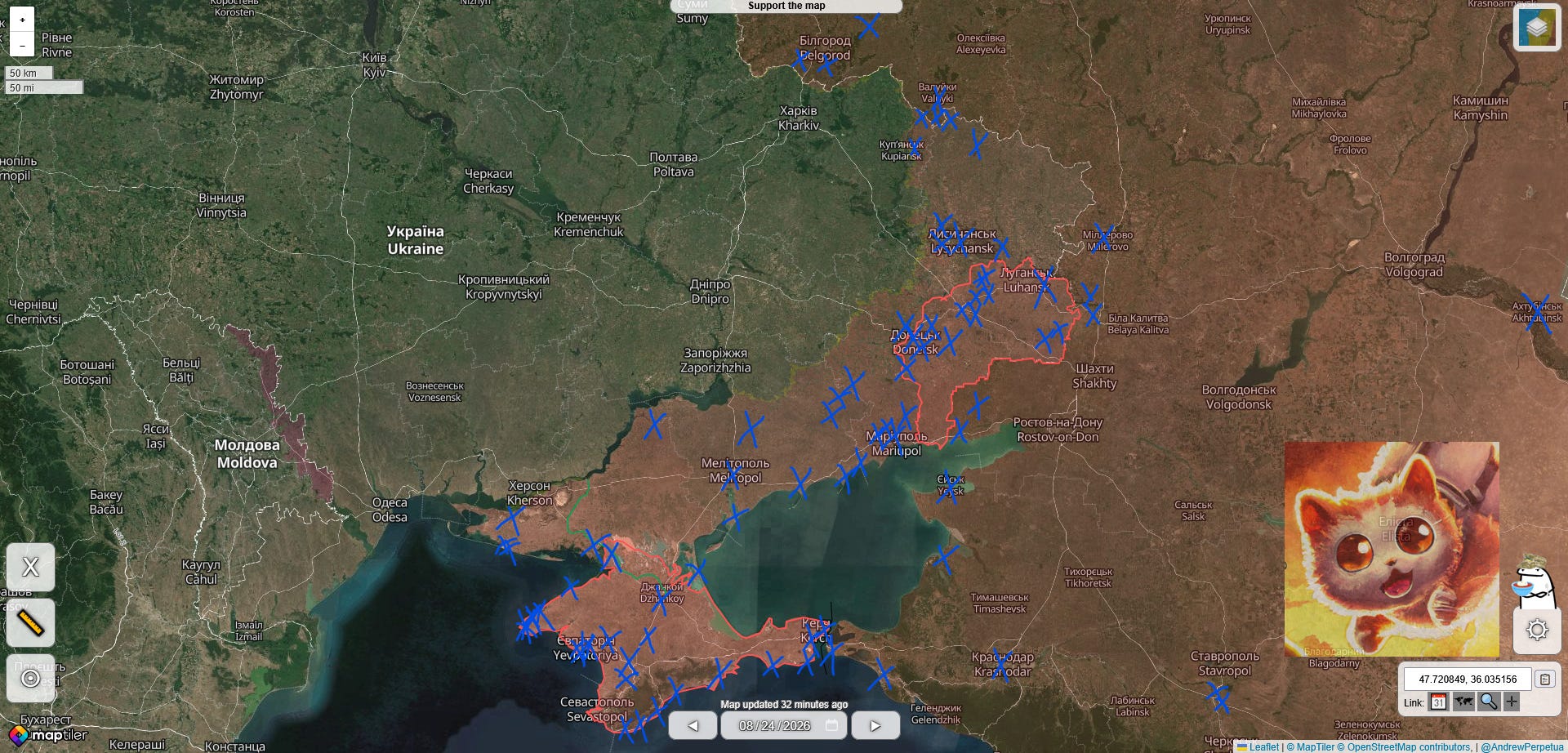
Not much more to be said than that. For now.
Concluding Remarks
Sorry to get long-winded with this one. But it’s time to shift focus a bit on the blog, and I felt I owed readers a sense of where it’s heading.
Gamers are a strategic asset like none other because the fundamental problem of these times is lack of experience with what happens when everything goes to shit. The Ukrainians have learned the hard way how to survive, and they’ve only managed it by leaning on a range of asymmetric tactics and novel developments.
They’ve been forced to play the most wicked game on Earth, and it stands to reason that Ukrainian gamers have been responsible for so much of what Ukraine has achieved. The full story has yet to be told, but the common thread is impossible to ignore: Ukrainian fighters who started out playing video games gained skills and perspective that served them well.
That doesn’t mean all games are equally useful. But there are cognitive lessons and habits to be drawn from and cultivated by the right types of game scenarios.
Cognitive flexibility is one. Especially as I’ve grown older, I’ve begun to notice how much tougher it is to learn a new game model and systems than used to be the case.
I actually attribute a great deal of this to a long habit of reading way too much in lieu of gaming for many years, especially during and after grad school. Reading and writing are obviously useful, but the way the human brain works, they’re not the best means of teaching people to cope with complexity. Much the opposite.
Effective writing is about convincing a reader to hear words you put in their brain as if they’re their own. This is why readers are drawn to certain writers, and why most professional writing has degenerated into a parasocial game designed to prey on loneliness and alienation. Writers are expected as an industry standard to maintain the false impression of a personal relationship with readers. Too many Substack features rolled out lately have supported this nonsense, and I despise it, so I’m done with giving them their 10% cut of what people send to me. And Stripe’s 10%.
I’ve made the decision to stop taking payments, because I’ve realized that I simply don’t like it, even if I could probably make a business of running an international security blog, especially if I moderated certain excesses. Yet I’m a bit old fashioned in that I don’t feel right accepting payment for services unless they’re clearly defined.
Over the past year, I’ve stopped feeling as if that’s true, and truth be told, I’m good with that. I’m not and have never been primarily a writer. It’s just a thing I do and have done since I was old enough to have teachers reward me in class for being better than my peers.
Which only meant more entertaining and easier to grade. That’s the trouble with contemporary writing: deep down, it’s a form of entertainment, not effective communication. When writers lament the lack of readers in modern society, it’s because writing itself has become a meta-genre, an industry serving a particular audience and demographic. If you liked your English teacher in high school, you are a reader.
Well, I hated everything remotely literary, preferring Tolkien - and video games. So it’s not the industry for me.
While I’m not going anywhere, I do intend to refocus the blog on more technical stuff, like how to model what’s happening in a battle or broader war. Because that’s how this unique dataset I’ve been constructing the past few years can best be translated into something useful. Only way anyone in the future will ever even remotely understand the Ukraine War is by experiencing aspects of it in digital simulations and games.
And I won’t be taking anybody’s money, though I do very greatly appreciate those of you who contributed this past year. Way things are going, eventually most of it will wind up being donated to Ukraine.
Nothing is actually changing right away, just wanted to explain why I’ve switched off payments. And that there’s going to be a lot more about game-specific systems going forward.
Because at the very least, if you snatched up the average RTS gamer over the age of about 35 and put them in charge of a Ukrainian brigade formerly led by a corrupt old Soviet, they’d be better than the alternative. Kinda crazy that in warfare this is possible where it wouldn’t be in, say, construction.
It’s a mad world like that.
Comments
Nothing yet. Say the first thing.
Sign in to join the conversation.