
Drapatyi’s promotion to Commander-in-Chief was well-timed. The move looks like a sure sign of what Ukraine plans to get up to in the second half of this year.
Every indicator that I’ve relied on to forecast the rough trajectory of the Ukraine War over these past few years points to Ukraine being in the early days of a large-scale counteroffensive effort aimed at bringing the war to an end before winter. May not work out as hoped, but something big is happening, unless I’m very wrong.
I sincerely doubt there’s enough energy on the russian side to carry on like this for another two or three years. Putin knows; that’s why he’s sounding even more clueless than usual in his recent appearances. Anything to keep up the con.
But Ragnarok is coming to russia. Ukraine is bringing it to them.
Self-promotion warning due here: I authored a long saga published in six parts titled Bringing Ragnarok. Beat Tolstoy on wordcount and, so far as I’m concerned, content too. You might best classify the work as a war saga, which is something quite different in form and function than a war novel, but in the same general literary universe. Taste of it - whole first book, actually, freely available here for the like five or so people who might be interested.
I wouldn’t bring it up here, except so much of the intellectual thrust of the project has been borne out during the course of the Ukraine War. Including the way the endgame plays out, or seems to be doing.
Granted, inevitable mutual destruction isn’t in the cards. But when one side is actually after that, deep down, any and all resistance is a kind of victory.
The paradox of russia as a system is that it can only exist in its present form if there’s a powerful enemy attacking it, otherwise Moscow’s claim to rightful authority has no grounds even in the warped russian world view of things. So the Muscovites are compelled to find enemies until they encounter one too tough to break and too resilient to wear down. The delusions inherent in their own system compel them to slaughter themselves because it cannot conceive of a world where it isn’t both perpetually dominant and eternally at war with indomitable foes.
In the Norse branch of the Indo-European mythological tree, a great deal of emphasis is placed on the inevitability of there being an end to all things in the due course of time. This is the truth of Ragnarok (as I English it, hating accent marks), one that echoes at all scales of life, from the individual to the cosmos itself. Essentially, Ragnarok is a mythic description of cosmic entropy.
Ragnarok isn’t a judgement issued by one or more gods, but a causal process: powerful forces long held at bay overwhelm natural defenses, and every prior assumption about the world starts to change. At the core of the Ragnarok concept is not cosmic destruction - that’s only an ur-myth encapsulating all conflict taking place within, reflecting the cycle at the largest possible scale to make a deep rhetorical point.
During any Ragnarok, conflict between people with differing interests escalates, tearing apart the bonds that hold their world together. After it’s all over, the survivors get back together and start again. Because that’s life: one thing works for a while, then the landscape shifts, and a new arrangement is required.
As with the similarly-derived Greek concept of apocalypse, Ragnarok is part of a cycle of death and rebirth. It’s both physical and cognitive, a force beyond forces yet comprised of them. Fighting it is a mistake - the only way forward is to hack the process as best as you can, taking advantage of whatever opportunities are available to you.
Society, from which media emerges to establish and enforce arbitrary norms of behavior, is in a sense a system built to oppose Ragnarok. You can’t beat the inevitable, though, so society teaches people to fear and despise it. As if that does anything.
But sometimes, it is necessary and even someone’s task to actually engineer the fall. Hello, general Drapatyi, Kyiv is calling with a mission.
And good news, everyone: it’s pretty much 2022 all over again out there. Only instead of HIMARS strikes the Ukrainians have tens of thousands of drones to work with. A hive in form and fact.
Not only flying types are zooming around: ground drones are everywhere now. The combination may even just make it possible for Ukrainian fighters to force the Dnipro in a month or two. If it happens, Moscow’s occupation of Kherson is toast, and Crimea will be vulnerable not long after.
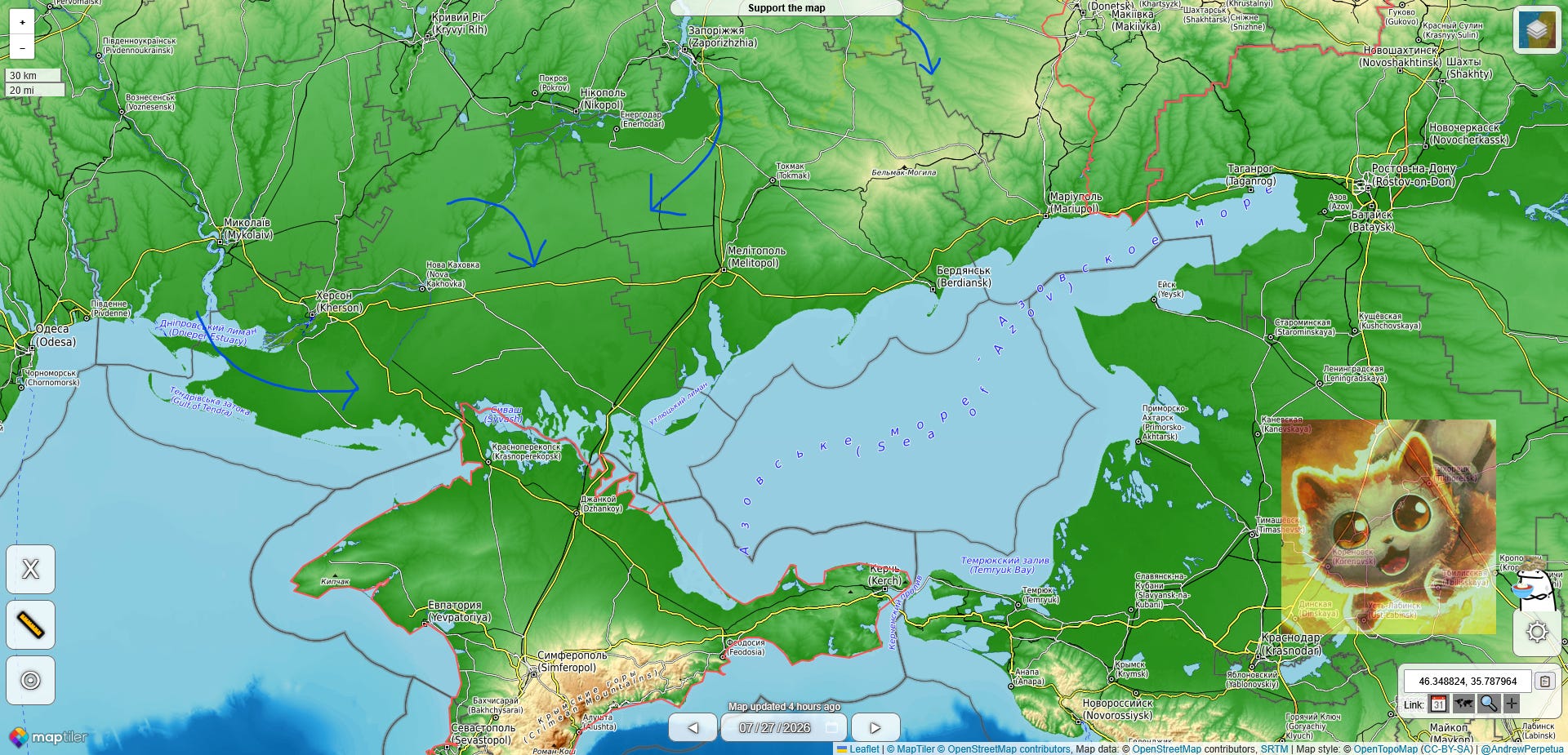
Logistics Lockdown, in and of itself, won’t accomplish anything other than make it more difficult for Moscow to advance in the field and hold positions. Smashing enemy industrial production follows the same logic, though the downstream effects of hitting the right node can definitely be crippling, impacts spreading like a wave.
Middle and deep strikes are incredibly important, yet remain only crucial enabling elements. Putin is simply not going to end the war unless forced to in some variety of coup, and he’s unlikely to be overthrown until Ukraine proves that sooner or later the occupied territories will be freed by force of arms even if russia refuses to negotiate.
Putin’s grip on the throne is now secured only by the belief that no army can ever get to it. Once that’s shattered, he’s done for. His own system can’t tolerate open failure of the magnitude the ignorant old swine has managed in Ukraine.
Ukrainian attacks on Muscovite oil and logistics infrastructure do damage to the sense of invulnerability he cultivates, but can’t dispel it on their own. They are about piling pressure on the ruscist economy as well as demonstrating to Putin’s people that this absurd war has colossally backfired. Since he was the one who insisted on this war, having it turn back on russia like this is a special sort of emasculation.
Putin can apply all the lipstick he likes, but a pig is still a pig. And his bacon is sizzling.
He’s been giving more public appearances lately, squealing about somehow winning (eventually) while accusing the so-called West of aggression that made the war necessary. While he’s pushing that boring line, Kremlin propagandists are busy tossing out outlandish nuclear bluffs so useful idiots among the expert class abroad can worry about dreaded escalation.
This propaganda campaign is just another sign of the orc-in-chief’s desperation. It’s easy to talk, and Putin’s geriatric flunkies will, but people pay closer attention to facts on the ground. Particularly in the form of boots.
Drapatyi’s challenge as Ukraine’s military chief is taking full advantage of the roughly three months that remain before Moscow’s increasingly exhausted occupying forces start receiving fresh meat from a new mobilization wave. New orcs won’t show up in huge numbers overnight, but in a matter of weeks the ranks of disposables will be high enough to blunt Ukrainian operations soon after they begin.
Thank goodness Putin and his orcs were too stupid and shortsighted to spend the past two years holding the line and training a truly modern army instead of throwing bodies into the grinder like it’s 1916 again. The Ukrainians have played the energy management game well, presently enjoying the benefits of a period of effective exponential growth in drone capabilities at the precise moment Moscow’s own fighting potential has stagnated for lack of appropriate resources.
Throwing people into the killzone has never been an effective approach. The killzone itself is expanding faster than orcs can crawl. Meanwhile large swaths of ground Moscow claims to have captured is occupied by no more than scattered groups of orcs hiding helplessly in holes, their only military purpose being to prove that the Ukrainians don’t have people in the same exact positions.
If your system is in the spring phase of the adaptive cycle, as Ukraine’s drone game presently is, while the enemy’s has entered autumn, it’s time to attack wherever and however you reasonably can. The essence of what is termed military art as well as science is engineering this mismatch. When it works out, the apparent trajectory of history can change in the blink of an eye.
This is an illusion, of course, like all history. Stuff just happens, and people apply a narrative after the fact to make sense of things. What occurs and how it goes for the participants tends to be a function of deep, slow-moving variables that largely fore-ordain outcomes. Ignoring them until they explode in your face doesn’t mean someone all of a sudden burned down the world. The kindling was already piled.
All systems have a breaking point. A threshold beyond which nearly all components involved, even tangentially, are changed, and reality isn’t what it used to be. Phase changes in physics are a great example: liquid water simmers, then bubbles are everywhere.
Ragnarok is the breaking point. It or something like it shows up in most mythological traditions around the world. Whatever term used in a give language, it’s a recognition of the same essential universal truth about how the world works.
Even if historians habitually over-state the level of real change affecting ordinary people and talk about the fall of civilizations and whatnot, that a system did go through a period of major change is usually tough to doubt. It’s only the characterization of the fall, it’s pace, and true causes historians foul up.
For the world system at large, a Ragnarok moment arrived in 2022 - several times. First when the USA made it clear that the Budapest Memorandum that denuclearized Ukraine in exchange for supposedly firm guarantees of American support in the event of a Muscovite invasion meant nothing. Then when Moscow failed to take Kyiv and was subsequently forced to retreat from northern Ukraine. And again when the Ukrainians overwhelmed Muscovite forces in the south and east, ending Moscow’s best and probably only chance of taking Donbas.
2022, coming right on the heels of the disastrous global response (with some exceptions) to the Covid-19 pandemic, has led to the state of raw anarchy that prevails today. Yet to each season comes a turn, and Ukraine breaking the orc front in occupied Ukraine this fall could actually halt the world system’s slide, initiating a long settling period in geopolitics.
Powerful reason to give the Ukrainians whatever help they need to deliver Putin’s regime its death blow, I say. Something only possible because the russian system has finally been strained to the point that the narrative illusion the russian state relies on is being dissolved by the acid bath of Ukrainian resistance.
The next few months could bring it down, if it takes the right hits. So no pressure, Drapatyi!
According to the guy’s combat record, many details of which helpfully spread across the media in the wake of his appointment, he isn’t the kind of dude to miss a critical moment. I expect that, aside from his apparent ability to maintain a good reputation with at least three of Ukraine’s four major military factions, him having a clear plan for taking advantage of the present moment of opportunity got Zelensky to give him the job.
Putin’s big hope is that if he can pretend to be meaningfully advancing into winter, a sustained assault on Ukraine’s energy infrastructure will finally collapse the Ukrainian will to fight. The extreme depletion of US air defense stocks thanks to the dismal failure that has been the Iran War from the get-go has given Putin some political breathing room.
Improved Ukrainian ability to block Muscovite ballistic missile strikes thanks to the Freyja project look all but certain to make this strategy unworkable in the fall of 2027. But Putin isn’t thinking more than a year ahead at this point, or else the strategy on the ground in Ukraine would be entirely different.
Ukraine will win in the end either way; even a catastrophic winter won’t make the Ukrainians surrender. But if possible, this is best avoided. For Ukrainians and russians alike. This winter, the Ukrainians can and will reply in kind, and things will get very ugly across Putin’s empire when both fuel and power are available only to the wealthy.
Right now, everything else aside, Ukrainian government is also aware of another key dynamic: the memory of how badly the Pentagon screwed over Ukraine in 2022 and 2023, failing to either supply or help organize a viable counteroffensive in the south before Muscovite defenses were set up in depth. I don’t think the Ukrainians are willing to let something like this happen again.
At the strategic level, a serious counteroffensive effort seems baked in. This feels like a make or break period for Ukraine. With any true remedy to Ukraine’s ongoing issues with the mobilization system probably months out at best, even if Federov is ultimately reinstated as Defence Minister and Drapatyi can tame the old guard Soviet holdouts in the army, the force Ukraine has now is it.
So the essential question is: where can an operation of sufficient magnitude be organized to achieve the strategic effect Ukraine’s victory depends on - a front collapsing so badly that Putin’s bluff about advancing everywhere can no longer be sustained?
Most analysts writing about the subject presently agree the southern arc, but precisely where is totally unclear. The contact zone runs roughly 400km from the mouth of the Dnipro to the confluence of the southern Vovcha and Mokri Yali. The divide between the eastern and southern theaters runs roughly through Volnovakha down to Rostov-on-Don, with everything closer to Moscow directly supplied from occupied urban Donbas.
All the occupied territory west and south of this line is supplied from a highway running along the Azov coast to Crimea or the peninsula itself, with a series of ports handling bulk shipments since railroad connections are too dangerous or damaged. This highway, these ports, and everything in between, plus shipping along the russian side of the Azov and Black Seas, are all now haunted by Ukrainian drones.
Efforts to protect their logistics corridors haven’t worked well so far. Mobile fire teams are, even if they are able to engage, vulnerable themselves.
This suggests that Muscovite supply issues will appear first and hit hardest the further along the road network you get heading towards Ukraine. The orcs should be weakest along the reduced course of the Dnipro river, but between it and the Mokri Yali enemy operations are notably falling short of late. That could be another failure point.
Drapatyi, notably, was in charge of the Kherson counteroffensive in 2022 which ultimately choked off orc supply lines and forced them to suddenly retreat across the Dnipro. Some of Moscow’s best forces had been deployed on the Kherson bridgehead to threaten Mykolaiv and Kryvyi Rih. Though it was a tough fight, Drapatyi’s brigades kicked them out, much aided by the shock of Syrskyi’s lightning counterattack west of Kharkiv.
A bloody block by block battle through the city of Kherson was mercifully avoided. Although the enemy later decided to blow up the Nova Kakhova dam, draining the reservoir behind, leaving a reduced Dnipro river flanked by extensive brush and wetlands. A decision I very much hope comes back to bite the orcs where it hurts the most.
While a formidable barrier still, certainly one the orcs haven’t dared to tackle in force, the violent reduction of the Dnipro reservoir’s lower reaches could fittingly prove Putin’s undoing. There are areas, especially where the open space is fairly narrow and there exists a straight run across water from the steep Ukrainian-held bank over to the flats on the orc-controlled bank, where a sudden assault after extensive drone infiltration could work.
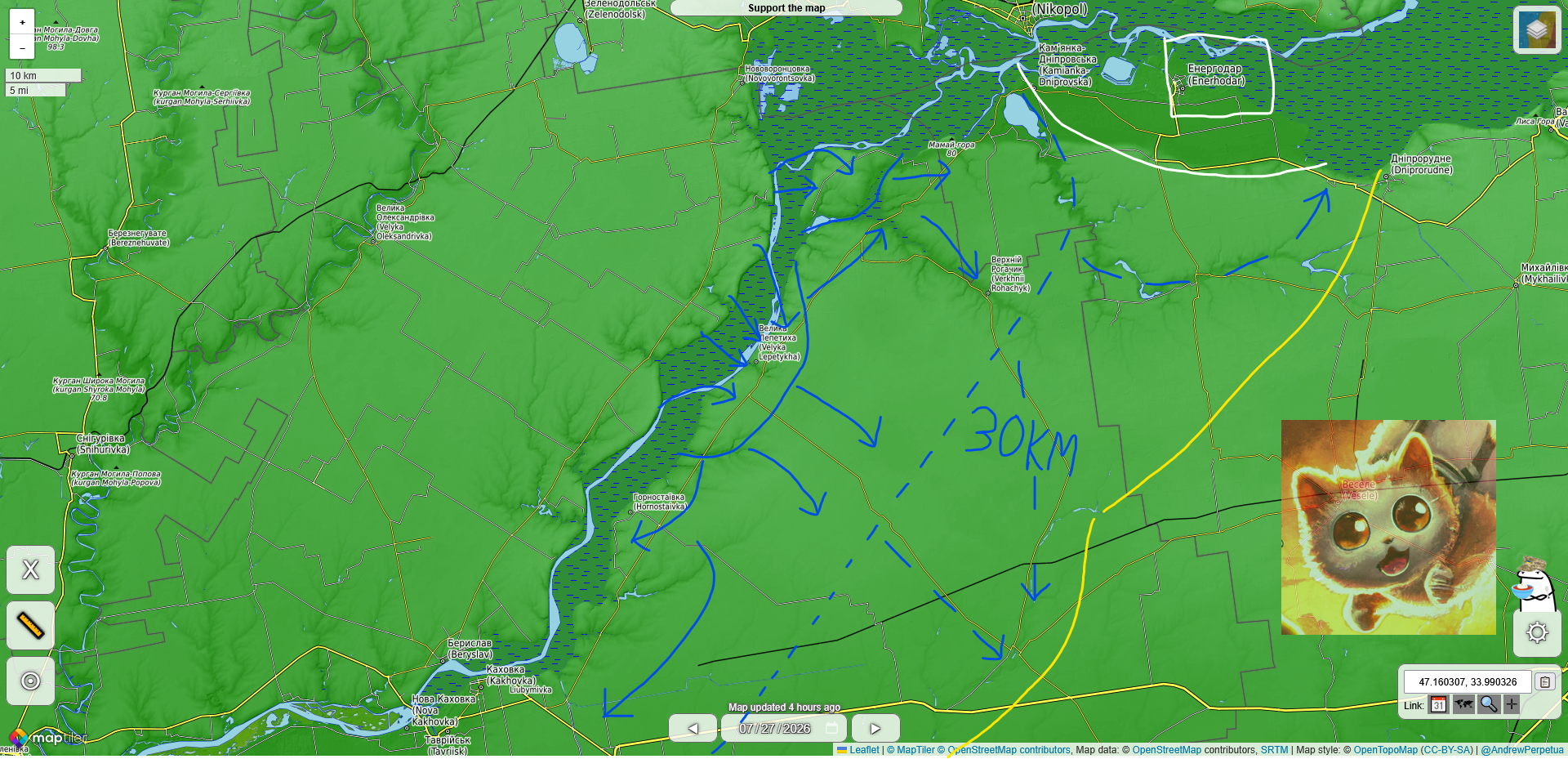
The potential for drones, which have a lower vertical profile than people, to be modified to cut their way slowly through the underbrush that’s apparently grown up thick on either side of the Dnipro river, should not be discounted. Low vegetation might wind up making close observation too difficult for orc drone teams to manage reliably. Even if drones have to work at a snail’s pace, they don’t care. One goes in, cuts a bit, then returns when charge or fuel runs low, gets replaced by another. An endless carousel.
When Allied troops in Normandy were trapped in a maze of hedges (bocage) that let the Germans launch repeated vicious close-range ambushes, they finally attached hedge-cutters to their Sherman tanks and cut new paths. Thinking smarter, not harder, sometimes pays off.
Anywhere the Ukrainians can sneak drones across the former reservoir and saturate a landing area with hidden machine gun and grenade launcher nests, actual movement of fighters to hides can take place during periods of induced chaos in the enemy’s ranks. That coupled to severing of logistics ought to roll the enemy back.
Whatever tactics are chosen, the operational intent would be to seize and secure a beachhead that drone operators could work from in relative safety, almost completely shutting down the movement of enemy reinforcements coming in to counter the Ukrainian attack. If the orcs are coping with severe supply shortages, they’re less likely to be able to fend off sustained attacks spread across several landing zones. Doubly so if the Ukrainians are able flood any area they choose with interceptor drone operators, preventing most enemy drones from getting close during specific windows.
In this sort of situation, Moscow could previously rely on air power to even the scales. Extensive use of heavy glide bombs rendered the Ukrainian hold on Krynky impossible to sustain in early 2023. Three years on, the Ukrainians have at least a partial answer to that, finally.
No Gripens yet, but improved Ukrainian airpower thanks to F-16s is proving its worth. A US general this week announced the “recent” downing of an orc Su-35 jet by a Ukrainian F-16, leading to speculation that it wasn’t in fact a wandering Patriot that got the jet the other week at all. I’m not sure he wasn’t referring to a kill scored last year, but whatever the case, between F-16s armed with long-range versions of the AMRAAM backed by AWACS and Ukraine having more than a handful of Patriot and SAMP/T systems these days, it’s no longer possible for Moscow to plaster a Ukrainian bridgehead freely without sustaining unacceptable losses.
In any crossing, Ukrainian forces won’t have to push lots of people over the river right away, which is another important advantage. In fact, the less obvious it is that the enemy faces something more organized than a raid, the better. The deeper that remote positions can be set up before the enemy responds in force, the harder they’ll have to struggle just to get to the fight at all.
Ukraine crossing the Dnipro isn’t apt to look like D-Day or Iwo Jima, but a slow, steady, relentless application of pressure designed to work in harmony with Ukrainian logistics and strategic attacks. Ideally, one bridgehead will support the establishment of another all the way down to the Dnipro delta and up to occupied Enerhodar.
Another important goal favoring action in the south this year is finally eliminating the potential for Muscovite mischief at the nuclear plant there. China has reportedly laid down the law with Moscow when it comes to using nuclear weapons, but an “accident” that releases radioactive material remains highly plausible. Blamed on Ukraine, of course, the act labeled a nuclear attack in order to justify russian attacks on Ukrainian reactor sites.
Objective: panic Europe. Putin wants this war to be as ugly as possible to keep media abroad portraying it as a human tragedy instead of an ongoing crime demanding an appropriate response from anything that dares to call itself a civilized society. It’s why russian ballistic attacks target entirely civilian stuff a lot of the time, despite the relative scarcity of Moscow’s most effective weapon.
They’re trolling all the people who say that there’s this thing called western civilization that cares about international law and human rights. It that were true, Putin’s bullshit about the united west being out to get russia would have led to him being tossed into a cell at the Hague back in 2023. Or shot in the face and his corpse dumped into the ocean, like Osama bin Laden, that’d work fine too. Sadly, the rules are not evenly applied in geopolitics.
The illusion that something dramatic would happen if radiation was ever released by some action in Ukraine is important enough to the toffs who think they rule the world that they are apt to go along with Putin’s scam, crying out for a peace deal no matter how unfavorable to Ukraine if a Geiger counter somewhere ticks too fast. Ironically giving him more of a reason to hold them hostage by threatening what they fear.
The collapse of positions on the battlefield is one of those signals which tends to transcend politics and other bullshittery. When orc officers are afraid they are about to come under fire, they move. When their baleful gaze is no longer watching over subordinates, they go too. Collective refusal to acknowledge what’s happening dissolves bonds as some groups encounter reality before others.
It’s what happened in Kharkiv four years ago. Fear of it happening again is why Putin’s elites ran from northern Kherson not long after.
When the breaking point comes in warfare, it tends to come suddenly. But not without substantial and very deliberate preparation.
Everything that the Ukrainians have done since has been all about surviving until the turning of the seasons brought about a moment of renewed asymmetry in Ukraine’s favor. I have no doubt they’ll use it well.
Not only because of Drapatyi - Syrskyi put Ukraine on the right path - but his promotion has definitely come as a shot in the arm for Ukrainian morale. No signs of any difference on the battlefield yet, but even absent the change of command happening less than a week ago, it’s still only July.
Plenty of summer left, with long sunlit days. Good weather for the drone hunt. And when there’s some rain, then people may move.
State of the Fronts - Week 30 2026
The orcs are in the middle of what was clearly supposed to be an intensive summer push, but the results are brutally underwhelming thus far. It’s one of those weeks where I actually question the point of a full battlefield update. The scale, both geographic and temporal, has shifted.
Tens of thousands of Ukrainians are fighting in almost unimaginable conditions, though, which makes the lack of map movement all the more astonishing. In pushes past, the orcs would make at least some progress during days they launch upwards of three hundred assaults. But now?
Stalemate this is not. More like one side being held at bay while the other winds up a nasty counterattack. Why else would Trump and favored acolytes be jumping on the Ukraine train all of a sudden?
In the past week, DeepState has claimed orc advances in the vicinity of six villages, while the Ukrainians moved forward near one or two - though caution is due here, as Ukrainian sources are getting better about keeping recent movements out of the public eye until revealing them will do no harm. Six successes, out of what I have to expect were dozens of attempts by multiple teams of two or 3 disposables to reach positions a kilometer or two beyond the last orc hole on the road. And success in this case means only a couple guys with guns hiding from drones in the middle of the killzone.
This is happening in the 21st century, with cameras recording all of the action, much of the footage available online in some form days or even hours after the fact. Yet the supposedly civilized world can’t be bothered to bring sufficient pressure to bear to stop it. Much of it continues to act like both sides are equal, handing territory to the russians before a shot is fired.
Of course, then there are the Ukrainians who aren’t in uniform yet seem to have no shortage of complaints about the military. People are the same everywhere, deep down.
Part of why I don’t hold with those who insist that all russians bear some kind of personal responsibility for this war. As if they have any real power.
It’s easy to pretend that people make deliberate choices about every aspect of their lives and judge them accordingly, but the evidence leans strongly towards a view of most governments as being distant, alien, and generally oppressive entities in the lives of most people. A necessary evil. The average person just tries to get by day to day. Often that includes going along with stuff that you can’t personally change, only try to remedy in the small ways you are able.
Save your condemnation for the people with access to the kind of resources that could have ended this shitshow long ago or even prevented it in the first place. I use the term deliberately, in solidarity with a Ukrainian named Serhii Krynitskyi, who documented almost a year of living in a hole outside of Chasiv Yar.
This dude lost both of his compatriots in battle and killed two dozen orcs. In showing the bodies of two, he made what is the only legitimate commentary about it that really should ever be published. Paraphrasing: “I didn’t want to have to kill them, but they came and tried to kill me. I just want this shitshow to end.”
The world should know and never forget that hundreds of thousands of people like him endured absolute hell on Earth because billions of others couldn’t be moved to pull what levers they could to get their governments to act in a decent way. And so they will be damned to go through this in their own turn, someday. Maybe then the lesson will take.
Anyway, setting aside the sick joke that is so-called society, Moscow’s ability to achieve military objectives against Ukraine is weak and getting weaker. It’s ironic that the one enemy Moscow could still fight reasonably well is probably a classic NATO force. And that’s only because the biggest NATO members (USA) will be the last to adapt.
Anyone who ever trained in their country’s land forces really ought to think hard about this Reuters portrayal of the contemporary killzone. War doesn’t change, but all the details warfare sure as hell do, and reliably history suggests that military institutions don’t adapt as they should until they lose a lot of people learning that the old ways are suicide.
Ironically, the orcs are more aware of this than your average NATO-trained officer, and definitely politician. That alone may impel Putin to try something stupid along the border of a NATO country. Were I in his shoes, I’d be very interested to see what NATO actually does.
As far as this week’s battlefield update goes, there’s really not a lot to cover, hence the long intro. Again, the pace of the fighting has shifted dramatically, with weekly posts now reflecting essentially tactical level results where they once got at the operational side. I’ve always been skeptical of detailed daily updates because of how difficult it is to know what’s significant on that timescale. Military rhythms used to take a few days to go through a full cycle.
Now you have to look at a full month of fighting to get any visible sense of how each side’s plans are unfolding. This may be why some Ukrainians are feeling like this period resembles the pre-2022 era, where fighting along the line of contact was routine but rarely decisive. Me, I see that as an illusion. So is the potential for rapid Muscovite gains after the Ukrainian line collapses.
If you’re going by the count of infantry operating in a brigade’s forward sector, then I’m sure the line looks scary weak right now. But this misses the shift the war has taken. Now depth matters, because every minute you’re out of cover is another where a drone has a chance to get you. Moscow’s great mistake is refusing to acknowledge the futility of relying on disposables.
That said, on to the overview of the fronts for week 30.
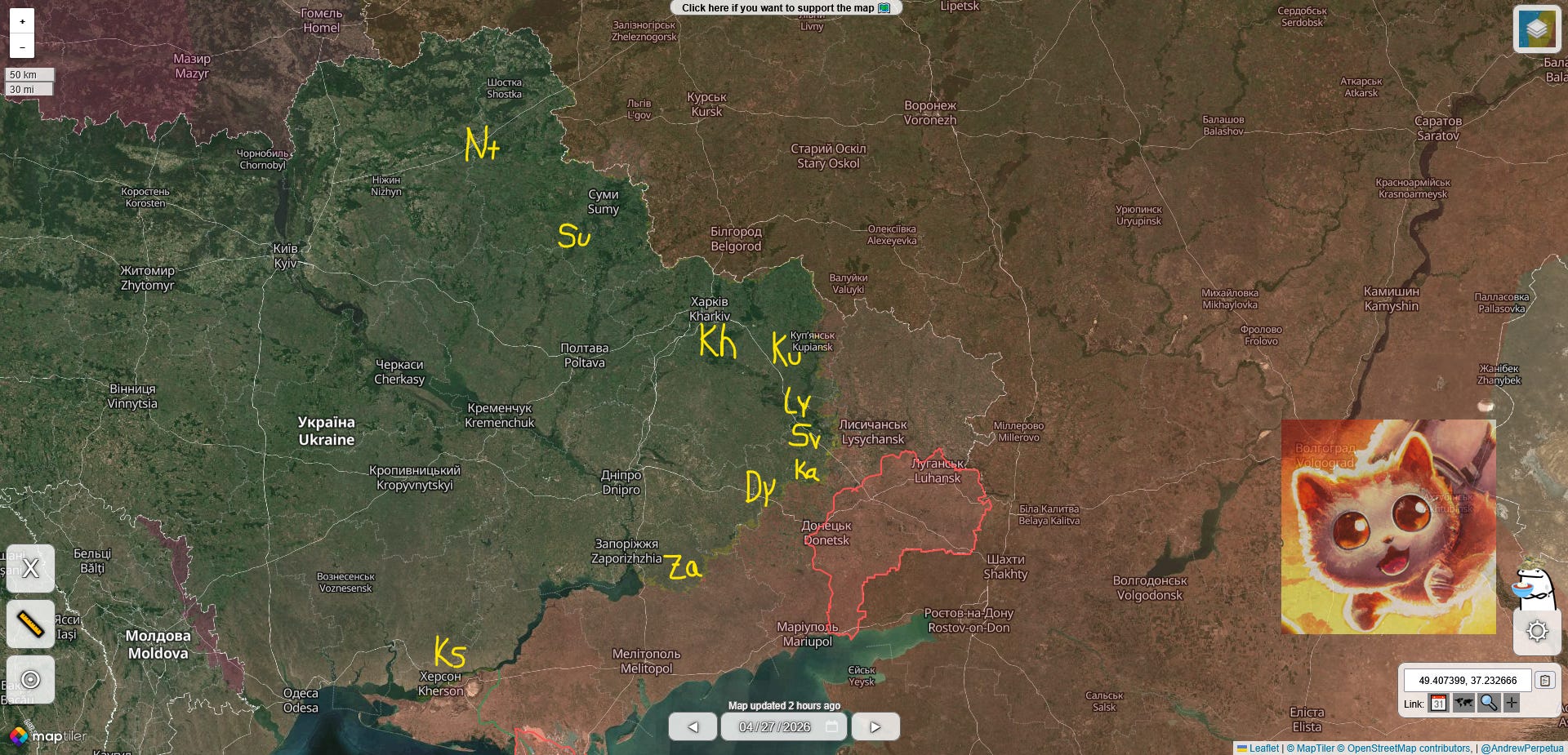
One of these days I will actually update the strategic view, I promise. But orc gains in Ukraine since April still can’t be spotted with the naked eye. Three months, approximately 100,000 dead and seriously injured, and the front is totally stuck.
North
Still in a holding pattern up north, waiting on the alleged threat from this axis to actually materialize. Now there’s talk of 30,000 North Koreans joining russian forces, enough to open a new front, or at least free up enough russians from reserve posts to do that on their own.
Possible, but I’m still highly skeptical. We’ll see what Drapatyi says about the matter when he starts giving regular briefings. I did wonder sometimes if Syrskyi was just maintaining an argument for keeping a reserve.
Two Ukrainian corps may be operating between Kyiv and Sumy, the 14th and 15th. Don’t hear much about them, which could mean their brigades are well rested. Difficult to say.
Sumy
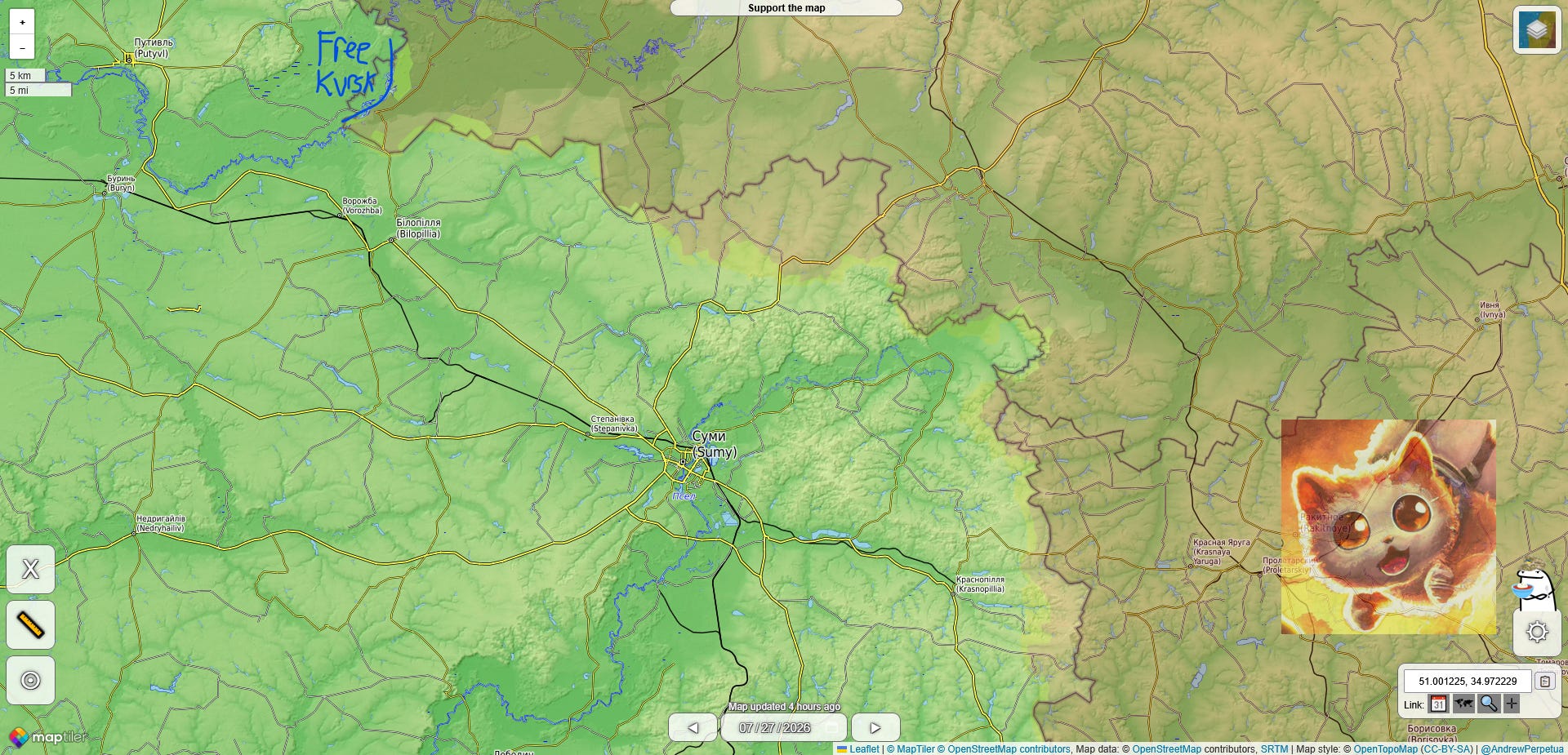
Situation in Sumy is still pretty static. Main orc pressure is starting to come from the east instead of north, but nowhere are the endless infiltration attempts getting far.
I still feel like Moscow is mainly just constantly probing to tie down 18th Corps. Which contains brigades which were once considered pretty tough, but might have been hollowed out by now. Another of those known unknowns. Me, I expect this is another relatively quieter sector that Ukrainian units are dispatched to so they can recover. Limited hostile activity should mean they’re largely free to regenerate.
Moscow still can’t clear that one corner of Kursk Ukrainian fighters still occupy up by Tetkino, funny enough. Although the steady widening of the killzone may explain that. Not a lot of positions maintained that close to enemy ones, I don’t think. The orcs simply may not have been able to get anyone there through Ukraine’s drone wall.
Hope there’s not just some lone Ukrainian with corpses for company waiting on the order to crawl home. Pretty harrowing, what people have to endure because politicians won’t accept reality.
Kharkiv
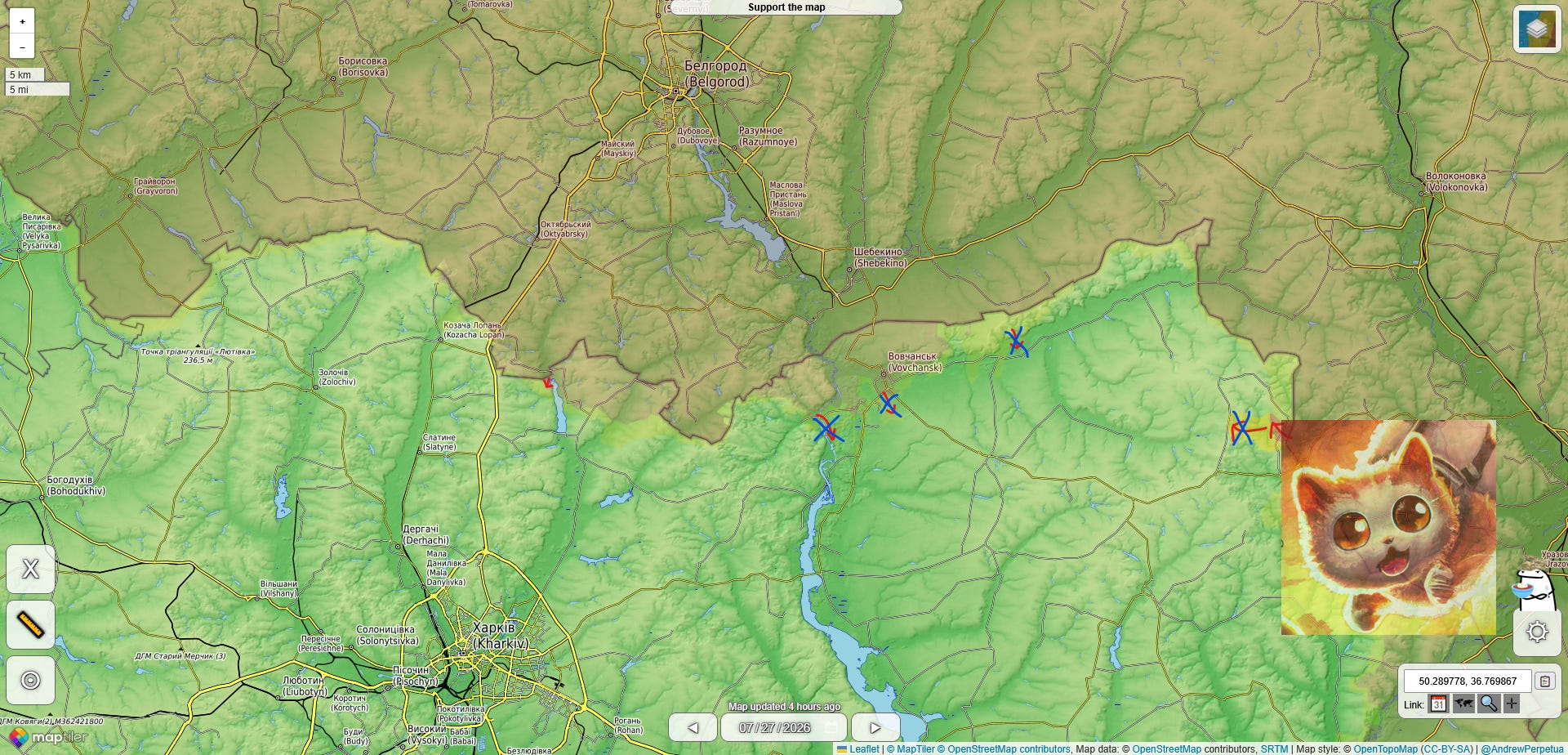
There’s been another orc effort to creep across the border well east of Kharkiv that’s taken a forest tract, and some Muscovite infiltrators made it a fair distance down the Siverskyi Donets near Vovchansk before being eliminated. A couple orcs appear to have made it into a forest tract northwest of Hlyboke, but this doesn’t seem to signify any systematic worsening of the situation in that area.
Moscow is still mostly just probing in Kharkiv, keeping 16th Corps occupied. As for 2nd Khartiia Corps, haven’t heard a lot from them lately, but they seem to stick around the northeast. Very probably planning something. Though as they’re often used as a ready reserve, they could wind up pretty much anywhere the fighting gets hot if and when the Ukrainians make a determined push.
Kupiansk
Nothing substantially changed in Kupiansk this week. Muscovite infiltrators are still coming in from the north and east, but the intensity of the fighting doesn’t look to be what it once was.
It ebbs and flows here a fair amount, though, I suspect because of the amount of forest cover the russians have to work with along the Oskil across the river from Dvorichna. Cost of taking it is probably just too high, otherwise the Ukrainians would probably do it to protect Kupiansk.
It, like so many other Ukrainian towns, is now fated to serve as an orc trap until the war ends. They keep coming here at the expense of advancing elsewhere, so the Ukrainians hold their ground and thin the horde.
Lyman
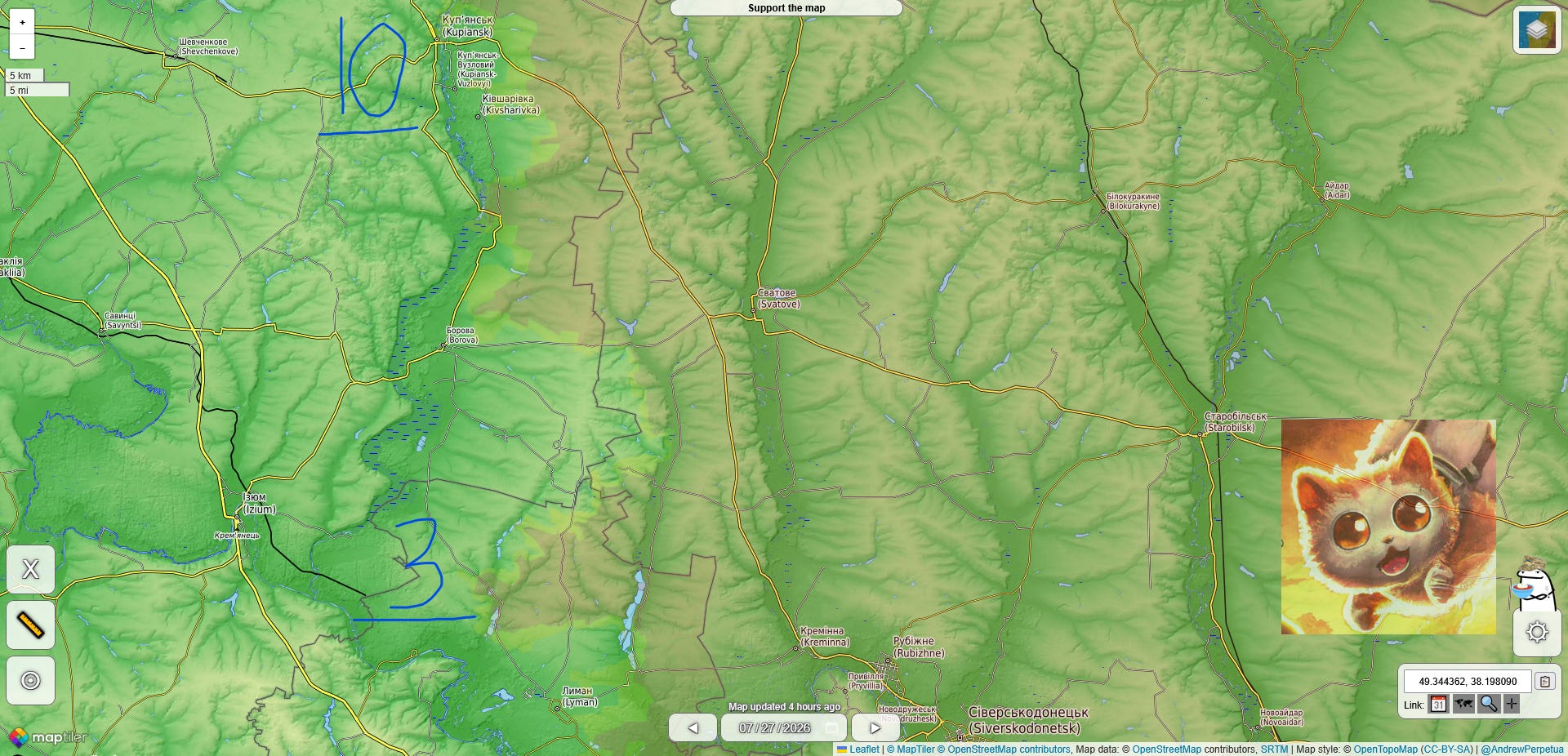
Very little news coming out of 3rd Corps’ sector these days. The orcs are showing real signs of exhaustion in this sector, and their hold on the bridgehead over the Zherebets may be much less durable than its apparent longevity might make it seem.
I very much get the sense of 3rd Corps actively using the orc bridgehead as a trap. If the enemy is making a mistake, why stop them?
Sloviansk
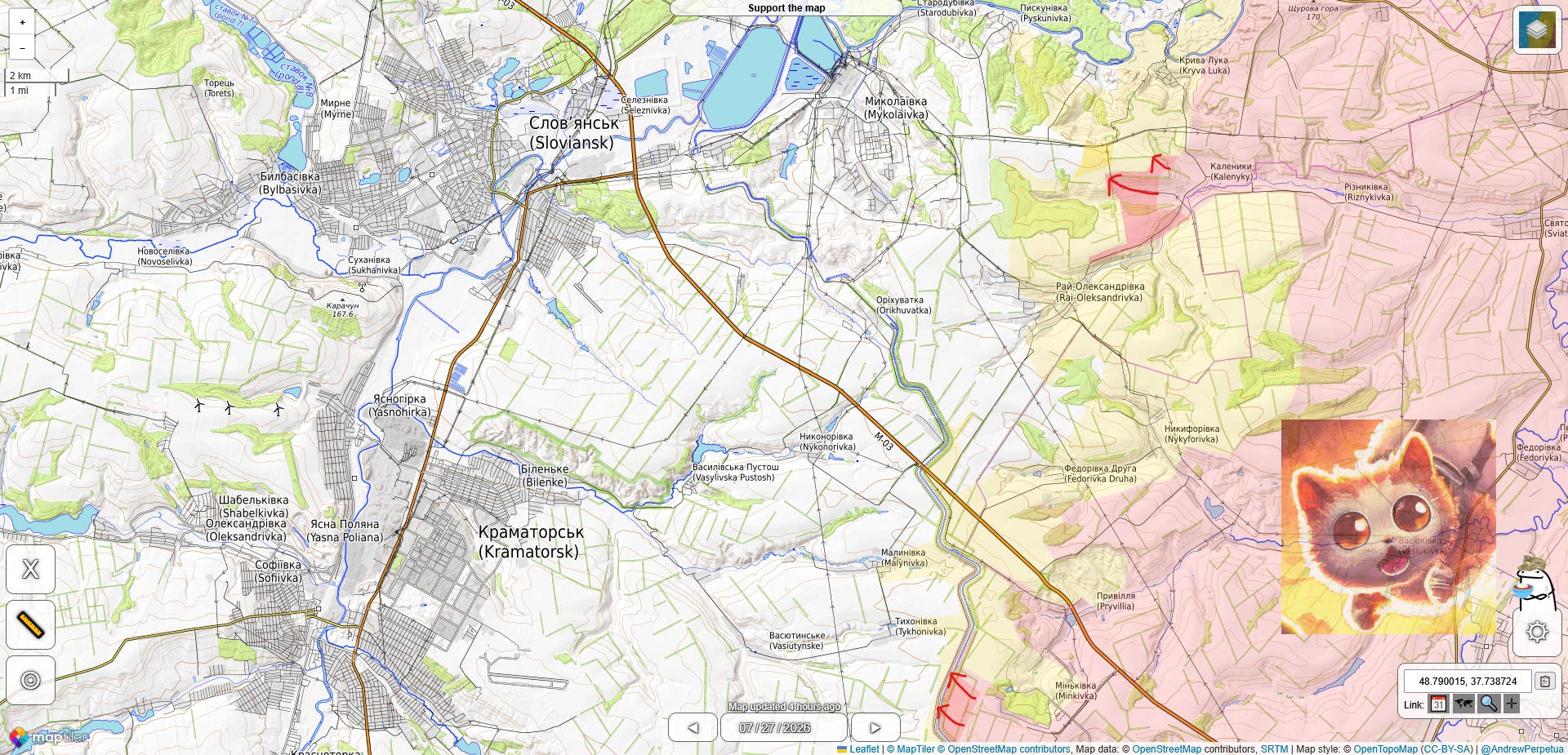
Moscow has managed some more progress on the Sloviansk-Kramatorsk axis, though nothing worth getting excited about. Disposables get wiped out in droves while they advance across territory the Ukrainians have largely pulled out of. Or should have, anyway.
To be fair, there’s only so much that can be gleaned from an open-source map, even if you’ve spent many years reading military science literature. With the killzone extending at least 20km on either side of the front line as indicated on anyone’s maps, troop densities don’t get high enough to allow full actual control in the classic sense. Ukrainian forces may operate for long periods in what’s labeled russian-occupied ground.
Creeping Muscovite advances may sustain the illusion of russia making progress, yet the cost is steady weakening of the strength of all subsequent attacks. Resources burned are gone forever.
Pretty much every meter between Bakhmut and Sloviansk was mined and zeroed in by artillery long ago. Even trying to advance here at all is a sign of how broken Muscovite operational planning has become. 11th Corps is fighting well, and from their main supply bases in Sloviansk and Kramatorsk. If Moscow were attacking only here, with all available force the effort might make sense.
But the main force of the summer push is still aimed at Dobropillya. So Moscow’s attacks are neither strong enough to break through or so weak as to constitute mere probes.
Kostiantynivka
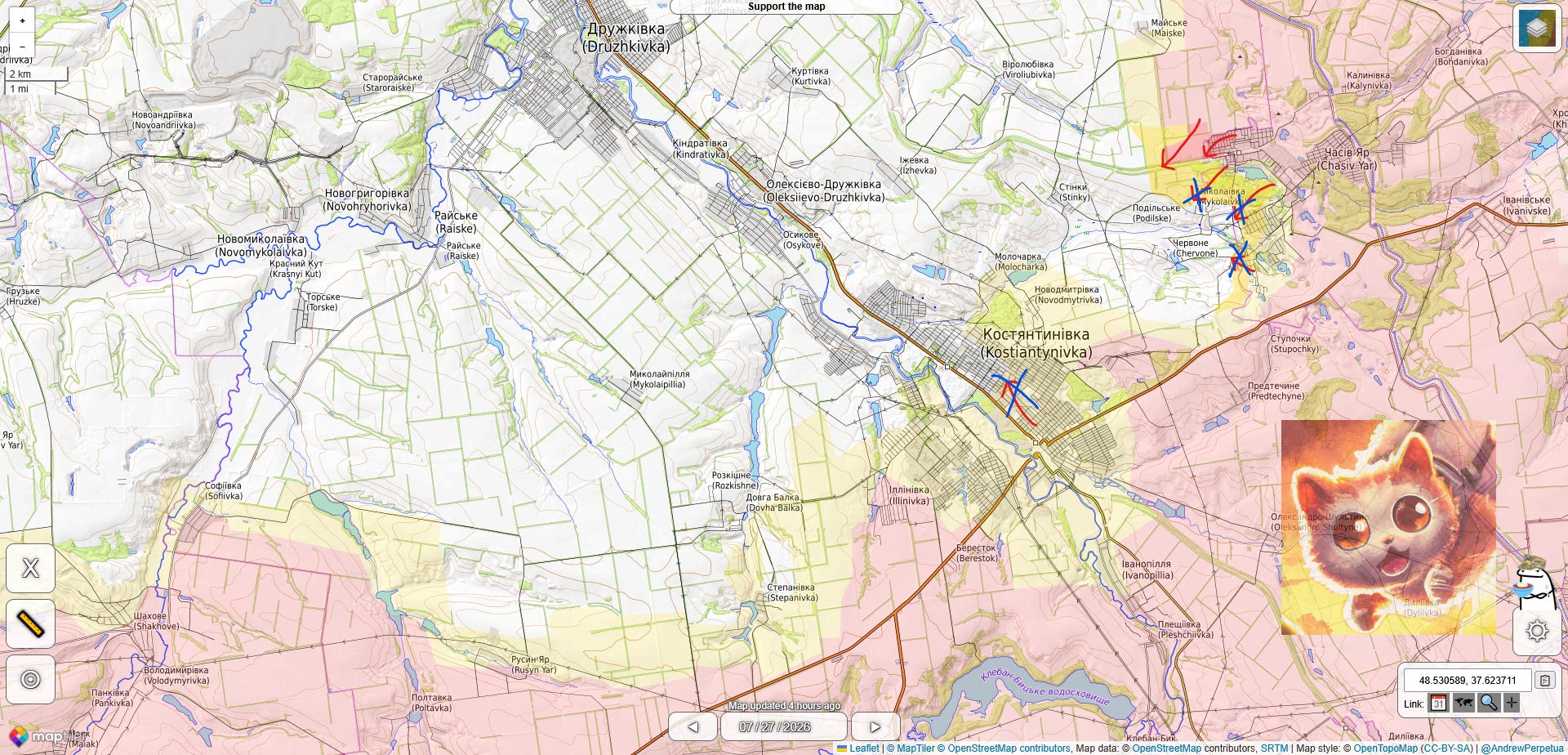
Ukrainian positions on the outskirts of Chasiv Yar look to be on the verge of being abandoned at long last, thanks to the manifest difficulty supplying them. With at least one 19th Corps position publicly occupied for almost a year, per that Reuters piece, I have to wonder how many more are in the same situation near Chasiv Yar. Always a price to be paid for a sector where the orcs make virtually no gains despite substantial effort across a couple years.
Should be plenty of fallback positions in this area, though. Frankly I had thought Chasiv Yar would be infiltrated before Kostiantynivka.
The situation in Kostiantynivka hasn’t worsened considerably, but remains not great for anyone in the city. That comprises probably several hundred Ukrainians in scattered positions and maybe half as many orcs, most of these wearing civilian clothes and hiding out in basements until enough make it in to start seizing buildings.
This style of infiltration is not without merit. But again, the cost is too high for it to be worth it, even according to Muscovite logic. You can say that the high cost means greater glory, but only idiots believe it.
The orcs spend weeks trying to get far enough into the Ukrainian defense zone to kill drone operators, knowing that only by reducing the density of drone sorties can fellows following behind get through before the first infiltrators are discovered and killed. This is the extent of their operations any more.
If the orcs committed to just shoving bodies through the meat grinder in one spot, they might still manage to advance even where the Ukrainians hang on the tightest. Then again, under present conditions the rapidly increasing casualty load could be impossible to sustain. Mass of flesh can’t offset lack of mass impacts.
In which case, Putin’s logic for the war itself is ultimately undone, as 1.4 going on 1.5 million casualties for what Moscow is demanding from Ukraine is a silly bargain to strike. Especially now, when even if the Ukrainians agreed to cede the rest of the Donbas ruins - perhaps in exchange for a truly effective deterrent against a future attack, like say a hundred nuclear warheads aimed at Moscow - Ukraine’s geopolitical position is an order of magnitude stronger than it was four and a half years ago.
Forecast for Kostiantynivka itself still isn’t great: the city is going to be churned to bits and mostly infested. But I don’t see the orcs gaining control of it this summer, and maybe not even by winter. And all these frontal assaults and sieges are breaking them.
Dobropillya
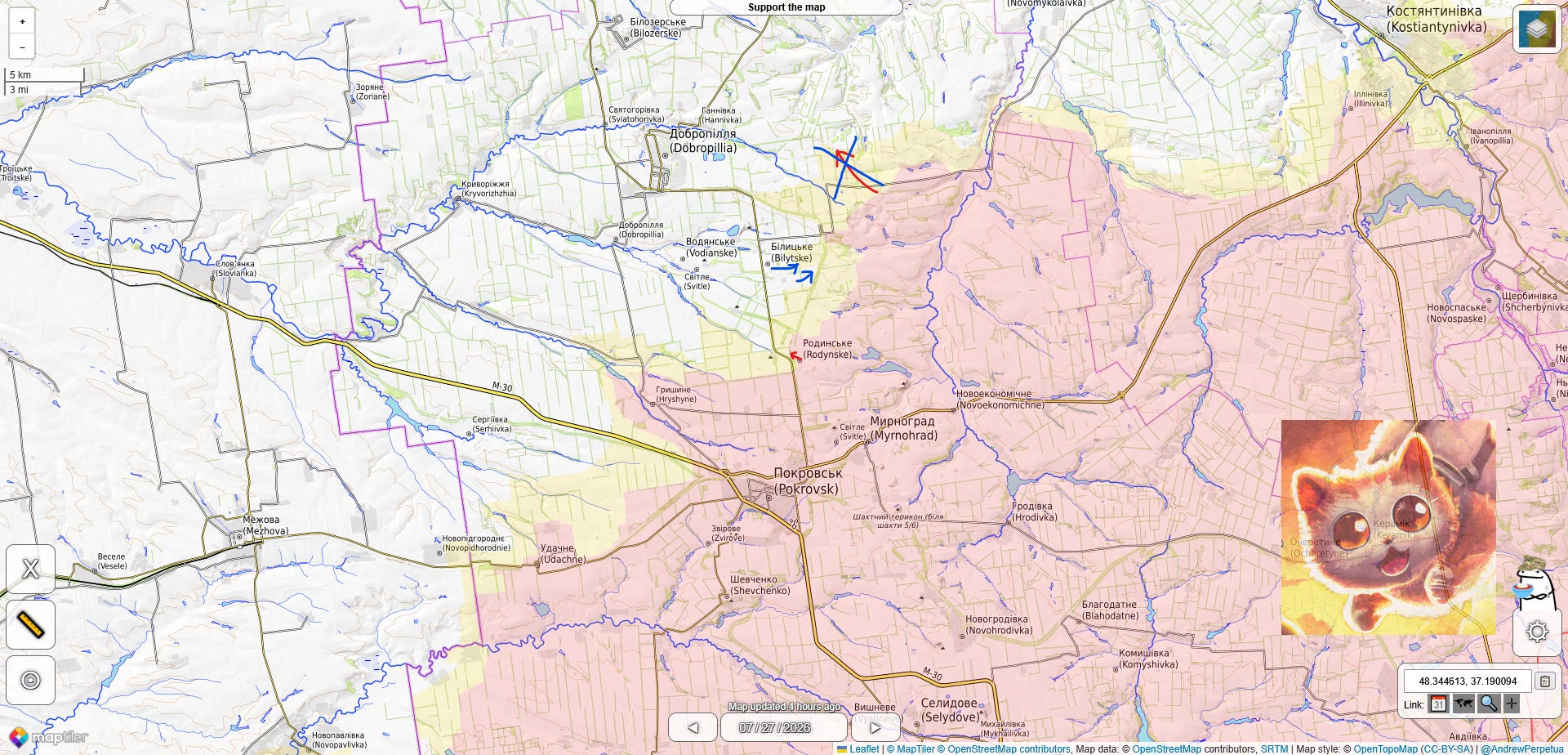
Pokrovsk remains the salient case study showing why Kostiantynivka probably won’t go quickly. The orcs here are still struggling to kick Ukrainian fighters from the western outskirts. And the advance on Dobropillya just will not gain momentum.
Weeks of fighting before the orcs consolidate any gains leaves the Ukrainians plenty of time to prepare new positions to smoothly replace ones lost. This core dynamic is exactly why warfare evolved beyond infantry-based tactics in most conditions almost a century ago. Armored vehicles let you move people so quickly that the enemy gets no chance to reset after a defeat.
Again, on no front is the fighting easy for Ukrainians or the danger of being within ten to fifteen kilometers of enemy drone operators not extreme. But relatively speaking, you’d absolutely rather be the Ukrainian than the russian if forced to fight in this war.
Moscow is still throwing a quarter or more of all its combat power at the Dobropillya front, but 1st and 7th corps (principally, so far is known) are handling it. Muscovite inability to protect positions in Pokrovsk and Myrnohrad from Ukrainian drone operators sitting in Dobropillya is not an easily fixed problem.
As happens every so often, some orc commander - probably new - decided that he’d be the one to make dense armored assaults work again. This time it happened near Shakhove in 1st Corps’ sector, and the result was as always: complete destruction of around ten vehicles, including a tank platoon, for nothing gained.
Moscow has just about nearly conquered all of Rodynske, after weeks and weeks of fighting, so I guess credit where it’s due. 1st and 7th Corps are both savaging the enemy - and even regaining ground in places, like Bilytske, the next barrier after Rodynske on the way to Dobropillya.
Zaporizhzhia
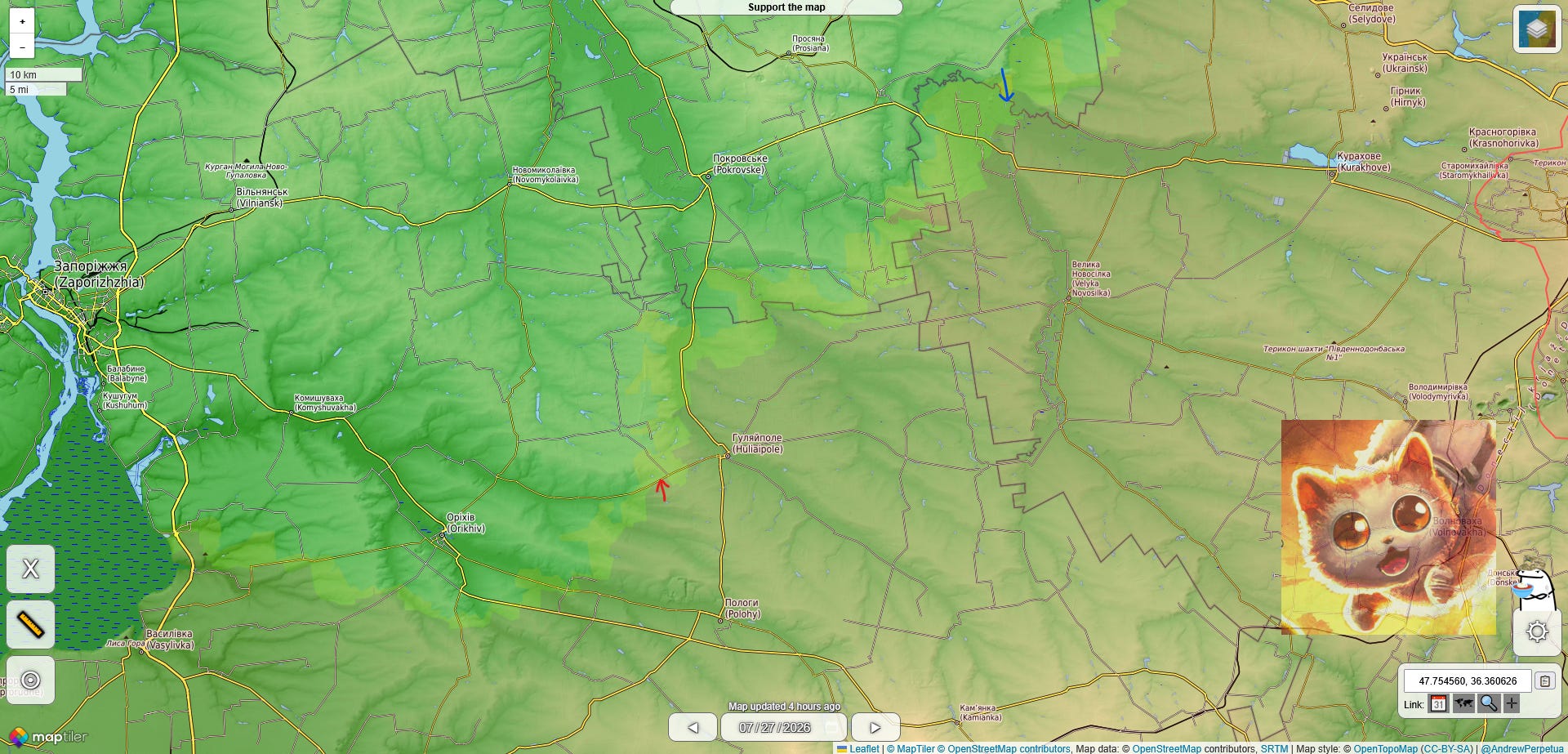
Ukrainian fighters are still pushing the enemy back at the confluence of the Mokri Yali and Vovcha. Slowly but surely, the Oleksandrivka front, as Ukraine terms it, is shifting in a manner that makes an assault on Velyka Novosilka not inconceivable. If, and this is a big if, orc logistics deteriorate sufficiently in this area.
Being closer to Donetsk, I have to assess it more likely that supply throughput can be sustained, making a counteroffensive very risky. A better move may be to simply keep up the pressure to avoid any enemy success north of Huliaypole. To the south and east of the occupied town, orc troops are still managing to advance at a rate of about one field a week. Hulaiypole itself is another drone hunting ground, and Ukraine could even recover it in a counterattack, especially if Velyka Novosilka were liberated.
Though the enemy has a lot of formations in this sector, they are acting almost exhausted lately. Again, this is mostly flat, open steppe, with almost no place to hide. Logistics issues may be mounting. Probably are.
Moscow’s push out from Huliaypole and the effective retreat underway along the Dnipro do potentially indicate a softening of orc logistics. In a few weeks, Ukrainian counterattacks may become a lot more frequent. It’s not out of the question for the Ukrainian counteroffensive of 2026 to attempt almost exactly what the one in 2023 did. Only now, the orcs aren’t prepared; they’re stretched thin with few available reserves and supply lines under constant fire.
Which makes the situation a lot like late 2022. When certain Ukrainians really wanted to drive towards Melitopol before the orcs were ready, instead of going at their elite troops head-on in Kherson. There was a chance to leave them even more isolated than they already were - and the rest of occupied Kherson and Zaporizhzhia too.
Perhaps it’s possible today. Might have been possible then, but the Pentagon said no, and Zaluzhnyi wouldn’t cross is friends abroad.
Kherson
My own money is on something happening along the Dnipro or Black Sea Coast, for the reasons laid out in the intro section. Just so much control the Ukrainians should be able to have over important variables.
As for what’s been happening on the ground in Kherson this past week, the answer is nothing visible. No more Ukrainian drone amphibious assaults or flag raise stunts. But this could change at any time, now. Though more probably after more time has passed, and orc inventories in the occupied south are drawn down.
When considering weather as a factor in timing, Ukraine’s south is less limited than is often the case further north. It’s rarely ever as cold, and higher water levels in fall stand to make it easier to get boats on the water and to the farther shore. Storms make it harder to control orc movements, but easier to conceal Ukrainian. Always tradeoffs.
Something is planned, on that I’d be willing to make a firm bet. The potential for triggering a voluntary collapse of russian lines as exhausted, isolated positions are abandoned close to Kherson thanks to the rumor of an all-out Ukrainian crossing is also real. A sustained raid spearheaded by drones might do the trick.
And if the Ukrainians ever figure out how to remotely deliver and plug in batteries using drones, Starlink-enabled ground drones become an altogether different breed of threat. Limited only by mechanical reliability. Because if you can deliver a battery by drone, a box of ammo isn’t out of the question.
Gods the future of warfare is scary.
Strike Campaigns
The name Wildberries is suddenly known around the world, but not for any reasons its owners would like. That distribution center the Ukrainians took out in Moscow the other week was only the first to burn: a full fifth of the company’s warehouse capacity, and at least a billion dollars worth of inventory, has now gone up in smoke across russia. St. Petersburg was hit hard this week, as was Krasnodar and a couple other spots.
A smattering of oil refineries and depots got it too, plus a Flamingo strike nailed a major arms manufacturer in Kirov, leaving a nice big hole in the roof of a workshop. Bit warhead like the Flamingo has, there’ll be a big mess inside to clean up. A couple weeks back the orcs were pleased that they knocked down an entire Flamingo flock, but turns out that was just a high score kind of day. Bad ones are as common.
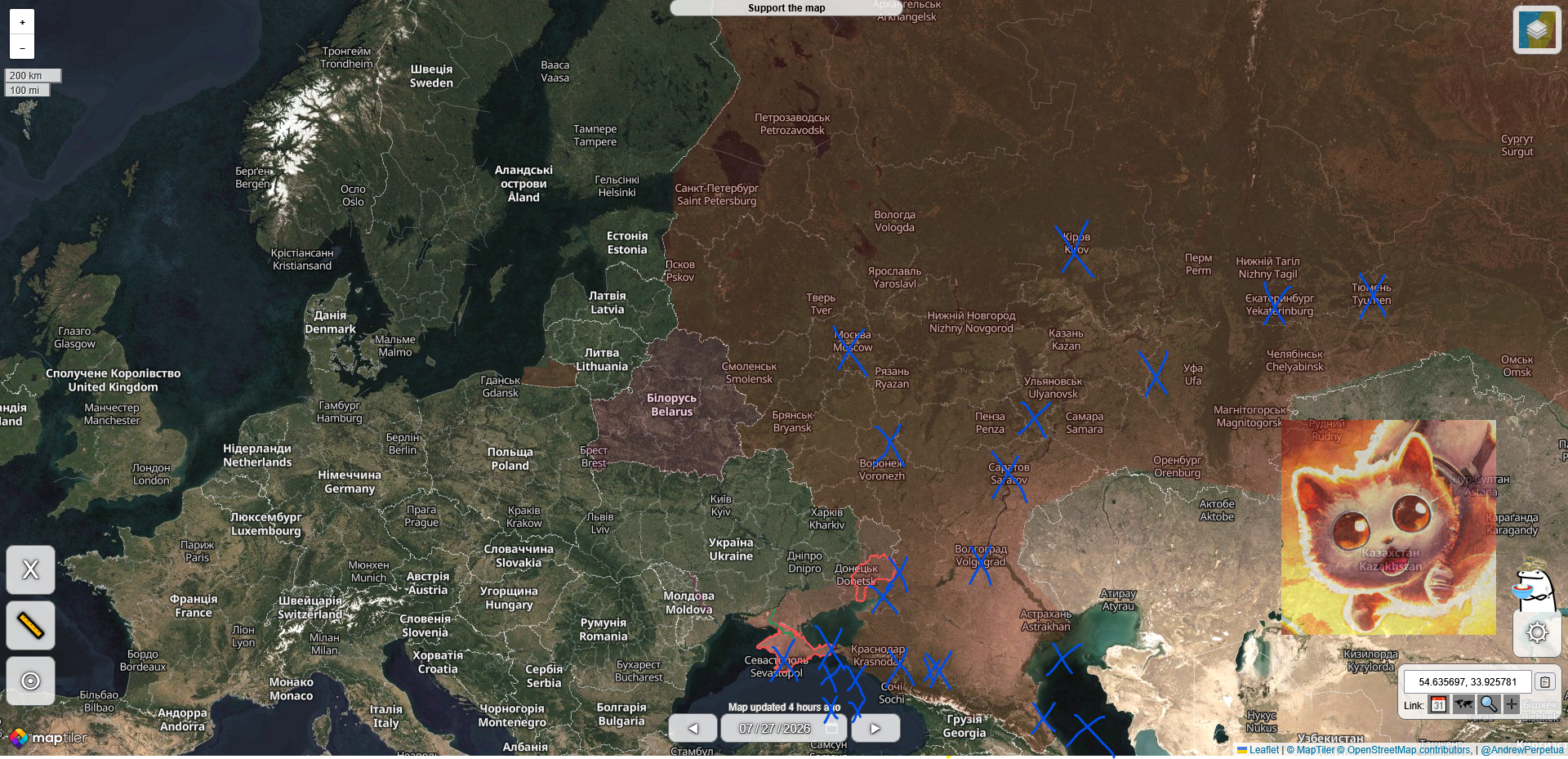
Moscow’s problem is simple and basically impossible to fix: geography. If Ukrainian drones can breach a dense air defense corridor along the border, they rapidly gain options for evading defenses with every kilometer they fly, up until they approach Moscow or St. Petersburg. And the most potent defensive ring still has trouble covering every possible angle all the time.
I’ve worked with computer software during grad school that could quickly build a map of the most vulnerable strike drone routes into Moscow using the right inputs, so what’s available to the Ukrainian government a decade later must be pretty neat. This is not a fight it looks like russia can win.
Until low-cost drone interceptors are deployed in high densities everywhere, strike drones will be able to use all kinds of clever tactics, even overwhelm conventional air defenses that can’t be avoided.
An example already seen over Ukraine, and certain to be imitated in attacks on russia, is having drones approach a target from different directions, but meet and group right before making the attack to ensure local defenses are overwhelmed. Gaps will continue to be found in Muscovite defenses. Complicating Moscow’s situation further, Ukrainian strike drone production is escalating towards five hundred a day. Moscow cannot make interceptors in volumes to match, and is lagging badly on producing interceptor drones at scale.
This isn’t a solution that you can deploy everywhere overnight, or probably even in six months. Operators take time to train, and AI isn’t able to replace them yet.
Drone pilots are already not coming online fast enough to meet orc demand. Moscow’s drone forces are 75% below desired recruitment levels, and the tendency appears to be to simply take a recon or strike drone operator and make them an interceptor drone operator. Efficiency is bound to decline if you do that: totally different missions and flight profiles.
Moscow made a bet long ago on ballistic missiles being sufficiently difficult to intercept that a full anti-ballistic missile shield was a cost-ineffective proposition. That’s largely proven true, but the scale of what ballistic missiles can accomplish was likewise over-estimated. They hurt Ukraine, but don’t achieve anything lasting.
The Ukrainians bet on drones for general purpose attacks, with precision missiles reserved for specialty work, and that combination presently has more proven staying power with roughly equivalent striking power. Flamingos balance aspects of both, with the advantage of being a too-big-to-ignore target bound to attract orc air defense attention. The combination enables Ukrainian strike planners to constantly present the orcs with novel problems.
As in nature, diversity has advantages to offset those lost by not relying on simplicity and scaling. Impacts are felt far more strongly along the band of occupied and russian cities in a roughly three hundred kilometer band behind orc positions.
Here the Logistics Lockdown campaign is still in full force, the risk to orc assets rising rapidly with proximity to the fronts. Recently, I’ve noticed an uptick in the number of attacks hitting air defenses around Rostov-on-Don, heart of Moscow’s southern logistics network. Before Sevastopol, Kerch, and Belgorod all started getting routinely plastered, air defenses were taken down first.
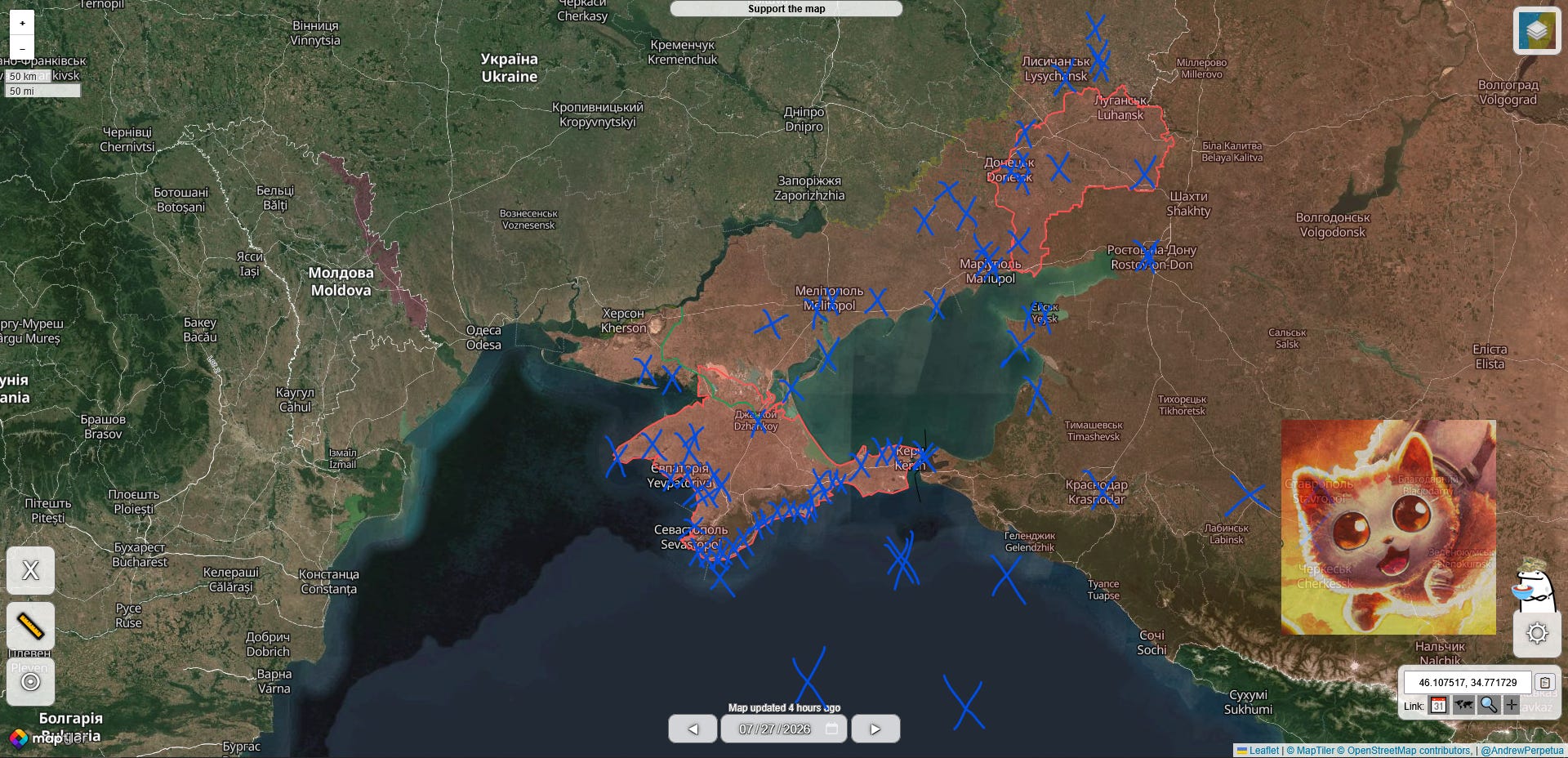
Kursk, Voronezh, Krasnodar, and Bryansk are increasingly looking set to join the list in the near future. The number of russians who have to worry about Ukrainian attacks landing nearby keeps growing, despite everything Putin keeps throwing at Ukraine.
Shitshow indeed. How absurd that nobody in Moscow is willing to stop it while there’s still something of the wreck called russia that might be salvaged. Instead, if it borders Ukraine, it’s now a warzone.
Crimea is, as the map above shows, almost a free hunting ground for Ukrainian drones. They’re dismantling the infrastructure that keeps the place up and running piece by piece. Electrical substations are being taken down with astonishing regularity, so not only will orc military forces lose easy access to liquid fuel, charging off the grid soon won’t work either.
Is Moscow ready for the sustained heavy lift operation that is necessary to maintain the military and civilian population of Crimea? Under conditions where every water crossing is vulnerable to disruption? You zoom out and ignore the fine details of this war, and the logical conclusion to draw is that the Ukrainians are absolutely preparing to bring Crimea home.
Oh, and incidentally, the Ukrainians hit some targets in the Caspian Sea, including a ship carrying Iranian stuff between Iran and russia. Tehran is making a big deal, even threatening to fire missiles at Ukraine.
Good luck with that, IRGC. Ukraine won’t whiff on bombing the ever-loving fuck out of your power plants like Trump keeps doing. Flamingos hit harder than Tomahawks. And after all Iranian-supplied Shahed designs have done to Ukrainians, Ukraine has a hell of a lot more call to be bombing Iran than the USA. More likely to achieve objectives, too.
Oh, and just to put paid to all this disgusting nonsense about US soldiers dying to stop Iran from getting nukes - if you want to end Iran’s nuclear program for many years to come, there is only one option: nuke the buried enriched uranium stocks under whatever mountain they’ve been stashed in.
Warmongering insanity, I know. But how is it that it’s considered acceptable to talk seriously about sacrificing US soldiers on some quest to extract Iran’s nuclear materials, but nuclear demolition is beyond the pale?
Nice to know how much western types value the lives of soldiers. Though wait, wasn’t incinerating a quarter of a million Japanese civilians with a couple atomic bombs supposed to be justified to avoid an invasion that didn’t have to happen anyway, seeing as Japan was under such a tight blockade it was doomed in a few months regardless?
Consistency is not to be found where ideology rears its head.
Air, Sea & Signals
Air
Big aviation news of the week, other than a US official claiming that a Ukrainian Viper did in fact recently shoot down an Su-35, was Moscow plinking one of its own super-modern Su-57s. Theoretically a stealth jet, I have to wonder whether the reduced radar signature wound up making it easy to mistake for a drone on an operator’s receiver.
Ukrainian sources claim that a cyber operation manipulated the Muscovite air defense system somehow, possibly by altering training materials. Nice.
Incidentally, you may have noticed that I don’t split out a separate cyber section. That’s because cyber was a big fad a few years ago, before AI took over, and so far has only been a proven factor on the battlefield in exceptionally limited cases.
So far, there’s been virtually zero hacking of drones to make them turn on their users or any Hollywood crap like that. Real cyber is more about obtaining signals from networks. Best practices will probably follow what works for so many scam artists: find the right victim. Someone with access and vulnerabilities.
Screwing with training slides to help teach russians to accidentally target their own jet - cyber. Switching off enemy tanks or drones - not happening yet. Only known exception: Kinzhal missiles are vulnerable to having one of the modules which gives them guidance information spoofed, making them miss by literal miles. But that’s really a russian shortcut screwing over its makers.
Back to the Viper-on-Flanker shootdown, if it was an F-16 that did the job earlier this month instead of a wandering Patriot, as originally claimed, that doesn’t negate the point of how potent cooperating platforms can be. The more threat vectors an orc jet jockey has to be concerned about, the better.
I am looking forward to running across some information about the frequency of orc interceptor patrols near the front given the pressing need to hunt drones that breach the interior of the empire. I suspect that pressure on Ukrainian aviators operating near the front is starting to decline, which would be setting the orcs still on patrol duty here up for ambushes.
A recent social media post featuring a Su-35 trying to chase down an FP-1 strike drone somewhere over russia illustrates another dimension of drone warfare: wear and tear on legacy jets. How much is Moscow having to boost the number of aircraft on defensive patrols, I wonder?
Glide bomb attack frequency is reportedly down by a significant fraction. Since some of Moscow’s glide bomb carriers are multirole jets, are a portion being pulled into interception duties?
Sea
Whatever truce was observed over the past couple years with respect to civilian merchant shipping in the Black Sea looks to have capsized and sunk like that Indian-flagged freighter the orcs hit with three cruise missiles off Odesa. Stands to reason with the Ukrainians now marauding the Azov and Black Seas, largely driving enemy shipping from them. Still, the orcs can’t even be bothered not to kill Indians, when India is still happy to do plenty of trade with Moscow?
Be wonderful if India’s victorious cockroaches took aim at their country’s military establishment one of these days. Hey, you guys got that education minister - after a break, will there be another campaign? Because the toff sentiments you all rebelled against haven’t dissipated.
This map, done by Project OWL OSINT, does a nice job of mapping confirmed Ukrainian strikes in the Black and Azov Seas over the past month. Modern naval warfare doesn’t look like nearly anybody expected. At least that I’ve read.
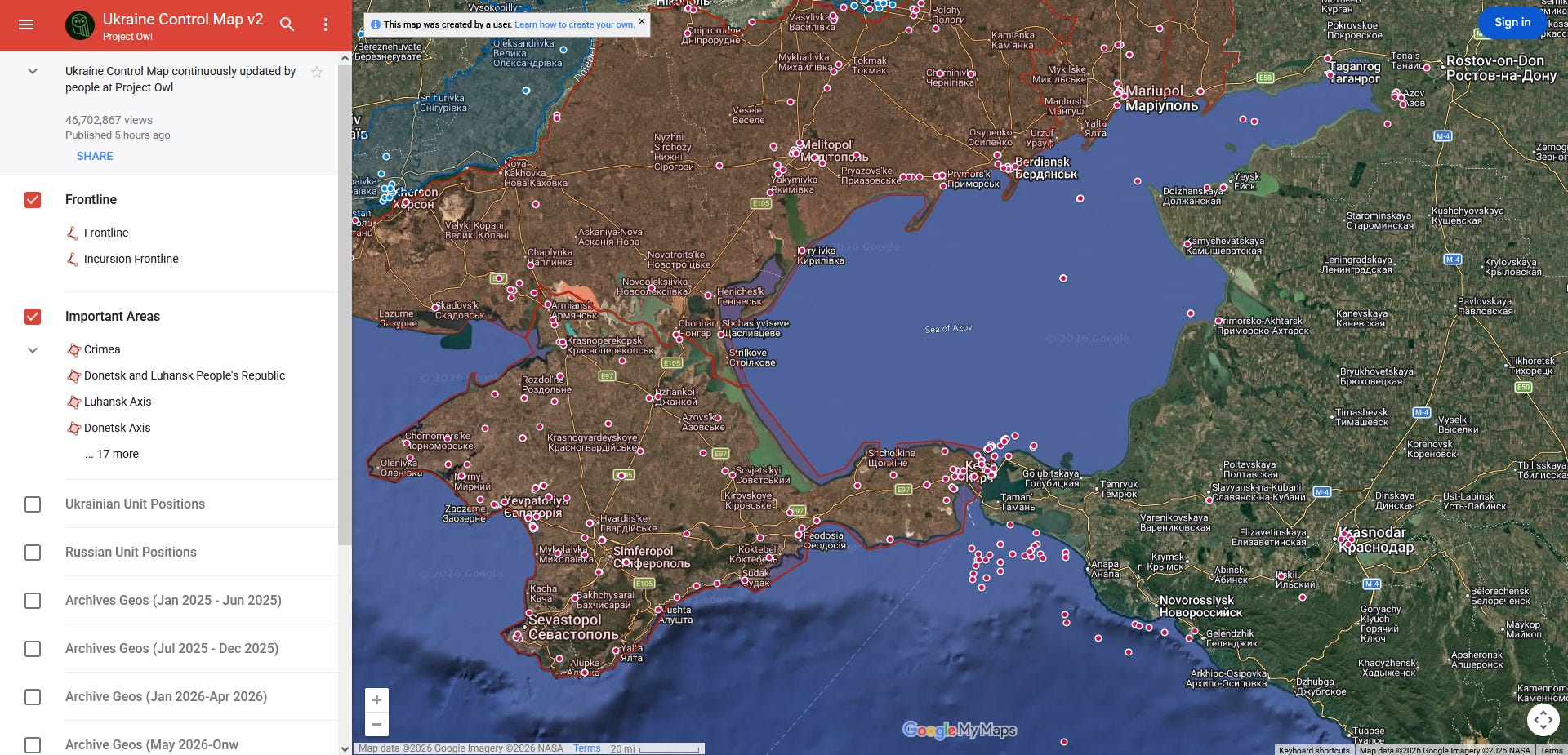
I’m not sure when we can officially call the complete defeat of the Black Sea Fleet, given there are some ships still afloat. But the remnants are basically hostages.
Signals
With Starlink unavailable to them except where they can get a rogue terminal registered, and Moscow’s rival coming online only slowly (if ever), the orcs are feeling the burn of Ukrainian digital superiority. But they’re not out of tricks, and the spread of mesh networks is incredibly worrying.
Eventually, all the thousands of drones in flight across the battlefields of Ukraine are going to be passing on signals to other friendly drones within their radio horizon. Allocation of bandwidth is bound to be hugely important for command and control, with the volume scaling with the density of friendly drone a activity in the area. But the growth in connectivity is bound to make electromagnetic countermeasures increasingly unreliable.
Hard-kill defenses will definitely take center stage. I actually expect armored vehicles to make a comeback - though many will now be drones. Because if you can’t stop the signal, why put a human in harm’s way?
One additional reason that I’m sure Moscow is doomed is the quality of innovation available to the Ukrainian side. Muscovites aren’t all ignorant bigots, but russia doesn’t have anywhere near the level of integration with China or other partners that Ukraine stands to with the rest of Europe, and even parts of the USA. Forward-looking states are probably already attracting Ukrainian companies.
Not Oregon, I don’t think, but Washington and California definitely. Isn’t a lot of sympathy for russia on the west coast, because a significant chunk of people here or their families got out of the Soviet Union years ago. They don’t want to see Putin stitch it back together.
Also, if strike drones with a 10,000km range appear, as Zelensky recently promised, then the damn things can fly across the entire northern Pacific. The russians, Chinese, or even North Koreans can do unto Americans (and Canadians, and Australians, and New Zealanders too) everything we think we can do to them. Fantastic.
About a billion people on this planet would like to see no more threat emanating from russia. Ukraine is fighting for us all. Unlock the innovative capacity of that population, and watch out, world.
In a technological arms race, the more savvy people who can work together, the better. There just aren’t enough russians to beat the rest of us if even a minority backs Ukraine.
Staff Affairs
Ukraine’s military leadership situation has been done to death over the past couple weeks, so little need to go deep into it. It will take a few months for anything Drapatyi does right now to show on the fronts, and who knows if the forces that blocked prior reforms can be tamed.
Drapatyi faces the same challenge Syrskyi did, one that bedevils military and civilian professionals: how to jump from one level of leadership to the next without becoming incompetent. There are real differences.
Syrskyi was probably one of Ukraine’s best corps-level commanders, which is why his signature operation, Kursk, was effective. He was not able to cope with institutional drama that swallowed up the reforms Syrskyi pushed, though. Different kind of war, that. Will Drapatyi be able to make the jump to a higher level of responsibility?
Drapatyi has, fortunately, held a revolving array of important high-level military jobs over the past few years, and in fact has been largely responsible for the broad conduct of Ukrainian operations from around Pokrovsk up to Kharkiv. He probably has much to do with Ukrainian resilience on the line. So hopefully the transition won’t be tough. Sidelining the idiot general class won’t be easy, though.
Still no definite word on Federov’s status, interestingly. He is reportedly insisting on reinstatement as head of the Defense Ministry, which would send a useful signal to the military brass about civilian control, but also raise tensions further by essentially validating my hypothesis that this shakeup was less spontaneous than it seemed. So we’ll see - this one may come down to brass knuckle politics. Maybe Federov is playing hardball because he has ambitions. In which case, Zelensky won’t be apt to give in easily.
Giving in to public pressure is a powerful move smart politicians orchestrate, if they can. Do it once too often, though, and perceptions of power shift. People are weird creatures.
The task of fixing mobilization remains beyond urgent, regardless of who is in charge of the thing. If for no other reason than the wedge it places between Ukrainian society and the war effort.
Concluding Remarks
By September, I have to forecast significant changes on the battlefield, or else my theory of this entire conflict is flat-out wrong. But every year of the war so far, Ukraine has launched a counteroffensive, even if only on a relatively small scale, like last fall. Each time, I’m fairly sure that the Ukrainians were conducting a test.
Even MAGA types are hedging their bets, some openly changing their tune on Ukraine. This is a sign of them not wanting to be on the wrong side. Funny enough, in a perfect demonstration of how broken the other side is in the USA, no sooner did Laura Loomer do an about face than Team Blue media outlets starts pushing rumors about payments coming from the Ukrainian side.
If my enemy likes it, I must hate it: that what US partisanship amounts to. A frickin’ cognitive plague.
At least the Ukrainians are out there, showing that there are still some people on this planet who can get a job done. Would that they never had to. But it’s the very people who you don’t expect to bring Ragnarok who wind up doing it.
When systems taken for granted for decades begin to crumble, they tend to crash out particularly hard and fast once a critical threshold is passed. Failed expectations reset cognitive assumptions, and long-held ones have a proportionally greater impact when they go.
Putin’s russia failing to defeat Ukraine or even secure all of Donbas in more time than it took the USSR to go from military calamity to the fall of Berlin is a big deal. It will be codified for all time as the debacle anyone with sense knows it is when after all this a front collapses and orcs go scurrying for the exits.
That, plus the isolation of Crimea, plus smashing oil refineries, plus 1.5 million russian casualties, plus the whole world laughing at russia, plus sanctions, plus Moscow burning through all its fiscal reserves not taking Ukraine, has got to be too much for Putin’s system to bear. Nobody can really say for certain what comes after, but to pretend that it might be worse than this is to ignore the murder of thousands of Ukrainians on and behind the front line.
I look forward to seeing what Drapatyi can do. That video clip of his BMP crashing through a militant barrier some years back sure looks like a taste of what’s to come in the near future.
Comments
Nothing yet. Say the first thing.
Sign in to join the conversation.