
You know the date. Most Americans celebrate it without knowing what actually happened on it, or why it is July 4 and not July 2, or why the document hanging in the National Archives was not signed until August.
On June 7, 1776, Richard Henry Lee of Virginia stood before the Second Continental Congress in Philadelphia and introduced a resolution: that these United Colonies are, and of right ought to be, free and independent States. John Adams seconded it immediately.
Though the resolution had wide support in Congress, moderate delegates persuaded their colleagues to delay a final vote for three weeks, giving colonial assemblies time to instruct their delegations. Some of those assemblies still were not ready to commit.
Congress appointed five delegates to compose a declaration: John Adams, Benjamin Franklin, Roger Sherman, Robert R. Livingston, and Thomas Jefferson. The committee then delegated the actual writing to Jefferson. He was thirty-three years old.[1]
Why Jefferson? Adams later recalled that Jefferson received the largest number of votes when Congress selected the committee.
But Jefferson could also write, and men knew it. Two years earlier his pamphlet A Summary View of the Rights of British North America had passed hand to hand through the colonies, making one argument plain: a man’s rights come from nature, not from a king’s good graces. That was not a safe thing to put in print in 1774.
Jefferson and his enslaved servant Robert Hemings lived in a rented room at 7th and Market Streets in Philadelphia when Jefferson drafted the document. Not a grand chamber. A boarding house. He used a portable writing desk he had designed and built himself.[2]
For seventeen days Jefferson worked in private under Congressionally imposed secrecy, in a country wracked by military and political uncertainties.
The war was already fourteen months old. The British were massing off New York. The army was short on gunpowder, pay, and time.[3]
Jefferson drafted the statement between June 11 and June 28, then submitted drafts to Adams and Franklin, who made changes before presenting the draft to Congress. By the time the committee finished, forty-seven alterations had been made, including the insertion of three complete paragraphs.
Jefferson hated most of it. He sent copies of his original draft to friends in Virginia so posterity would know what had been taken from him.[4]
One change matters more than the others. Early in the draft, the phrase “sacred and undeniable” had been crossed out. An edit added the now-iconic phrase “We hold these truths to be self-evident,” which originally read “We hold these truths to be sacred and undeniable.”
It is not entirely clear whether this revision belongs to Franklin or Jefferson. What is clear is that “self-evident” is a harder, more philosophically precise claim.
Sacred things require faith. Self-evident things require only the capacity to reason. The change turns a religious assertion into a logical one.[5]
Adams had risen early and written to a friend: “This morning is assigned the greatest debate of all.”
John Hancock gaveled the Second Continental Congress to order at ten o’clock and they would debate for more than nine hours, into the evening. Outside the rain came down in torrents flooding the roads and lightning flashed from the darkened skies.[6]
John Dickinson of Pennsylvania spoke first. He was not a coward and he was not a loyalist. He had been fighting British overreach for over a decade, longer than most men in that room. He had written the Olive Branch Petition, the last serious attempt at negotiated settlement.
His argument on July 1 was strategic, not moral: independence now was premature. No formal alliance with France. No functioning central government. No unified military command capable of sustaining a prolonged war.
“This morning is assigned the greatest debate of all.”
John Adams
His insistence on reconciliation had already destroyed his political standing with radicals like Adams and Jefferson, who called his constitutional views an unacceptable “half-way house.” He knew this. He spoke anyway.[7]
Adams spoke second. During a terrific thunderstorm, without any prepared notes, he rallied the room for American independence. One witness, Richard Stockton of New Jersey, called Adams “the Atlas of the hour” and “the man to whom the country is most indebted for the great measure of independency.”[8]
The first vote of Congress on the Lee Resolution failed. Pennsylvania and South Carolina voted no, Delaware was deadlocked, and New York abstained. Nine colonies for independence, two against, one split, one silent.
Congress was not unanimous, and unanimous was the only thing that would do. Picture the Declaration going out to the world with two colonies on record voting no. Britain reads that as a family quarrel and settles in to wait it out. France reads it the same way and keeps its fleet in port.
A split vote was not a technicality. It was a weapon handed to the enemy.[9]
Congress went home that night knowing they had to try again in the morning.
Eighty miles away in Dover, Delaware, a man named Caesar Rodney read a letter by candlelight and reached for his boots.
The two Delaware delegates in Philadelphia were divided: Thomas McKean in favor of independence, George Read opposed. Without a third delegate, Delaware’s vote fell into a stalemate.
When McKean learned of the impending vote, he dispatched a messenger to fetch Rodney, then at home in Kent County tending to militia and private affairs. Rodney was roughly forty-seven years old and suffering from a serious facial cancer. His doctor had warned him against travel. He mounted his horse anyway.[10]
All night, as the first of July turned into the second, Rodney rode through a thunderstorm. He covered eighty miles and arrived at Independence Hall’s doorstep in time to cast his decisive vote.
Years later Thomas McKean remembered meeting Rodney at the door “in his boots and spurs.” Rodney later wrote his brother a brief account: “I arrived in Congress, tho detained by thunder and rain, time enough to give my voice in the matter of independence.”[11]
On July 2, the vote held. Dickinson, along with fellow independence opponent Robert Morris, abstained from voting with the rest of the Pennsylvania delegation. Their removal allowed the remaining members, including Benjamin Franklin, to vote in favor of independence, swinging Pennsylvania into the yes column.
South Carolina changed its vote. Delaware was now whole. Twelve colonies voted yes.
New York still could not vote: its delegates had standing instructions from home to abstain until further guidance arrived. But twelve was enough to proceed.[12]
John Adams wrote that July 2 would be celebrated as the most memorable epoch in the history of America. Instead, the day has been largely forgotten in favor of July 4.
He was wrong about which date would stick. He was not wrong about what the vote meant.[13]
The vote on July 2 settled the question of independence. It did not settle the question of the document.
For two days Congress went at the committee draft line by line. Thirty-nine more changes, argued out on the floor and voted through, until the afternoon of July 4th when the thing was finally adopted.
Jefferson sat through it all, watching his language get cut and replaced, and later described the experience as a kind of torture.[14]
The most consequential deletion was an entire paragraph blaming King George III for the transatlantic slave trade. Jefferson had written that the king had “waged cruel war against human nature itself, violating its most sacred rights of life and liberty in the persons of a distant people who never offended him, captivating and carrying them into slavery in another hemisphere.”
During the revision process, Congress removed the bulk of the paragraph and reduced it to a veiled reference, complaining that King George incited “domestic insurrections among us.”
Money made the cut. Southern plantations ran on enslaved labor, and Northern ships carried the trade that stocked them. Blame the king for slavery in writing and you put the crime on every man in the room who profited from it.
Jefferson later claimed both southern and northern delegates had objected. The exact circumstances of the removal may never be known. The historical record does not include details of the debates undertaken by the Second Continental Congress.[15]
The man who wrote “all men are created equal” owned 180 enslaved people at the time he wrote it. He owned 267 by 1822. He did not free them upon his death. The document that became the foundation of American liberty had its most direct engagement with slavery excised before it ever went to the printer.
When Congress approved the text on the afternoon of July 4, it carried two names. John Hancock signed as president of Congress. Charles Thomson signed as its secretary. Two signatures, enough to make it legal for the printer, and no more.
A committee took the manuscript to John Dunlap’s print shop that evening. On the morning of July 5, copies were dispatched by members of Congress to assemblies, conventions, committees of safety, and commanders of Continental troops.[16]
Around 200 copies are estimated to have been printed on the evening of July 4 and early morning of July 5, 1776. Today, only 26 known copies of the Dunlap broadside survive. One of those copies, incomplete, belonged to George Washington.[17]
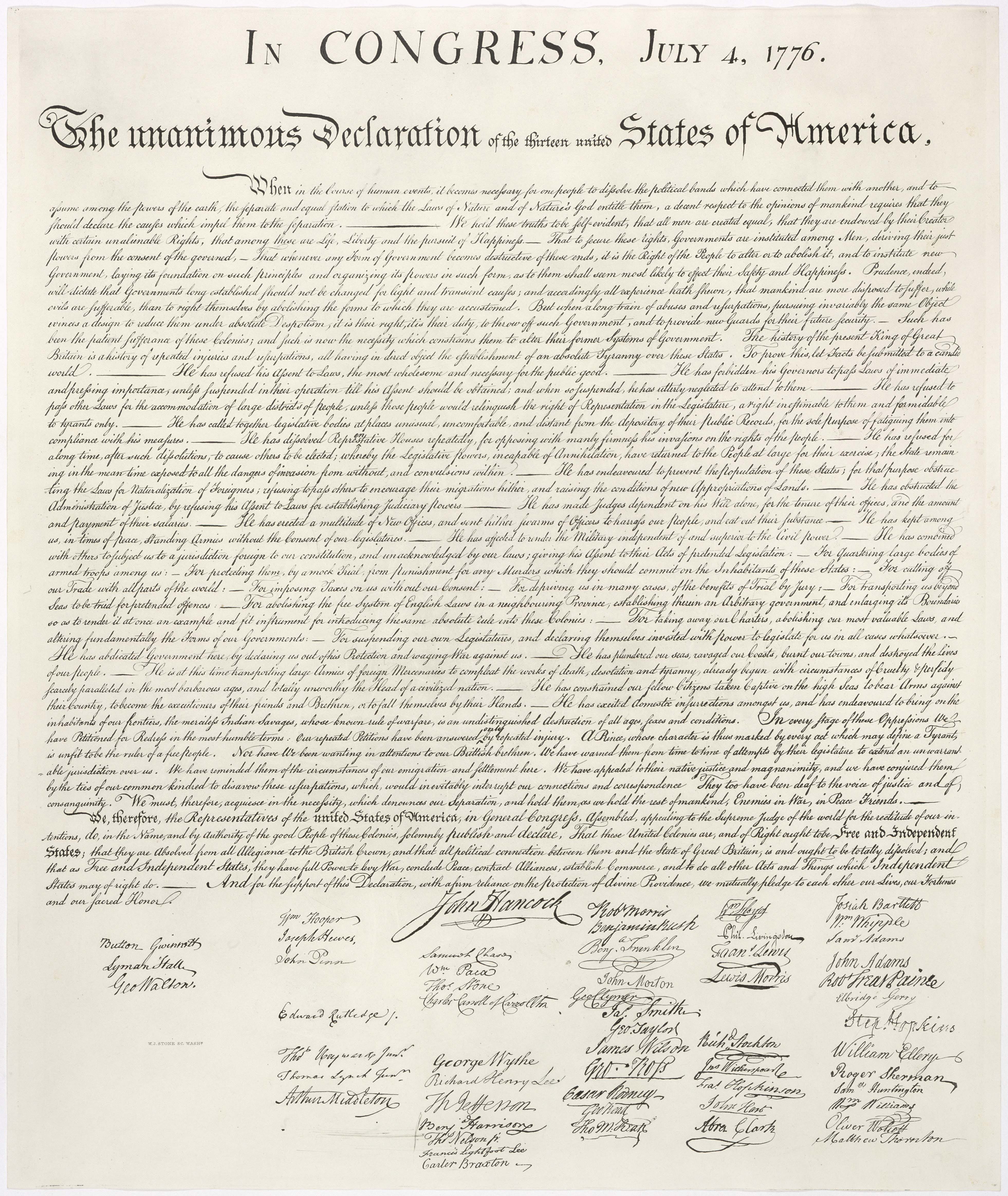
The document you see in the National Archives Rotunda, the famous parchment with the sweeping signatures, is not the document approved on July 4.
On July 19th, Congress ordered that the Declaration be engrossed on parchment with a new title: “the unanimous declaration of the thirteen united states of America,” and that the same, when engrossed, be signed by every member of Congress. The title changed because New York’s delegation had finally received authorization from home to vote yes, making the approval genuinely unanimous.[18]
Timothy Matlack, a Philadelphia scribe and assistant to Secretary Charles Thomson, engrossed the parchment in English Roundhand script, making only two errors across the entire document. On August 2nd, John Hancock signed the engrossed copy with a bold signature. The other delegates signed beginning at the right, arranged by states from northernmost New Hampshire to southernmost Georgia.[19]
John Dickinson, whose final act in Congress had been to vigorously oppose independence on July 1, left Congress the following day to join the Continental Army. He never signed. Neither did Robert Livingston, one of the Committee of Five who had helped draft the document. He had been recalled to New York before the vote.[20]
The Declaration reached most Americans not as a document but as a voice. Congress had ordered it proclaimed at the head of the army and throughout each state, which in 1776 meant one thing: someone had to stand up and read it aloud in public.
The first official public readings occurred simultaneously on July 8, 1776, at noon, at three previously designated locations: in Trenton, New Jersey; Easton, Pennsylvania; and Philadelphia. In Philadelphia, Colonel John Nixon, a local merchant and militia officer, read the Declaration in the State House Yard.
The crowd shouted “God bless the free states of North America!” three times. Pennsylvania militiamen removed the king’s coat of arms from the State House and threw it into a large bonfire.
Not everyone cheered. Others were not at all happy, yelling “Treason!” and “Long live the King!” There were plenty more who just did not know what to think.[21]
Washington had his copy by July 5. After the reading of the Declaration to his troops in New York on July 9, the soldiers toppled a gilded lead statue of George III on horseback and melted it down into musket balls. In Savannah, Georgia, the crowd staged a mock funeral for the king, parodying the Anglican burial service.[22]
Most Americans first met the Declaration in a newspaper. Thirty printings ran that July, in eighteen towns strung from Portsmouth, New Hampshire down to Williamsburg, Virginia. They heard it before they read it. For most of them, it was news.[23]
The famous names dominate the story. The men who stood further down the signing table left their own record.
William Ellery of Rhode Island positioned himself deliberately near the secretary on August 2 so he could watch each delegate’s face as they stepped forward to sign. He later reported seeing a look of “undaunted resolution” on every face as each man approached what might have been his death warrant.
Benjamin Rush of Pennsylvania, a physician who had not even been elected to Congress on July 4 but signed with the others on August 2, wrote a letter to John Adams thirty-five years later that captured the room more precisely than any official account: “Do you recollect the pensive and awful silence which pervaded the house when we were called up, one after another, to the table of the President of Congress, to subscribe what was believed by many at that time to be our own death warrants? The silence and the gloom of the morning were interrupted, I well recollect, only for a moment by Col. Harrison of Virginia, who said to Mr. Gerry at the table, ‘I shall have a great advantage over you, Mr. Gerry, when we are all hung for what we are now doing. From the size and weight of my body I shall die in a few minutes, but from the lightness of your body you will dance in the air an hour or two before you are dead.’”[24]
Rush also noted, pointedly, that by 1811 the July 4 celebrations in Philadelphia had been taken over by military men. “Scarcely a word was said,” he wrote, “of the solicitude and labors, and fears, and sorrows and sleepless nights of the men who projected, proposed, defended, and subscribed the declaration of independence.”
He was complaining, thirty-five years later, about exactly what still happens today.[25]
The names of the signers were not made public until January 18, 1777, six months after the signing. Publishing them earlier was too dangerous. Every man who put his name to the parchment on August 2 understood that the document was evidence of treason, and that British victory would mean prosecution.
Five signers were captured by the British during the war. Twelve had their homes ransacked or burned. Two lost sons serving in the Continental Army. Another had two sons taken prisoner.[26]
Richard Stockton of New Jersey signed on August 2. By November 30 he was a prisoner, captured by loyalists in the dead of night, dragged from his bed and marched in freezing weather clad only in a nightshirt and breeches. He was taken first to Perth Amboy, then to the notorious Provost Prison in New York, where he was put in irons and deliberately starved through the winter of 1776-77.
Benjamin Rush, his son-in-law, wrote to a friend: “The whole of Mr. Stockton’s furniture, apparel, and even valuable writings have been burnt. All his cattle, horses, hogs, sheep, grain, and forage have been carried away by them.”
Under those conditions, Stockton broke. He accepted a pardon from General Howe, signing an oath of allegiance to the Crown. He was the only signer to recant.
He died of cancer in 1781, two years before the war ended, never seeing the country he had signed for come into being.[27]
George Walton of Georgia was wounded and captured at the Battle of Savannah in December 1778.
Thomas Heyward Jr., Arthur Middleton, and Edward Rutledge, three of the four South Carolina signers, were all captured at the Siege of Charleston in May 1780 and imprisoned at the British garrison in St. Augustine, Florida. During his imprisonment, Heyward’s wife died at home. On the prison exchange voyage, Heyward fell overboard and saved himself by clinging to the ship’s rudder until he was discovered.[28]
Francis Lewis of New York was not captured, but the British destroyed his Long Island estate and took his wife prisoner, where she was subjected to harsh treatment that broke her health. She died in 1779.
Thomas McKean of Delaware wrote to John Adams that he was “hunted like a fox by the enemy, compelled to remove my family five times in a few months.”[29]
Benjamin Harrison of Virginia, the large man who had broken the silence on August 2 with his joke about the gallows, was not wrong about the stakes. He was simply one of the lucky ones.
Not everyone received the Declaration as liberation. For loyalists, it was propaganda. For the British establishment, it was an act of criminal rebellion dressed in philosophical language.
Thomas Hutchinson was as American as Jefferson. Born in Boston in 1711, a Harvard man, he had served as chief justice, lieutenant governor, and finally royal governor of Massachusetts.
He was not unsympathetic to colonial grievances; he had opposed the Stamp Act himself. But he believed in the rule of law and the constitutional authority of Parliament, and when the colonists moved toward rebellion he chose the Crown. By 1774 he was in exile in London, his house already ransacked by a mob a decade earlier.[30]
On July 4, 1776, the same day Congress adopted the Declaration, Oxford University granted Hutchinson an honorary doctorate in law. A few months later he published his response.
“The real design was to reconcile the people of America to that Independence, which always before, they had been made to believe was not intended.”
Thomas Hutchinson, Strictures Upon the Declaration of the Congress at Philadelphia
Hutchinson’s Strictures Upon the Declaration of the Congress at Philadelphia appeared anonymously in London in November 1776, a 32-page point-by-point rebuttal of every grievance Jefferson had listed.
His core argument was structural: the colonies were never a distinct people from the kingdom. There never had been but one political band, and that was just the same before the first colonists emigrated as it had been ever since.
He dismissed the Declaration’s grievances as “false and frivolous,” and bluntly asserted that many were “either grossly misrepresented or so trivial and insignificant as to have been of no general notoriety.”[31]
His closing argument was pointed. The Declaration had claimed a decent respect for the opinions of mankind as the reason for its publication. Hutchinson disagreed. “The real design,” he wrote, “was to reconcile the people of America to that Independence, which always before, they had been made to believe was not intended.”
He added: “Discerning men have concealed their sentiments, because under the present free government in America, no man may, by writing or speaking, contradict any part of this Declaration, without being deemed an enemy to his country, and exposed to the rage and fury of the populace.”
The Declaration had proclaimed freedom while suppressing dissent. That was Hutchinson’s argument. He died in London in 1780, never returning to the Massachusetts he had spent his life serving.[32]
Jonathan Lind, a London barrister, published a separate rebuttal the same year. His tone was aristocratic dismissal. It could not be expected, he wrote, that his Majesty or his Ministers should condescend to give the Declaration any answer. He described the first three indictments of the Declaration as tedious and trite, involving nothing more than ordinary matters of imperial governance.[33]
They read the same words Jefferson wrote and reached the opposite conclusion. Their argument, that order matters more than natural rights, lost the war and never fully went away.
The holiday we celebrate on July 4 commemorates the adoption of a text, not the act of independence and not the act of signing. The vote for independence was July 2. The parchment most people picture was signed August 2.
The document did not even carry the names of the signers in its first public printing: those appeared only in January 1777, when Mary Katherine Goddard of Maryland printed the first broadside that include the full list.
July 4 became the date because it was the date printed on the Dunlap broadsides, the first copies anyone outside that room ever saw.
The text said July 4. The celebration organized around the text. By the time Americans began marking the anniversary in the 1780s and 1790s, the date was fixed.
The document that came out of those four days is no clean founding myth. It is a human one: written under pressure, edited by committee, compromised at every turn, and still capable, at its best, of meaning more than the men who wrote it were willing to live by.
That tension is exactly what the Revolutionary era was made of.
Jamestown-Yorktown Foundation, “What Factors Finally Pushed the Second Continental Congress to Declare Independence in July 1776?,” https://www.jyfmuseums.org; National Constitution Center, “About the Declaration of Independence,” https://constitutioncenter.org/declaration/about-the-declaration-of-independence.
National Park Service, “The Declaration of Independence: Draft Copy,” https://www.nps.gov/articles/independence-declarationdraft.htm.
Library of Congress, “Drafting the Documents,” https://loc.gov/exhibits/declara/declara3.html.
National Archives, “Declaration of Independence (1776),” https://www.archives.gov/milestone-documents/declaration-of-independence; Library of Congress, “Drafting the Documents.”
The authorship of the phrase “self-evident” is debated, though most historians attribute the revision to Benjamin Franklin. See The Papers of Thomas Jefferson, “Drafting the Declaration,” Princeton University, https://jeffersonpapers.princeton.edu/declaration-of-independence/drafting-the-declaration/.
Descendants of the Signers of the Declaration of Independence, “John Adams,” https://dsdi1776.com/john-adams.
American Enterprise Institute, “‘Puritan’ John Adams and ‘Quaker’ John Dickinson: A Reassessment,” https://america250.aei.org; American Battlefield Trust, “An Introduction to the Quaker Influence During America’s Founding,” https://www.battlefields.org.
Descendants of the Signers of the Declaration of Independence, “John Adams.”
National Constitution Center, “About the Declaration of Independence.”
National Constitution Center, “Caesar Rodney,” https://constitutioncenter.org/signers/caesar-rodney; CivicsForLife, “Caesar Rodney: The Ride That Secured Independence,” https://civicsforlife.org/caesar-rodney-ride-that-secured-independence/.
US History, “Caesar Rodney,” https://www.ushistory.org/march/bio/rodney.htm; National Constitution Center, “Caesar Rodney.”
American Battlefield Trust, “An Introduction to the Quaker Influence During America’s Founding.”
History.com Editors, “Continental Congress Votes for Independence from Britain,” History.com, https://www.history.com/this-day-in-history/july-2/congress-votes-for-independence.
National Archives, “Declaration of Independence (1776).”
American Battlefield Trust, “Jefferson Condemns the Slave Trade in the Declaration of Independence,” https://www.battlefields.org/learn/primary-sources/jefferson-condemns-slave-trade-declaration-independence; History.com Editors, “Why Thomas Jefferson’s Anti-Slavery Passage Was Removed from the Declaration of Independence,” History.com, https://www.history.com/articles/declaration-of-independence-deleted-anti-slavery-clause-jefferson.
Library of Congress, “Dunlap Broadside,” https://www.loc.gov/resource/gdcwdl.wdl_02716/.
University of Virginia Library, “The Dunlap Broadside,” https://guides.lib.virginia.edu/c.php?g=1522310.
National Archives, “Declaration of Independence (1776).”
Harvard Declaration Resources Project, “Unsullied by Falsehood: The Signing,” https://declaration.fas.harvard.edu/blog/signing; National Park Service, “The Declaration of Independence: Engrossed Version,” https://www.nps.gov/articles/engrossed.htm.
Our American Revolution, “John Dickinson,” https://www.ouramericanrevolution.org/index.cfm/people/view/pp0017.
Encyclopedia of Greater Philadelphia, “Declaration of Independence,” https://philadelphiaencyclopedia.org/essays/declaration-of-independence/; Philadelphia’s 6abc, “The First Reading of the Declaration of Independence,” https://6abc.com/amp/declaration-of-independence-july-fourth-4th-day/12032729/.
Gilder Lehrman Institute of American History, “The Proclamation, Reading, and Immediate Reception of the Declaration of Independence,” https://www.gilderlehrman.org.
HistoryOfInformation.com, “John Dunlap Prints the First Copies of the Declaration,” https://www.historyofinformation.com/detail.php?id=425.
Benjamin Rush to John Adams, July 20, 1811, Founders Online, National Archives, https://founders.archives.gov/documents/Adams/99-02-02-5659.
Ibid.
American Battlefield Trust, “Who Were the Signers of the Declaration of Independence?,” https://www.battlefields.org/learn/articles/who-were-signers-declaration-independence.
Benjamin Rush, quoted in Descendants of the Signers of the Declaration of Independence, “Richard Stockton,” https://www.dsdi1776.com/signer/richard-stockton/; “The Signer Who Recanted,” American Heritage, https://www.americanheritage.com/signer-who-recanted.
“The Delegates Behind the Declaration,” American Heritage, https://www.americanheritage.com/delegates-behind-declaration; Jarrett Stepman, “The Sacrifices Made by the Men Who Signed the Declaration,” The Daily Signal, July 1, 2016, https://www.dailysignal.com/2016/07/01/the-sacrifices-made-by-the-men-who-signed-the-declaration/.
Stepman, “The Sacrifices Made by the Men Who Signed the Declaration”; “What Really Happened to the Signers of the Declaration of Independence,” PhillyTalk.com, https://phillytalk.com/blog/what-really-happened-to-the-signers-of-the-declaration-of-independence.
J. L. Bell, “Thomas Hutchinson and His Letters,” Journal of the American Revolution, August 9, 2023, https://allthingsliberty.com/2023/08/thomas-hutchinson-and-his-letters/.
Thomas Hutchinson, Strictures Upon the Declaration of the Congress at Philadelphia (London, 1776), https://oll.libertyfund.org/pages/1776-hutchinson-strictures-upon-the-declaration-of-independence.
Hutchinson, Strictures Upon the Declaration of the Congress at Philadelphia.
J. L. Bell, “That Audacious Paper: Jonathan Lind and Thomas Hutchinson Answer the Declaration of Independence,” Journal of the American Revolution, July 1, 2025, https://allthingsliberty.com/2025/07/that-audacious-paper-jonathan-lind-and-thomas-hutchinson-answer-the-declaration-of-independence/.
American Battlefield Trust. “An Introduction to the Quaker Influence During America’s Founding.” https://www.battlefields.org.
———. “Jefferson Condemns the Slave Trade in the Declaration of Independence.” https://www.battlefields.org/learn/primary-sources/jefferson-condemns-slave-trade-declaration-independence.
———. “Who Were the Signers of the Declaration of Independence?” https://www.battlefields.org/learn/articles/who-were-signers-declaration-independence.
American Enterprise Institute. “‘Puritan’ John Adams and ‘Quaker’ John Dickinson: A Reassessment.” https://america250.aei.org.
American Heritage. “The Delegates Behind the Declaration.” https://www.americanheritage.com/delegates-behind-declaration.
———. “The Signer Who Recanted.” https://www.americanheritage.com/signer-who-recanted.
Constitution Center. “About the Declaration of Independence.” https://constitutioncenter.org/declaration/about-the-declaration-of-independence.
———. “Caesar Rodney.” https://constitutioncenter.org/signers/caesar-rodney.
CivicsForLife. “Caesar Rodney: The Ride That Secured Independence.” https://civicsforlife.org/caesar-rodney-ride-that-secured-independence/.
Descendants of the Signers of the Declaration of Independence. “John Adams.” https://dsdi1776.com/john-adams.
———. “Richard Stockton.” https://www.dsdi1776.com/signer/richard-stockton/.
Encyclopedia of Greater Philadelphia. “Declaration of Independence.” https://philadelphiaencyclopedia.org/essays/declaration-of-independence/.
Founders Online, National Archives. Benjamin Rush to John Adams, July 20, 1811. https://founders.archives.gov/documents/Adams/99-02-02-5659.
Gilder Lehrman Institute. “The Proclamation, Reading, and Immediate Reception of the Declaration of Independence.” https://www.gilderlehrman.org.
Harvard Declaration Resources Project. “Unsullied by Falsehood: The Signing.” https://declaration.fas.harvard.edu/blog/signing.
History.com. “Continental Congress Votes for Independence from Britain.” https://www.history.com/this-day-in-history/july-2/congress-votes-for-independence.
———. “Why Thomas Jefferson’s Anti-Slavery Passage Was Removed from the Declaration of Independence.” https://www.history.com/articles/declaration-of-independence-deleted-anti-slavery-clause-jefferson.
HistoryOfInformation.com. “John Dunlap Prints the First Copies of the Declaration.” https://www.historyofinformation.com/detail.php?id=425.
Hutchinson, Thomas. Strictures Upon the Declaration of the Congress at Philadelphia. London, 1776. Online Library of Liberty. https://oll.libertyfund.org/pages/1776-hutchinson-strictures-upon-the-declaration-of-independence.
Jamestown-Yorktown Foundation. “What Factors Finally Pushed the Second Continental Congress to Declare Independence in July 1776?” https://www.jyfmuseums.org.
Jefferson Papers, Princeton. “Drafting the Declaration.” https://jeffersonpapers.princeton.edu/declaration-of-independence/drafting-the-declaration/.
Journal of the American Revolution. “That Audacious Paper: Jonathan Lind and Thomas Hutchinson Answer the Declaration of Independence.” July 2025. https://allthingsliberty.com/2025/07/that-audacious-paper-jonathan-lind-and-thomas-hutchinson-answer-the-declaration-of-independence/.
———. “Thomas Hutchinson and His Letters.” August 2023. https://allthingsliberty.com/2023/08/thomas-hutchinson-and-his-letters/.
Library of Congress. “Dunlap Broadside.” https://www.loc.gov/resource/gdcwdl.wdl_02716/.
Library of Congress Exhibits. “Drafting the Documents.” https://loc.gov/exhibits/declara/declara3.html.
National Archives. “Declaration of Independence (1776).” https://www.archives.gov/milestone-documents/declaration-of-independence.
National Humanities Center. “Thomas Hutchinson Responds to the Declaration of Independence.” https://americainclass.org/sources/makingrevolution/rebellion/text8/hutchinsonrebuttal.pdf.
National Park Service. “The Declaration of Independence: Draft Copy.” https://www.nps.gov/articles/independence-declarationdraft.htm.
———. “The Declaration of Independence: Dunlap Broadside.” https://www.nps.gov/articles/dunlap.htm.
———. “The Declaration of Independence: Engrossed Version.” https://www.nps.gov/articles/engrossed.htm.
Our American Revolution. “John Dickinson.” https://www.ouramericanrevolution.org/index.cfm/people/view/pp0017.
Philadelphia’s 6abc. “The First Reading of the Declaration of Independence.” https://6abc.com/amp/declaration-of-independence-july-fourth-4th-day/12032729/.
The Daily Signal. “The Sacrifices Made by the Men Who Signed the Declaration.” July 1, 2016. https://www.dailysignal.com/2016/07/01/the-sacrifices-made-by-the-men-who-signed-the-declaration/.
University of Virginia Library. “The Dunlap Broadside.” https://guides.lib.virginia.edu/c.php?g=1522310.
US History. “Caesar Rodney.” https://www.ushistory.org/march/bio/rodney.htm.
Copyright © 2026 Richard Iorio. All rights reserved.
No posts
Comments
Nothing yet. Say the first thing.
Sign in to join the conversation.