
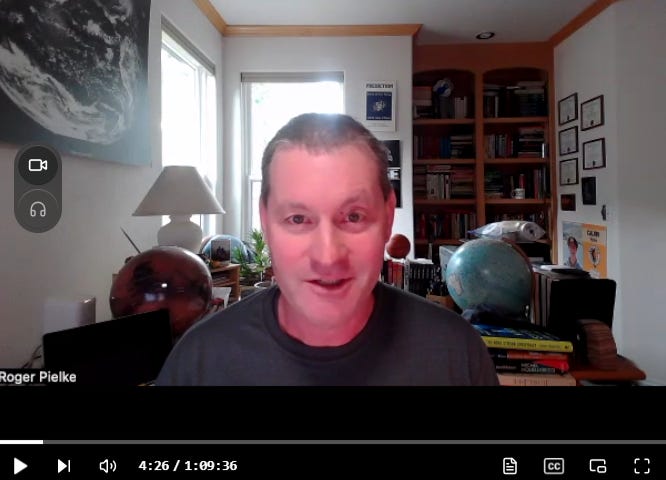
I appear on a lot of podcasts, but I rarely share them here at THB. Today, I make an exception for a conversation I had earlier this week with Darren Samuelsohn, who writes at Love, Journalism on Substack, and until recently served as the White House, Congress, and campaigns editor at USA TODAY.
Readers can find a full transcript of our conversation below. You can also head over to Darren’s site if you’d like to see me beaming out of the THB Global Headquarters or listen to our conversation as a podcast.
I’ve known Darren professionally for going on two decades, and I respect him enormously for his many years of reporting at E&E News and Politico. On a personal level, Darren has always treated me fairly. He never adopted the overt or stealth political advocacy so ubiquitous on the climate beat. Instead, he acts as a journalist should — reporting facts, calling things like he sees them, and recognizing that the world is complex and nuanced.
I share our conversation because Darren asks me some questions that no one else has — as I said, he is a pro. In our discussion I talk about The Honest Broker on Substack, how I approach my work at THB, offer some personal reflections on my career, my thoughts on journalism and journalists, and discuss some of the complexity and nuance that I’ve explored across many topics.
Give Darren a follow over at Love, Journalism — you’ll be glad you did.
HOW ROGER PIELKE JR. BECAME VOLDEMORT
Love Journalism Show by Darren Samuelsohn
Lightly edited for readability.
DARREN: It’s been a while since Roger Pielke Jr. and I caught up. That’s how it’s been with a lot of guests lately. David Roberts, the old E&E crew. Climate has only become more everything since I moved away and into other horizons 15 or so years ago. Roger Pielke of the Honest Broker on Substack, a senior fellow at the American Enterprise Institute, is here to talk us back into this discussion. Welcome to the Love Journalism Show. I’m Darren and this is Roger.
ROGER: Hey Darren, good to be with you.
DARREN: Great to have you, Roger. So last time I saw you, you were, gosh, this was a long time ago and you were in academia. You are now quite popular on Substack, writing about all the topics that you and I met on all those years ago. Tell us, tell my audience who your audience is.
ROGER: My audience, that’s a good question. Substack is amazing, as you know. It has an enormous reach. I have more than 40,000 subscribers in every U. S. state in 174 countries around the world. And about half of them are in the U. S., half overseas. And it’s an eclectic, politically diverse, highly educated, smart group. I’d be interested in hearing your views. I have a small proportion of people who Seem to be interested in being regular commenters. But it gets shared around and discussed. And I tell people, it’s no exaggeration. I’ve written a bunch of books as an academic. And I bet you in one week, more people read my Substack than over the last 30 years, all my books combined ever. So it is a remarkable platform. And it’s very rewarding.
DARREN: Do you read the comments?
ROGER: I read all the comments. I respond to some of them. And I do restrict the comments to my paid subscribers, which really elevates the quality. Everyone writes under their own name. And I’ve been doing it for six years now. And I can count it on the fingers of one hand, the incidents I’ve had where I’ve had to intervene. It’s a great community that has sprung up.
DARREN: One of the rules in a newsroom is never read the comments underneath the story. Did you get that memo or do you avert your eyes sometimes?
ROGER: Ha! I enjoy engaging. And for me, and this goes back a long time, more than 20 years, back when what we now call Substacking was called blogging. I use it as a form of extended peer review. I put ideas out there. People critique them, and they’re not shy. Sometimes I push back, and we have a debate and discussion. For me, engaging with the participants is actually a form of learning and getting better at what I try to do.
DARREN: It’s what the media world has gone into. if you don’t engage, you’re screaming into a mountain valley, I presume, right? Right, right. Tell us about your cadence. So how much are you writing? When are you writing? Are you doing in the morning, afternoon, every day? Are your ideas coming to you constantly?
ROGER: It’s another good question. I’m always writing. Writing is how I think. I just put together a new site using Claude Code where I compiled all my blogs from 2005. And you can map out what I’m thinking, not day to day, but pretty close, every couple of days nonstop for the past 20 years. And honestly, I write much more than I post because I don’t think my readers would like to hear all that much from me. I’ve done this even before Substack. I organize my professional life in public through my writing. And, ideas go from half-baked notions out there that get refined, and eventually some appear in the peer-reviewed literature, some appear in books. So the cadence is I publish a couple times a week, two to three times a week, pretty regularly. And I probably have two or three posts that I write that I don’t publish every week.
DARREN: So how do you find the stories that you’re going to tell? Where do you make the decision on I’m going to write about this when there’s probably 100 other things that you could easily write about in the course of a day?
ROGER: Oftentimes I will write on something on a particular day that I didn’t expect I would write on, just because of breaking news or a paper being published, or something else coming out. Part of the, and I’m sure you have this sense too, part of getting older and being around for a while is that I have a lot of experience on a lot of these topics. And so when something pops up unexpectedly, It fits into a stream or a thread or some longer term discussion I’ve had on topics that I can build upon. So there isn’t too much that comes across that I have to approach entirely anew.
I do a column for The Dispatch. And last week, my column was about data centers. And I do a lot on energy policy, but I’ve never written anything on data centers. So that was useful in the sense that I had to force myself to get up to speed on a lot of the energy and climate debates around data centers. But that’s more a parallel lane, I guess. I learned a lot doing it. And the reason I wrote about it is because I wanted to learn about it. So those things come up every once in a while.
DARREN: What’s your news digestion? Like, are you on Twitter all day? Are you re-flowing your social media posts and clicking and reading papers? Or are you stepping away because that wisdom, I presume, of you probably can anticipate the news to some extent doing this as long as you have, right?
ROGER: I was a public policy professor for almost 25 years, University of Colorado, and I teach it and I breathe it. I’m at American Enterprise Institute, which is a great think tank. So, I live on a steady diet of information and news. And so I read all sorts of sources and I really enjoy the triangulation that comes with seeing different perspectives and different arguments. So I would say I’m probably in the upper tier of news consumers.
DARREN: So if any of my watchers, listeners spend some time with Roger Pielke Jr.’s Substack, The Honest Broker, you’ll see he’s in the weeds. You’re in the weeds. You belong in the weeds and your audience loves the weeds. Tell us why are you in the weeds and why does your audience like that? I’d be just curious to have you explain that to folks.
ROGER: If you would have told me that I would have had 40,000 subscribers who are reading about the innards of climate scenarios and details of scientific papers that are relevant to policy, I would have laughed. But there are a lot of people who want to know the details and the details matter on these issues. And when I used to teach public policy to undergrads and grad students, I’d always tell them that when I was young and you first came to an issue, things started out being black and white. Like, I know it’s obvious. The answer is obvious. It’s obviously this. It’s obviously that. And the more I learned in my areas of expertise, the more the world was painted in shades of gray and red and purple and green. And you realize that there’s a lot of nuance to issues that often get painted as black and white. And so I do spend a lot of time on issues trying to help people see the shades of gray. And, we live in an era where everything is partisan. Everything is left or right. You’re MAGA or you’re a socialist or whatever. I just find that those descriptors and those clubs do a very poor job of describing the real world that we happen to live in. And I think there’s a lot of people who are actually hungry for understanding nuance, even if it doesn’t always map identically onto their preferred politics.
DARREN: You just described the life of a trade journalist in some respects, because we lived in, for many, many years living in the world of nuance. When you try and write to a larger audience or to a mainstream audience, you end up, you have to water things down. You have to water things down. I’m curious, as you’ve grown your audience at 40,000, I’m sure there are some people, this goes way over their heads, what you’re writing about. So do you ever try to water things down? And if so, what does that do to your writings?
ROGER: I don’t know if watering it down is how I would characterize it. It’s knowing how to, and it’s always an imperfect process, but knowing how to explain complex issues to normal people, I think I’ve gotten better at it. I think writing and getting feedback, you have to get better at it or you won’t do it anymore. But trying to preserve the nuance and the realities, And so, I do come at issues from many different directions. I’ve been writing about climate scenarios for almost 20 years. And you could not invent a more arcane, impenetrable set of issues. I don’t think anyone has to be super smart to understand them. It’s just that the effort required to wade through the acronyms, the jargon, the history, and the overlay of politics, it does take a lot of effort.
DARREN: That couldn’t be a better, I guess, segue to what you just did. You just built a whole new public database tracking heatwaves, wildfires, hurricanes, drought. I don’t think you have locusts on there, but the other types of extreme weather that are going on, I guess you do have drought, so we get to locusts from there. And partly you’ve done this because the feds pulled their own climate indicators offline last year. What should Americans actually understand about what’s going on outside their front doors right now in their backyards, maybe the next door state, as we just learned from the fires in Canada that are going to drift all across America? So how do those things connect or don’t they to everything else that’s going on in the mix?
ROGER: I have to say my dad, who’s a retired atmospheric scientist, sent me a paper last week about locusts in the 1870s and the Great Plains were infested by, I don’t know, Gazillion, bazillion locust infestations. So it happens. so I wrote a paper with a guy named Ken Kunkel, who I think is just recently retired from NOAA, and Stan Changnon, who was an old school climatologist, no longer with us, 1999, and we basically surveyed what the data said about trends in extreme weather and its impacts in the US. And it’s, it’s a widely cited paper and it was a huge effort to pull together all that stuff back in that day. And then, as you mentioned, the new THB Extreme Weather and Climate Change Dashboard was motivated in part by the Trump administration, taking offline a lot of climate data that was readily accessible.
It motivated me to say, well, in this era of AI, I’ve become somewhat proficient in coding with Claude. I started my professional career out as a Fortran programmer, so I have a programming background. And so the tools that are available now allow just an integration and presentation of a massive amount of data. And so I’ve been building some data dashboards and one that I wanted to build for a long time is one that presents trends in extreme weather events in the United States. And I’m working on one for the world. We could talk about that. That’s a much bigger and more difficult effort. But the U. S., props to NOAA and the U. S. government and Congress and presidents for generations for supporting the creation of these data sets. That are publicly available.
And I wanted to put the data out there so that normal people, so journalists, policymakers have one stop shopping if they want to know what are flood trends in the US, hurricane trends, drought trends. There are so many claims made, particularly in the media, but also that filter into policy that are based on single studies. And, the headline will say, scientists say hurricanes are getting worse. And, those studies may or may not say that, But having access to what the official data sources actually say can help people put those things into context and better identify, I would think, when science is being sensationalized or misused or abused. And so right now, the dashboard has 32 indicators across seven different weather phenomena. IBack in the day, it would have taken me a couple of years and probably a team of PhD students to put this together.
And I was able to put it together in a couple of months. So it’s, it’s work in progress. It’s going to be improved. But, and then I guess the other thing I did is I wanted to align what the official data says with what the Intergovernmental Panel on Climate Change (IPCC) has concluded. And, good news for the IPCC and good news for my Dashboard, they align just fine, just perfectly. So, the IPCC working group one is perfectly consistent with this official data.
It’s funny, I put this out there and I don’t know if it’s yesterday, day before I was reading on X/Twitter, someone was saying, this is all fake information because you can’t believe this guy. And, you take 30 seconds and you’ll see all this is just official data from government sources scraped off the internet, once a week.
DARREN: Don’t read the comments. Have you gotten a Claude sponsorship deal out of this? Because, you’re preaching to the choir here. I love what Claude has been able to do to my life, but I got to pull off here for a second and just speak to my audience about what artificial intelligence has done for your career, please.
ROGER: Ha! I think, Claude, at this point, Claude should advertise that I’m sponsoring them for how much I’m paying and how much I’m using. artificial intelligence, for me, I use it almost exclusively for my quantitative work. I treat Claude like I would a human research assistant, a highly skilled research assistant. So I built a decarbonization dashboard. I used to have a research assistant that I would have do this for me. And he would take, a couple months to pull together. a spreadsheet that was a rudimentary form of what I was able to pull together in a couple weeks. For doing math, for doing statistics, for replicating analyses AI tools are better than people at this point.
The Honest Broker on Substack does not have a back office staff of, people with abacuses or spreadsheets or anything. It’s me and Claude working to produce these things. And it’s been fantastic. It’s game changing.
DARREN: Do you have a name for your Claude?
ROGER: No, just Claude.
DARREN: Fair enough. I will not bore you. But if you bring me on your show, I’ll tell you all about my cloud system, which is crazy and insane. But let’s go back to extreme weather for a second. You spent your entire career pushing back. On the idea that every extreme event in climate change is climate change in action. And I think that’s maybe where I first found my way to you and to your dad for that matter. Here we are. It’s 15 years later. When you look at the data and now you can look at the data in a probably instant way, you’re tracking yourself. What’s changed? What hasn’t from what you were talking about back in 2005, six, seven period even?
ROGER: I’ll go back further than that. I did a postdoc at the National Center for Atmospheric Research, NCAR, in the 90s. I started in 1994. And my mentor, guy named Mickey Glantz, who ran a social science group at NCAR on climate impacts, came in the office in January 1996 with a copy of Newsweek. And it said, hurricanes, floods, and blizzards blame global warming. And at the time, there was some connection of extreme weather and climate change, but not anything like today. And he gave me this. And I tell my students, it was a magazine. It was made out of paper and it had a cover and it came in the mailbox. He gave me this and he said, this looks interesting. Why don’t you take a look at that? And so I blame Mickey for setting me down that path. My postdoc was on hurricanes and floods.
And so at the time, it was pretty clear that the claims that were being made about trends in extreme weather didn’t match with what the data said, even then. And so I started working on hurricanes and floods and branched out to fires and heat waves and things like that, tornadoes.
Everything changed in 2006. And there was this interesting combination of events. I won an award from the National Academy of Sciences, the Roger Revelle Award. Roger Revelle was a professor at Harvard. He happened to be the professor that turned Al Gore on to climate change. And I won an award for my work on extreme weather, in particular demonstrating with data and evidence that rising costs associated with extreme weather events were due to more people, more property, more wealth in harm’s way, not a change in the statistics of the events themselves.
That was in March 2006. In May 2006, Al Gore’s movie came out, An Inconvenient Truth. And people of a certain generation will remember the movie poster had a hurricane coming out of a smokestack, spinning the wrong way, by the way. That was Hurricane Katrina. It was flipped over. And late in the production of that, apparently, as I gather, Hurricane Katrina occurred in October of 2005. And they reoriented some of the movie to focus more on Hurricane Katrina and its impacts, which was a horrific tragedy and obviously badly handled, but a very extreme storm. And for me, that represented a real change in how my work was received and how I was portrayed by journalists and in the media, because all of a sudden extreme weather was the face of climate change. And this was a concerted effort.
People like Matt Nisbet, who’s a professor at Northeastern, have documented how environmental funders, philanthropists gathered together and they thought we have to bring climate change home to normal people. We can’t just say we’re going to have a three-degree temperature change in 2100, that’s not going to get people to act. Extreme weather is very photogenic. It has horrific impacts. It happens everywhere, every day on planet Earth and in the United States. So it feeds the media cycle. I was already well-established as a researcher. I was a young researcher, doing great. But my work, right away, it was palpable. My work was inconvenient because it didn’t fit that narrative. And I remember thinking: Am I still going to work in this area?
And I had colleagues saying, maybe you should downplay your work or it’s going to cause you trouble down the road. And they were probably right about that. But I faced a choice. Do I want to keep doing this stuff or do I just want to go along? In 2006 or 2007, I could have had a very different career track if I would have just joined the bandwagon and said, every hurricane is getting worse. And we need to reduce emissions so that we can modulate future extreme weather events. I might have gone down a very different path than I did.
DARREN: You know who took that path? I remember this so well because I was driving home from a vacation when Katrina hit. And I remember for some reason, because I like listening to, I don’t remember what exactly it was. I remember coming on to Sean Hannity on the radio and the person arguing with him right after Katrina about hurricanes was Robert F. Kennedy Jr. Yeah. Which is just boggles the mind to think about where he sits today. Right. And what position he was taking compared to where we are today.
ROGER: Well, you might have seen some of this because around that time, 2006, 2007, 2008, first it was Grist. I was one of their favorite punching bags. Then it was the Center for American Progress for a long while. And, as people left their early jobs there and moved on. Some of them, like Dave Roberts, who you had on before, decided I was public enemy number one. And there were journalists at places like the New York Times and elsewhere who decided that the work that I did couldn’t be correct, obviously, because it was contrary to a narrative. But things really changed at that point for me.
DARREN: So around that period, I’m covering climate science, but my focus was the policy. I’m covering the regulations, I’m covering the cap and trade bills that ultimately would crash and burn in 2010. So none of that stuff passed. And yet, I just was for the hell of it looking today, 15, 16 years later to see where emissions went, comparing to what those bills required. And emissions have come down anyway, for reasons most of those lawmakers, presidents, agencies never really had in mind. What’s your read on that? What actually moved the needle? What does it say about climate policy itself versus everything else that happens in energy markets and energy, overall?
ROGER: So I came to climate change ass backwards. I started with adaptation and extreme events, and later moved into energy policy and decarbonization. And one of the, this is down in the weeds again. So down in the weeds on my side, I often talk about decarbonization of the economy. So it’s carbon dioxide emissions per unit of GDP. It’s a simple metric. And that metric has been declining for as long as we have data for 60 years, which is good news. That means that we’re moving in the right direction. We’re not reducing emissions fast enough to meet targets. But one very fascinating aspect about that particular curve, if you look at the United States or the world, for that matter, it’s a linear, it’s a straight line downward.
And so if climate policy and mitigation policy efforts to reduce emissions, deep decarbonization, if that’s working, we should see an acceleration in that curve. We’re moving it downward faster. And so we don’t. We don’t see that at all. There is no evidence. You start in 1992 with the Earth Summit, 1997, Kyoto, Paris Agreement. In the US, clean power plan, cap and trade, name it, IRA, pick your favorite proposal or outcome. And there’s no evidence that any of it has moved the dial. And people get upset when I say that. Part of the reason is that what we used to call other names, maybe environmental policies, maybe economic policies, we’ve relabeled them as climate policies. So maybe there are things we call climate policies that contribute to decarbonization, but they haven’t accelerated decarbonization.
There are other things, particularly the rise of natural gas over the last 20 years that has displaced coal. Policies that have made coal more expensive and more difficult to build have contributed. Expansion of solar in particular and wind to a lesser degree have also contributed to that. But in terms of reducing emissions, there’s no evidence that our climate policies have done anything to accelerate the rate of decarbonization, which I would think should cause us to think, all right, so what is it we’re doing? And why do we think doing more of the same is going to lead to better outcomes? So I’m a proponent of deep decarbonization. I think it makes a lot of sense just to take that risk off the table. I wrote a book about that 15 years ago, 16 years ago now. But what we’ve been doing is obviously not working.
DARREN: I think I want to go to the politics of this for one second, because over this 26 years that I guess I’ve been in this world in Washington, and this really does overlay with the Bush years and the rejection of Kyoto, we’ve seen the politics of climate rise up, as you said, and it’s dropped down to nothing, and then it’s popped back up again, I think, around maybe the Inflation Reduction Act in Biden is when it gets another swing. And now, again, we’re down into a place where there ain’t nothing happening per se on climate. But the figures have changed. I mentioned RFK Jr., for example, 2005, screaming at Sean Hannity, what the hell are you talking about? It used to be, again, in that Obama era, they needed to win over some Democrats and they couldn’t win over those coal state Democrats. They’re long gone.
And the Tea Party is a brand new thing. And then MAGA is a brand new thing. So talk to me about the politics of climate change for a second, where you see them today versus where they were. And is this Is this one of those issues that’s just going to forever be third rail in the same way as you name it on the other political issues?
ROGER: I’ve been around long enough to remember when George H. W. Bush was campaigning for president saying he was going to counter the greenhouse effect with the White House effect. And there was a good faith battle over the degree to which government and government regulation should be the driving force in decarbonization. And it fell along predictable, old school, New Deal Democrat versus regular Republican conservative lines. But there was a debate about that. And that was, I think, a natural outcome of how climate change, global warming originally was originally framed. And people have to understand that the knowledge of climate change emerged from very sophisticated earth system models. And one, I guess it’s a career risk for modelers is that it’s very easy to map your model onto the real world.
And so if you want to reduce emissions, you put a knob or two in your model that reduces emissions such as going from scenario A to scenario C. And that gets translated into a real world understanding of something like a carbon price or some regulatory fiat to change technologies. And that early framing of climate change, mapping a model onto the real world, did get interpreted by people on the left as, well, we need more regulation. We need some top-down approach to manage the economy. And resistance from the right, who said, well, no, we’ve got to let the free market work. We need more innovation. Basic research is great, but none of this regulation stuff. That, I think, was normal climate politics and normal discussion.
I do think that the Bush versus Gore presidential election, going to the Supreme Court, Al Gore becoming, honestly radicalized on climate issue and making that his signature issue and combining that with the anti-Bush administration stuff helped to make climate change a very powerful wedge issue. And everybody knows what a wedge issue is, but I feel very strongly that folks on the right and folks on the left felt very strongly they could use climate change instrumentally to get political advantage, regardless of what it meant for decarbonization or adapting to climate, that it just became a symbol. And with the debates 20 years ago over the hockey stick mapped very nicely onto that. Honestly, the Republicans, Joe Barton, James Inhofe, they like to pick on climate scientists.
And to be fair, climate scientists, many of them haven’t been shy about advertising their progressive credentials and criticizing Republicans. And so everybody put on their partisan costume, and the politics became pretty poisonous for a long time. And it culminated with, if you look at the Inflation Reduction Act passed with, straight Democratic vote. And, the One Big, Beautiful Bill Act that ostensibly, probably not too significantly, but rolled back a lot of that was all Republican. And so climate change at some point morphed into just another place of the political battles of the U. S. And, the normal politics of climate change is a distant, distant memory.
DARREN: I almost I got asked like the alternative question, George W. Bush. For anyone in our world knows, in 2000, he actually campaigned on a pledge to reduce carbon dioxide emissions and only changes it thanks to the Cheney Energy Task Force at the very beginning. Had we gone the other way, like had Bush actually pushed through a bill in 2000, not giving Al Gore then the Inconvenient Truth platform, that then changes, I’m sure, the John McCain presidential run in 2008 and Obama, it changes everything. Right. What do you think happens if George W. Bush keeps his dad’s like environmental mantra going all the way through and try and answer it in three minutes because we’re going to run out of time in this particular segment of the Zoom. I think we should come back for a second. So, yeah.
ROGER: I think it’s a fascinating alternative history. I do think I’ve said this for a long time, that there is a huge opportunity for folks on the right for Republicans with energy policy and climate policy. There’s a term that Obama coined or his campaign coined, all of the above strategy. And it’s very popular again today. But all of the above means all of the above. Not everything everywhere all at once, but wind has a place. Solar has a place. Nuclear has a place. Natural gas has a place. Coal has a very small place, maybe for chemical reactions. But the most recent administrations have all played well. They’ve been picking winners and losers. And that goes for Trump. That goes for Biden.
And so I do think that for whichever political party picks up a mantra that, yes, reducing emissions is part of smart energy policy, I think there’s an audience for that out there electorally. And it moves us away from fighting over science and the vile partisan nature of the issue.
DARREN: You did so well so we got two and a half minutes left. I’m going to milk this question just one more line. And when I learned this policy back in the days, when I walked into E&E News, my old boss, Kevin Braun, would scream all the time, energy is not a partisan issue. Energy is not a partisan issue. It is a regional issue. And nobody understands that. And that got drummed in my head to understand the way that the country breaks down on where you’re getting your energy from and where you live and how you live and why they need air conditioning all the time. But has that changed? Has the regional dynamics changed because of our politics and tea parties and MAGA issues? Or are we still in a regional, energy war?
ROGER: Energy is always going to be regional in a country as big as ours. most people don’t realize that California gets a significant part of its finished gasoline product from overseas, from South Korea, from India, from the Bahamas, because the refineries in the US can’t process it. That’s very different than other parts of the country. Texas is an electricity island, and it’s not connected to other parts of the country. If you’re in North Dakota or Wyoming, Natural gas and coal are a big deal. West Virginia, Joe Manchin came out of West Virginia, which coal is part of the history, part of the culture. So yes, of course, energy is going to be a regional issue.
I do think there’s one big change I’ve noticed. really over the long term is that in 2005, the Bush administration and the U. S. Congress led a discussion over national energy policy, which we haven’t had really since then. From 2005 and that time, through Obama and then through Biden, climate policy usurped energy policy. It became the umbrella and energy policy was underneath. And, I think that was a mistake because energy policy means something to everybody everywhere, even if it means different things regionally. In climate policy, it turns out there was just a new report that came out this past week. The working class across ethnic groups in the U. S.—people of all races without college degrees—, climate change is not a big deal. So climate was the umbrella and energy policy was folded under that. And what it meant was that a lot of focus on issues that people care about in different places was lost to this big globally focused issue, but it also meant that things associated.
With energy policy falling out of the discussion other issues go with it, most notably affordability, inflation in an era where energy, particularly electricity demand is picking up, how to meet that demand is lost because you’re talking about reducing emissions, not growing energy systems. The big change has been in really the last couple of years, that’s flipped again. And now energy is the umbrella and climate to the extent that people are still talking about climate, which I think they should be, is underneath that. And I think it’s perfectly compatible to have an agenda that’s an all of the above energy agenda, focused on affordability, energy expansion for growth, for things like data center and AI and reducing emissions.
So, hopefully we’re poised to be in a better place for this discussion, but the partisan elements of climate seem to have lost some of their power over the left and the right because they’re not really talking about it.
DARREN: When you add the data center element, which you just said you were digging into, what did you come away with? Because that’s not in the equation 15, 20 years ago.
ROGER: Necessity is the mother of invention. And so for the U. S. for 15 years or so, we were fat and happy. We had plenty of electricity. It wasn’t a lot of demand growth. None was really expensive. There were a lot of projections that we would become ever more efficient and energy demand wouldn’t be as high as it was. And that’s changed. And it’s not just data centers, but the push to electrify heating and electrify the automobile fleet is going to have a greater draw on electricity. And so with the expectations of much greater demand comes questions, well, how are we gonna meet that? What technology is going to meet that? And that forces people to start having a discussion that we haven’t had for a long time.
And so one reason why people often point to China as the true all of the above energy nation is because they have to keep bringing online more and more Energy, not just electricity. And so we’re experiencing a taste of that ourselves in the US.
DARREN: Roger, now you and I have known each other for a long time. I spent a little bit of time looking back through some of my notes where I found your name, thanks to Claude, looking back through things. And I had a chance to look through things. You spent over a decade as a lightning rod. You spoke to that a moment ago. The congressional testimony I found from like 2012, 13 on the nuances of uncertainties, writing for FiveThirtyEight for Nate Silver in 2014, what you’ve been just discussing about the IPCC report. What do you think people misunderstand about why you keep ending up in these discussions, in these fights that are playing out in the online space increasingly more and more?
ROGER: It’s interesting. I think there’s a much greater understanding today than maybe back then. In 2013, you mentioned my congressional testimony. I don’t know how these things happen. I testified before Congress—the Senate first, and I think the House second. But my Senate testimony, which I gave first, when we give testimony, you have a five minute opening statement and you’re supposed to summarize what you say. But my five minute opening statement, somebody put it on YouTube and it went viral. And it got 400,000 hits in the two weeks. And that drew a lot of attention. All I did—the same thing I’m doing with my extreme weather dashboard—was summarize what the IPCC says about extreme weather and climate. I just laid it out there. That led to the Obama White House coming after me, John Holdren, President’s Science Advisor.
That led to a congressional investigation of me by Raul Grijalva, rest in peace, claiming that I must be taking money from Exxon in exchange for my congressional testimony. Ridiculous things. And as I mentioned, there was an organized effort by the Center for American Progress and Michael Mann and a few others to get me fired from Nate Silver’s 538, which they succeeded in doing.
And so I think part of it was, looking back in time, and having the perspective, part of the issue, I think, is that I just didn’t quietly go away. this was the early in the era of deplatforming and canceling. And, I don’t even believe that you can be canceled unless, you’ll let people cancel you. And the climate issue was notable because of the degree to which, legitimate, authoritative organizations, not just people, but in the media and in science wanted to clear the stage of people who were perceived to be off message or inconvenient.
And what I’ve always said, and it’s always been true, my work is just right in the fat part of the scientific consensus. The IPCC cites my work, it’s peer reviewed. The stuff that I do is not contrarian, it’s not skeptic, it’s just normal science. But as the climate movement, And this includes a lot of scientists became increasingly extreme in their rhetoric and their claims. The normal scientific consensus started looking a little boring, not exciting enough. And so I guess the other the other flaw I had is that my work got a lot of attention, probably just because I’ve been around for a long time and I write a lot. And I didn’t fall for the bait, didn’t go off the deep end, didn’t join some extremist party or anything like that.
Today, it’s vastly different. My stuff is widely read. It’s widely accepted. We could talk about climate scenarios. I saw that go from 10 years ago, same playbook. I first started writing about that. Oh, you must be a climate denier, climate skeptic, to now everybody in the world accepts all that stuff. They may not like it, but that’s where the science is.
DARREN: Has Substack helped? talk to me about the good and the bad of what Substack allows you now to do that maybe you couldn’t do 10 years ago and you were probably screaming into what, a Twitter universe that was not very rewarding, I presume.
ROGER: I don’t know what the secret sauce of Substack is. So I joined Substack in 2020, mainly because the platform was so elegant, so simple to use. I like to write and think. I don’t like to work on images, do HTML coding. I’d use Blogger and WordPress and things like that. And they were just clunky but you could get things out there. And Substack also, I came to learn, and I’m sure you learned, it has an ecosystem so people can find people. And I just thought it was going to be a blogging platform. And then at some point I decided, so I was having kids during the dot-com boom and, working and starting my job as a professor. So I felt like I missed that era, went by me. And I thought, well, if I’m going to do this new, approach to doing research, to doing writing, I’m going to be an early mover.
And so joining Substack, it was immediately rewarding. And this is another dynamic that I did not expect. At some point, I decided there are expenses associated with doing research and coding and things like that. But I thought, all right, if I’m going to pursue an alternative approach to research and writing than academia. And for reasons that are well-documented, I left academia in 2024. But I thought, all right, I need to pay the mortgage. And so I’m going to try this paid version of Substack. And if I could ever get to half my academic salary, I’m out of here, which I thought was a pipe dream at the time. But the minute I turned on the paid subscription thing, my readership started on a different slope. So I don’t know if people thought, well, if I have to pay for it, it must be good, or I don’t know what it was.
But what Substack does is it gets a writer’s work out there. I hear literally every day from people around the world in organizations, governments, businesses that I would have no access to without Substack.
So I did meet half my salary. I left academia. I joined the think tank later, but Substack, for me, has been a completely new approach to doing what I always have done, which is do research, write, do good work, get it out there, talk to people about it, and have agreements, disagreements. It’s not an exaggeration to say that for me, Substack was life-changing.
DARREN: Has it changed the way what you’re willing to say that you couldn’t have said as an academic?
ROGER: Not really. I’ve been pretty unfiltered. Academia is a weird place and it’s probably been a weird place for a thousand years, but there are a lot of ways that your peers and your colleagues can put pressures on you. So like in the climate space, I’ve never been invited to participate in the IPCC. I was told by an IPCC official, you’ll never be picked. And, IPCC for a lot of people is central to their career advancement. So that’s, and, at the University of Colorado, for a long time, my office was taken away from me. My classes were taken away from me. It’s just, making your life miserable. When you work for, I have 40,000 subscribers. Obviously, not all of them pay, but they all should — Ha, ha!
But when you work for, thousands of people who each pay you a small amount of money, there is essentially no pressure. Nobody’s going to write to me and say, I’m going to cancel my subscription unless you say this, that, or the other thing. There are people on my Substack who are obviously on the right and some on the left, and they tell me they don’t like my politics on this issue or that issue. And the beauty of it is if you’re coming to get partisan points, you probably should go to somebody else’s Substack, and that’s fine. So the decentralized nature of it is actually, it’s liberating in the sense that there absolutely is no pressure on me to do anything other than what I want to do. So in that sense, it’s a very empowering environment.
DARREN: What’s the biggest challenge of doing this, like outside of that institutional backing that you have had before? The thing that, nobody warned you about as you got into this.
ROGER: I have to say, for me, being associated with AEI, which maybe 90 years ago was created after the New Deal, which is a center-right think tank full of heterodox thinkers, very well positioned. That replaces a key element of what I had in academia. As an academic, for better or worse, you get stature. Oh, you’re a full professor and you got a PhD and all that. You’re at an R1 university. And I do think, if I was just a Substacker right now, I wouldn’t have that institutional authority. I’m lucky that I get a chance to talk to elected members of Congress from both parties and if they don’t know who I am, and if I say, I write The Honest Broker on Substack, they still won’t know who I am. But if you say, oh I’m a senior fellow at AEI, all of a sudden I get credibility.
And they don’t know what I’m going to say, but if you’re at AEI, you must be somebody I can listen to. So I do think I was lucky in that I had this dual role where I write, I do all my work first and foremost on Substack, and then I have access to the policy world through AEI. And I do wonder, if I was just an independent scholar, I really doubt I would have the footprint that I do in the intellectual world. So that was maybe something I didn’t think through 100% when I was thinking about getting half my salary through Substack. But that said, if you’re an old professor and you fade into the sunset, you write for your little audience, that’s not a bad outcome either.
DARREN: Has any piece of your work landed totally differently than you expected?
ROGER: I’m working on a book. It’s almost done on, the gender wars in elite sport. so I’ve been working on, on sports governance issues for, going on 20 years and I led a sports governance center. It’s one of the things I did when I went out in the wilderness and left the climate debate after getting investigated by Congress and it’s super rewarding. and, and I, it’s like my climate work.
If you understand the nuances and the shades of gray of gender eligibility in elite sport, it’s not a black and white issue. And it’s not a MAGA versus progressive issue. It’s much more complicated. And there’s real people and real humans. And so I have a book, it isn’t coming out yet because I don’t have a publisher, but the book’s almost done.
And it’s about women who traditionally, historically have been called intersex or DSD, differences of sex development or variations of sex development, —my preferred term. But they’re born female, identified female, raised as female. They are what I call collateral damage in the war over trans athletes. So it’s not a book about trans athletes. It’s about this group of women. And one of the things that I’ve come to very deeply appreciate is that people on the left really like my work on gender and sport. And people on the left really don’t like my work on climate. And people on the right have the exact opposite view.
And so for me, when I’m writing on these issues, both of them, I do have to orient my mind in very different ways to kind of, make sure I have my bases covered because my work doesn’t get critiqued from one political direction all the time. And so as far as how things land, I do have to take care in crafting nuanced arguments that are politically robust, realizing that the politics depends on what issue I happen to be writing about.
DARREN: I think you’ve checked all of the boxes. You might have like the equivalent of an EGOT for your career. You’ve been investigated by Congress. You’ve testified before Congress. I think I saw that you were cited by a Biden White House on one of your tweets when you gave praise to a nominee. I think you’ve clearly got the EGOT at this point.
ROGER: Ha! I was in WikiLeaks and I was in the ClimateGate emails and I was in the Proximal Origin Slack messages.
DARREN: I’m going to award you the EGOT for climate policy nerddom right now. Who on Substack is doing something you wish you’d thought of first?
ROGER: That’s a good question. I wish there’s a lot of people who are really good at doing podcasts like you, for example. And I did a few podcasts and produced them. And I did one that I’m pretty proud of. It was about how I became Voldemort in climate science. But Good Lord, it was a lot of work and it was just challenging. And it’s, I’m not a media person. I’m not a journalist. I don’t have those skills. And so I’m a good writer and I write a lot, but it’s like a rebounder in the NBA who can’t shoot. So I can do one thing really well. So I do wish I had the ability to have a greater diversity of media outlets. Robert Bryce, a guy who does an energy Substack, he’s a friend of mine. He told me one of his kids helped him get onto TikTok and he’s done one- and two-minute videos and they get a lot of views and a lot of hits.
But I’m not good with the video or the podcasting thing.
DARREN: So your dad’s been in this world forever too. Does climate science in your bloodline change how you write or just how people read you from your perspective?
ROGER: That’s another great question. I’m close to my dad. He’s just about to turn 80. He’s still super smart, super active, doing a lot of stuff. When I grew up, he was a young father. he treated me like his students. I used to take his college atmospheric science exams when I was in elementary school and stuff. And so I do think I’m very familiar with a lot of aspects of climate science, the jargon, the literature. I think the fact that I got my initial postdoc at NCAR was probably helped by my name. There’s no doubt about that. There’s some privilege being Roger Pielke Jr. So I do think working at the interface of science and policy, you have to know something about the science to be able to connect it to policy. Collaborating with him and just having someone to talk about these issues has been really important.
In the 1990s, after I did my postdoc at NCAR, when I was focused on hurricanes and floods, he and I decided to write a book together on hurricanes. And I remember, we literally would sit next to each other and he would explain something about, baroclinic instability and Coriolis force. And, then I’d say, all right, we’re going to write this in English for people so they can read it. And so we’d go back and forth and we still do that thing. So I think, it’s anyone who has a chance to grow up in a household with a world leading scientist on any topic is going to benefit probably in ways if they decide to apply it professionally.
DARREN: What on earth do newcomers think if they get invited to your house for Thanksgiving dinner? Do they beg you guys to not talk about this or are they just sitting back, with their mouths agape?
ROGER: No, I think everybody’s by this time familiar. We lost my mom not too long ago. And so he’s making a lot of new friends. And when he starts talking to people, everybody likes to talk about the weather. he’s a weatherman. People love to talk about the weather. And, he starts out with an atmospheric science graduate level discussion. So, so that’s always a challenge, but, our family discussions don’t center too much on the stuff that we do.
DARREN: Has your relationship with the phrase climate change changed over the course of your life, your career?
ROGER: I think it has. It’s really interesting that for a long time, Climate change was understood in common parlance, just like it was in science, that climate change was a statistical description of some change in a variable that we care about related to weather or climate. A change in the average temperature of the earth is like a change in a hitter’s batting average, right? And over time, climate change, particularly in the media, but this is filtered back into science, climate change has become an all-purpose causal actor. So, was the heat wave “caused by climate change”? And that doesn’t even make any scientific sense from the standpoint of the IPCC, because climate change, it’s a little bit like saying the hitter’s home run, was that caused by his batting average change? No, but the home run might filter into how we interpret his batting average.
And so when I talk about climate change, and I’ve been writing much more about this lately, I go to great lengths to explain that climate change is not a cause. Climate change, greenhouse gases might be a cause, aerosols might be a cause, changing the land surface might. But climate change is not the cause. It’s a completely circular discussion. So I’ve had to really change how I talk about climate change and make sure I don’t slip into that lazy formulation of, Was this caused by climate change? Because it doesn’t make any sense. So the understandings that people have, I think, have become much flatter over time, which makes it even more difficult to break through with a more nuanced discussion. Because if you say climate change doesn’t cause anything, the first response you get is, well, you must be a denier, of course it does.
And you say, well, no, climate change is a statistical concept. It’s not an actor, right? people go to sleep when you start talking like that. So, yes, I do think it has become much more difficult to actually talk about the notion of changes in climate, which are real and have a significant human impact. And there’s something we want to mitigate. But if we can’t talk about it accurately, it’s going to be real hard to implement policies that make any sense.
DARREN: And yet it does feel like, again, maybe this is just because I’ve been in this world myself, like awareness feels higher thanks to the Gores, thanks to, our just going outside and just having a human experience. So how do you square that when people are able to talk or people are aware of the concept, they talk about it again. And in the last 25 years, we can now literally. We could turn off this camera and we would instantly know what’s happening the other side of the planet in a way that we wouldn’t have known 25 years ago. So how do you spur those two things?
ROGER: It’s interesting. If you look at opinion polls, and we did an opinion poll, Rui Teixeira and I at AEI right before the 2024 election. climate change as a concept is incredibly salient. It’s very popular. People, if you say, do you want to do something about climate change, you will get a very high proportion of people across the political spectrum, obviously more on the left than on the right, but still it’s very, no one’s against doing something about climate change. The problem is that I think that becomes very disempowering. So, do you want to do something about climate? okay. Let’s do something about climate change. And so you’ll see a lot of advertisements about, public support for climate change.
But then when you ask people, would you pay $10 more a month on your electricity bill to do it, the majority of people say, hell no, I’m not going to do that. And then when you talk to policymakers or when policymakers talk to the public, like with respect to the fires that have occurred in Europe or in Oregon, it’s very easy for a policymaker that says, we really have to do something about climate change. And that’s an avoidance of responsibility or accountability. we’ve got to do something about climate change, but it’s not going to help with your exposure to fire risk this year, next year, in the next 10 years, even longer. And so joining up climate change with the thing that just happened, I find to be very disempowering and a little bit frustrating.
DARREN: What’s the most undercovered policy story in this world right now?
ROGER: On climate change. I think that the most undercovered story still remains the retirement of the most extreme climate scenarios that have dominated climate research for the last several decades. I talked to a lot of people. I was just presenting it in a workshop on response to rural disasters, and I presented on the extreme scenario retirement. Nobody had heard that these scenarios had changed. In their local communities, they’re still using the outdated retired scenarios for their planning. It is remarkable to me. There was a flurry of coverage. It was mostly in response to Trump’s tweet a bout RCP 8.5. Had you told me, a president, much less Donald Trump, was going to tweet about a climate scenario. I would have laughed a few years ago.
But the media coverage was more Donald Trump said this thing and here’s where he’s wrong rather than going into the details of, what are these scenarios? Why is a little committee in Europe making them and they influence what central banks do? I do think that there’s a continued neglect by the larger media, I don’t know if we call it mainstream media, but the larger media of the actual details of climate science in favor of continued hype and hyperbole and partisanship.
I will be doing an interview with a big Australian outlet on my new climate dashboard. They’re the first media group that has contacted me about this. I would think that this would be the stuff that the media would eat up, but who’s going to show a dashboard where six of the seven indicators don’t show any significant change over many decades?
So I do think that the basic elements of consensus climate science are well undercovered today.
DARREN: I’m going to close out our entire show here. I got a couple of questions for you. I know you just said a couple of minutes ago, you don’t have a media training, you’re not a journalist, but I ask these questions of everyone. And I think in the context, you’re making money on Substack and you’re writing every day. And there is no license to be a journalist. I’m going to call you a journalist. So welcome to the club. And I guess one question I ask everybody is, is there one thing? Whether it be tangible, physical, that you carry with you from, that you need to do your job day to day, whether it is a pen, a pencil, it sounds like maybe it’s Claude, but is there a thing that you carry with you that you do, that you need every day in this space?
ROGER: That’s a great question. I need a steady diet of information and that can come. honestly, I don’t watch much TV or, sometimes I have TV news on in the background, but I don’t get a lot of information from that. I do find that X/Twitter is an absolutely fantastic resource for surveying what people think, pointers to information, things I should read. Honestly, I’ve dabbled, I guess I would say, in the discussion over COVID origins, which is another science meets policy topic that is fascinating and problematic. I would say 95% of what I’ve learned on that topic has come from people on social media pointing to me to things I should read, science articles, public lectures. theses that were recovered from Chinese students in the archives and translated.
So to do what I do at this intersection of science and policy requires the best, the latest information so that I can start triangulating among it to figure out what I think is what.
DARREN: Really quick, Twitter of old versus Twitter of new, which do you prefer, the Jack Dorsey Twitter or the Elon Musk Twitter, if you had to pick?
ROGER: I haven’t noticed a change. I don’t go into the partisan spaces all that much. the earlier one, I’m pretty sure I was throttled or rate limited because of some of my climate stuff. Not all, but many of the climate journalists on the climate beat have me blocked. So, I don’t hear from them. I don’t get much crap from people on Twitter. And so for me, Twitter, I do put stuff out there, but it’s the ratio of Substack to Twitter for how my stuff is taken up in the world. It’s probably 99 to 1. Twitter for me is an information resource and I use it the exact same way now as I did before. So I don’t do any of the Nazi stuff; I don’t do any of the socialist stuff. So my bubble is pretty cleansed to all that stuff.
DARREN: And last but not least, you’re on the Love Journalism show. Tell me if journalism has loved you back.
ROGER: Yes and no. I think I have long thought that what what journalists do and what public facing academics do has a lot of things in common. We seek the truth. The work that we put out is often a first draft at best of that truth. We try to get better over time. We try to refine what we’re doing. We’re all telling stories as they occur and as they evolve. Peer review gets, people call it the gold standard and it’s great, but peer review is a minimal standard. I had stronger review of things that I wrote when I wrote for The Atlantic or The Wall Street Journal, The New York Times than, a lot of academic journals. The fact checkers did a lot more rigorous job. And so, at its best, I have learned an enormous amount from journalists and journalism. And I couldn’t do what I do without a strong, vibrant sector of journalism.
At the same time, obviously, it’s very publicly known. There have been a number of journalists who’ve seen their job is to silence me or criticize me or label me and somehow in their stories. There was just a Political article in the last few months where, they tried to make it sound like I was some raging, crazy MAGA guy. it’s always funny when they, I work for AEI, which is a fantastic think tank. And it always comes in certain outlets with, the “conservative” AEI think tank and, others in the same article who are associated with left leaning groups, they don’t get, they don’t get an ideological label. So I could have done without over my career journalists who are campaigners and seeing their job to shut me down, ha haa. But at the same time, if that’s the worst complaint I have, it’s not that big a deal.
So I love journalism. Journalism is done great by me for the most part.
DARREN: 40,000 subscribers certainly agree that you certainly got a message to share. And I really appreciate you taking the time, Roger Pielke Jr., for our show today. This one really plugs right into the whole recent run we’ve been doing on energy and environmental policy with David Roberts, with the E&E crew, as I said, and then check out my Powerlines series of photos of power plants, excuse me, Powerlines that just pop up whenever you take a picture of Out there in the world. Last but not least, Sunday brought something very different from Love Journalism, my poetry collection. Please, God, let there be a bowling alley in heaven. Please go check it out and please subscribe.
If you’re among the next couple of people to subscribe, next couple dozen people to subscribe, you’ll get hooked up just like my other subscribers with my first ever book, which I self-published, just like Thomas Paine, Jamie Frazier, or Alexander Malcolm from the Outlander series. This has been the Love Journalism Show. See you next time.
Today I have two favors to ask! First, before you go — Please click that “❤️ Like” button. And second, head over to Love, Journalism and give Darren Samuelsohn a follow.
Postscript: Andy Revkin, former NYT journalist and current Substacker, coined the phrase “Voldemort of climate science” to characterize me as “he should not be mentioned” — a reference to the broad commitment among journalists on climate beat to pretend like I and my work does not exist. Its a good one! Below you can listen to a podcast I created with original source materials explaining how that all came to be.
Comments
Nothing yet. Say the first thing.
Sign in to join the conversation.