
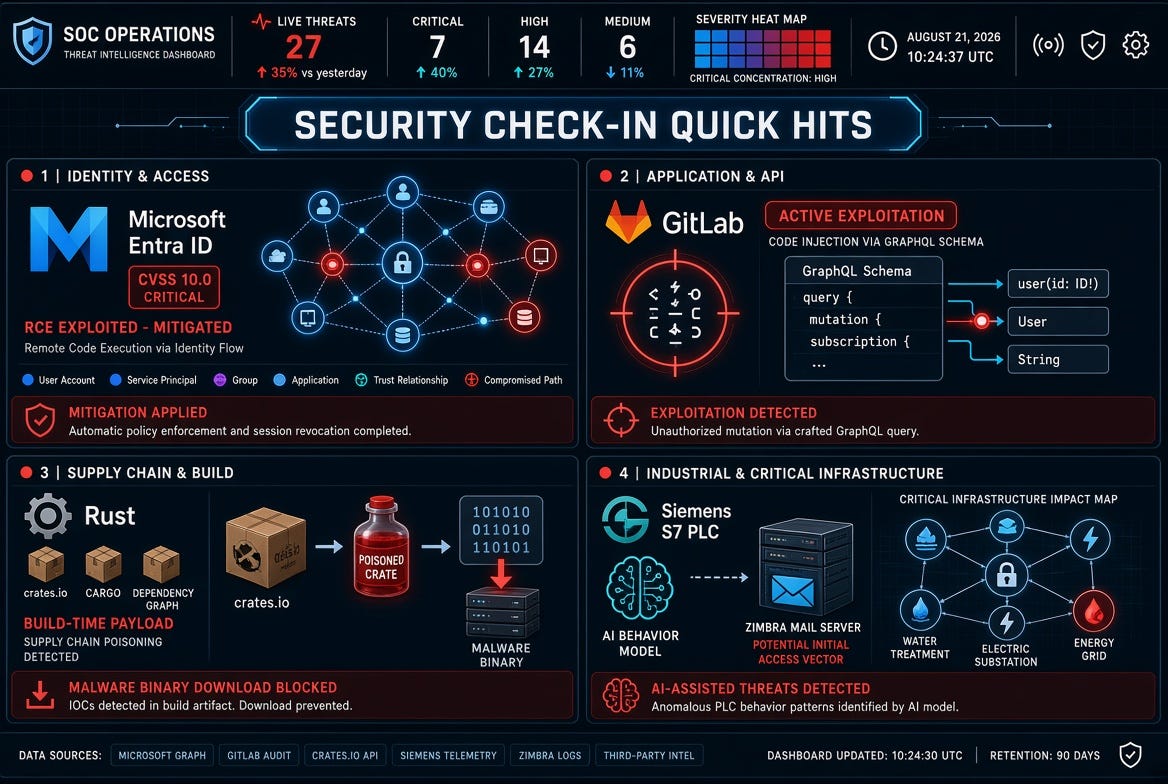
Microsoft disclosed a maximum-severity remote code execution vulnerability in Entra ID (formerly Azure AD), scored CVSS 10.0. The issue stems from deserialization of untrusted data (CWE-502), allowing an unauthenticated attacker to execute code over the network with no user interaction required.
Microsoft confirmed the flaw was exploited in the wild prior to public disclosure. Because Entra ID is a fully managed cloud service, the company fully mitigated it server-side. No customer patches, configuration changes, or actions are required. The disclosure is primarily for transparency so organizations can understand potential prior exposure to their identity and access management plane.
This highlights the high stakes of identity-platform flaws: successful exploitation could impact authentication across Microsoft 365, Azure, and integrated third-party apps. Defenders should review any unusual Entra ID activity or authentication anomalies from the relevant window and continue monitoring Microsoft’s transparency updates on cloud CVEs.
A critical code-injection flaw in GitLab CE/EE (CVSS 9.4) allows unauthenticated attackers to modify or delete publicly accessible projects and user data via a malicious GraphQL directive. Affected versions include those from 18.2 before the patched releases 18.11.11, 19.0.8, 19.1.6, and 19.2.4.
GitLab.com and GitLab Dedicated were already patched. Self-managed instances remain at risk. Researchers (including watchTowr) reproduced the issue quickly from the advisory and observed in-the-wild exploitation attempts shortly after disclosure—underscoring how short the window between public details and attacker weaponization has become.
Immediate action: upgrade self-managed GitLab to a patched version. Temporary mitigations include restricting unauthenticated access to the GraphQL endpoint or limiting public project exposure. This is a classic reminder that public-facing DevOps platforms with powerful APIs need aggressive patching and exposure controls.
Attackers compromised a maintainer account and published malicious versions of popular Rust crates—most notably arrayref@0.3.10 (hundreds of millions of lifetime downloads), plus internment and append-only-vec. These pulled in a typosquatted dependency (proc-macro1 and related packages) whose build.rs script downloaded and executed a remote payload during compilation. Simply running cargo build was enough to trigger it.
The malicious versions were live for roughly 1.5–2 hours before the Rust Security Response Team removed them and locked the account. Infrastructure overlaps have been noted with recent campaigns attributed to North Korea-linked actors. The payload focused on credential and data theft (browsers, etc.) with persistence mechanisms.
Developers and CI systems that resolved the affected versions in that window should treat hosts as potentially compromised: clear Cargo caches, audit for dropped files and persistence, rotate credentials, and review dependency trees. This incident reinforces the need for locked dependency versions, supply-chain monitoring, and build isolation for high-impact ecosystems.
U.S. agencies (NSA, CISA, FBI, DOE, EPA) issued a joint warning that threat actors are using AI-generated exploitation scripts, combined with open-source libraries such as python-snap7, to target internet-exposed or poorly segmented Siemens S7-series PLCs. These controllers are widely used in critical manufacturing, energy, water/wastewater, chemical, food/agriculture, and commercial facilities. Attackers scan for exposed devices, then leverage AI to rapidly produce tools that mimic legitimate OT monitoring software for read/write access to memory, configuration, and ladder logic. The agencies describe this as an active threat and an evolution in adversary capability that lowers the skill and time barriers for ICS attacks.
Separately, CERT Polska reported active exploitation of a high-severity command-injection flaw in Zimbra Collaboration Suite (CVE-2026-73570). When the optional SNMP package is installed and notifications are enabled, unauthenticated attackers can execute OS commands as the zimbra user via crafted requests. Zimbra fixed it in version 10.1.20 (July 2026); unpatched internet-facing instances remain high-value targets for mailbox access, credential theft, and further pivoting.
Bottom line for the day: Identity platforms, DevOps tools, open-source supply chains, industrial control systems, and email collaboration suites all saw high-impact activity. Prioritize rapid patching of self-managed GitLab and Zimbra, supply-chain hygiene for Rust (and similar ecosystems), visibility into Entra ID telemetry, and proper segmentation/hardening of any internet-reachable or poorly protected PLCs. The disclosure-to-exploitation window continues to shrink—especially when AI assists attackers.
Comments
Nothing yet. Say the first thing.
Sign in to join the conversation.