
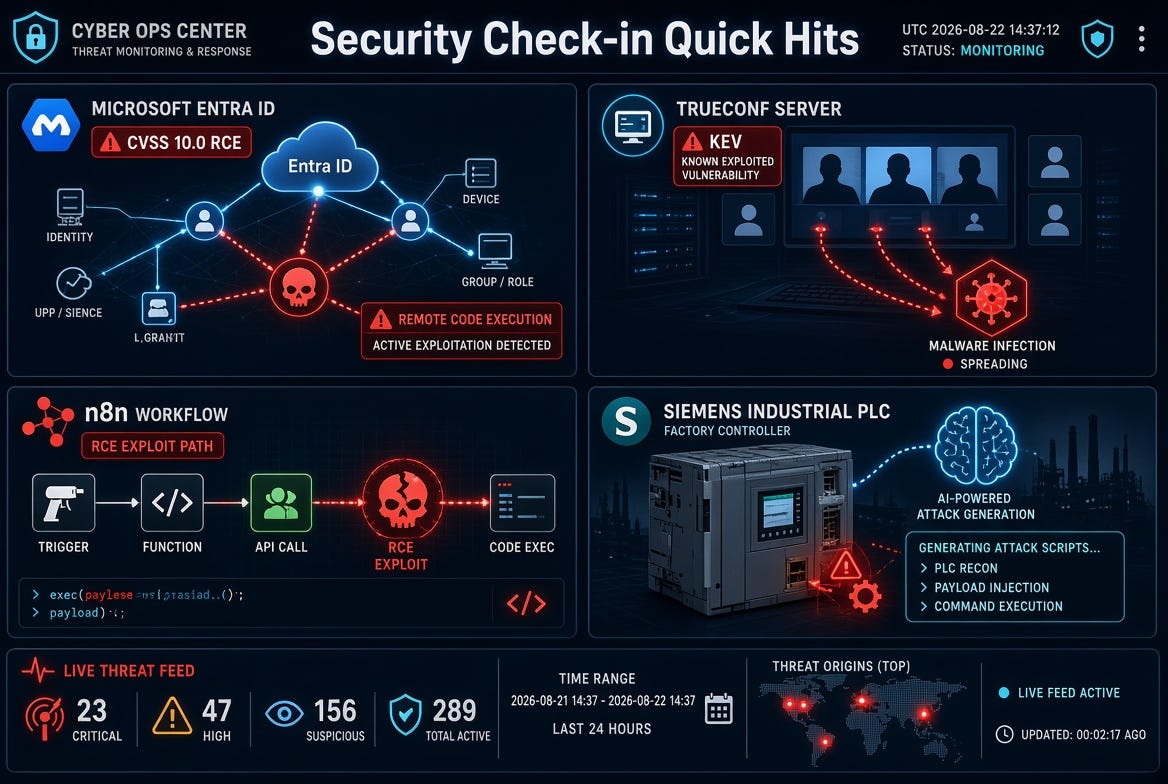
Microsoft disclosed and fully mitigated a maximum-severity remote code execution vulnerability in Entra ID (formerly Azure AD), its core cloud identity and access management service. The flaw stemmed from deserialization of untrusted data, allowing an unauthorized attacker to execute code over the network with no privileges required.
Microsoft’s own researchers discovered it. The company applied a server-side fix, stating customers need take no action—the CVE exists mainly for transparency. Early messaging briefly flagged exploitation in the wild before correction; the final status is that it was not exploited. Multiple related high-severity patches landed in the same wave for Azure, Exchange Online, and related services.
Why it matters: Entra ID underpins authentication for Microsoft 365, Azure, and countless connected apps. A flaw this severe in the identity backbone underscores how even heavily cloud-managed platforms can surface critical issues that demand rapid vendor response. Organizations should continue monitoring for anomalous sign-in or identity activity as standard hygiene.
CISA added two critical TrueConf Server vulnerabilities (CVE-2026-72529 and CVE-2026-72530) to its Known Exploited Vulnerabilities catalog and directed federal agencies to prioritize patching. TrueConf is a self-hosted video-conferencing and messaging platform.
CVE-2026-72529 is a missing-authentication issue that lets a remote unauthenticated attacker reach an undocumented function over TCP/4307 and execute arbitrary scripts in a restricted environment. CVE-2026-72530 enables escape from that environment to run code on the host with elevated privileges. The Head Mare group has chained them since at least July 2026, compromising servers, planting web shells, and replacing legitimate client installers with versions that deliver PhantomCore malware to meeting participants.
Patches have been available since mid-June (TrueConf Server 5.3.9 / 5.4.9 / 5.5.5 and later). Exposed or partner-accessible instances remain high risk.
Why it matters: On-prem collaboration tools are attractive targets. Successful exploitation turns the server into a malware distribution point for every participant—classic supply-chain style impact from a single compromised host. Check exposure of port 4307, apply updates immediately, and hunt for signs of prior compromise.
Multiple high-severity remote code execution issues in the popular open-source n8n workflow automation platform drew attention, with proof-of-concept material circulating. Notable among recent disclosures is path-traversal and related sandbox/escape problems (including CVE-2026-77068 and expression/sandbox issues) that can allow authenticated users with relatively modest privileges (e.g., global:member or workflow edit rights) to achieve code execution in the n8n process.
n8n is widely used for automation, integrations, and increasingly AI/agent workflows. Several advisories and GitHub security notices in the August 19–21 window highlight the need for rapid upgrades.
Why it matters: Automation platforms sit at the intersection of credentials, APIs, and business logic. A compromised n8n instance can exfiltrate secrets, pivot into connected systems, or abuse AI-related workflows. Treat any internet-reachable or multi-user n8n deployment as priority patching, restrict member-level access, and run the process with least privilege.
U.S. agencies highlighted AI-written exploitation scripts targeting Siemens S7-series factory controllers and related industrial control systems. Attackers are leveraging AI to generate or refine attack logic against programmable logic controllers that drive physical processes (pumps, breakers, production lines). Compromised logic can alter outputs while presenting normal readings to operators.
This sits alongside broader activity involving exposed industrial and edge devices.
Why it matters: OT/ICS environments have long suffered from delayed patching and limited visibility. AI lowers the barrier for crafting tailored exploits, compressing the time between vulnerability discovery and weaponization. Segment OT networks, monitor for anomalous controller behavior, and treat internet-exposed or poorly segmented Siemens (and similar) devices as urgent inventory and hardening targets.
These stories illustrate recurring themes: identity-layer risks in cloud services, rapid exploitation of self-hosted collaboration tools, automation platforms as high-value targets, and the accelerating use of AI against industrial systems. Prioritize patching of exposed services, identity monitoring, and OT segmentation.
Comments
Nothing yet. Say the first thing.
Sign in to join the conversation.