
Last week, Moody’s published an article with a blockbuster warning about the AI debt bubble. Also, last week I said this during a YouTube interview:
“A lot of the AI bubble is funded by private equity and private credit behind the scenes. And there’s no way that you would have this kind of capital expenses—which is feeding the bubble - if you didn’t have the ability to issue debt. The ability to issue debt depends on ratings as well as private credit and private equity.”
“Even for Google / Alphabet, the amount capital expenses they have proposed will swamp all of their liquid assets. So maybe Google’s double-A is at risk.”
While the rating agencies often give empty warnings that result in no rating action, this one feels different. The Moody’s article has a degree of specificity and alarm that makes me wonder if there will soon be a day of reckoning.
Below is the key takeaway:
“Heavy capital spending relative to revenue will lead to declining, and in some cases negative, free cash flow and will hurt leverage ratios, to the extent these expenditures are debt financed.”
Will Moody’s effectively shut off or curtail new AI debt issuance via issuing a private ratings warning (directly to the company) or a public debt warning that massive new debt issuance will have ratings consequences (as it should)?
Limiting the ability or raising the cost to issue debt will heavily impact the CapEx spend which is the entire foundation of the AI exuberance.
I first called out the financing of AI infrastructure one year ago when I criticized a AAA CMBS deal that featured a single loan with a large concentration of lease exposure to AI hyperscaler/neocloud CoreWeave.
I followed that up a few months later criticizing S&P for their overly generous rating of Meta’s massive $25B data center deal. The title of my Meta post says it all:
“The Great AI Credit Risk Laundering Has Begun: Meta Case Study”
While Moody’s offered no indication of imminent rating action, the article was clearly meant as a warning and the breadcrumbs leading to rating action are there. And it’s quite possible, likely even, that Moody’s is delivering warnings mano a mano to the 6 hyperscalers; sotto voce rather than through public downgrade or watchlist warnings.
Moody’s is likely signaling they have their limits and this report may be a Roberto Duranesque, No Mas messaging. They are, perhaps, establishing a firebreak to keep the debt explosion capped.
Unless the CapEx spend is financed entirely by cash or equity, bondholders and Rating Agencies get a vote.
Moody’s warning is apropos given the massive projected CapEx spend and the enormous risk of building the infrastructure and the significant doubts about whether sufficient revenue will materialize to provide a return on the CapEx spend.
In addition to the large on balance sheet debt, much of the debt is being created in off balance sheet vehicles. Moody’s report seemed to indicate an increasing focus on including the off balance sheet commitments in to their rating analysis. The hidden off balance sheet debt may have a cost after-all.
See below a case study on Meta’s large off balance sheet exposure.
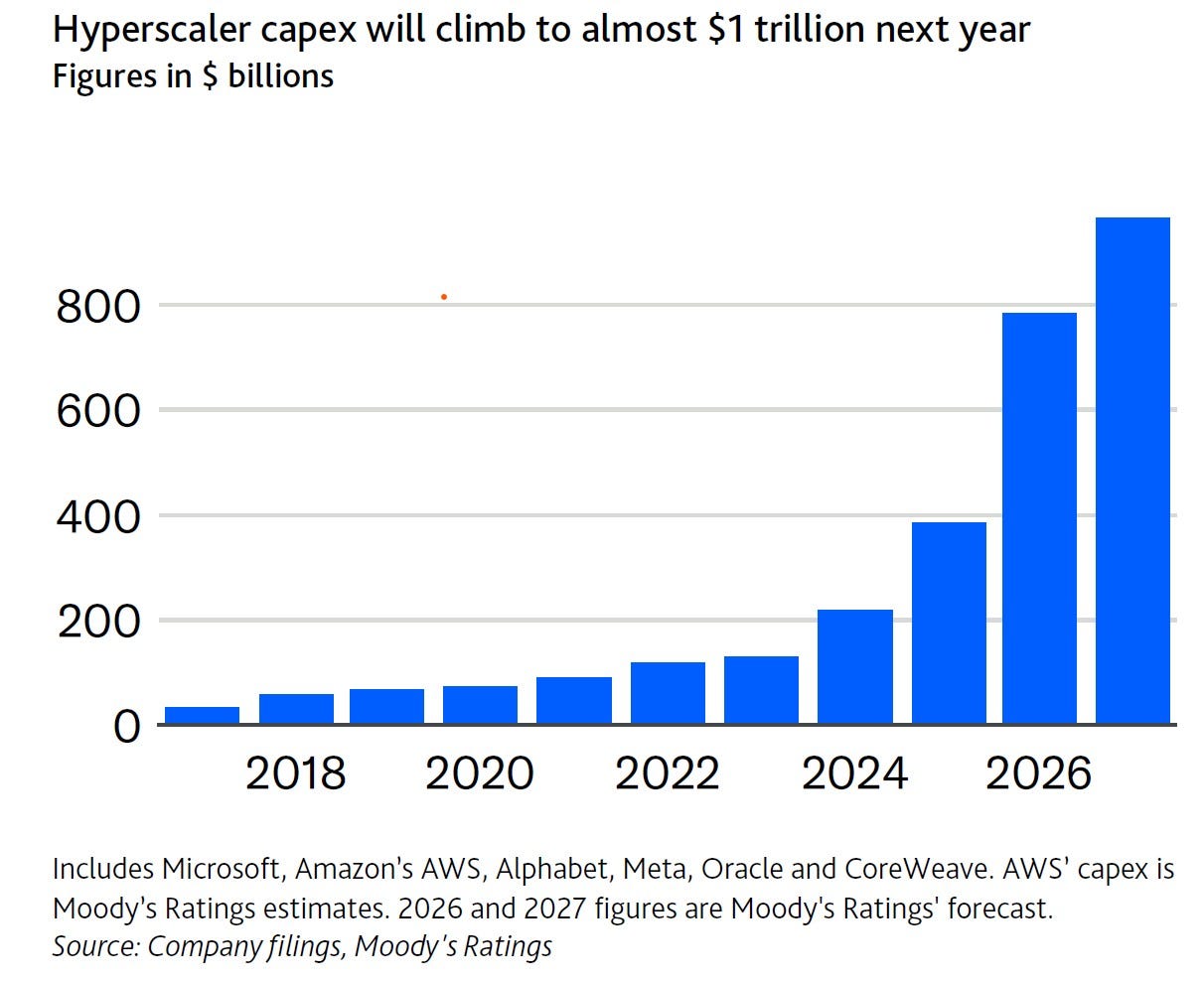
Moody’s sited 2026 datacenter commitments of $1.2T, most of which consists of leases that have yet to begin. Moody’s also noted $460B direct debt of the 6 hyperscalers (Microsoft, Amazon’s AWS, Alphabet, Meta, Oracle and CoreWeave. AWS). Moody’s also expects the massive hyperscaler spend to reach $1T in 2027. See chart below from their report.
And this is all with very, very limited revenue visibility,
This is just one big, giant trillion dollar financial Hail Mary.
It’s important to understand that most of the AI spend is largely serving two masters – OpenAI and Anthropic. While Alphabet, Meta and SpaceX (via xAI) all have LLM ambitions, the AI bubble is heavily dependent on OpenAI and Anthropic, two private non-rated companies.
In fact S&P in their recent Oracle downgrade attributed it to the fact that more than 50% of Oracle’s spend is based on exposure to OpenAI. In a December article I suggested that Oracle would be downgraded to junk and therefore become the largest fallen angel (downgrade from investment grade to junk).
S&P acknowledged errors in their prior rosier view of Oracle:
“We now recognize that that we underestimated the scale of the investments required to expand the AI business and its impact on our overall view of Oracle’s creditworthiness.”
They also acknowledged that Oracle has bet the farm on the unrated OpenAI.
“We estimate that OpenAI makes up roughly half of the $638 billion in RPO. OpenAI’s ability to meet its contractual obligations and raise external financing will be contingent upon AI tailwinds continuing and its models being market leaders. If OpenAI were unable to pay Oracle, we believe Oracle could be left with massive data center leases that it might be unable to exit or have to re-lease to new tenants under less-favorable terms.”
S&P also acknowledges that Oracle’s leverage remains above a very non-investment grade 4.0.
The Moody’s report also acknowledges the dependence of the hyperscalers on the big 2 for revenue: “A large share of the growth in the backlog is coming from OpenAI and Anthropic”. Here Moody’s is referencing the $900B Remaining Performance Obligations (RPO) that the hyperscalers have inked as potential revenue.
Competition from low cost open source Chinese models (EG the recently released Kimi-k3 model, the successor to Kimi-k2 which I discussed in my SpaceX article) further erodes the moat that OpenAI and Anthropic have built.
And much of the debt doesn’t appear in easy to find places on the balance sheet. It’s mostly hidden in a complex array of shell companies (AKA Special Purpose Vehicles) with complex lease arrangements, incredibly complex build challenges and various forms of guarantees from the likes of Broadcom, Google, Nvidia and Meta.
A large part of the debt is being cleansed via SPV created by Private Credit players like Blackstone, Apollo and Blue Owl and placed with captive insurance companies with unsuspecting policyholders holding the bag. In fact a large part of the recent $35B Blackstone/ Apollo/Broadcom/Anthropic deal will likely be jammed on to insurance balance sheets. The NAIC however is watching - they announced a review of data center debt on insurance balance sheets with a particular focus on the ratings.
And before the ink dried on Moody’s article, news came out that Nvidia is in talks to guarantee $250B of OpenAI debt.
Moody’s should put their words into action and IMMEDIATELY put their Nvidia AA rating on review for downgrade. While Nvidia is large, they aren’t big enough to provide a $250B guarantee without impacting their ratings. Will Moody’s take action? Words are good, action is better.
The massive CapEx is running head on to the revenue reality – no remotely visible quantum of revenue that can match the massive spend. At least not in the horizon that debtholders expect to be paid back. Perhaps that’s why OpenAI suggested a bailout by the US government and a generous offer to gift 5% of their massively over valued stock to the US Government in exchange for some sort of divine intervention by Uncle Sam (remember TARP during the GFC)?
Even before the revenue reality sets in, the datacenter commitments are facing many hurdles including community backlash, state intervention (eg NY banning new AI datacenters) and shortage and / or massive price increases for critical supplies (eg DRAM chips). Moody’s noted the rising cost of hardware including:
“Rising hyperscaler capex projections reflect, in part, sharp increases in costs for GPUs, CPUs, memory and other key semiconductor products.”
Meanwhile the revenue that is meant to provide the returns on the investment have zero visibility. At best the revenue will lag the spend by years. At worst the locked in spending will collide with a confirmed reality that AI revenue CANNOT remotely cover the $ of spend, thereby causing largescale defaults and or widespread termination of contracts (where legally permitted).
One data point on the revenue side – OpenAI is 90% short of their advertising revenue budget.
“What’s past is prologue.”
— W. Shakespeare
“It’s Deja Vu all over again”
— Y. Berra
In 2007 as the lead Subprime RMBS analyst for Credit Suisse, I published an article that argued that over 80% of BBB subprime bonds should have been downgraded whereas only 1% had actually been downgraded. Bloomberg picked up the story and quoted me as warning that “there will be massive, massive downgrades.”
Within days S&P unleashed a tsunami of rating actions, downgrading 500 subprime bonds. In my subsequent article on the S&P action, I called it “a day of reckoning”. In my view that was one of the seminal moments that pushed the subprime bubble over the cliff.
Moody’s powerful words, if backed up by action, could signal a similar day of reckoning moment for the AI bubble.
Below I highlight disclosures from Meta’s financials revealing $500B in AI related commitments, most of it off balance sheet.
Before jumping into the numbers we should pause here and consider the following. Meta is making a $500B bet on AI. The same Meta threw over $80B on a bonfire in their hapless effort to transform Facebook into the Metaverse.
To put it in perspective, the $80B in value Meta torched on the Metaverse folly is the equivalent of 5 WeWorks. So the firm that torched 5 WeWorks of value we’re supposed to trust with a massive $500B AI debt? The same firm that lost their AI Star Yann Lecun (who by the way wasn’t a believer in Large Language Models (LLMs)).
And speaking of WeWork - you know who lost the $15B in WeWork - Softbank -the same firm who is the largest contributor to OpenAI. Fool me once…
Side note: Subscribe to my channel for an upcoming story on Athene’s very large bet on OpenAI via a Softbank vehicle.
Note the precise language that allows Meta to disappear $46B in potential obligations.
“As we do not have the power to direct the activities that most significantly impact the Venture’s economic performance, we are not the primary beneficiary and, therefore, do not consolidate the variable interest entity (VIE). Our ongoing involvement with the VIE includes providing construction management, administrative and property management services to the Venture.”
Not the primary beneficiary? Seriously?
The above is technical jargon that allows Meta to keep the “Project” off balance sheet, Enron style.
Sidenote: The VIE concept was born out of the ashes of the Enron collapse. While it forces disclosure it does nothing to prevent issuers from using financial and legal slight of hand to keep the debt off balance sheet.
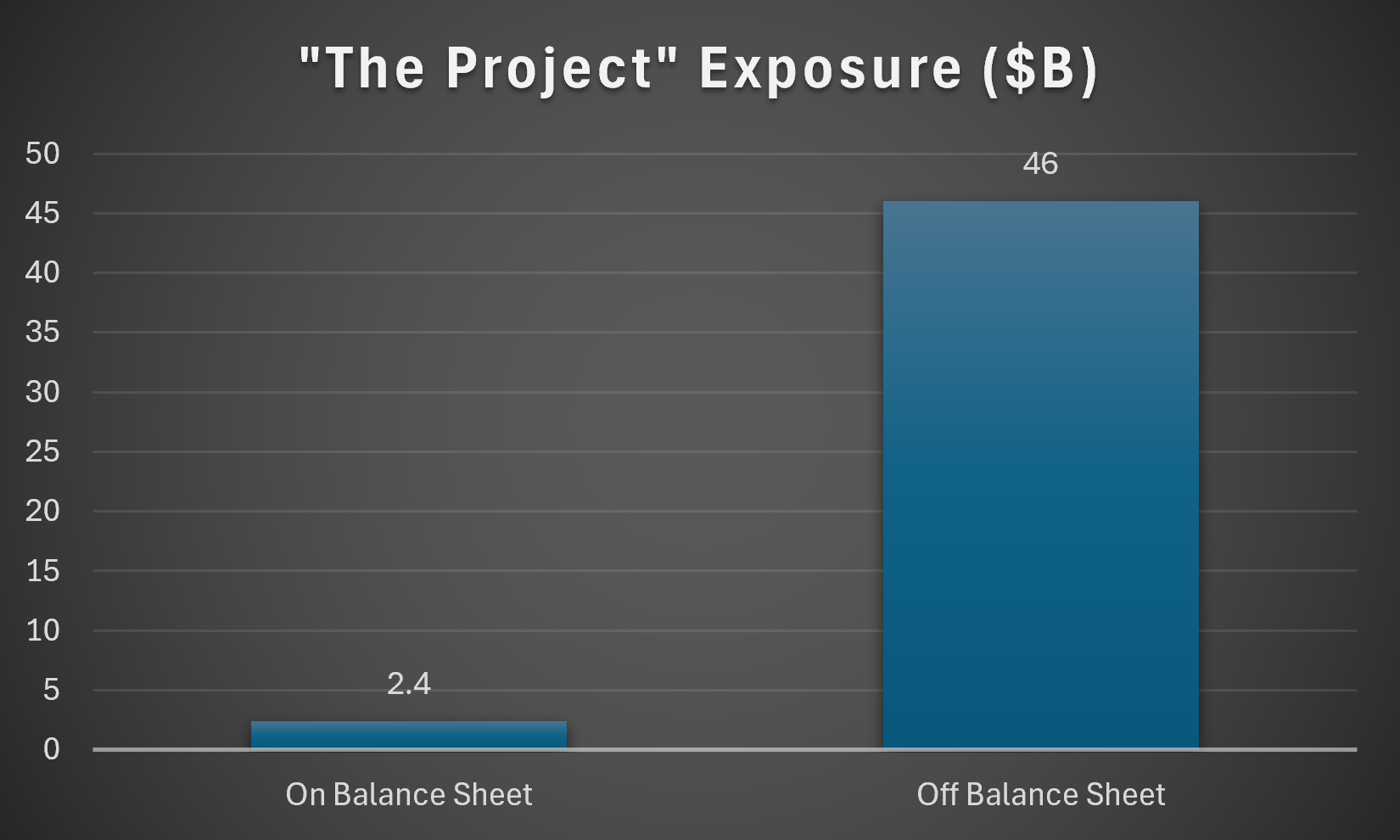
Importantly Meta disclosed that their on balance sheet equity exposure of $2.4B was dwarfed by the maximum off balance sheet risk VIE exposure of $46B. See chart below. Their 10Q literally calls it “The Project”. Hence the reference in my chart. I believe this includes the Beignet deal I previously wrote about which included Blue Owl and Pimco.
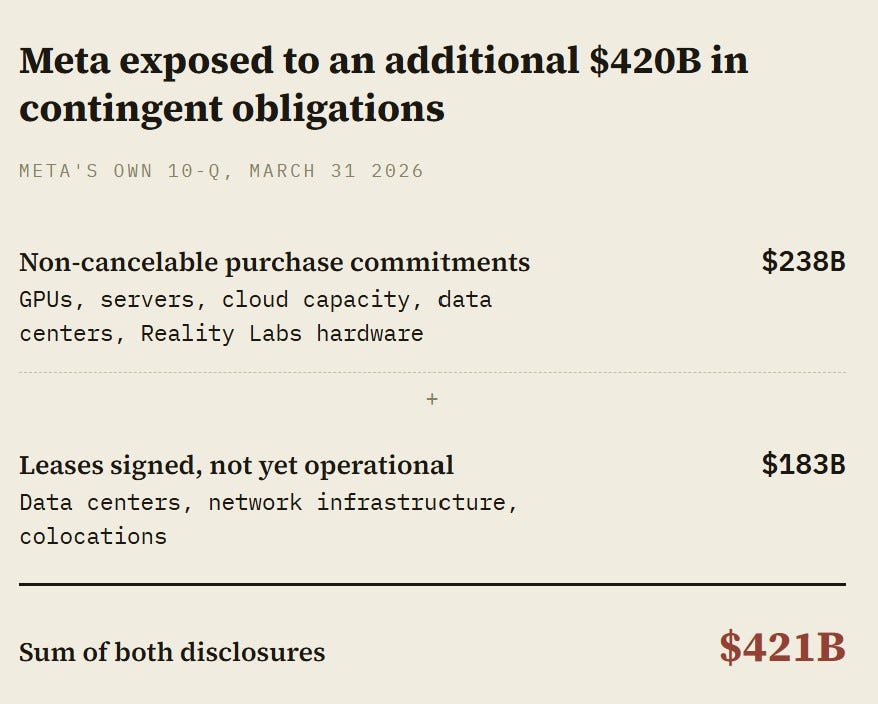
Separately, Meta disclosed another $420B in commitments and contingent liabilities (see table below). A recent report by Nikkei News revealed over $1T off balance sheet liabilities for the hyperscalers of which the $420B was from Meta alone.
No posts
Comments
Nothing yet. Say the first thing.
Sign in to join the conversation.