
CoreWeave’s recent $2.6B DDTL 5.5 (Delayed Draw Term Loan) debt issuance wasn’t going well initially. Not at all. It was a dog’s breakfast in bond market parlance.
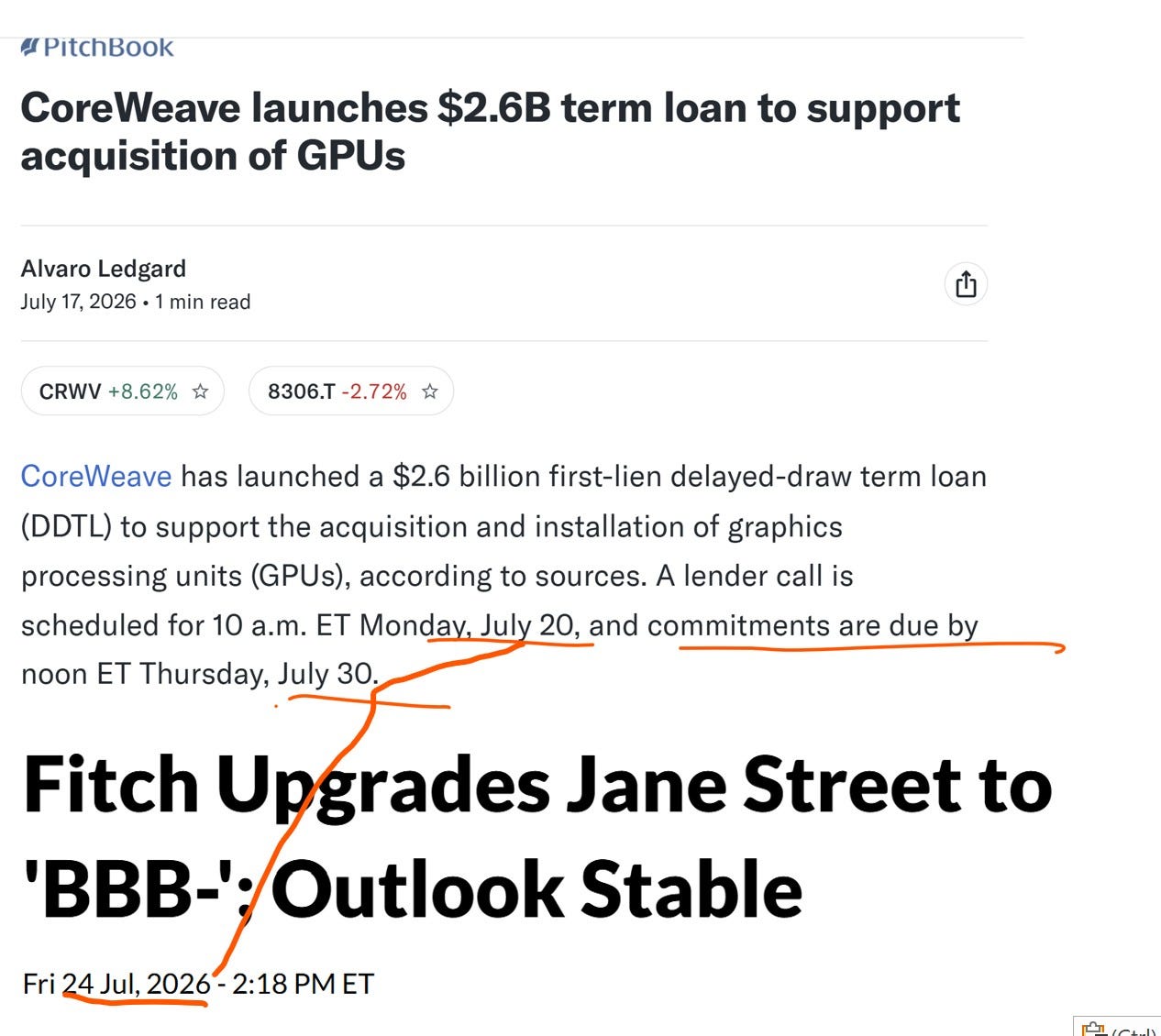
In the middle of the marketing period, however a curious thing happened. Fitch, the sole rater of DDTL 5.5 also happened to upgrade Jane Street to investment grade. Jane Street, it turns out, was a critical contract counterparty in the deal.
In this article I offer a brief summary of the deal, some background on Jane Street and CoreWeave and why I think Fitch’s Jane Street upgrade timing raises serious questions.
Much of CoreWeave’s debt is issued by SPVs using the DDTL loan structure. DDTLs allow specific draws over time. Each deal is different with different ratings and parties.
DDTL 5.5 is the 6th DDTL and was sole rated by Fitch at BB+, two notches above CoreWeave’s BB- rating. Proceeds flow through an SPV that purchases GPUs and equipment tied to newly signed take-or-pay contracts.
Fitch noted that while CoreWeave’s leases “typically span up to 15 years, its customer contracts generally have shorter durations of three to five years.”
Side Note: Does that risk sound familiar? One year ago, when commenting on a CMBS deal featuring CoreWeave, I said about CoreWeave: “It’s the data-center version of WeWork.” Yeah, not a good model.
A key credit attribute of this deal is the credit quality of the take or pay contract counterparties.
This deal featured a prominent role for Jane Street, the Wall Street prop trading giant. Jane Street is one of Wall Street’s largest Proprietary Trading firms and their near $40B 2025 trading revenue is the largest on record for any trading firm. In addition to prop trading they have made large investments in Anthropic and CoreWeave and the unrealized gain on sale for these are included in the $40B figure.
As far as DDTL 5.5 goes, according to the FT, Jane Street was the second largest of the committed contracts, (35%) after unrated Anthropic (40%). This is mentioned nowhere else including in the Fitch DDTL 5.5 rating report where you would think that the contract counterparties are somewhat important.
Some context. The CoreWeave deal was absolutely struggling. It was only after concessions were made – such as cash lock box, wider spreads and a discount price did the deal clear. According to FT, CoreWeave paid a SOFR spread that increased 100 bps to 550 as well as offering a 4 point discount or 96 for an all-in yield of around 9%.
Given that Anthropic is unrated, the credit quality of #2 contract counterparty Jane Street is also critical. Curiously, on July 24th, in the middle of the marketing period for the deal, Fitch upgraded Jane Street to an investment grade rating of BBB-. Both Moody’s and S&P rate Jane Street Speculative Grade (Ba1 for Moody’s and BB).
This isn’t Jane Street’s first rodeo with CoreWeave. In April this year, Jane Street invested $1B in CoreWeave common stock and “committed approximately $6 billion to use CoreWeave’s AI cloud platform.”
Is it possible that the team rating Jane Street at Fitch operated independently of the team rating DDTL 5.5? Yes. But It’s also possible that the upgrade was coordinated between the two Fitch teams. It’s important to note that communicating between two ratings team at Fitch wouldn’t necessarily be inappropriate. But the timing raises questions.
A line is crossed when a rating is upgraded for the purposes of winning a deal or assisting with the marketing of a deal.
As the image below shows Fitch’s Jane Street upgrade came smack in the middle of the DDTL5.5 marketing period. A period in which the deal was clearly struggling. And Fitch had Jane Street rated BB+ since 2022 with a positive outlook for the last two years.
In Fitch’s rating rationale they mentioned factors that had been in place for years:
“The upgrade reflects Jane Street’s strengthened business profile in recent years…”
Though they also mentioned the role of Jane Street’s investment in CoreWeave and unrealized gain on their Anthropic shares these are hardly things that justify an investment grade rating nor are they things that arose during the marketing of the deal. Particularly considering the warning signs signaled by spiking CDS spreads.
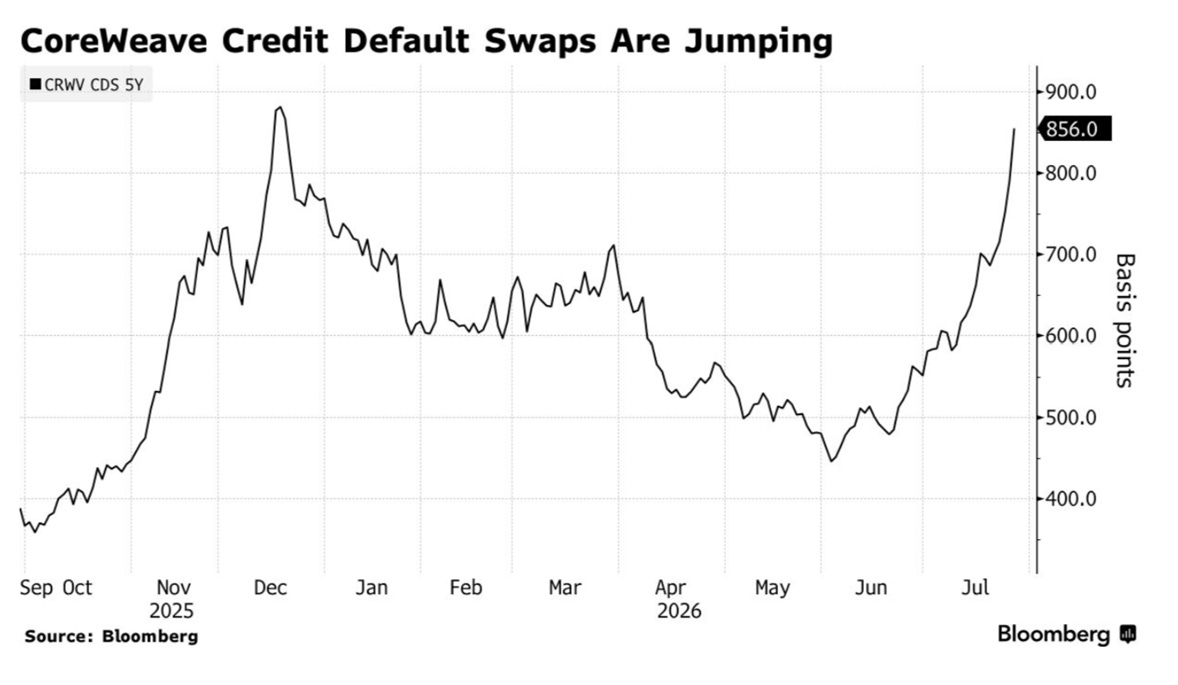
According to a Bloomberg article last week CoreWeave’s Credit Default Swaps (CDS) approached 1000 bps which Bloomberg noted put their probability of default close to 50% over 5 years. This implies a CoreWeave rating closer to low B/CCC than Fitch’s rating of BB- and the rating of DDTL5.5 at BB+ are perhaps distinctly generous.
It’s impossible to know what went on behind the scenes of this deal and at Fitch, but the facts suggest questions should be asked.
No posts
Comments
Nothing yet. Say the first thing.
Sign in to join the conversation.