
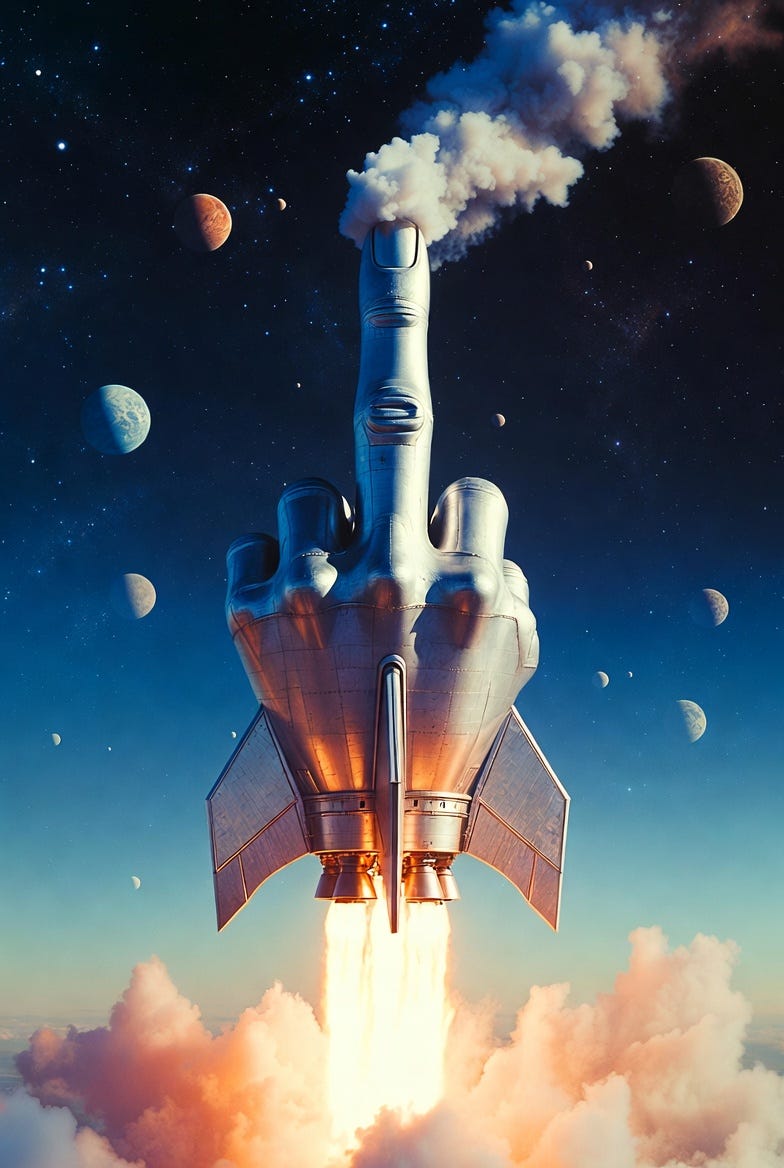
The SpaceX IPO will be the largest in history after Saudi Arabia’s flagship oil company Aramco. Aramco, which raised $25B at a valuation of $1.75T, is a real business, with annual income of $100B vs SpaceX’s annual revenue of $19B and a loss of $5B. Though SpaceX has aspects of real businesses, the current and potential magnitude of earnings don’t come close to justifying the valuation. SpaceX is a stitched-up collection of minimally connected companies tethered to a rocket ship of hype, hope and a large dollop of science fiction.
SpaceX’s 100x to revenue valuation is far beyond nearly every other company and any logical rationale of valuation. Ben Graham would be spinning in his grave.
My view is that the valuation isn’t real. Elon had two goals – raise max X amount of money with min of Y shares floated. The valuation was likely backed into specifically to hit the fundraising target without floating too many shares. Sounds cynical? Not as cynical as the Wall Street machinery enabling this.
In this article I review SpaceX’s business segments, governance issues, the manipulation of the listing process by NASDAQ and finally I will address the role of Wall Street in this fee bacchanale.
Pop Quiz: Which of the following is the mission statement of the world’s largest IPO and which is the tagline for a popular science fiction TV series?
“To build the systems and technologies necessary to make life multiplanetary, to understand the true nature of the universe, and to extend the light of consciousness to the stars.”
“Space: the final frontier. These are the voyages of the starship Enterprise. Its five-year mission: to explore strange new worlds, to seek out new life and new civilizations, to boldly go where no man has gone before.”
One of the above is the tag line for television’s most popular SciFi TV series. The other is the mission statement for the world’s largest IPO.
I would argue that Star Trek’s is a more investable and grounded mission statement.
In fact, I will go as far as to say that Musk appears to have written the SpaceX mission statement and a good part of the S1 filing, while on an Ayahuasca retreat in Peru.
Side Note: Ayahuasca is a powerful, traditional South American psychoactive brew made from Amazonian vines and shrubs, often used in spiritual and shamanic rituals.
SpaceX recognizes the magnitude of the challenge of achieving their mission statement:
“We face a number of challenges relating to our business and growth strategy and, ultimately, the achievement of our mission to make life multiplanetary, understand the true nature of the universe, and extend the light of consciousness to the stars.”
A number of challenges? Ya think? One question I do not attempt to answer – how do you monetize “extending the light of consciousness to the stars.?” I do not know and will not venture to prophesy.
Key Takeaways:
· SpaceX claims a Total Addressable Market (TAM) of $28T, equal to the entire US GDP. Of the $28T, $22T is attributed to the enterprise AI market – A market that the AI division can scarcely be said to have entered. xAI’s LLM model Grok is a non-factor. Grok’s app store downloads are plunging. Several months ago SpaceX bought xAI at a value of $250B. Now post-acquisition the sum of the whole is 7x the value of the company that represents over 80% of the TAM? That’s some magical thinking.
· I also highlight the unusual data center leasing deal xAI struck with Anthropic and how it helped Anthropic’s earnings as they themselves move towards an IPO and allowed SpaceX to boost their top line revenue.
· xAI made much of their $60B deal with AI coding platform Cursor. However, Cursor is basically a wrapper on an open source Chinese LLM model. So $60B for an AI wrapper with no proprietary tech. Window dressing.
· The premise of the SpaceX IPO revolves around space – colonizing Mars, launching orbital data centers, etc. largely depends on the success of their latest class of rocket - Starship. Though the recent launch was deemed moderately successful I highlight a major faultline of the launch that the media is ignoring.
· Governance: I address several governance concerns including the 10 to 1 voting sharing of non-offered Class A securities as well as deep conflicts of interest with a board member and the suppression of the ability of investors to bring lawsuits. In addition, the lockup period is significantly compressed enabling insiders to sell far sooner than most IPOs.
· Elon’s Bonus is truly an astounding exercise in wanton disregard of governance. While the bonus doesn’t fully vest until some outlandish goals are achieved what shouldn’t be missed is that on day one Musk will enjoy the full benefits of those shares at a $135B valuation. The only thing he can’t do is sell the shares. But he can borrow against them, which is generally what the super wealthy do anyway. So on day 1 Musk earns a bonus exceeding 50% of the entire valuation of xAI.
· NASDAQ manipulation: in the fevered zeal to land the SpaceX IPO, NASDAQ relaxed the inclusion criteria in their widely held Nasdaq 100 index. This includes waiving the required float %, dramatically reducing the post-IPO inclusion period and weighting SpaceX 3x the float % in the index. This puts the thumb on the scale for SpaceX and forces millions of QQQ index-holders to buy into a absurdly overvalued company.
· The role of Wall Street: With over 20 banks listed on the IPO this will be one of the most lucrative ever. In this article I review the role of the lead IPO banks with respect to the $20B Bridge loan that itself is a legacy of Musk’s Twitter purchase.
A few things before we begin.
This isn’t financial advice. I have no view, long or short, on SpaceX. And Elon’s fever dream valuation may yet materialize.
But that future is not visible in the current numbers. Not even close.
This article isn’t whether SpaceX succeeds - but how Wall Street and corporate insiders use the IPO process to enrich themselves at the cost of retail.
That’s the story worth telling.
SpaceX comprises 3 segments: 1. AI (primarily xAI including Twitter, AI Compute and Grok), 2. Connectivity (mostly Starlink satellite) and the eponymous division, 3. Space.
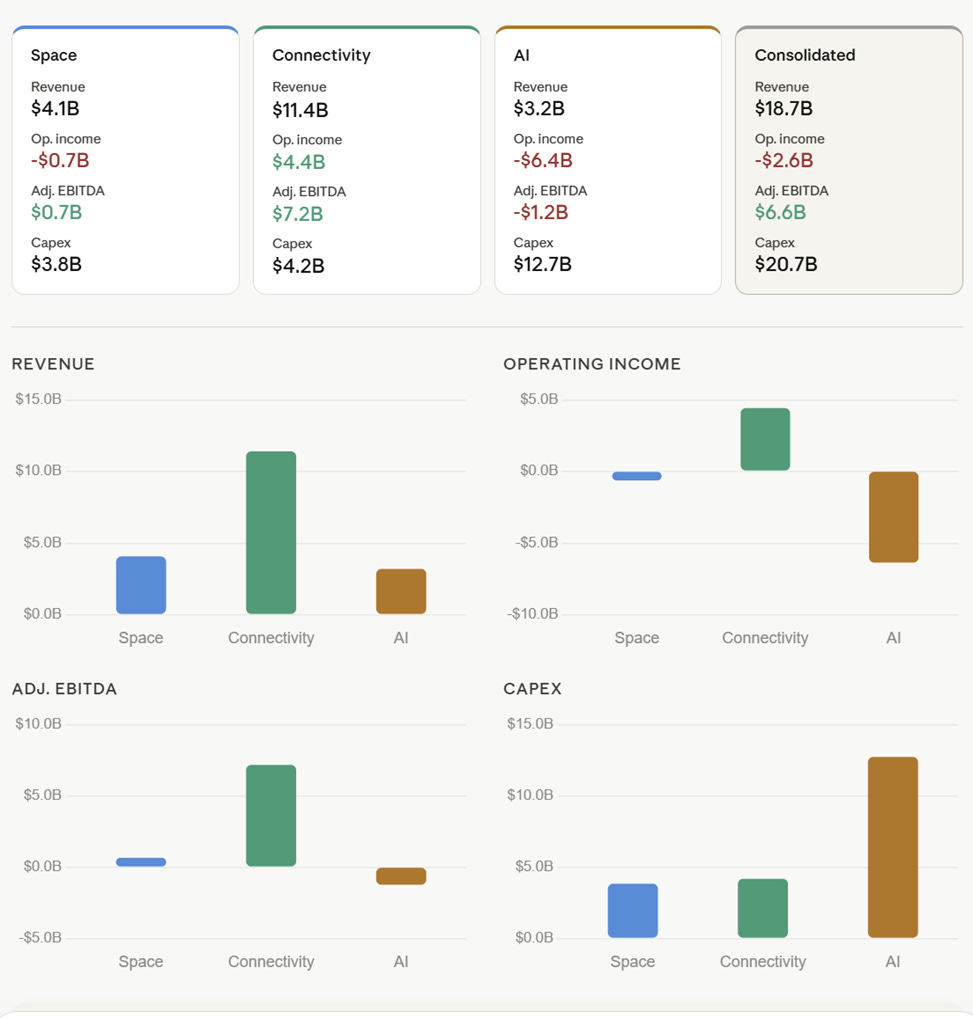
SpaceX acquired xAI in February 2026 and xAI bought X in 2025. See summary financials below.
Thanks for reading Rod’s Substack! This post is public so feel free to share it.
As the image above shows, SpaceX was facing a critical cash burn with $20B consolidated Cap Ex in 2025 - more than 100% of their revenue. The CapEx spend is live or die, needed to justify the valuation Elon’s fever dream demanded.
CapEx in 2026 is even more intimidating as it’s on track to double to $40B.
Of all the segments, Starlink is closest to being a real business with real revenue and profits. Starlink generated $11.4B in revenue and $4.4B in income from operations in 2025 and has 9600 low earth orbit satellites serving 10.3M subscribers in 164 countries.
The problem with Starlink is that its total addressable market is not that large. The internet service is too expensive for areas that are well covered by terrestrial broadband providers and in densely populated cities the signal quality, speed and reliability of Starlink can’t compete with traditional broadband providers (most of the planet).
Starlink’s retail target population - rural areas and areas lacking access to broadband - is both too small and too poor to consider Starlink a meaningful contributor to the overall valuation story.
In addition to Starlink’s retail customers, they also serve military, government and airlines.
As much as Starlink has garnered headlines for its use in Ukraine and Iran, and has solid business prospects, there is a real limit to market expansion and Starlink isn’t a material contributor to the $1.7T valuation.
Lest you think Starlink alone may be sufficient to justify SpaceX’s lofty valuations, consider that the combined market value of the 3 largest mobile/broadband providers is around $600B. And the Total Addressable Market (TAM) for connectivity is $1.7T so despite Starlink being the flagship of the IPO there is no way to twist the Starlink story to justify the valuation, despite Starlink having a critical role in the more pie in the sky vision of interplanetary colonization and orbital data centers.
Finally, as noted below, 75% of SpaceX rocket launches are for Starlink satellites. While that does reveal interesting synergy it also raises the question of Starlink’s real profitability given the opaque nature of how costs are allocated for the use of the rockets.
In 2025, the AI segment generated revenue of $3.2B and a loss from operations of $6.3B. xAI also reported a 300% increase in R&D expenditure.
In trying to justify the valuation, SpaceX provides an astonishing Total Addressable Market or TAM of $28T, which nearly equal to the US GDP.
But don’t take my word for how extraordinary this is. Directly from their S1:
“We believe we have identified the largest actionable total addressable market (“TAM”) in human history.”
Well at least they didn’t say “in human or interplanetary history”.
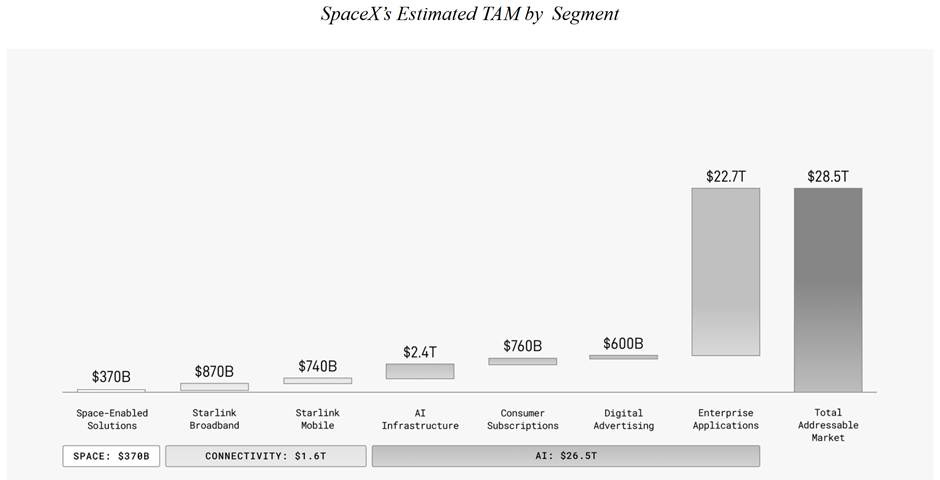
The AI segment comprises over 90% of the TAM with AI Enterprise at $22.5T nearly 80% of the TAM. AI Enterprise is a market that one could argue that xAI has no more market share, than my very own start up, The People’s Economist.
When SpaceX bought xAI it valued the company at $250B. We’re expected to believe that the segment recently valued at $250B, 3 months later contributes to 80% of the $1.75T value?
The heart of the AI business is their LLM model Grok. The problem is that Grok is a non-factor in the AI arm’s race.
Downloads of Grok as a standalone app dropped 60% from an earlier peak. The earlier peak was likely driven by stories of Grok’s usefulness in creating celebrity p0rn. Not exactly a use case central in colonizing Mars.
Looking at paid usage, the numbers are more troubling. In a survey, quoted in the WSJ, just 0.17% of Grok users were paying customers vs 6% for OpenAI. And Grok’s conversion rate has been flat.
xAI has a similar problem to Facebook. Both are massively scaling compute power and data center buildouts, but neither have an LLM model that can justify the CapEx spend.
xAI likely recognizes the challenge, which explains their paradoxical leasing arrangement with Anthropic.
A significant new revenue source for xAI is a large data center lease with primary competitor Anthropic. xAI has built two massive data centers, Colossus 1 and 2. While Colossus 2 is online it’s still not complete.
Anthropic has agreed to lease xAI’s entire Colossus 1 data center operations for $15B a year through May 2029, or 40% of SpaceX’s near-term revenues. However, Anthropic has a 90-day cancel option and so this can’t really be said to contribute much to the valuation story.
What does that say about near term prospects for Grok, if they are leasing their entire Colossus 1 data center to their #1 competitor. OK they are building Colossus 2, but does that mean they built a data center they don’t need?
Another interesting point about the Anthropic deal is that xAI gave Anthropic a sweetheart discount on the lease rate, which artificially boosted Anthropic’s operating margins for a critical quarter.
According to AI perma-bear Ed Zitron:
“That’s $15 billion a year in compute costs, but reduced to an indeterminately-discounted level for the precise months that Anthropic is using to tell investors and the media that it has an operating profit. That operating profit is a result of accountancy rather than any improvements to its business model.”
You see how this works in AI world?
Two mega AI IPOs (SpaceX and Anthropic) helping each other cook manage their collective books. SpaceX books more revenue, and Anthropic temporarily boosts operating profits by booking compute/data center costs at a discount.
There are other problems with xAI. As Musk himself notes, Grok needs to be rebuilt from scratch and isn’t a real competitor especially in enterprise. Don’t take my word for it.
“xAI was not built right first time around, so is being rebuilt from the foundations up.”, said Musk recently. xAI has also been bleeding leadership.
Let that sink in. The division that is the largest driver of value is a complete garbage dump of value.
In short, Grok is a lagging quality LLM model with massive CapEx requirements and no near-term prospects to compete with market leaders Google, OpenAI and Anthropic. In other words - a money pit.
Included in the S1 filing is a troubling lawsuit against xAI’s Colossus 2 under the Clean Air Act. There are several entities who joined the lawsuit including the NAACP. Below is an excerpt from the lawsuit by the Southern Poverty Environmental Center who joined the NAACP lawsuit.
“Just south of the Tennessee-Mississippi state line sits dozens of unpermitted gas turbines that power xAI’s Colossus 2 data center while releasing smog-forming pollution, soot, and hazardous chemicals like formaldehyde. The tech company set up the de facto power plant with no permits, no public input, and no notice to nearby communities that will have to deal with the consequences.”
I had previously read that xAI was building unpermitted energy generation facilities so this isn’t a surprise. In their S1 they seemed to acknowledge the strength of the lawsuit and reserved $400M in litigation losses. It’s not clear whether monetary damages will suffice and I expect SpaceX to be required to legally permit the gas turbine plants.
Much was made of SpaceX’s Cursor deal, but the headline obscures the reality. SpaceX didn’t acquire Cursor - it signed a compute agreement with an option to buy at a $60B valuation, subject to a $1.5B breakup fee and $8.5B in deferred services obligations.
Cursor is an AI coding wrapper built on Kimi K2, a Chinese open-source model. At $60B, SpaceX holds an option on what is essentially a distribution layer with no proprietary AI beneath it.
The deal is window dressing. xAI remains a damp squib as an AI asset — and yet a $1.75T IPO valuation leans heavily on it.
In 2025, the Space segment generated $4B in revenue with an operating loss of $657M.
The Space segment is primarily launch services, utilizing the Falcon 9 and Falcon Heavy rockets.
At the very small end of the TAM chart above is the segment that is the mission statement of SpaceX: The TAM for the Space division is $370B. So SpaceX is valued at 4X the total market of their core division. Come on folks, this is bat s#!t crazy.
Though SpaceX is dependent currently on the Falcon class of rockets, they have bet the farm on their newest rocket, Starship. Much of the dreamy Asimov, Heinlein SciFi vision depends on the success of Starship.
Starship has had recent challenges, but at least the latest launch this month was considered reasonably successful.
Or was it?
According to one engineering expert, the media isn’t covering a critical fail of the starship launch:
“It is very important to mention that this isn’t 44 tonnes to orbit [referring to the payload carried on this flight]. This is 44 tonnes on a suborbital flight that reached a maximum altitude of just 194 km (121 miles) and only 26,300 km/h (16,300 mph). For some context, a Starlink satellite orbits at an altitude of 550 km (340 miles), which is nearly three times as high as this Starship reached. These Starlink satellites also travel at 27,320 km/h (16,976 mph), or a thousand kilometres an hour faster than this Starship!
I don’t think people realise what a colossal difference this small detail makes. The media is seemingly parroting SpaceX’s narrative that this means Starship now has a usable payload of 44 tonnes. But it doesn’t! Instead, the only thing this does is heavily imply that Starship still has a major payload deficit. Not just a small underperformance, but an underlying critical flaw which makes it totally unusable. But, by running with the 44-tonne figure and not the 194 km figure, that isn’t what people notice.”
Starship is the bridge between SpaceX’s AI and Space business IPO fever dreams of colonizing mars, long haul point to point terrestrial travel, massive orbital datacenters, introducing consciousness to the stars (whatever TF that is), etc. It seems Starship is far from ready to fulfill SpaceX’s greater ambitions.
Plus, there are a whole lot of other engineering challenges to orbital data centers.
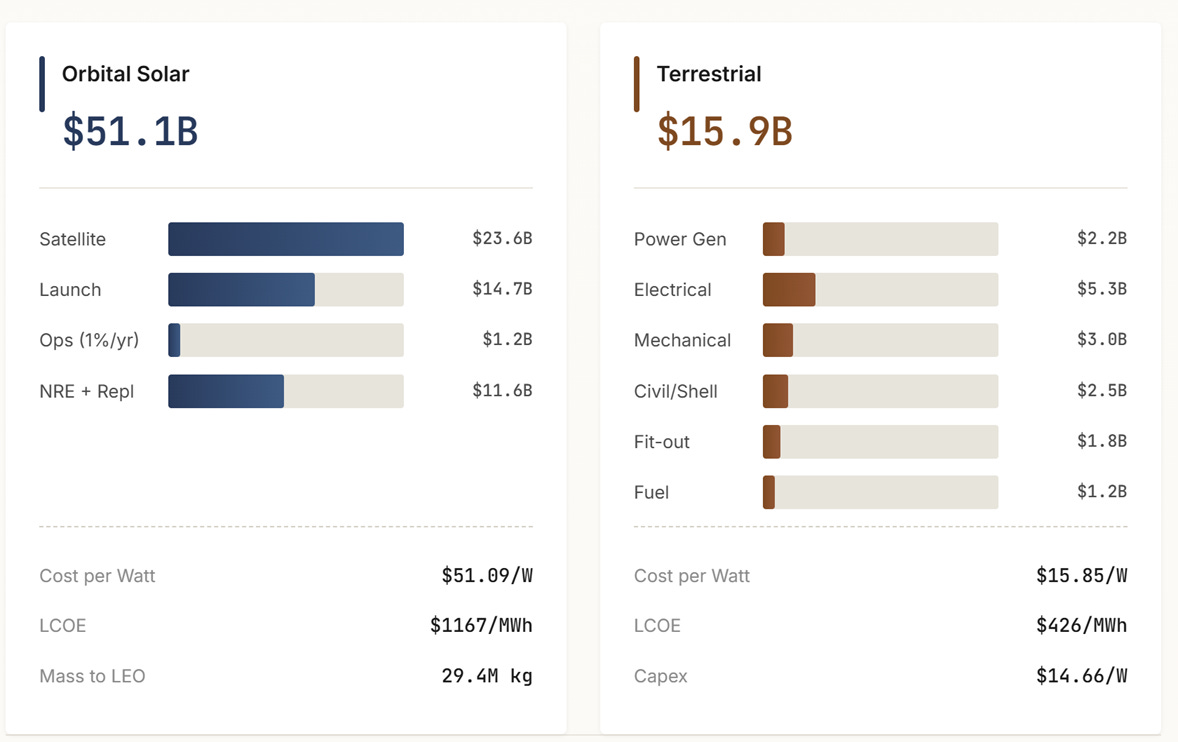
One scientist ran the numbers on orbital vs terrestrial data centers and concluded that the cost of orbital data centers would be 3x that of terrestrial data centers (see graphic). At the same time, the author acknowledged that if any company can make the numbers and tech work it would be a vertically integrated company like SpaceX.
The Space segment is effectively a single-client business - the US government. What complicates the picture further: 75% of Falcon 9 launches in 2025 were internal Starlink missions, raising a question about whether Connectivity segment margins are quietly subsidized by the rocket business. It also points to critical synergy between space and connectivity.
In aggregate, 20% of SpaceX’s consolidated revenue comes from government agencies — a concentration the S-1 itself flags as a material risk. The US government is a client of both the Space and Connectivity.
I would describe SpaceX governance post-IPO as a private company masquerading as a public company. Elon wants to have his cake and eat it too. He wants the billions the retail chumps will provide to cash out early VCs and the lender banks and feed his insatiable CapEx needs but he doesn’t want to relinquish one scintilla of control to the huddled masses.
Nel Minow, corporate governance and shareholder rights legend called SpaceX the biggest corporate governance risk she has ever seen.
“Minow said the arrangement is typical of SpaceX, which wants “the access to capital of a public company” but “the control of a private company.”
I highlight below some of the troubling aspects of governance.
10 to 1 voting share:
The IPO features multiple classes of stock, most critical are the Class A and B shares. Class A shares - what public investors buy - carry just one vote vs ten votes for Class B shares. Elon Musk holds Class B shares, giving him 85% of total voting power which effectively means he can’t be fired.
Elon’s ridiculous SpaceX pay package will never be triggered (after all it requires Mars colonization as a pre-condition). Don’t be fooled. It will have an immediate impact on Day 1. Musk’s Mars Colonization bonus is 1 billion in class B shares or $135B at an IPO price of 135. Musk wants you to think the bonus is very unlikely to be received, but in reality it is a very real day one bonus.
Given the Mars colonization precondition, it’s obviously unlikely they will vest. It’s almost a joke really. However, while shares can’t be sold, they do earn dividends, enjoy voting rights and can be pledged for loans. The only thing he can’t do is sell them. So despite the vesting of the bonus having a very remote probability, under the unusual terms of the bonus Musk gets to enjoy nearly all the benefits on day one, short of an outright sale.
And the best part, SpaceX doesn’t have to expense the shares because of the Mars Colonization thing. So in case you were wondering why the Mars clause was included. Now you know. It has nothing to do with Mars, but everything to do with SpaceX pushing every governance and accounting boundary possible.
That’s some heavy duty, industrial scale Holy F@#k governance.
It’s different in Texas. As a rebellion to Delaware’s challenging Musk’s exorbitant Tesla pay package (how dare they), Elon relocated the state of incorporation of both Tesla and SpaceX to Texas. This has important implications for governance.
State securities law SB 29 guts shareholder rights in three ways.
First, to bring a derivative lawsuit you need to own 3% of the company. At a $1.75T valuation, that’s $52B. Good luck.
Second, winning a suit requires proving intentional misconduct or fraud.
Third, shareholders can’t request emails or text messages. And if you’re already in litigation with the company, they can deny your records requests entirely.
The S-1 is a masterclass in conflicts of interest.
Take Board Member Antonio Gracias, founder and CEO of Valor Equity Partners, and reportedly Musk’s best friend of 25 years. Between October 2025 and April 2026, an xAI subsidiary signed three separate GPU lease agreements with Valor, totaling nearly $20B in obligations. SpaceX guarantees those leases.
Here’s where it gets interesting. The deals were structured as sale-leasebacks — designed to keep the debt off SpaceX’s balance sheet. However, PwC, SpaceX’s auditor concluded the transactions were loans in substance, not leases, and forced SpaceX to record ~$9B of it as related-party debt. That’s a board member’s firm owed billions by the company he helps govern.
Gracias isn’t just being paid as a lessor. His Valor funds hold 7.3% of SpaceX Class A shares, worth about $90B at IPO valuation, potentially $140B if SpaceX lists closer to $2T. He stands to become one of the 50 wealthiest people on earth on IPO day alone.
This sits alongside other reported conflicts: SpaceX purchasing $640M in goods from Tesla, including $131M in Cybertrucks at full MSRP. The S-1 discloses these conflicts but it doesn’t disclose whether they would survive arm’s-length scrutiny - because under Texas law, it doesn’t have to.
The SpaceX lockup structure is unlike anything seen in a major IPO. And no surprise it’s not good for public investors.
Musk and certain significant investors have agreed to a 366-day lockup. Everyone else operates on a staggered release schedule with the first 20% hitting after Q2 earnings release (Likely August) and continue from there.
The optics are stage managed - calling it “staggered” makes it sound like an orderly process, while in reality, up to 65% of insider shares could be in play within the first 90 days.
There’s one more twist. As noted below Nasdaq 100’s new fast-entry rule which forces passive index funds to buy the stock just 15 days after listing, could mask the wave of selling post expiring lockups.
Nasdaq controversially adjusted its Nasdaq 100 index inclusion rules in order to convince SpaceX to list on the NASDAQ over the NYSE. The Nasdaq 100 is tracked by $600B of passive investments.
SpaceX will be deemed a “controlled company” under Nasdaq rules, which exempts them from standard corporate governance requirements, including the requirement for a majority independent board. From their S1:
“A controlled company is not required to have a majority of its board composed of independent directors or to establish independent compensation and nominating committees.”
Normally, NASDAQ requires an IPO to age 12 months before index inclusion. In the case of SpaceX (and potentially other mega-IPOs) they can be included within 15 days of IPO. This change means there will be mandatory automatic buying of SpaceX starting 15 days post-IPO. This adds a huge amount of forced buying to one of the most expensive (in relative and absolute terms) IPOs in history.
Normally, the Nasdaq 100 requires a 10% minimum free float for listings. They waived this criteria for SpaceX (and likely will be the case for Anthropic and OpenAI).
SpaceX’s IPO will float only 4% of total shares. Nasdaq is further allowing the index weighting to be 3x the SpaceX float, which results in SpaceX weighting in the Nasdaq 100 to be 12%.
The Bridge Loan: Cleaning Up Wall Street’s Mess
When banks financed Musk’s $44B Twitter acquisition in 2022, they initially paid dearly for it. The $13B syndicated loan became what the WSJ called “the worst merger-finance deal for banks since the 2008-09 financial crisis” - hung on bank balance sheets for two years.
Relief came through a chain of mergers. xAI acquired X in 2025, absorbing the Twitter debt. SpaceX then acquired xAI in February 2026. Each deal shuffled the debt to a more creditworthy entity. By the time it landed on SpaceX, the original $13B had grown to $17.5B, increased by xAI’s own borrowings.
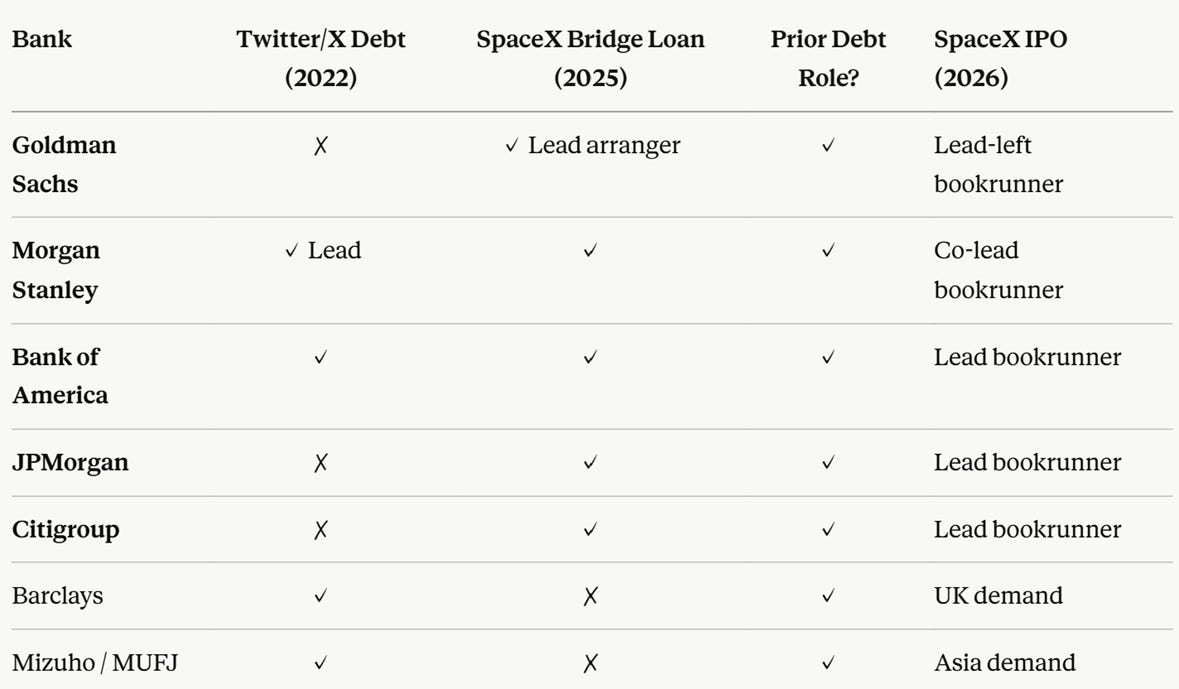
In March 2026, Goldman led a five-bank syndicate consolidating everything into a single $20B bridge loan - at dramatically lower rates. The old debt carried junk coupons of up to 12.5%. The bridge starts at SOFR+175bp, stepping down to SOFR+75bp at Single-A. A significant yield give-up for the banks. So why did they agree? Because the bridge was the audition for the IPO. All five bridge lenders - Goldman, Morgan Stanley, BofA, JPMorgan, Citi - are the five lead bookrunners, sharing ~$500M in fees. (see table below).
The conflict couldn’t be more explicit: the same banks owed $20B are also advising on the IPO price that will repay them. In assigning IPO roles, it’s not unusual to consider overall banking relationships. However, the scope is far beyond anything we’ve seen.
Further, here’s what makes it worse. The mandatory prepayment trigger, requiring IPO proceeds to repay the bridge within six months, is buried in a loan exhibit, not the S-1’s Use of Proceeds section. That’s the section retail investors actually read. Instead, they’ll see Starship, orbital data centers, and AI compute. The fine print tells a different story: a substantial portion of the $75B raise goes straight back to Wall Street. The reason the banks want such a quick payout is because the terms offered to SpaceX are so generous and given the cash burning nature of SpaceX they want the loan paid down as quickly as possible to avoid a Twitter 2.0 hung debt deal.
No posts
Comments
Nothing yet. Say the first thing.
Sign in to join the conversation.