
In Part 1 of this article, I explored Athene’s $11B alternative equity investments vehicle, Apollo Aligned Alternatives or AAA. AAA is a repository for equity or equity-like investments that are reported on Schedule BA of Athene’s statutory filing and require a 30-45% capital charge.
In Part 2, I review $13B of even more troubling investments. These investments are largely backed by equity yet have investment grade ratings and are reported on Schedule D (schedule for Fixed Income Securities), resulting in capital charges 97% lower (e.g. 1% vs 30%) than the underlying collateral would require. Schedule D investments generally attract a capital charge based on the credit ratings (mostly BBB and higher).
All investments discussed in this article are Apollo affiliated investments.
“We rate every deal. It could be structured by cows and we would rate it.” S&P Official in the lead up to the Global Financial Crisis
Anyone who has followed my posts over the past few years, knows that I believe that post GFC rating agency reform has been a complete disaster. This post reinforces that view. Every investment discussed in this article has been assigned an Investment Grade (IG) rating, despite being backed by equity or equity like assets.
Buried in Athene’s statutory filing, is a troubling investment category called Equity Backed ABS. This category was added by the NAIC in 2025, in response to growing concerns over insurance companies increasingly converting equity risk to IG fixed income investments. This was part of the NAIC’s broader Principles-Based Bond Project.
As the name implies, these are equity backed investments that through the alchemy of financial engineering become Investment Grade (IG) investments. That means that collateral which on its own would require 30-45% capital are transmogrified into an investment that requires about 1% capital.
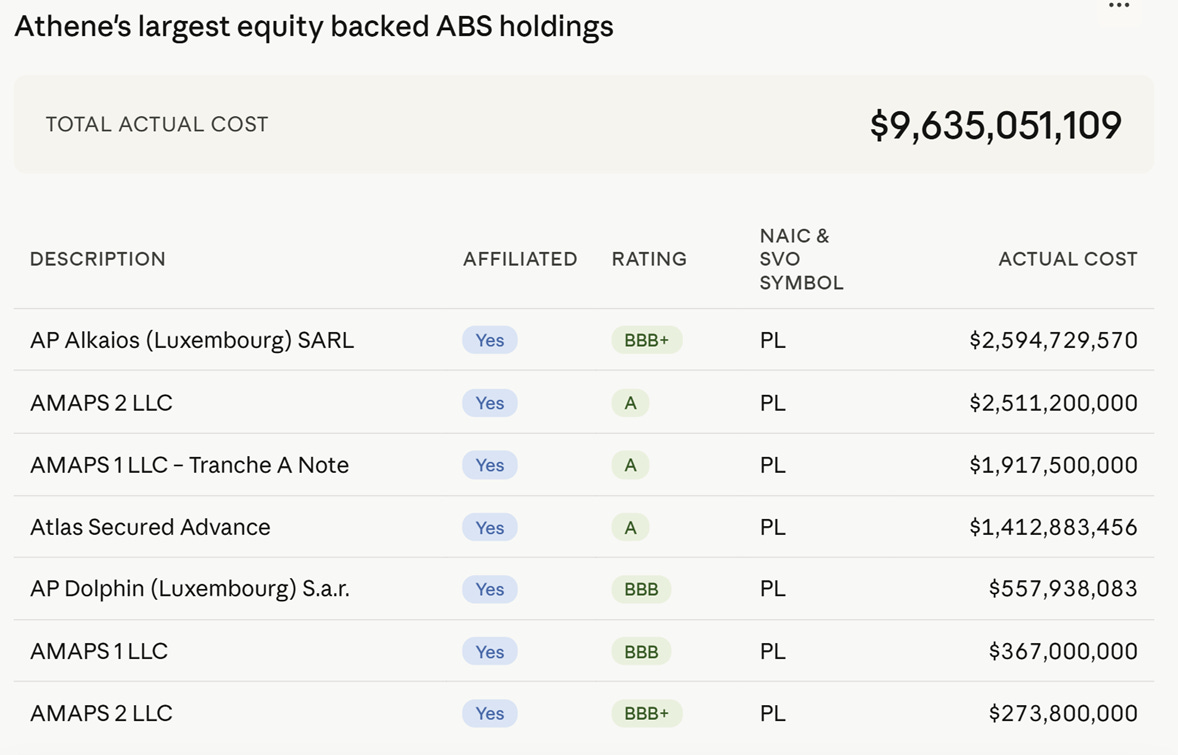
In addition to the $9.6B in Equity-Backed ABS (E-ABS) shown in the below table I also review Fox Hedge LP (since renamed) despite it being classified as “ABS - Other Financial ABS”, owing to the nature of the underlying collateral. Based on descriptions of the collateral and speaking with others I believe the risk warrants consideration alongside Equity-Backed ABS.
The below table summarizes Athene’s Equity-Backed ABS holdings
As mentioned above, Equity-Backed ABS has been a recent concern for the NAIC. According to the NAIC’s guidance on Equity-Backed ABS reporting:
“Include structures where the financial assets backing the structure reflect equity. These securities must overcome the rebuttable presumption that equity-like structures do not inherently possess the characteristics to be reported on Schedule D…, Part 1… and have appropriate reporting entity documentation…”
For such investments, Athene must document that the investment has sufficient fixed income-like characteristics.
To put it simply, the NAIC is saying – “you can classify equity-backed investments as debt, as long as it doesn’t look like equity.” The subtext is also that the NAIC doesn’t trust the ratings. Otherwise the rating itself would be sufficient proof. They are right to be concerned.
To treat Equity Backed ABS as Fixed Income Schedule D assets, insurance companies are required to document at the time of purchase that, despite being backed by equity, the investment has sufficient debt-like characteristics to justify the more favorable Schedule D, Fixed Income treatment.
Assets that don’t meet the regulatory criteria for debt would be reclassified as equity, and move from Schedule D to Schedule BA and therefore subject to a far higher capital charge. The chart below illustrates the possible dramatic impact of merely reclassifying Athene’s Equity-Backed ABS. One caveat, is that this chart simplifies the somewhat more complex capital rules for Schedule BA assets. But it does directionally reflect the magnitude of risk.
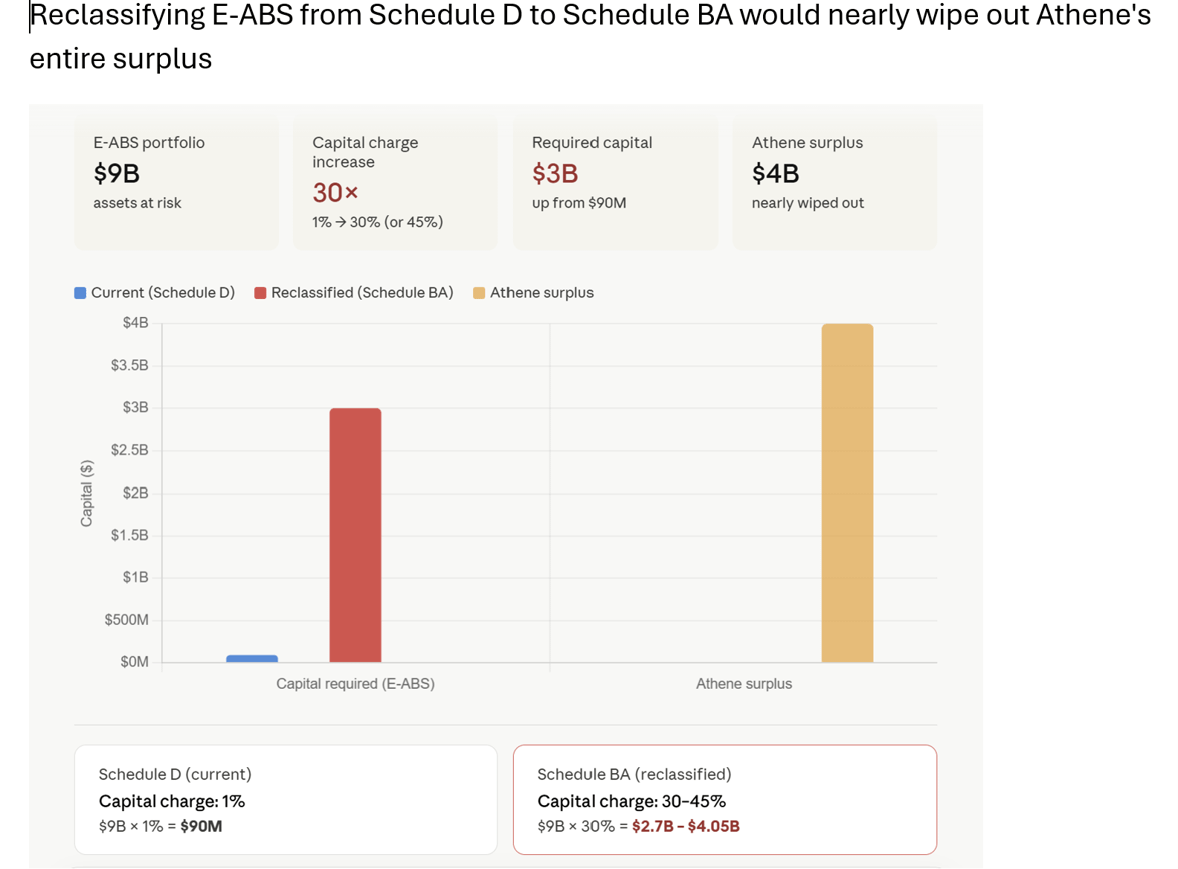
Before $1 of loss, before any downgrade, the simple reclassification from Schedule D to Schedule BA would trigger a $3B increase in capital requirements. The judgement call that enabled these E-ABS to be considered debt for capital purposes can be withdrawn as easily as it was given.
In Athene’s 2025 Schedule BA, investments totaling $500M were reclassified from Schedule D to Schedule BA. This reflects the real possibility that some or all of Athene’s $9.7B E-ABS could be reclassified from Schedule D to BA.
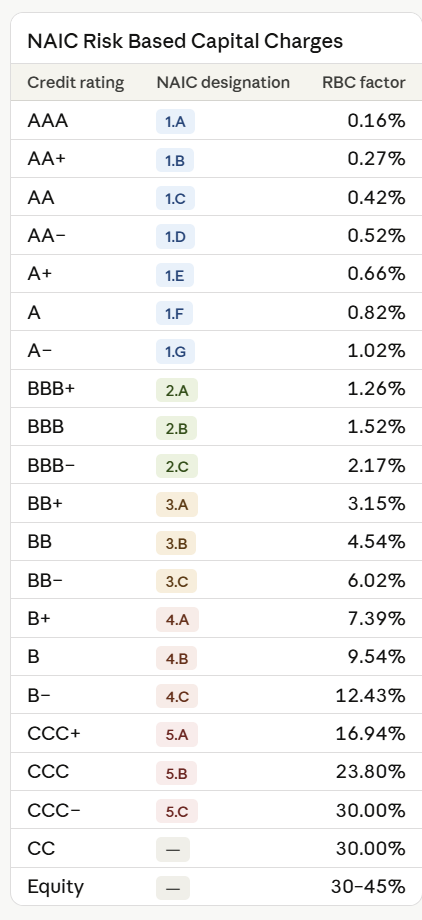
See table below for the NAIC’s Risk Based Capital charges.
In addition to dramatically higher capital treatment, Schedule BA assets are carried at fair value, meaning that any impairment is immediately recognized from a statutory accounting standpoint.
Therefore, should the underlying collateral deteriorate in value at the same time as the investments are reclassified as equity, that would result in a double threat – loss recognition and dramatic capital increases.
In the section below I provide a brief overview of each asset.
AMAPS - Apollo Multi-Asset Prime Securities - has received recent press including a recent Bloomberg article . The Bloomberg article followed Apollo’s own PR puff piece released earlier this month.
According to the Bloomberg article, 4 AMAPS deals have been issued. Athene owns AMAPS 1 and 2. Perhaps there is more AMAPS in store for Athene.
AMAPS is a structure that Apollo advertises as a next-gen CLO backed mostly by investment grade (IG) credit, more diversity and lower leverage than CLOs (see image below). Apollo touts the 600-line items backing AMAPS, as being 50% IG, with good credit support, and attractive spreads. That sounds like investment nirvana. A true alts unicorn. You may be wondering - why AMAPS is classified as Equity-backed ABS if they are backed by IG credit?
There is zero transparency. None. Not in Athene’s disclosures, not in Apollo’s new marketing pitch, nor was there detail in the Bloomberg article.
Here is Apollo’s pitch for AMAPS (see also image below from their presentation):
“Apollo Multi-Asset Prime Securities, or AMAPS, is a structured credit product enabling access to more diversified and higher-credit-quality assets that are risk-managed every day. In comparison to US BSL CLOs, the vehicle has a thicker equity tranche and is approximately 85% investment-grade rated by leading agencies, with underlying collateral that is more diverse and significantly higher rated. It was structured with investors in mind.”
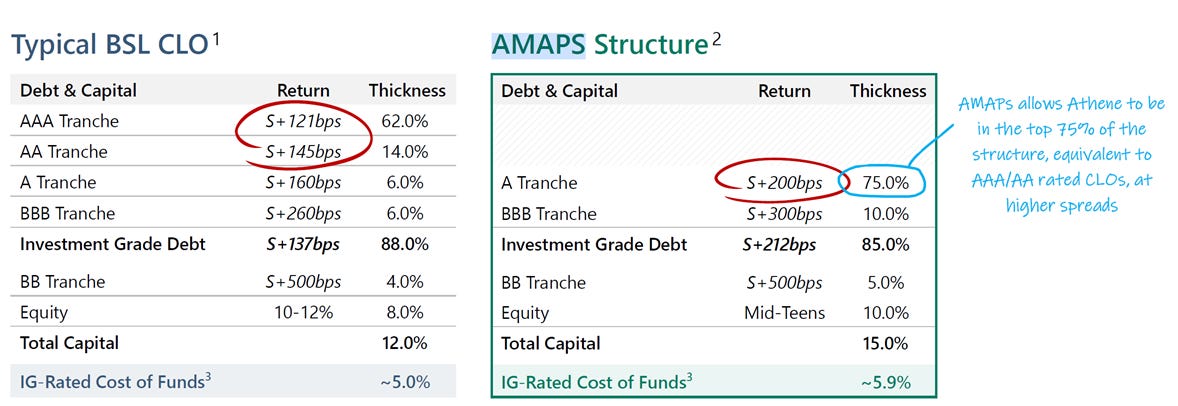
87% of Athene’s AMAPS securities are Single-A rated for the senior class, with the 13% subordinate class rated BBB. All with Private Letter Ratings (PLR). While Athene claims that 50% AMAPS collateral is Investment Grade (IG), they don’t address what those assets are and who provided the rating.
They failed to address the EITR (Elephants in the Room): 1. Private letter ratings are usually provided by smaller RAs who tend to be more generous with their ratings 2. How could something classified as Equity-Backed ABS also be 50% backed by IG Credit? Both can’t be true at the same time, without serious manipulation of the debt vs equity definition.
There is a reason why the NAIC created this category. They were seeing more examples of insurance companies transforming equity type risks into Investment Grade Credit. With vehicles such as Collateralized Fund Obligations (CFOs) and Feeder Funds being used to create IG debt from riskier assets there is reason to be concerned.
Some have suggested to me that AMAPS is akin to a CFO.
According to Global Legal Insights, a CFO “is a structured transaction that involves the securitization of various fund interests (such as equity interests in private funds or less liquid registered funds) and other assets.”
Side Note: CFOs are another tool that has enabled private equity to replace real distributions to LPs (e.g. exiting Portfolio Companies) with financially engineered distributions.
In a recent CFO methodology change report Fitch further relaxed their criteria such that they expected 2/3 of CFOs to be upgraded. Already CFOs can achieve Single A or even AA ratings according to Fitch. Considering it is backed by a basket of likely overvalued, overleveraged Private Equity Portfolio Companies (PortCos) this relaxation is very concerning.
Fitch also admitted that they don’t even look at the underlying PortCos, blithely attributing such abdication of responsability to lack of information on the PortCos and sufficient diversity.
In Athene’s recent affiliates presentation, they provide a troubling case study of an emerging asset class, Structured Equity. AP Alkaios was also classified as Equity-ABS in Athene’s Schedule D.
AP Alkaios is an SPV for the large German utility RWE. The goal is to structure an investment that is treated as equity for RWE, but debt for the investors. There is obviously potential for some troubling games here.
All publicly released information about the RWE/Apollo deal reveals that this investment is, in reality, equity. Even Athene’s recent affiliates presentation characterizes the deal as equity. At the same time, the investment is treated by Athene as BBB+ IG Credit.
According to Athene’s May affiliates presentation:
“The investment is structured to qualify as equity for both accounting and rating purposes, supporting RWE’s balance sheet while addressing its significant forward capital requirements.”
The only clue how this “equity” investment is also considered “debt” is in the following, very vague line from Athene’s presentation:
“The structure includes downside protections from RWE to support Apollo’s target IRR.”
What that “downside protection” isn’t clear. “Support Apollo’s target IRR” is presumably code that the downside protection (whatever that means) is required to support a rated investment eligible for NAIC’s debt treatment.
So here you have one rating agency saying - “oh yes RWE can treat this as equity for the purpose of their rating”. But they also tell Apollo, “oh yes Apollo this very same investment can be given a BBB+ rating”. That is some impressively creative needle threading on the part of the rating agencies.
Considering that equity attracts a 30% capital charge vs BBB+ at 1.26% charge, this would require a huge jump in capital if the investment is reclassified from debt to equity.
Atlas is Apollo’s asset-based finance platform, acquired from Credit Suisse. Athene has substantial exposure to Atlas in various ways. They own equity in Atlas but also have over $5B in Atlas mostly IG fixed income investments. Of the $5B Atlas IG fixed income investments, $1.4B is classified as Equity-ABS.
Given that Atlas was the lead lender at the center of the recent massive UK MFS fraud, one perhaps can’t sleep comfortably well at night knowing that Athene has $5B exposure.
There is little I can say about the $1.4B E-ABS investment because there is little information other than the fact that it is backed by equity. What I can say is that with a Single-A rating it requires a mere 0.86% capital or $12M. Should this classification change from debt to equity, the actual capital required would increase to around $500M.
APADS, formerly known as Fox Hedge LP, is a $3.2B opaque Piñata filled with a basket of Apollo stuff. I first revealed the connections between Fox and Apollo in my original Athene deep dive 1.5 years ago.
Fox/APADS was the subsequent target of a Bloomberg investigative report which lifted the cover of this investment.
According to Bloomberg:
“That’s where Fox Hedge steps in. Working with ACS, Apollo bundled up a smorgasbord of assets plucked from its own funds, including safer assets and racier stuff like real-estate debt, into a Bermuda-based vehicle. They then sold bonds against it with investment-grade ratings and unusually long lifespans.
The plan was to give an insurer private credit-style returns while only having to set aside a fraction of the regulatory capital needed if directly investing in such assets, multiple people with knowledge say. The 40-year final maturity was built to match the needs of an insurance company with long-term liabilities.”
I don’t know about you but investment grade debt backed by a “Smorgasbord” of anything doesn’t sound like the capital held is sufficient given the risk. Very likely another case of inflated ratings.
See our main website for general personal finance calculators, news and dashboards as well as our BDC Intel tool and CLO calculator
No posts
Comments
Nothing yet. Say the first thing.
Sign in to join the conversation.