
Share price: 650p
Market Cap: £960 bn GBP
Float: 57.8%
Special Situation: Compelling turnaround underway
DISCLAIMER & DISCLOSURE: The author is not invested in Saga at the date of publication but that may change. The views expressed are those of the author and may without notice. The author has no duty or obligation to update this information. Some content is sourced from third parties believed to be reliable, but accuracy is not guaranteed. Forward-looking statements involve assumptions, risks, and uncertainties, meaning actual outcomes may differ from those envisaged in this analysis. Past performance is not indicative of future results. All investments carry risk, including financial loss. This analysis is for educational purposes only and does not constitute investment advice or recommendations of any kind. Conduct your own research and seek professional advice before investing.
The story of Saga Plc is a multi-decade epic involving brand resilience, private equity mismanagement, and a family’s return to its roots to reclaim a national treasure.
Founded in 1951 by Sidney De Haan, Saga was built upon a simple yet profound contrarian business insight. It targeted a demographic that the rest of the commercial world largely ignored.
In the United Kingdom back in the 1950s, when overseas package holidays were not yet a thing, most people enjoyed a ‘staycation’: most commonly a trip to seaside towns.
School breaks were the most popular choice for obvious reasons. Demand spiked and so too did prices.
However, De Haan identified that the out-of-season spare capacity in the travel market could be utilised to offer high-touch, low-cost coach holidays to retired people. Not only was it available at a lower price, but the absence of screaming children was part of the attraction for the older generations.
This original model focused exclusively on the UK until the 1970s, after which the company began expanding its travel offerings overseas.
The shift from a pure-play travel company to a multi-faceted business occurred primarily in the 1980s. Having acquired a loyal customer base within its niche demographic, De Haan recognized that he could sell them other services.
This is the point at which Saga moved into insurance and financial services.
The 1990s saw a rapid acceleration of this diversification. Saga launched its in-house cruise operation in 1996 with the purchase of its first ship. The company also introduced private medical and pet insurance lines.
The quality of its service generated an extraordinary level of loyalty from customers, building a brand which people came to know and trust. It almost attained the status akin to the membership of a club for relatively affluent people aged over 55.
By 2004, the company was a cultural icon with over two million regular customers.
But that same year marked an unfortunate pivot point in the company history. The De Haan family decided to exit the business through a £1.35 billion GBP management buyout, backed by private equity.
What followed was private equity doing what private equity does. For nearly two decades it was all about short-term profit maximisation, customer neglect, together with the layering of inappropriate leverage and asset stripping through dividend recaps1. It was a story of mismanagement and private equity greed.
There was also a change of strategy. Under private equity ownership, the company shifted from being a capital-light insurance broker to a full-service insurance underwriter, with its in-house subsidiary, Acromas Insurance Company Limited (AICL), eventually underwriting 60% of its motor policies.
The business was then merged with the Automobile Association in a deal described as bizarre and exit-driven.
This chapter in its history culminated with a listing on the London Stock Exchange in 2014.
The IPO proved to be a disaster for retail investors, many of whom were loyal Saga customers. Shares lost over 95% of their value within five years.
The same company with different management is no longer the same company. The De Haan family had been excellent stewards of the business. In stark contrast, when private equity took over, it was all about their investment returns and to hell with the business and its minority shareholders.
Yet, this is where the story takes an unexpected twist and starts to gets really interesting. The investment thesis for Saga today begins with the return of Sir Roger De Haan, the founder’s son, in 2020.
The company had become weighed down with too much debt and then came the Covid-19 pandemic during which the travel industry was hit particularly hard. With an impaired balance sheet and a collapse in sales, Saga faced an existential threat.
This is when Sir Roger De Haan stepped in to backstop a £150 million rights issue to restore the balance sheet, investing over £100 million of his own money. Encouragingly, he has since further increased his ownership through open-market purchases of stock.
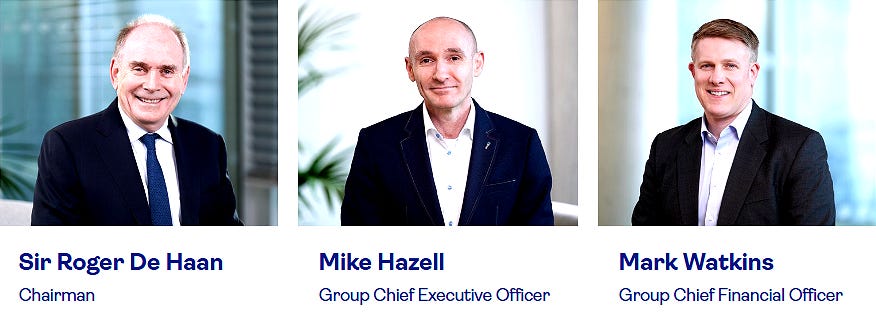
Now the largest shareholder with an approximate 27.5% stake, Sir Roger serves as non-executive Chairman.
Under his influence, Saga has undergone a sweeping management and operational restructuring. Not only did he remove an unecessary layer of senior management, he also consolidated the Cruise and Holidays leadership teams into a single Saga Travel Group. This was designed to drive consistency and efficiency across all of the company’s high-margin travel offerings.
Most importantly, Sir Roger reshuffled the senior managment team.
Saga is now led by Group CEO Mike Hazell, who joined Saga in October 2023 and initially served as the Chief Financial Officer before being promoted to the top role in early 2024. He is a chartered accountant with over 30 years of experience in the retail and consumer sectors. Since taking the helm, Hazell has been credited with steering the business through its recent return to profitability and the pivotal de-risking of its insurance operations.
Mark Watkins was brought back to serve as CFO, rejoining Saga in June 2023. Watkins is also a chartered accountant with two decades of experience in senior finance, strategy, and investor relations roles. This is his second tenure at Saga, having previously spent six years with the company starting in 2016.
Rather disappointingly, Hazell and Watkins have little to no ownership in the business. Shares have been granted to both under incentive schemes, but most (or all) were then subsequently sold, in part to cover the resulting tax and national insurance liabilities that flow from the grant. While disappointing, this is not uncommon among UK executives.
To those who argue that share-based compensation aligns management with external shareholders, this rather neatly disproves the theory.
External investors put their own capital at risk, backing the company in the hope of generating a handsome return.
Management, ironically, often do the opposite. The people steering the business are frequently unwilling to back themselves, treating their equity grants not as ownership rights, but as deferred salary to be cashed in at the first opportunity.
However, comfort can be taken in Sir Roger De Haan being personally invested, as the largest shareholder in the business. He acts as the true driver of insider alignment with external shareholders.
Other key figures in the restructured management tier include: Nigel Blanks, a long-serving executive who has been instrumental in the cruise business since 1996 and now leads the combined Saga Travel Group; and, Lloyd East, who was promoted to CEO of Saga Insurance in early 2025 to manage the division’s transition to the new Ageas partnership (more on this shortly).
This restructuring has seen a 40% reduction in headcount while simultaneously improving customer satisfaction and returning the group to profit for the first time in eight years.
The turnaround in the fortunes of the company has been achieved in a way described by Sir Roger as restoring the “proper” service ethos that initially built the brand: always putting the customer first.
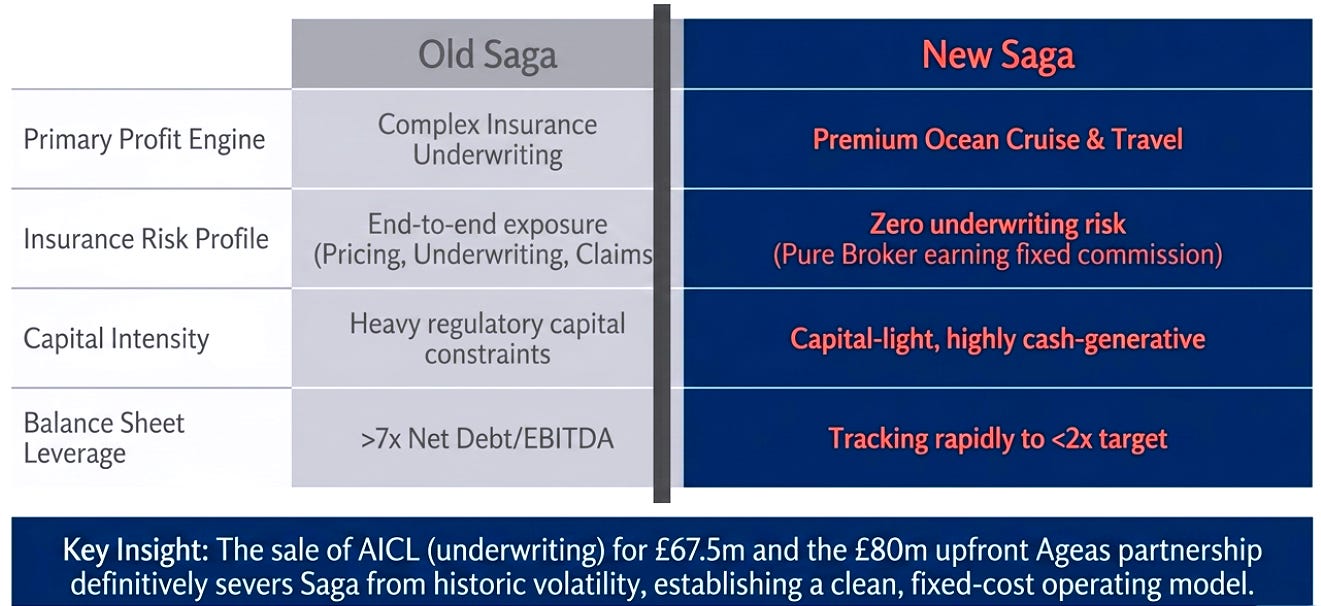
At the heart of this pivot is a fundamental structural transformation of the business model from a capital-intensive insurance underwriter to a capital-light brand aggregator.
Under its prior management, Saga had morphed into a company that was viewed as an insurance-dominated business, which was a huge departure from its roots.
This is now changing with the sale of its insurance underwriting subsidiary, AICL, to Ageas together with a partnership that will see the two companies working together for the next two decades.
This shift has moved Saga away from the volatility of underwriting risk, such as claims inflation and catastrophe losses, and allows management to focus on its core strengths: brand marketing and customer engagement.
The 20-year affinity partnership with Ageas, which went live in late 2025, is a transformative catalyst that de-risks the insurance operation while securing a steady stream of commission-based income tied to gross written premiums (more on this later).
The return of the De Haan family provides the long-term runway necessary to restore this business to its former glory. It’s a turnaround that offers potential for multi-bagger style compounding as the business moves away from its distressed past toward a future as a high-margin free cash flow machine.
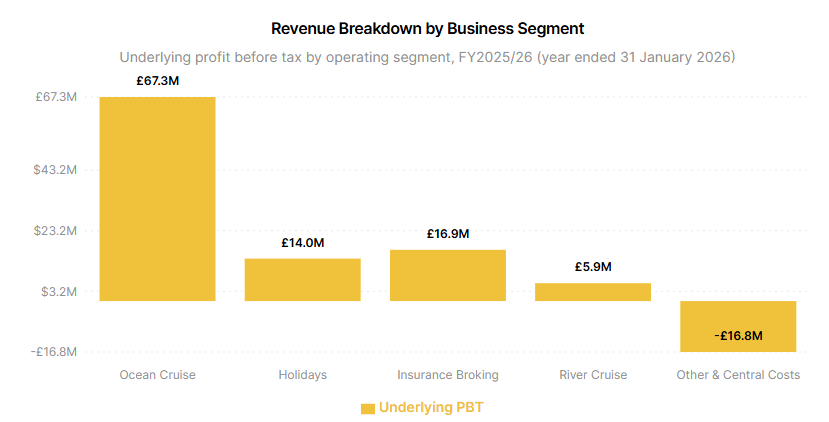
The business now looks completely different as the following EBITDA mix diagram demonstrates:
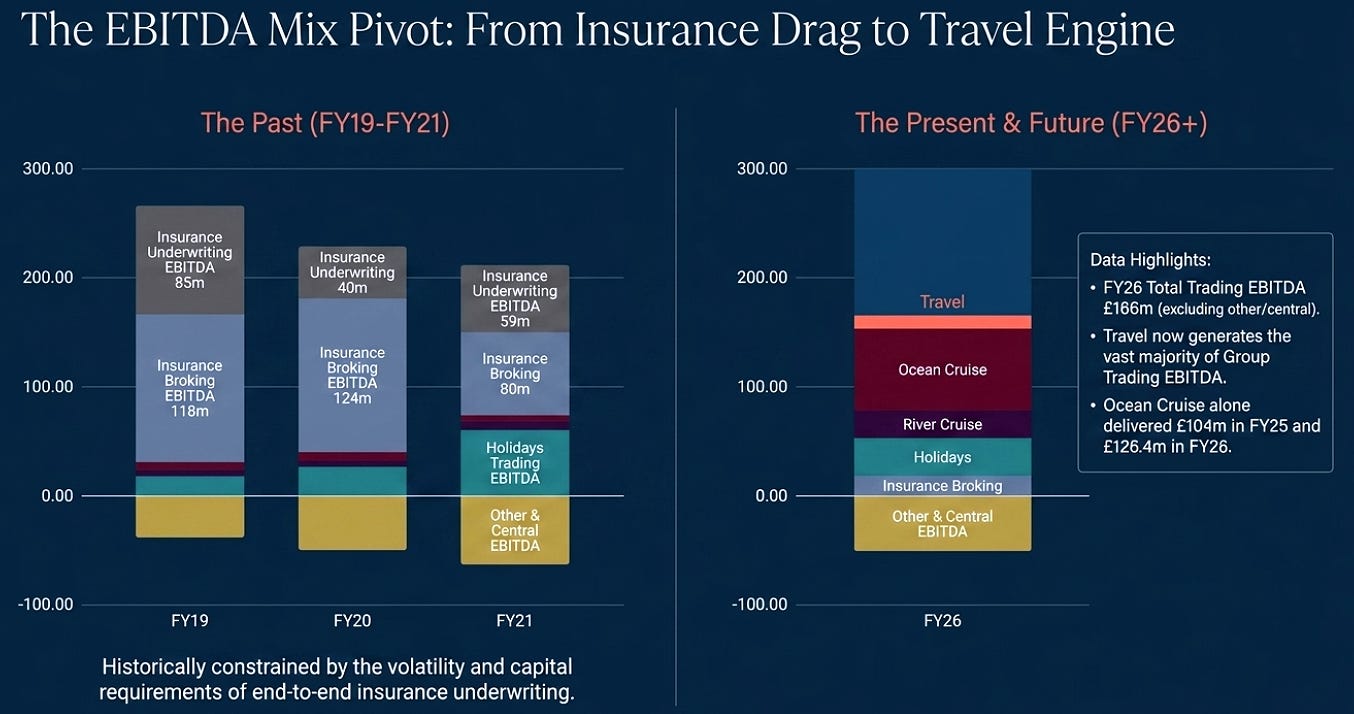
Essentially, it operates across three primary segments:
Travel: Comprising owned Ocean Cruises, chartered River Cruises, and curated Holidays.
Insurance Broking: Focusing on motor, home, private medical, and travel insurance.
Other Businesses: Including Saga Money (personal finance partnerships like the 2026 NatWest Boxed savings account), Saga Publishing (which produces the UK’s biggest-selling monthly subscription magazine), and mailing operations.
Ocean Cruises
Ocean Cruises is currently Saga’s largest and most profitable operating segment, and its performance is the single most important variable for the group’s mid-term targets.
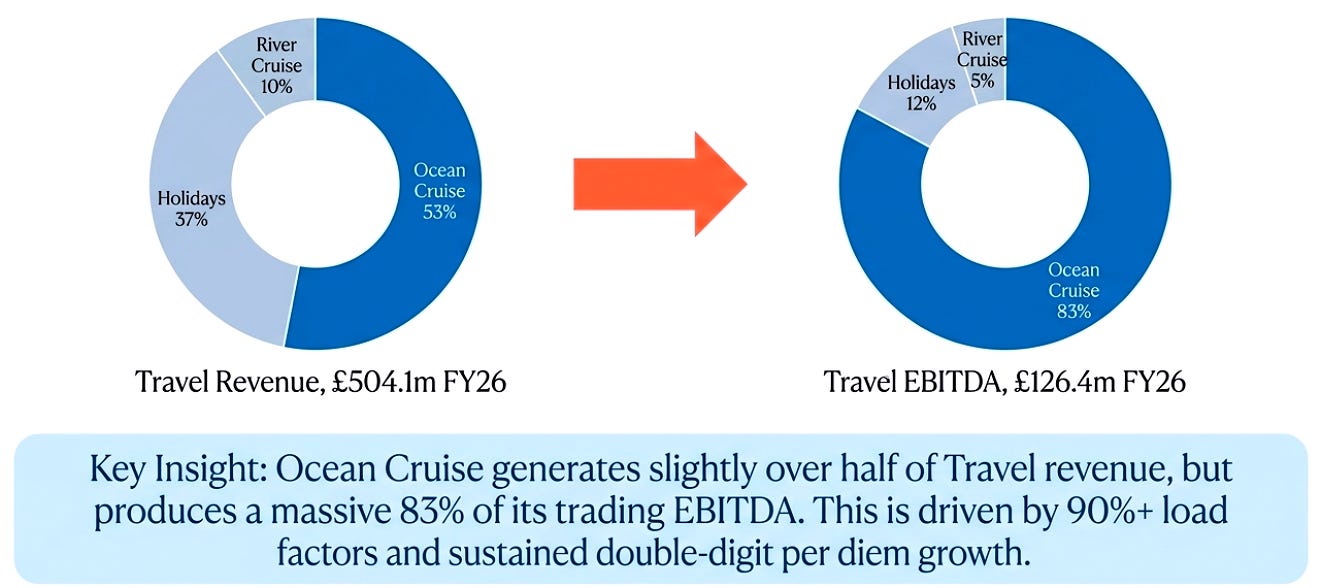
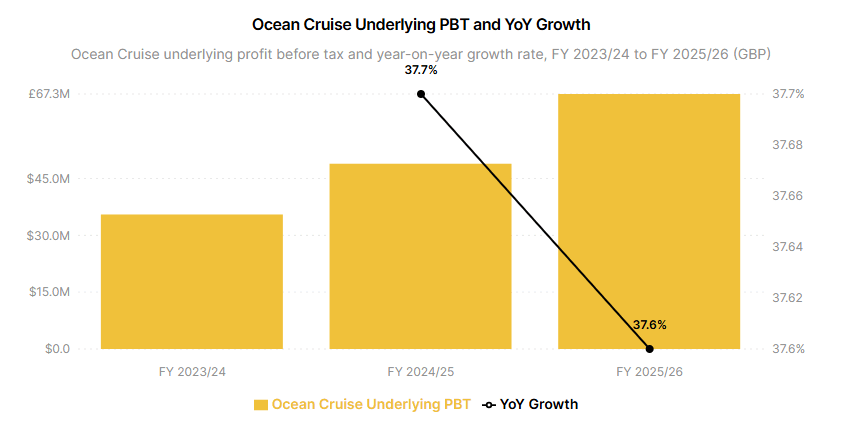
In the last financial year, Ocean Cruises achieved an underlying profit before tax of £67.3 million, and it has been growing at over 37% annually for the past few years.
This growth was driven by the group’s two purpose-built boutique ships, Spirit of Discovery and Spirit of Adventure, which cater exclusively to the over-50s market with a refined, all-inclusive, no-fly proposition departing from UK ports.
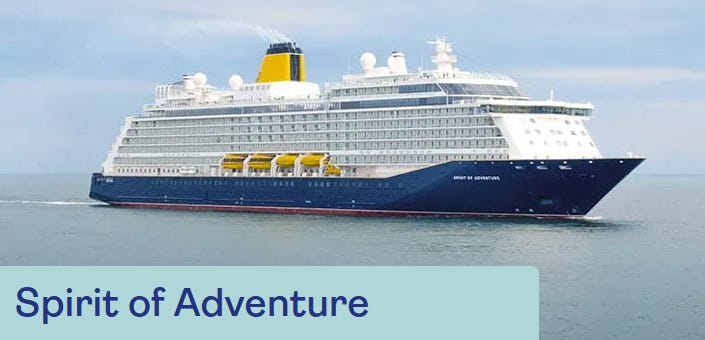
Although the company now has a capital light model, these ships were commissioned prior to the return of Sir Roger. They explain a large part of the current debt profile of the business. Each ship cost approximately $350 million to build, and while this represents a significant investment, each has a useful life of 30 to 40 years, promising decades of future cash flows for the company.
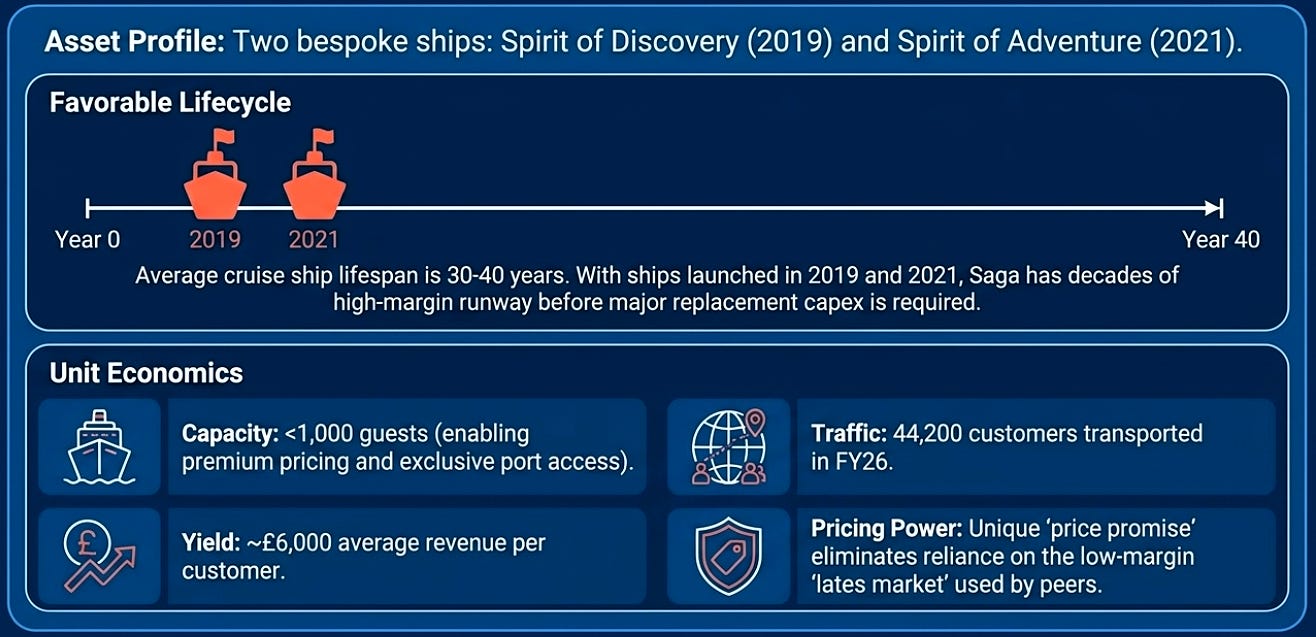
These vessels offer a high-service staff-to-guest ratio of 1:2 and include unique features such as 100 single cabins for solo travellers, which accounts for 20% of the total cabins and constitutes a major differentiator in the market.
The transactional Net Promoter Score (tNPS) for Ocean Cruise reached an all-time high of 83 in 2026, and the repeat booking rate stands at a robust 64%.
The unit economics of the Ocean Cruises business demonstrate the power of Saga’s niche positioning and the resulting operating leverage.
For FY2025/26, Ocean Cruise achieved an extraordinary 93% load factor and a per diem revenue of £394.
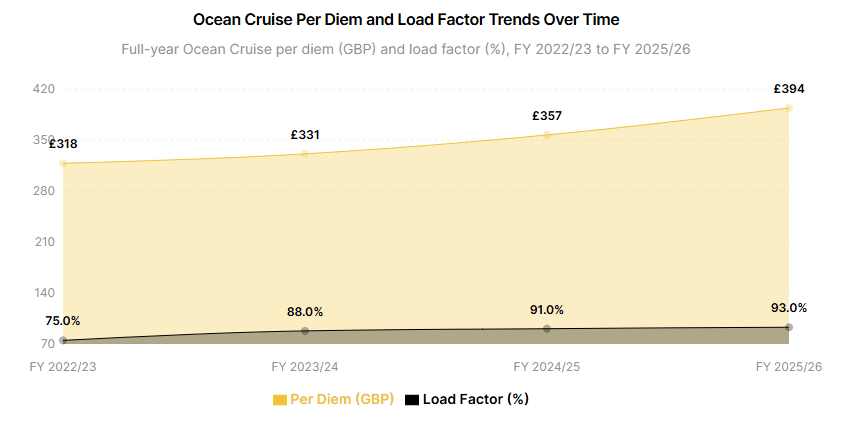
Because cruise ship operations carry high fixed costs (principally depreciation, crew wages, and port charges) incremental passengers above the break-even threshold generate disproportionate profit.
Approximately 70-75% of Ocean Cruise cost of sales is fixed, creating an incremental contribution margin of approximately 81% on each additional percentage point of load factor.
Furthermore, forward bookings for FY2026/27 confirm sustained pricing strength, with per diems reaching £447, which is 13% ahead of the same point in the prior year.
This pricing power is particularly impressive when compared to mass-market peers like Carnival or Royal Caribbean, whose yield growth is typically in the low single digits. Saga’s ability to grow per diems at double-digit rates without sacrificing occupancy is clear evidence of the brand’s unique differentiation.
Saga claims to have no direct competitor in the UK-departure boutique cruising market for the over-50s.
While global giants like Carnival’s P&O Cruises and premium players like Viking Cruises target similar demographics, they lack the exact bundle of features Saga provides. For instance, Saga offers a nationwide return shared chauffeur service from a guest’s home to the port, removing the stress of flying and providing a seamless door-to-deck experience.
P&O operates much larger ships and has the ability to compete on volume of passengers. However, it has recently alienated its loyal base by opening its adults-only vessels to families for select sailings starting in late 2026, a move that is expected to drive disaffected cruisers toward Saga’s more intimate and exclusive age focused offering.
Viking represents a more credible threat. It offers a similar ship size and has a 100-ship fleet, meaning less concentration risk than Saga. It has a “no kids, no casinos" brand purity that rivals the Saga over 55 adults only, but its UK offerings overwhelmingly require fly-cruises and it lacks Saga’s UK-centric bundled ecosystem.
River Cruises
Saga’s travel segment’s growth is further supported by the scaling of the River Cruise business and the operational recovery of the Holidays division.
River Cruise operates on a capital-light charter model, leasing boutique vessels on European waterways, such as the Spirit of the Moselle which launched in July 2025. This segment saw a 48% increase in underlying profit to £5.9 million in FY2026.
River Cruise revenue is expected to scale as the fleet expands with new vessels like the Spirit of the Lorelei in 2027.
Holidays
Meanwhile, the Holidays business, which includes escorted tours and hotel stays, has undergone significant “surgery” to move away from what management described as a “generic” offering. Under the leadership of Nigel Blanks, the division implemented a package of operational changes including extending chauffeur services to hotel stays and expanding themed special interest holidays. These efforts drove a 9-point improvement in customer satisfaction scores to 54 and helped the division return to a profit of £14 million in FY2026. The 31% profit growth on 11% volume growth in Holidays suggests improving unit economics and the potential for further margin expansion as the business scales.
Risks to Holidays and Cruises
To add some balance to the narrative, it is important to point out that the discretionary nature of travel makes Saga vulnerable to macro shocks. The holiday and cruise businesses should not be assumed to be plain sailing (punn intended). There is inherent risk that ought to be factored into modelling Saga.
Historical data from 2008 shows that while cruise occupancy can hold up during a recession, per diems took seven years to recover. If high inflation or an energy shock rolls off current hedges, or if geopolitical tensions escalate, Saga’s fixed-cost model could see significant margin compression.
Insurance
The insurance pivot to the Ageas affinity model is the most consequential shift for Saga’s risk profile. By selling its underwriting arm and receiving an upfront fee of £80 million, Saga has eliminated exposure to the claims inflation, reserve volatility and catastrophe losses that historically hampered its performance. This shift allows management to focus on its core strength: marketing to those on its proprietary 9.7 million person database.
Saga performs the capital light role of broker, while all the heavy lifting and technical operations are left to Ageas.
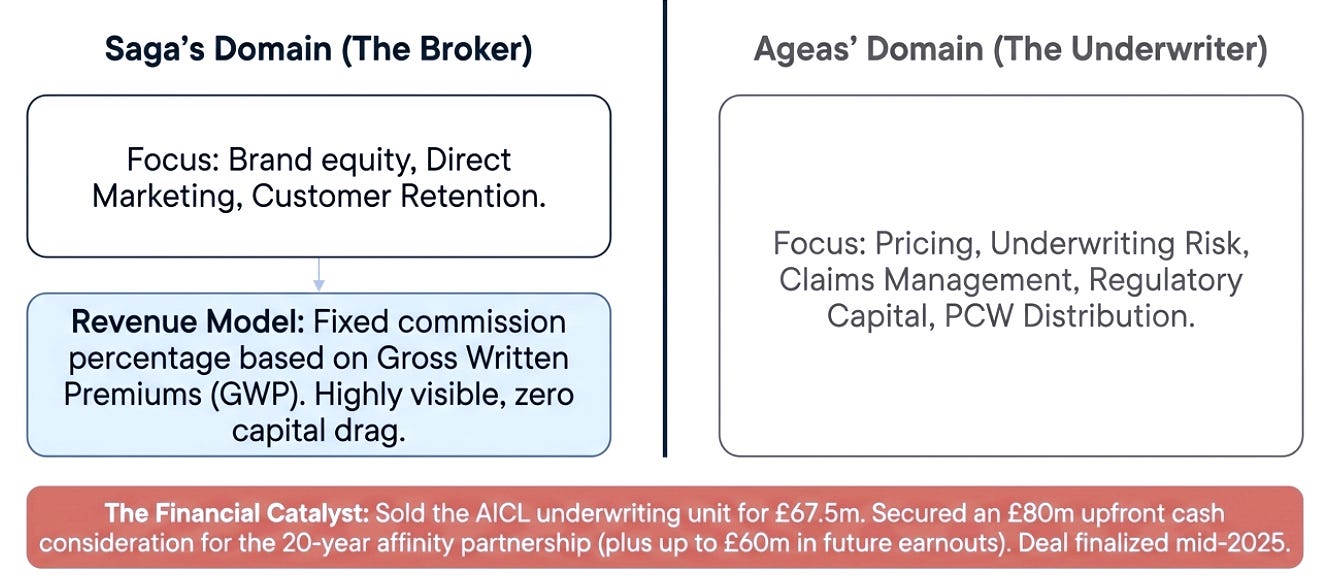
Under the new 20-year partnership, Saga leads marketing and proposition development while Ageas manages distribution, pricing, and claims. This provides a stable, commission-based earnings stream tied to gross written premiums.
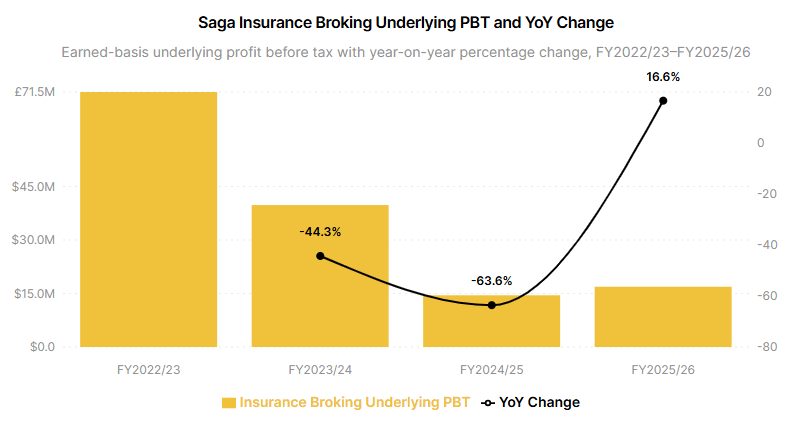
Early proof of concept was seen in FY2026, when Insurance Broking returned to policy growth for the first time in four years and triggered a £10.5 million contingent payment from Ageas due to outperformance.
The dependency on Ageas for the next 20 years is not without risk. Ageas is currently undergoing massive internal restructuring itself, cutting half its UK workforce while simultaneously integrating its £1.3 billion acquisition of ‘Esure’.
Any deterioration in service quality or claims handling by Ageas could permanently damage the Saga brand trust, which is the company’s most valuable asset.
While motor and home insurance remain highly competitive and yields lower margins, the higher margin ‘Other’ insurance lines are the real drivers of profit growth.
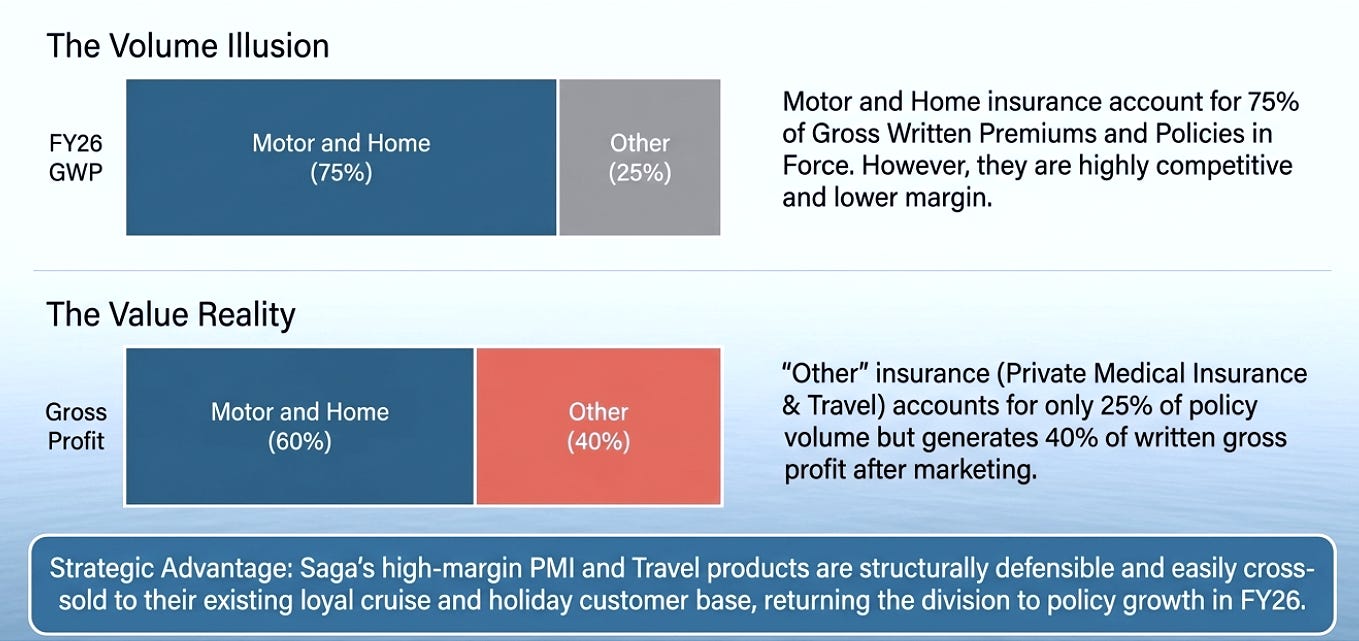
The Private Medical Insurance (PMI) line, underwritten by Bupa, emerged as a standout performer, with underlying profit more than doubling to £11.2 million last financial year.
The Money Segment
Additional growth potential lies in Saga’s expanding partnership-led strategy, exemplified by its new personal finance collaboration with NatWest Bank ‘Boxed’. This seven-year partnership aims to deliver a suite of savings and financial products specifically tailored for the over-50 demographic.
The addressable market is enormous, with UK cash savings worth £2.05 trillion and over-55s holding an average of nearly £28,000 in savings per person.
Saga already has a meaningful footprint in this space, with over 130,000 customers trusting the brand with more than £3 billion in legacy savings.
Management has explicitly stated that for the first two to three years of the NatWest partnership, the focus is on establishing the platform and ensuring a positive customer experience, meaning profits will not materialize immediately. Instead, the profits are “back-end loaded,” the Money segment is expected to contribute meaningfully to the £100 million Vision 2030 profit target only in the final two years of that period.
The partnership contract extends for two years beyond the current Vision 2030 deadline, ensuring that this new revenue stream continues to support the business after the initial turnaround targets have been met.
Ultimately, the partnership demonstrates the versatility of the Saga brand as an ecosystem for the senior market.
Saga operates within one of the most structurally favourable demographic segments in the United Kingdom.
The number of people over 50 is expected to increase from 26.7 million in 2025 to 32.7 million by 2055.
This cohort already controls over 70–80% of UK household wealth, and 55% of over-55s report they would rather spend money on holidays than leave an inheritance! Too bad for their kids; great news for Saga.
This affluent customer base, who now own their homes mortgage free, are relatively insulated from the pressures of rate changes and cost-of-living pressures.
The over-65 demographic showed the highest travel spend growth of 8.7% in 2024, supported by structural protections like the State Pension ‘triple lock’ and inflation-linked defined benefit pensions.
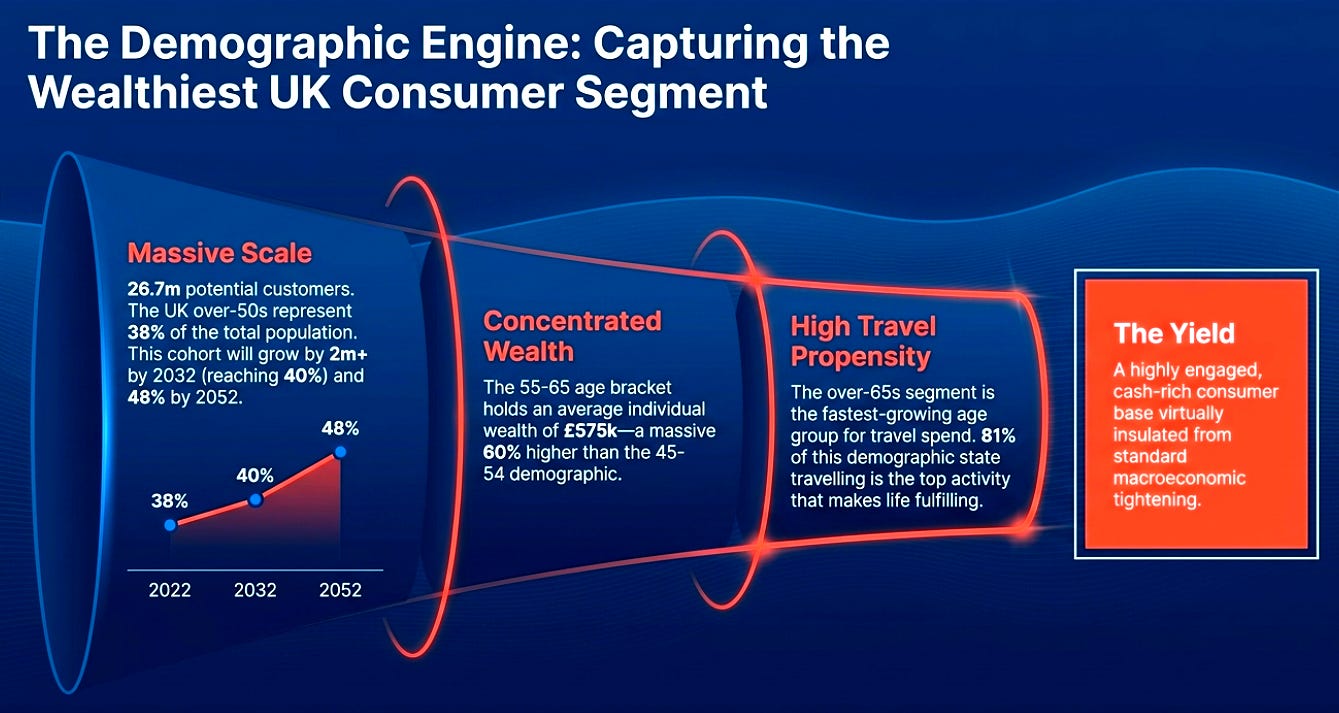
These demographic tailwinds provide a long-term underpinning for demand across all of Saga’s divisions, reducing the need for aggressive market share capture to drive growth.
Average life expectancy in the UK is 83 years for females and 79 years for males, so a satisfied customer acquired at age 55 is likely to provide recurring revenue for decades to come.
However, for any business built to capture the discretionary spending of over 55s, the landscape is changing.
For decades, targeting this ‘Baby Boomer‘ demographic was relatively straightforward: market to comfortable retirees who had guaranteed final salary pension plans, mortgage-free homes that had generated more wealth from the real estate boom than their owners had earned in their working life, and plenty of time on their hands during a comfortable retirement.
That fortunate generation will not live forever. The next wave were not quite so lucky. In place of Baby Boomers, a stark divide is likely to emerge between the minority coasting on wealth generated on accumulated or inherited capital, and a growing cohort of over-55s who saved far less because the rapidly increasing cost of homes over the past 25 years had consumed significant amounts of their income. Many over 50s now report that they are simply unable to afford to retire and will be forced to work well into later life.
That has important implications for businesses like Saga. Premium leisure, luxury travel and high-end experiences could face structural headwinds. The easy-spending, asset-rich retiree, happy to spend thousands on cruises, long-haul holidays or expensive hobbies, may become an increasingly rare customer, concentrated within the relatively small proportion of the population that benefits from the “Great Wealth Transfer”.
The outlook for the wealthier cohort also depends heavily on the direction of the UK housing market. Nearly two decades of near-zero interest rates transformed millions of Baby Boomers into paper millionaires as residential property values marched relentlessly higher, creating both a powerful wealth effect and expectations of substantial inheritances for the next generation. But those assumptions deserve closer examination.
The UK does not suffer from a housing shortage so much as an affordability shortage. Those are two very different problems, yet politicians and much of the media routinely conflate them. An asset is ultimately worth only what someone is both willing and able to pay. Higher interest rates, combined with years of stagnant wage growth, have fundamentally changed that equation, and the long-running property bubble now appears to be slowly deflating.
This matters for the Saga investment thesis because consumer spending is influenced not only by income, but also by perceived wealth, even when that wealth exists only on paper. If house prices continue to correct, which many would argue is both overdue and economically necessary, consumer confidence may weaken and future inheritances could prove materially smaller than many currently expect.
Even so, Saga is not a mass-market business. It is built around serving a highly specific demographic. Its two cruise ships carried approximately 44,000 passengers in 2026, equivalent to just 0.2% of the UK’s over-55 population. It is therefore difficult to envisage a scenario in which demographic or macroeconomic changes materially impair demand across such a small, carefully targeted affluent customer base.
This discussion, however, raises some interesting strategic questions:
Should Saga continue to double down on its affluent niche, positioning itself as the luxury brand for Britain's wealthiest retirees?
Or should it broaden its offering to appeal to the much larger cohort of over-55s who may become increasingly value-conscious, prioritising affordability over luxury?
The answer could determine whether Saga remains a specialist operator or unlocks an entirely new avenue for long-term growth.
There is no doubt that Saga’s financial metrics are improving significantly.
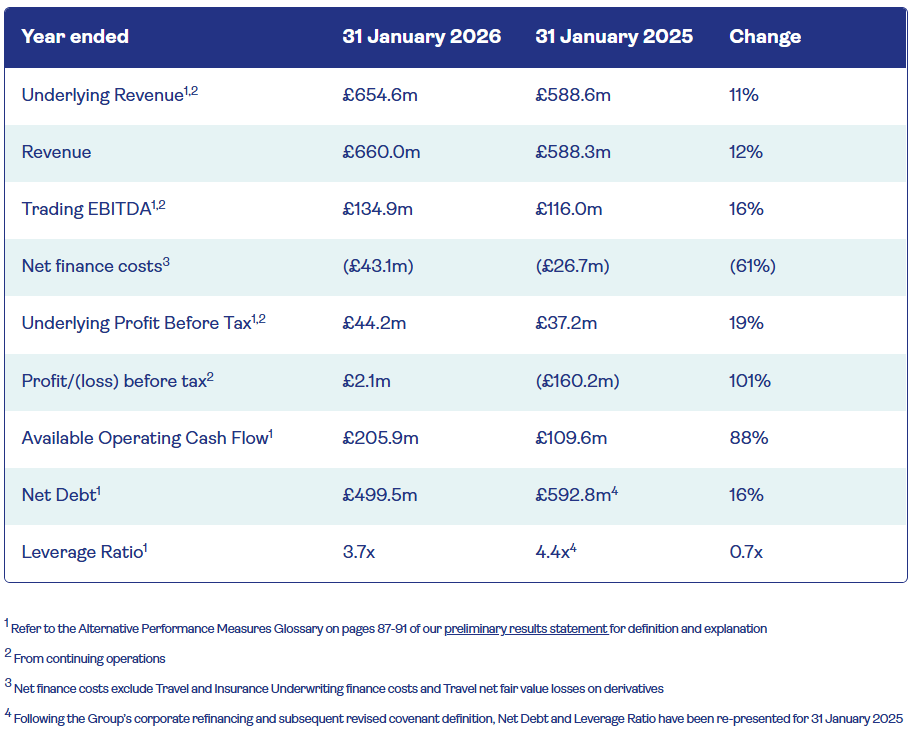
However, while revenue has continued to grow, the cost of generating that revenue has grown even faster. As a result, gross margins have compressed from the high-60% range to the mid-40% range.
Much of the increase in Saga’s cost of goods sold (COGS) has been outside management’s control. The Cruise division has been hit by a sharp increase in operating costs, particularly fuel prices, driven both by geopolitical turmoil and the introduction of FuelEU Maritime regulations in January 2025. The latter has forced operators to adopt lower-carbon fuels that can cost 50% to 150% more than conventional marine fuel.
But not all of the increase in COGS can be attributed to external inflationary pressures. Some of it is a direct consequence of management’s strategic repositioning of the business.
The deliberate shift towards lower-margin, capital-light revenue streams means that a greater proportion of Saga’s reported revenue is effectively captured on behalf of third parties. Think chartered river cruise ships, third-party flights and hotel accommodation.
Similarly, the nationwide rollout of its chauffeur service across hotel holidays and the expansion of its specialist travel itineraries have helped deliver record customer satisfaction scores. But they have also placed a structural floor under the company’s cost base.
As such, under the new business model, gross margins are unlikely to return to where they once were.
But that is not necessarily the problem. Operating margins are improving.
Although labour costs have increased on a per-capita basis, headcount has been dramatically reduced as part of the restructuring. At the same time, SG&A as a percentage of revenue has fallen as economies of scale begin to take hold.
Operating leverage is therefore driving improvement further down the income statement, and the good news is that this dynamic looks set to continue.
But for Saga, it is the bottom of the income statement that matters most.
Historically, too much of the operating profit generated by the business has been consumed by financing costs. That is the real issue. Solving it sits at the heart of the company’s strategic plan.
The group’s financial trajectory is centred on a path to “Vision 2030,” which targets an annual underlying profit before tax (PBT) of at least £100 million and a leverage ratio below 2.0x.
To achieve the “Vision 2030” by January 2030, Saga assumes a fundamental shift in its revenue mix and a substantial expansion of its margins, primarily driven by a material reduction in finance costs.
While management has not publicly disclosed a detailed segment-level profit bridge, the group’s reported trajectory provide a clear picture of the underlying assumptions.
Saga assumes total group revenue will grow to approximately £829.7 million by FY2029/30.
Against these top line assumptions, the group assumes margin expansion that relies heavily on the extraordinary operating leverage inherent in the Ocean Cruise business.
Furthermore, Saga has been aggressively deleveraging which facilitates margin expansion. A major refinancing completed in early 2025 replaced near-term maturities with a term loan extending to 2031, giving management valuable financial breathing room.
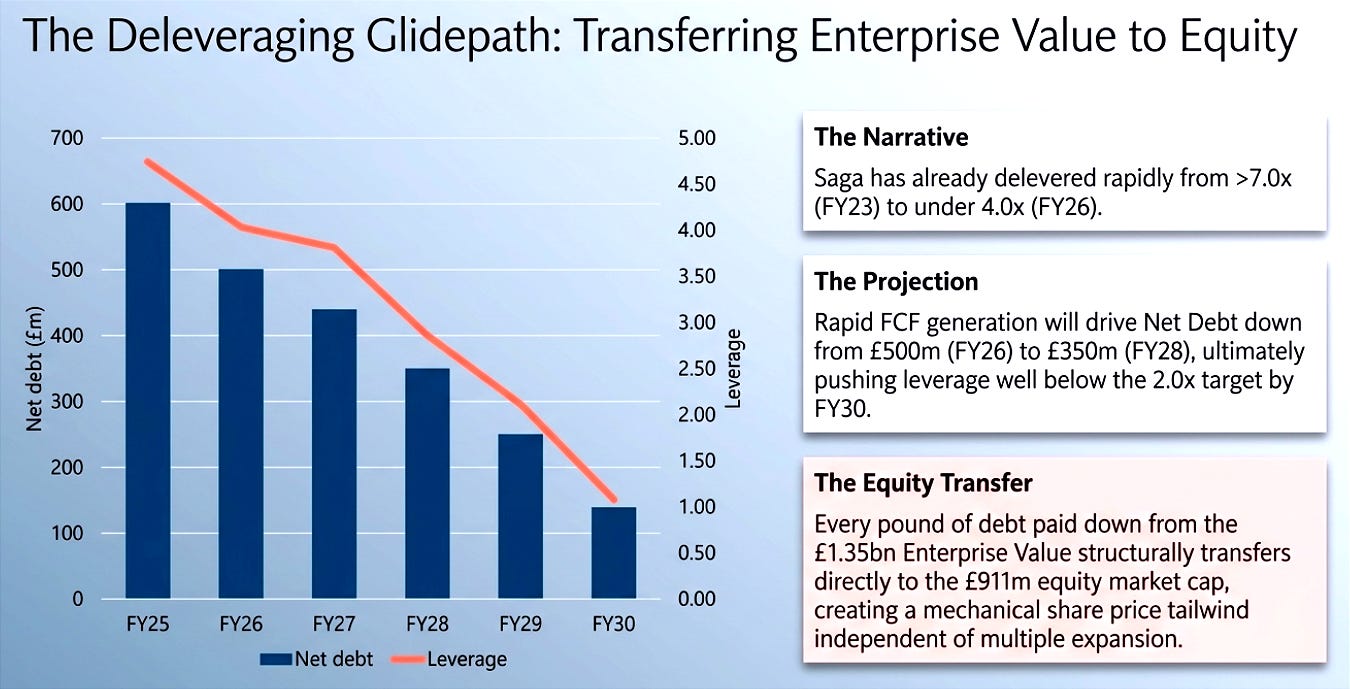
Thus far, it has reduced net debt from £637.2 million in early 2024 to £464.7 million by May 2026, and the leverage ratio have dropped from 7.5x to 3.7x.
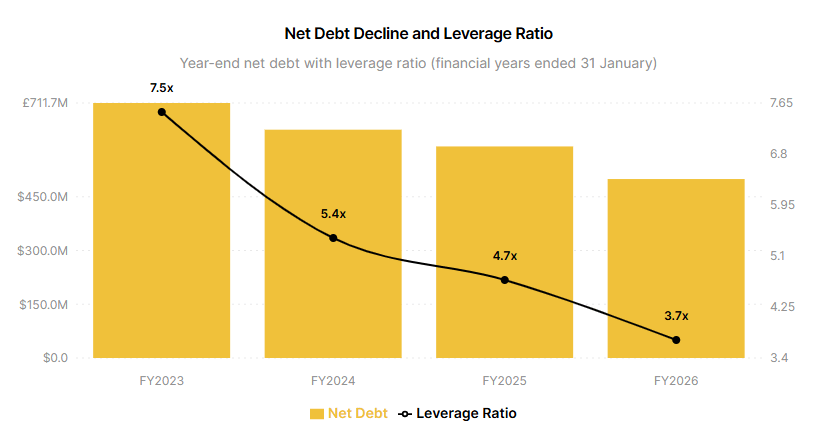
The company anticipates that this deleveraging will continue resulting in a dramatic reduction in finance costs from the £43.1 million reported in FY2025/26 to as little as £3.4 million by 2030, effectively transferring operating gains directly to the bottom line.
As debt is paid down and financing costs fall, the business will become a meaningful free cash flow machine by the end of the decade.
The other point worth mentioning is that Saga’s strategic shift to a capital-light business model is significantly changing its net working capital position.
First, the travel division, now Saga’s primary profit engine, has very favourable negative working capital dynamics, allowing Saga to hold customer deposits and full payments well in advance of the actual vacation. As the Holidays division returned to profitability and increased passenger numbers (up 11% in FY26), it also saw a positive contribution from advance receipts, totaling £10.3 million.
Second, through the unwinding of its legacy insurance operations, it is experiencing a structural change in how it manages customer receipts.
Historically, as both a broker and an underwriter, Saga held significant insurance-related working capital on its balance sheet (float). As the renewal book for motor and home insurance transfers to Ageas, Saga is undergoing a "working capital unwind".
To help aid in this process, Saga received an upfront payment from Ageas (~£60m, which was part of the larger £80m partnership consideration), but ultimately that cash will leave the business as the renewal book transfers over to Ageas. This has been confirmed by CFO Mark Watkins.
These proceeds are effectively being used to fund the cash outflows required as the legacy insurance liabilities and policy requirements are satisfied during the transition period, which is expected to complete during FY2026/27.
So although this process creates a temporary inflow of cash, it is not considered accretive to the group’s long-term value.
However, eliminating the capital-intensive underwriting business removes regulatory capital requirements, further freeing up cash flows for debt paydown.
As the business moves past the Ageas transition, working capital requirements are expected to stabilize. Group-level cash conversion (after interest and tax) is anticipated to exceed 65% by FY2030 as the interest burden falls and the capital-light model fully embeds. At this point, the Saga cash engine will be firing on all cylinders.
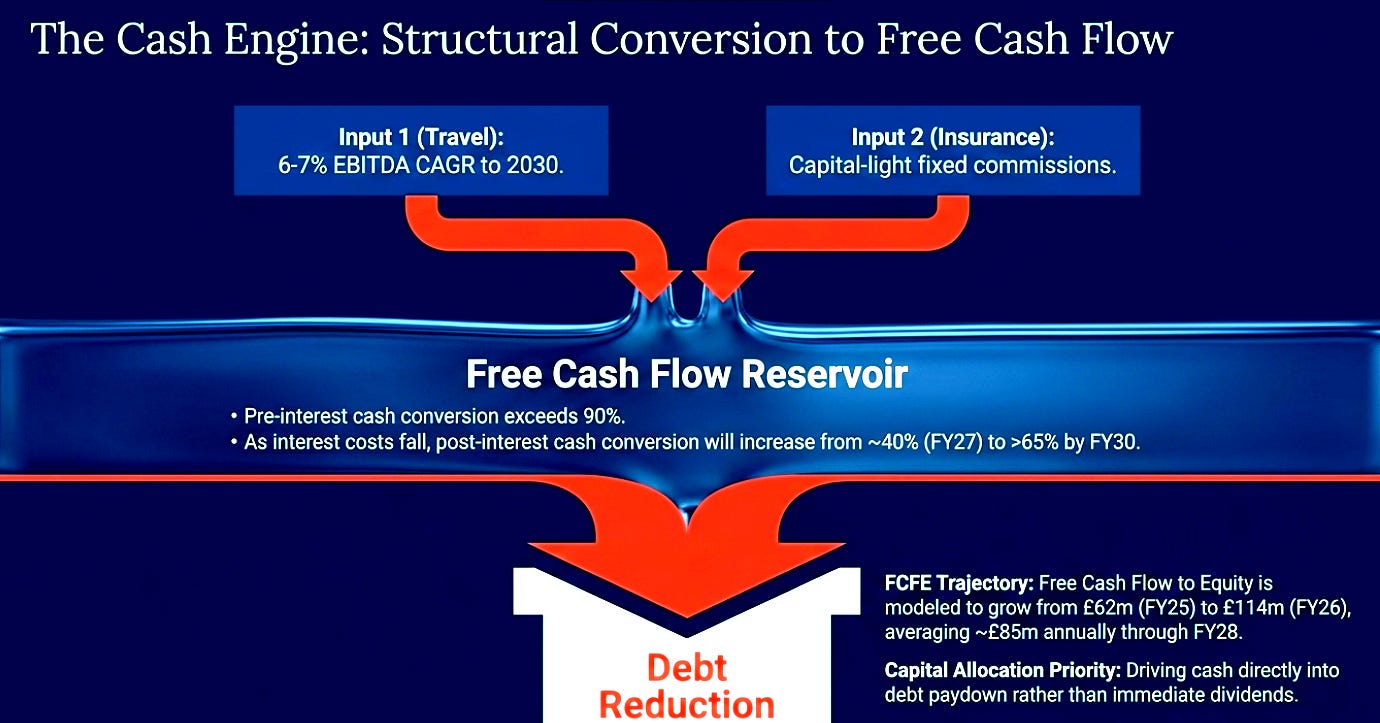
Central to the investment thesis is the transfer of enterprise value to equity. Saga is effectively a highly leveraged equity stub. When a company carries a substantial debt burden, almost all of its enterprise value is represented by debt, leaving only a thin layer of residual equity value. As the business generates free cash flow and repays borrowings, the enterprise value can remain unchanged, yet the composition of that value shifts: debt shrinks and equity expands to fill the gap.
The mathematics can be remarkably powerful. If debt is roughly ten times the equity value, then a 10% reduction in debt, with enterprise value held constant, can approximately double the value of the equity. In other words, modest progress on deleveraging can translate into outsized returns for shareholders.

Saga is not a company that screens very well at the moment, primarily because of its debt and financing costs. The former suppresses balance sheet equity, which distorts the price to book ratio, while the latter suppresses net earnings and so the company appears to be capitalised at an unattractive P/E multiple.
For a turnaroud business, such valuation short-cuts are useless and so should be avoided.
Over the past year or so, those that have taken the time to understand the turnaround story have initiated positions. The market has been rewarding Saga for its transformation, yet many argue that today’s valuation does not fully reflect its potential as a high-margin travel leader. They suggest significant remaining upside despite a strong share price performance over the past 12 months.
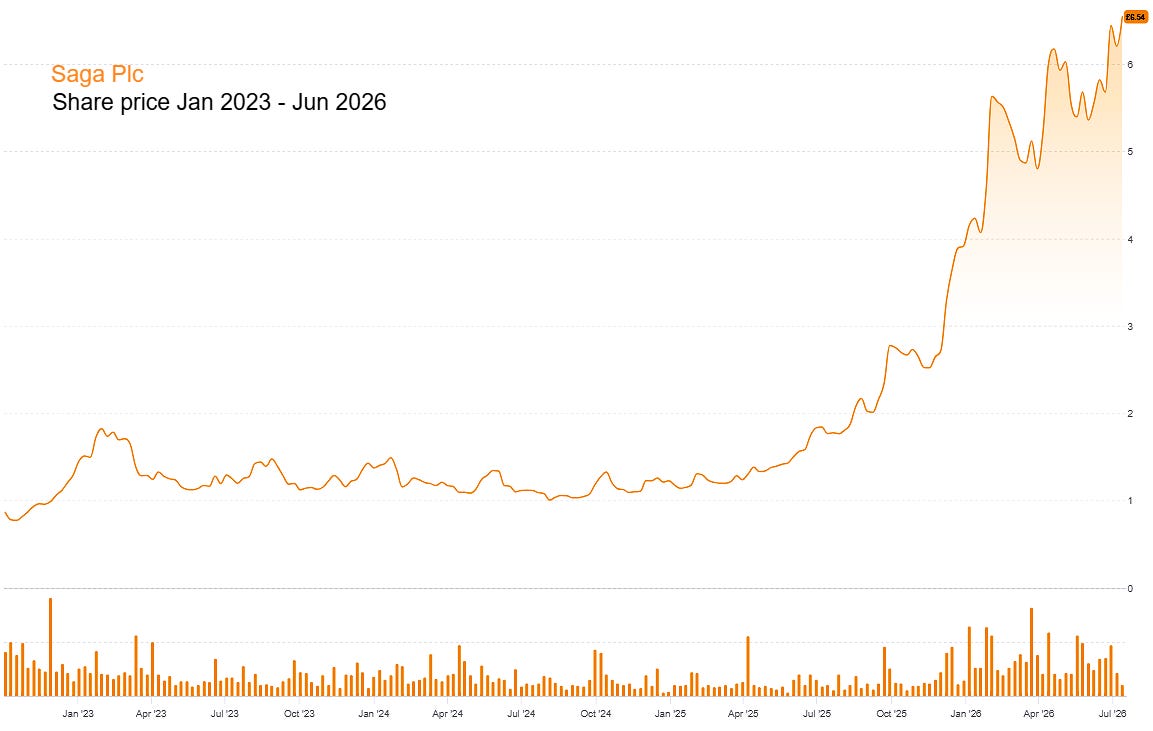
Over the five years from 2021 to 2026, Saga’s share price increased from approximately 130p to 664p, equating to an impressive 38.7% CAGR. As no dividends were paid during the period, this represents the entirety of shareholder returns.
Factorising those returns reveals where the value was created.
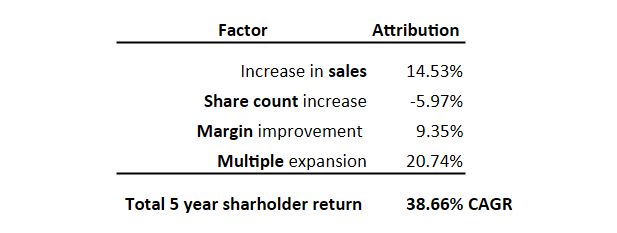
It becomes apparent that the majority of shareholder returns, most of which have been generated over the past twelve months, have been driven by earnings growth (sales growth + margin improvement), and also by a dramatic improvement in market sentiment, reflected in substantial multiple expansion.
As recently as January 2025 the business was capitalized at 0.25x top line sales. Today that number is closer to 1.40x. It has been the market’s willingness to pay a much higher valuation multiple that accounted for most of the share price appreciation.
Had the share count remained unchanged, annualised returns would have been 44.6% rather than 38.7%.
The expansion of Saga’s share count is fundamentally rooted in the group’s 2020 rescue capital raising. The £150 million rights issue backstopped by Sir Roger De Haan was accompanied by a 15-for-1 share consolidation in October 2020, which reset the group’s share capital baseline and saw the adjusted number of shares expand from approximately 101 million to 140 million.
Since then, the count has experienced steady “dilution creep” primarily through the issuance of new shares to an Employee Benefit Trust (EBT) to satisfy various turnaround-linked stock-based compensation plans. Notable recent tranches include 1.49 million shares issued in July 2025 and a further 1.44 million in May 2026, increasing the basic issued share count to ~146 million.
This dilution impacted the per share metrics and acted as an annualised 6% drag on shareholder returns. Nonetheless, there can be no complaints at a 38.7% CAGR over 5 years.
Looking ahead to the end of the Vision 2030 plan, the return drivers are likely to look very different.
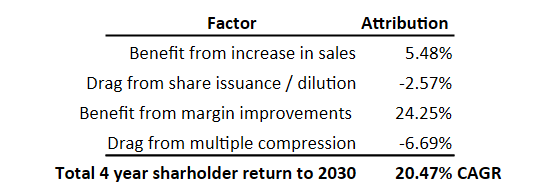
Management’s revenue targets imply a slower, but still respectable, mid-single-digit rate of organic growth.
The remaining gap between this basic issued count and the higher diluted figures cited in analyst models, which reach approximately 153 million, is attributable to the accounting inclusion of in-the-money employee share options and long-term incentive plans.
Given the company’s capital allocation priorities, share repurchases are highly unlikely. Free cash flow should instead be directed towards reducing leverage, meaning share-based compensation will continue to create a modest dilution headwind. With no further equity raises anticipated, I have assumed that dilution moderates through to 2030.
While these issuances serve to incentivise the new executive management team during a complex recovery, for investors, this expanding share base represents a quantifiable drag on the per-share economics of the “Vision 2030” turnaround, and so should be factored into valuation models.
The valuation story is also likely to be very different. Investors should not expect anything close to the extraordinary rerating witnessed over the past few years. Most of the easy gains from sentiment have already been realized.
The company is currently capitalized at 1.4x NTM sales and trades at 9.5x EV/EBITDA. Based on peer comparisons, there appears to be limited scope for these multiples to expand further. In fact, multiples may compress slightly from here in the short term.
I have therefore conservatively assumed that valuation acts as a modest drag on shareholder returns through to 2030, with the sales multiple reverting closer to parity. This looks reasonable given the net income margins the company is expected to achieve by the end of the decade.
The result is that multiple compression and dilution effectively cancel out the accretive value of top-line growth over the period.
In other words, the investment thesis is likely to evolve.
Between now and 2030, the dominant driver of shareholder returns is likely to be margin expansion. Essentially, the company will be converting its growing revenue into significantly higher levels of profitability.
Some of this will come from operating leverage as revenue continues to grow, but the much larger opportunity lies below the operating profit line. For the year ended 31 January 2026, Saga generated £66 million of operating income (gross profit less SG&A), yet incurred £68.6 million of financing costs. In effect, almost the entirety of the company’s operating earnings was consumed by interest expense.
That dynamic is now beginning to reverse. Debt is being paid down. The combination of higher operating profits and sharply lower interest expense has the potential to transform the company’s margin structure, allowing a far greater proportion of operating earnings to reach the bottom line.
My factor-based valuation approach suggests that, if management successfully delivers on its Vision 2030 objectives, the share price could reach 1,685p by the end of the decade. That would imply a 20.5% CAGR over the next four years.
Applying an Ibbotson 10% discount rate puts fair value today at closer to 1,150p.
This is not a prediction, merely a plausible outcomes based on the current fact set.
Hosking Partners is well known for spotting opportunities early and is far more optimistic about valuation. Django Davidson, porfolio manager, notes that in relation to Saga, on “non-heroic” earning assumptions, the share price could rise significantly if management reaches its profit goals. It feels that the business could justify a high-teens EV/EBIT multiple, potentially valuing the shares at 2,500p by the end of the decade.
Hosking Partners are backing their assumptions with capital. The firm has been building a position in Saga for a number of years now and currently owns ~8% of the business. This investment firm was established in 2013 by veteran investor Jeremy Hosking who had formerly spent 26 years as a co-founder and lead portfolio manager at Marathon Asset Management, where he helped pioneer their capital cycle investment philosophy. This is a contrarian investment house with an uncanny knack for finding hidden gems.
Analysts at Berenberg have recently initiated coverage on Saga with a short-term price target of 1,025p, implying roughly 62% upside from July 2026 levels based on a sum-of-the-parts and discounted cash flow methodology. This valuation is not too disimilar to my own 1,150p.
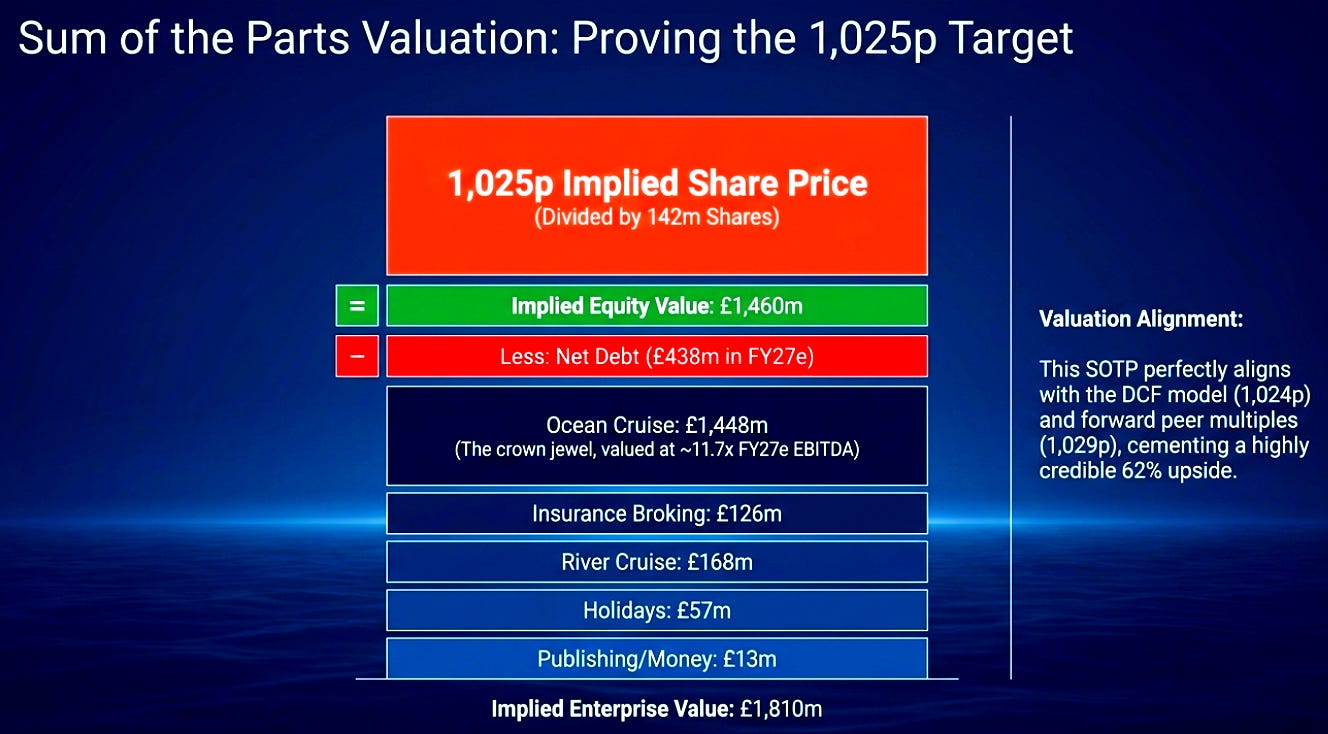
However, investors must weigh this analysis against structural risks.
Investment Case Risks
The investment case is highly sensitive to setbacks.
If, for example, one of its two ships were to be taken out of service for any reason, Saga would lose half of its ocean cruise capacity.
Additionally, while falling, a leverage ratio of 3.7x remains elevated and leaves limited room for exogenous shocks, such as another global pandemic or a major geopolitical crisis.
Environmental regulations, such as Fuel EU Maritime which came into force in January 2025, will also require ongoing investment in cleaner fuels or retrofits, which could compress margins if not managed effectively.
Perhaps it is precisely this downside risk that is keeping the current share price anchored at a lower level.
One other caveat worth highlighting is that the return profile is unlikely to be linear. The benefits of debt reduction should compound over time on an exponential basis, while many of the gains from today’s strategic initiatives, such as the NatWest partnership, are expected to be back-end loaded. In other words, the investment thesis is inherently convex.
Given the exceptional share price performance over the past 12 months, a period of consolidation, or even a pullback as investors take profits, would not be surprising before the next leg higher. In short, the destination appears obvious, but don’t expect a smooth ride.
Divergent views among short sellers provide a tactical window into the market’s remaining scepticism.
Fundamentally-driven shorts like ActusRayPartners have been covering their positions as refinancing and underwriting risks resolved, whereas quantitative firms like Systematica have initiated small short positions. These model-driven shorts likely view the stock’s 240% one-year rally and peak operating metrics as a signal for mean-reversion.
Yet, for fundamental investors, the alignment of Sir Roger De Haan, who is now the largest shareholder and has been increasing his stake, indicates that management is confident in long-term value creation.

By moving away from capital-intensive insurance and doubling down on its boutique cruise and travel offering, management has uncovered a hidden gem of a business that was long buried under debt and mismanagement.
It has four pillars to its turnaround story with a clear path to £100 million in annual profit and a commitment to restoring a capital-light “proper” service model, Saga is well-positioned to reward shareholders who can look past its historical distress to see its future as a free cash flow machine.
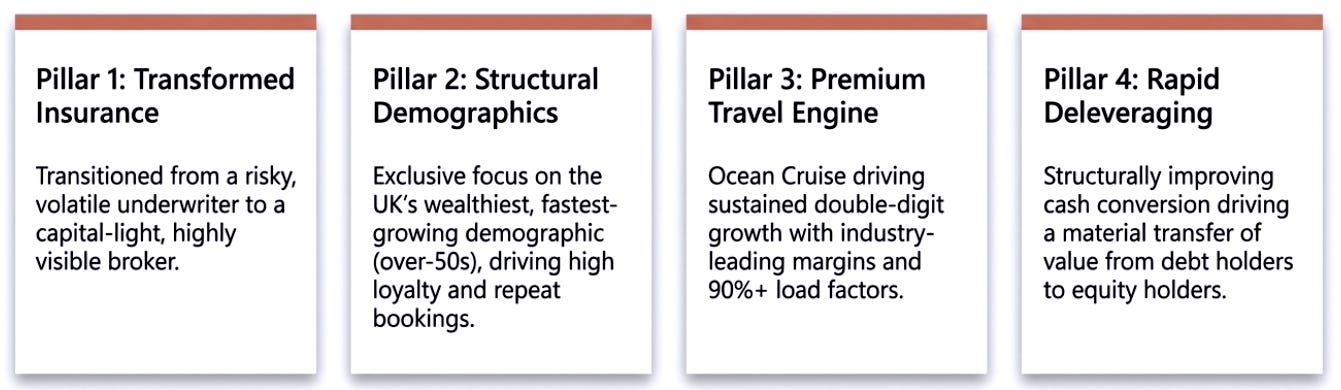
In summary, for the next four years, Saga is a high-convexity turnaround play. The bull case sees it evolving into a free cash flow machine as interest costs collapse and ship debt amortizes, allowing for outsized shareholder returns between now and FY2030.
The bear case warns that its high leverage leaves no margin for error, and a single asset failure, macro economic shock or partner misstep could derail the recovery.
Fortune favors the brave!
What do you think about Saga Plc? Please leave a comment:

A dividend recapitalization (or "dividend recap") is a financial strategy where a company takes on new debt specifically to pay a large, one-time "special" dividend to its shareholders. It fundamentally alters a company’s capital structure and destroys shareholder equity. It is otherwise known as ‘asset stripping’.
Comments
Nothing yet. Say the first thing.
Sign in to join the conversation.