
The backlash against AI infrastructure spreading across the US may be the least of the industry’s problems. The real danger lies in the debt, private credit and off-balance-sheet structures financing the buildout.
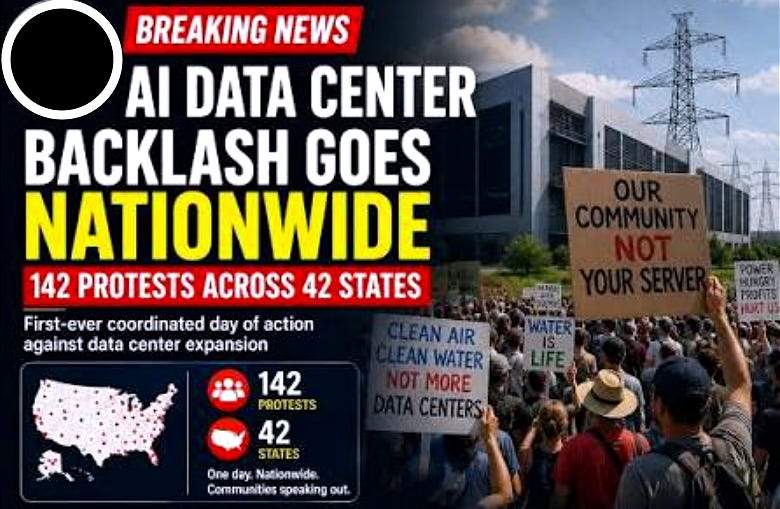
Americans don’t want data centers in their backyard. Investors don’t want them on their balance sheet. But here we are, data centers appearing everywhere!
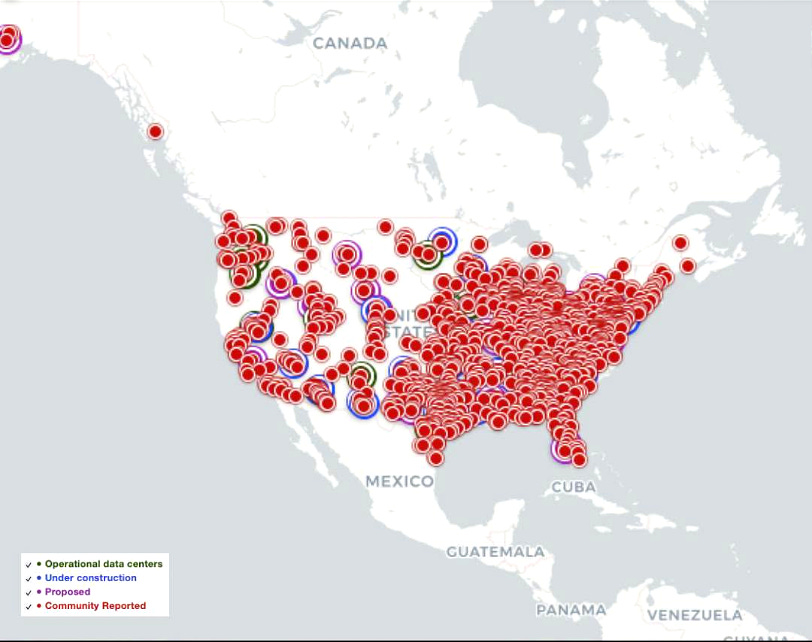
The map below shows all of the data centers that are being built-out across the US:
Wall Street is visibly concerned.
"The biggest challenge is that, over the next several years alone, we're going to spend over a trillion dollars developing AI around infrastructure, data centers, utilities, and applications. A trillion dollars. What trillion-dollar problem is AI going to solve?"
Jim Covello (Head of Global Equity Research, Goldman Sachs)
Historically, technology has enabled us to develop an efficient solution to an existing challenge. Today we have a very expensive solution looking for a problem to solve.
Other key figures have voiced similar concerns.
“A question I have for Oracle, Google, Meta, Microsoft and all the rest: 'When does the spending for AI data center buildout actually end?' It is consuming all your cash flow, you are borrowing, you are financing in ways you never have... Now you are engaging in accounting tricks to hide expense, to protect earnings... When does it end?"
Michael Burry (Scion Asset Management)
Microsoft's invested capital has grown more than two-and-a-half times in four years, and its return on that capital has fallen from the low forties to the high twenties.
“Hyperscalers are on track to spend $4 trillion on capex through 2029. Unless they want their returns on invested capital to collapse, severely damaging their valuations, their margins suggest they’ll need to generate around $20 trillion in revenue annually to justify that investment. For context, the entire S&P 500 generated $18.5 trillion in revenue last year.”
Kevin Koharki, Associate Professor Accounting at Purdue University, Founder CAE Consulting, frequently quoted in the Wall Street Journal
These quotes set the stage. But in truth they only scratch the surface.
If you care to look under the hood, the real issues become visible.
A tidal wave of capital has arrived to build out data centers, explaining the explosion in numbers. This harsh reality is showing up everywhere:
“In Q2, we booked $2.7 billion of data center orders in Electrification, bringing total segment data center orders to over $5 billion in the first half of 2026, more than double full year 2025.”
Scott Strazik, GE Vernova (GEV)
Why is this happening?
The starting point is straightforward. Demand for data center capacity rises faster than supply, existing capacity becomes scarce, utilisation increases and pricing strengthens.
But as the old saying goes, “the best cure for high prices, is high prices”.
The promise of strong returns on capital sends a powerful signal to investors to build more.
This is the beginning of the end of high prices.
A data center can’t be constructed overnight. They are enormous, capital-intensive projects with very long lead times. Power availability, land acquisition, grid connections, planning, construction, cooling infrastructure and, increasingly, access to GPUs all take time.
But here’s the thing: when capacity takes up to 36 months to come into service, even if developers have already committed to building sufficient capacity, the market continues to appear supply constrained in the interim.
But it’s an illusion. A little like an oasis in the desert.
If capital is readily available, the hurdle rate for investment falls.
This is how a shortage can sow the seeds of its own destruction. People conclude that if they invest in plugging the perceived supply gap, their investments will benefit from predictable cash flows.
The irony of capital-intensive industries is that the shortage is often greatest at precisely the moment when the most capital is being committed to eliminating it.
Currently operational U.S. data centers have an estimated total capacity of approximately 50 to 57 gigawatts of IT load and grid power demand. Yet Paulo Sternadt, CEO of Eaton, noted that planned data centers that have been announced will bring on online 300 gigawatts of capacity. That implies that the data center capacity will expand by six times in the years ahead.
“Total U.S. data center backlog has grown to 307 gigawatts… Only roughly 20% of this backlog converts near term. The majority will translate to 2028 and beyond...”
Paulo Sternadt, CEO Eaton
You can probably see where this is going. Everyone starts building all at once. When the capacity eventually arrives, they discover that the industry has collectively built far more than the market can absorb.
The industry moves from being supply constrained to supply abundant. Pricing weakens. Utilisation falls. Returns on capital deteriorate. Projects fail, as do many of the companies that financed the buildout.
This is classic Capital Cycle Theory, made famous by Edward Chancellor’s book ‘Capital Returns’.
The danger with data centers is that the industry may be particularly vulnerable to this dynamic because the investment pipeline is enormous, the assets are highly specialised and the cost of construction is so high.
A data center that sits empty is not like an empty warehouse. Far more capital has been deployed to build it, vast amounts of debt still needs to be serviced, electricity contracts still need to be paid for and critical components such as GPUs depreciate rapidly as they become obsolete in a small number years.
The financing structures used to build these assets often assume that revenue begins flowing almost immediately once construction is complete and that the facilities operate at full utilisation.
That is not a safe assumption, as both Meta and SpaceX have discovered (more on this later).
The twist this time is that the capital cycle is being amplified by project finance, SPVs, private credit and off-balance-sheet structures, potentially allowing the underlying risk to become much larger and more widely distributed than the headline balance sheets suggest.
Which brings us to what I believe is the more interesting part of the story.
The capital cycle is one problem. The way this capital is being financed could make the consequences considerably worse.
Much of the investment is not simply being funded by companies writing cheques from their own balance sheets.
Instead, data centers are increasingly being financed through special purpose vehicles (SPVs), allowing the debt obligations to be held by an independent entity on a non-recourse basis.
The basic structure is relatively simple. A separate entity is created to own the data center, the GPUs and the associated debt. That entity raises financing, pays contractors and equipment suppliers, and then expects to repay its creditors from the future cash flows generated by the data center.
During construction, interest can be funded from a reserve account. Once the facility is operational, customer payments flow into the SPV, operating expenses are paid, creditors are paid according to their seniority and anything left over ultimately flows back to the parent company.
On paper, this can look remarkably attractive. The debt is backed by a physical asset. The customer may have signed a long-term contract. The financing may have a debt-service coverage ratio. There may be liquidity requirements and a debt-service reserve account.
But what happens if the revenue doesn’t arrive as expected?
The economic risk has not disappeared. It has simply been moved.
A company such as Meta, Microsoft, Google or Amazon may effectively be the reason a data center is being built and may ultimately be the primary, or even sole, customer. Yet the debt used to finance the construction can sit elsewhere in the corporate structure.
If the data center is underutilised, somebody still owns the GPUs, somebody still owes the lenders and somebody ultimately has to absorb the loss if the customer doesn’t pay.
That distinction matters enormously.
The question is not whether the debt exists. It is who owns it, who is ultimately responsible for it and who is holding the risk when the capital cycle turns.
The entire financing structure rests on an assumption that today’s demand will still exist tomorrow.
A 10- or 20-year contract may look like an extraordinarily valuable asset. But the real question is whether the customer will still need the capacity over that period, whether it can still afford it and whether the price being paid is sufficient to cover the cost of the infrastructure.
The risks are plentiful. If the market becomes oversupplied, compute prices fall. If technology improves faster than expected, the value of existing GPUs declines and maintenance CAPEX increases. If AI models become more efficient, less compute may be required. If customers fail to monetise their AI investments, they may cut their spending.
The capital cycle can change quickly and without notice. Contractual terms cannot. The debt remains.
This is the fundamental duration mismatch. The assets are long-lived. The technology cycle is not.
The demand for AI compute is also heavily concentrated among a relatively small number of companies, with OpenAI and Anthropic representing a particularly important part of the ecosystem. Much of the demand flowing through hyperscalers and neoclouds is ultimately connected to these companies rather than representing broad, diversified end-market demand.
This creates an important distinction between contracted demand and sustainable demand.
If a data center is financed on the assumption that a customer will pay billions of dollars over ten or twenty years, the lender is not simply underwriting the infrastructure. It is underwriting the customer’s business model.
That is a very different proposition.
This is where the NVIDIA relationship becomes particularly interesting.
The increasingly interconnected relationship between NVIDIA, the companies buying its GPUs and the companies ultimately renting those GPUs back to customers raises an important question.
NVIDIA has invested in several neocloud companies and entered into agreements to purchase or backstop compute capacity.
The concern is obvious. If NVIDIA helps finance a company that uses the financing to buy NVIDIA GPUs, and then NVIDIA subsequently commits to renting some of that capacity, the financing structure can create the appearance of demand that is, at least in part, being manufactured by the ecosystem itself.
The capital allows more GPUs to be purchased → The GPU purchases create more revenue for NVIDIA → The apparent demand for GPUs encourages more investment in data centers → The data centers then require customers to justify the debt, and the presence of large, supposedly high-quality counterparties makes it easier to raise still more capital.
This is not fraudulent, but it is a structure that can become self-reinforcing.
And this is precisely where capital-cycle investors should become cautious.
The risk becomes more serious when we consider who ultimately provides the capital.
Hundreds of billions of dollars of AI data center debt may already be outstanding, held through private credit, banks, asset managers, pension funds and insurance capital.
This matters because private credit has become one of the major beneficiaries of the search for yield.
Data centers can look particularly attractive to lenders. They are physical assets. They have long-term contracts. They have apparently creditworthy customers. They offer attractive yields and appear to benefit from one of the most powerful technology trends of our generation.
Put those characteristics together and it is easy to understand why investors might conclude that data center debt represents a relatively safe way to participate in the AI boom.
But this is precisely where investors need to be careful.
The safest-looking credit is often the credit that receives the least scrutiny. If everybody believes that the customer is guaranteed, the asset is essential and demand is infinite, underwriting standards inevitably become less important.
That is how capital cycles become bubbles.
In the US, the roughly 3,000 operating data centers and more than 1,500 in the pipeline fall broadly into two categories: hyperscalers building capacity for their own cloud and AI workloads, and third-party colocation and wholesale operators building capacity to rent.
By capacity, measured in MW of IT load, hyperscalers such as AWS, Microsoft, Google, Meta and Oracle controlled around 48% of total US data-center capacity at the end of 2025, with roughly half in owned facilities and half in leased space. Non-hyperscale colocation providers such as Equinix, Digital Realty, CyrusOne and QTS accounted for around 20%, while enterprise on-premise data centers made up the remaining 32%, mostly in smaller, owner-occupied facilities.
The new-build pipeline is even more skewed towards large, power-hungry users. Around 40% of new capacity is being built directly by hyperscalers for their own use, while roughly 60% is being developed by data-center operators to lease to customers, much of it already pre-committed to hyperscalers or other large tenants.
At least this is the intent. Some hyperscalers, including Meta and SpaceX, appear to have overbuilt and now have surplus capacity that they are attempting to place in the market.
In July 2026, Meta confirmed that it is launching a “Meta Compute” initiative to rent AI compute capacity to external customers. Meta CEO Mark Zuckerberg has pushed back on the idea that the company has “too much compute” or has “overbuilt”. Instead, he argued that market pricing makes external rentals profitable and that Meta will allocate excess marginal capacity to third parties when external demand exceeds internal priorities. Nice spin. Not sure anyone bought it.
Similarly, SpaceX appears to have built more AI data-center capacity than it can currently use internally, partly because of technical setbacks with its own AI projects, and is now leasing large blocks of capacity to Anthropic and Google.
If the experience of Meta and SpaceX is repeated across the industry, the implications could be significant.
Adding roughly 50% new capacity at a time when surplus capacity is beginning to surface in the market may foreshadow a sharp turn in the capital cycle.
The question is no longer simply whether we are building enough data centers.
It is whether we are building more capacity than the industry will ultimately need.
At the moment, much of the risk is hidden because the capacity is still being built. The debt has been raised. The GPUs have been ordered. Construction is underway. The interest reserve is funding the early payments.
But the real test begins when the data center is switched on.
That is when the project has to do what it was financed to do.
Generate cash.
If demand is as strong as the market assumes, everything works. The customer pays. The SPV services its debt. The lender receives its interest. The developer earns its return. The parent company collects the residual cash flow.
But when the capital cycle turns, the question changes. It is no longer how quickly we can build another data center, but who actually needs the ones we have already built.
This is when the financial structure becomes important.
An underutilised data center can trigger covenant breaches, liquidity requirements and cash traps. The SPV can stop distributing cash to the parent company. Debt service reserves can be depleted. Refinancing becomes more difficult.
What looked like a virtuous cycle can quickly become a vicious one.
The cycle can therefore move from under-capacity to over-capacity to financial distress surprisingly quickly.
A data center generating 80% of its expected revenue may simply be a poor investment. But a data center generating 80% of expected revenue when its debt was structured on the assumption that it would operate at full capacity is something very different.
It can become a credit event.
That is the distinction between an operating overbuild and a financial overbuild.
There are signs that this risk may already be surfacing.
“Effective at the start of FY27, we are extending the estimated useful life of our data centers… from 15 to 25 years.” Amy Hood, CFO, Microsoft’s Q4 2026 earnings release on 29 July 2026
In a continuation of the same announcement, Hood explained that Microsoft’s future data-centre leases will now be treated as operating leases rather than finance leases1.
When these data centres were built, the CFO must have done the due diligence and reached an informed decision that the assets should be depreciated over 15 years.
Now that assumption is being changed, and not by a small amount. Moving from 15 years to 25 years is a 66% increase in the estimated useful life.
What motivated that change?
The buildings did not suddenly become 66% more robust overnight.
To me, this looks as though it was motivated by a need to repair the damage done to the corporate accounts by excessive AI capex. Margins are being squeezed. Cash flows are deteriorating. Returns on capital have been cut in half over four years.
That is the real issue, and the need of the CFO to introduce significant accounting changes brings that issue into sharp focus.

The data center boom may ultimately prove entirely justified. AI could generate enough demand to absorb the enormous amount of capacity now being planned and constructed.
But that does not mean every data center will be a good investment.
That is why I am less interested in whether AI is the future than in how much capital is being committed to monetising that future.
If demand is not there when the capacity arrives, the capital cycle will do what it has always done: destroy capital.
That’s where the real opportunity lies.
The winners will be those who patiently waited in the wings, watching the madness unfold, ready to pick up high-quality assets from those caught on the wrong side of the cycle and forced to sell at distressed prices.
That is how the capital cycle works.
The biggest fortunes are often made not by participating in the boom, but by having the patience and the capital to take advantage of the bust.


Comments
Nothing yet. Say the first thing.
Sign in to join the conversation.