
This week I arrived in Washington state, where I spend the summer with family and write. In June, I look forward to the cool maritime winds and even some gray drizzle. This time I was greeted with a heat advisory!
Per the Kitsap Sun:
As World Cup festivities get underway today in Seattle, the region could see 90-degree heat for the first time this year.
Ninety degrees Fahrenheit might not sound like much (I grew up in Las Vegas, after all), but that’s 20 degrees higher than average. This, in a region without much air conditioning.
Across much of the country, temperatures have climbed into the 90s and, in some places, above 100 degrees. Forecasters estimate that more than a hundred million Americans have already experienced unusually hot conditions this month. (I’ve been warning you about El Niño, but that phenomenon is probably not related to this week’s heat waves.)
We should be especially concerned about heat waves for two reasons that might surprise you.
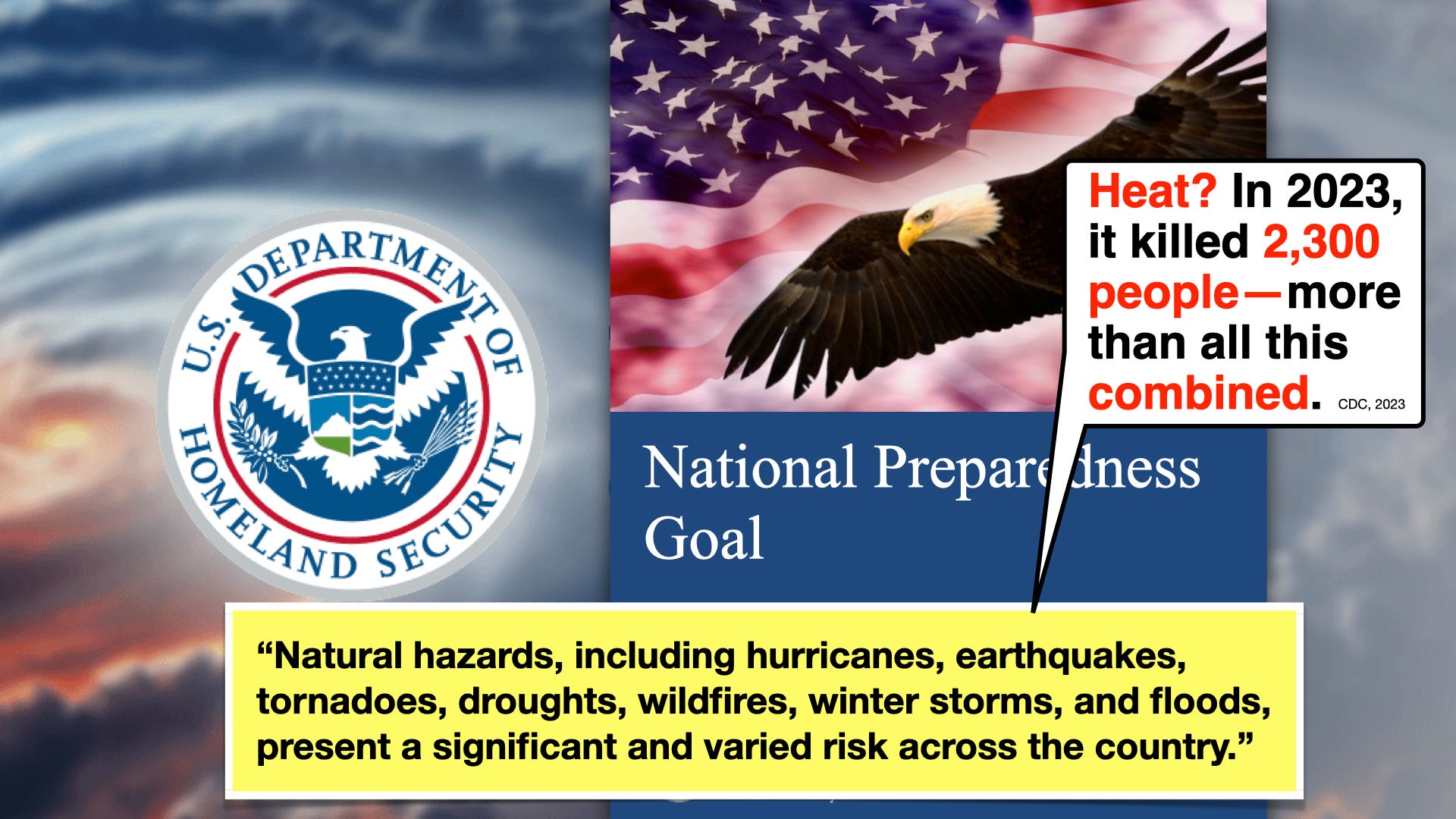
Heat waves are by far the leading weather-related cause of death in the United States. In 2023, for instance, extreme heat took 2,300 lives—more than all the deaths attributed to hurricanes, earthquakes, tornadoes, droughts, wildfires, winter storms, and floods combined.
Despite these facts, in more than 70 years of comprehensive disaster response, no president has ever declared a “major disaster” based on extreme heat, nor has FEMA ever recommended he do so.
To me, that seems nuts. In 2022, a heatwave in California resulted in 395 deaths in a ten-day period and an estimated $3.168 million in economic loss. Governor Newsom begged President Biden and FEMA to recognize the event as a “major disaster” ( legal language that under the Stafford Act unlocks a treasure of federal resources to respond to emergencies), but to no avail. No disaster aid for expanding cooling centers, for distributing water, for helping businesses recover, for retrofitting houses with insulation and A/C. Not a dime.
Add to this the fact that extreme heat hits disadvantaged communities the worst and that climate change is dialing everything up to 11.
How can this be? Why does FEMA ignore America’s most lethal form of disaster?
Part of the reason might be that the Stafford Act, the federal statute, that organizes emergency response procedures, doesn’t explicitly list extreme heat as a type of “major disaster.” Instead, it says “any natural catastrophe (including any hurricane, tornado, storm, high water, winddriven water, tidal wave, tsunami, earthquake, volcanic eruption, landslide, mudslide, snowstorm, or drought), or, regardless of cause, any fire, flood, or explosion” that the President finds “causes damage of sufficient severity and magnitude” to require assistance.
But the list is not intended to be, as lawyers say, “exclusive.” Congress said “national catastrophe . . . including” XYZ, not “national catastrophes . . . limited to” XYZ.
Anyway, FEMA and the president have already recognized major disasters that weren’t specifically mentioned. The most famous case occurred when President Trump declared 57 major disasters based on the COVID-19 pandemic in all fifty states; five territories; Washington, D.C.; and for the Seminole Tribe of Florida.
Some FEMA staffers have told me that they think heat waves should be treated differently because even though they hurt a lot of people, they don’t damage a lot of property. But nothing in the Stafford Act instructs public officials to put property over people. Instead, the act emphasizes the degree of need in an overwhelmed community. By that measure, significant heat waves should easily make the grade.
When COVID-19 was declared a disaster in 57 jurisdictions, the aim was to address the needs of people (by expanding testing facilities, providing medical equipment, and so on), not replace or repair damaged property.
To pick a more prosaic example, FEMA often recommends that snowstorms be declared disasters even when the property damage is minimal. The purpose here is to clear snow off the roads, rescue stranded pedestrians, and generally prevent human injury and death. When it comes to snow and pandemics, FEMA has no problem putting people over property.
If I had to offer a single explanation, I would say the problem is money. Everyone knows that a heat wave can kill scores of people and lead to devastating economic loss. But to admit that affected communities are deserving of federal disaster aid, would place an enormous burden on a disaster-response system that is already stripped of workers and strapped for cash.
But that’s an explanation, not a justification.
It would be best for Congress to amend the Stafford Act to explicitly include extreme heat in the act’s disaster definition and its aid programs. But in absence of that, FEMA should take action to increase the chances that states and Tribal governments threatened by extreme heat can receive their fair share of disaster funds, from individual assistance, public assistance, or hazard mitigation funds.
Will it cost the federal government more money? Of course. But providing security in times of disaster is a basic job of government. And our leaders should be willing to take the heat.
(For the legal Jedis reading this page, I wrote a longer law review piece on FEMA and extreme heat, which you can find here.)
Comments
Nothing yet. Say the first thing.
Sign in to join the conversation.