
In last week’s survey, many of you said you wanted to know more about work on my upcoming book. You’re also interested in news topics. Say no more. I’ve got you covered.
This is Blue Tomorrow—a weekly look at the law, science, and stories shaping the future of the ocean and coasts. If that matters to you, you can subscribe here.
Last week, the New York Times reported on deep-sea mining. This long-simmering issue is now reaching a boil as Trump pushes his plan to issue U.S. mining permits in international waters. (Until now, most nations, including the United States, assumed permitting on the high seas would be governed by the Law of the Sea convention, an agreement the United States mostly follows but has not ratified. Trump is plowing his own course.)
The Times article focused on a recent test of deep-sea-mining technology in a patch of the Pacific between Mexico and Hawaiʻi. The expedition was conducted in 2022 by The Metals Company, “a Canadian firm at the forefront of the competition to mine the seabed.”
I’m in the middle of writing a chapter on deep-sea mining for my upcoming book, The Whale Who Danced the Blues. I’ve touched on the deep-sea mining in this newsletter too.
For me it’s a story about three different ways of thinking about natural resource management. These views are reflected in three different people whose activities I’ve been following for years. In this post, I’ll tell you about one of those people (and the view he represents). You’ll meet the other two figures in future posts this summer.
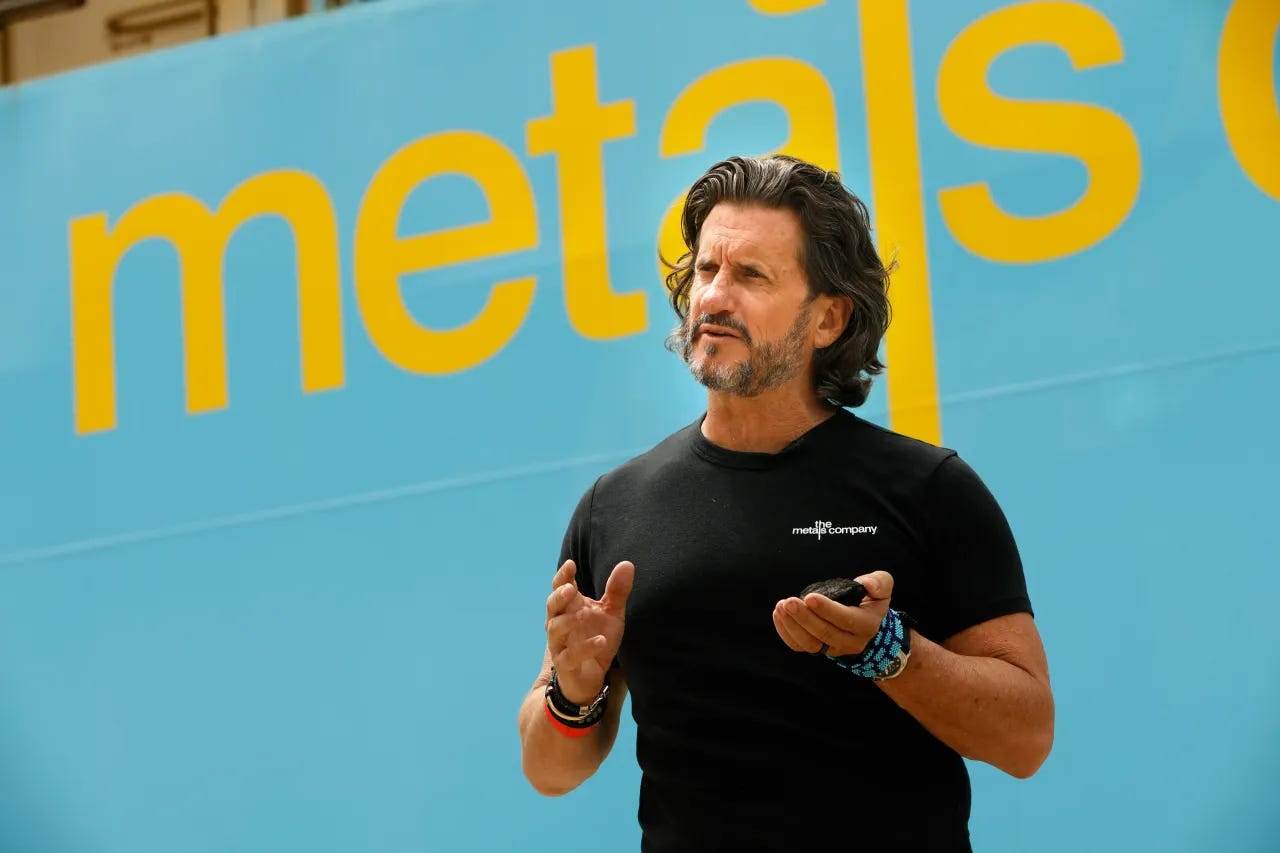
Gerard Barron is CEO of the straight-forwardly named, The Metals Company. That’s the firm responsible for the expedition covered in the Times article. Barron is an Australian businessman who has raised hundreds of millions of dollars trying to bring metal mining in the deep sea to an industrial scale. If you were designing a male avatar for a world-changing technology, he might look something like Barron, with dark eyes, stubbled jaw, and hair caught permanently in an ocean breeze. He’s really charismatic.
Barron’s been lobbying politicians and U.N. regulators for years to allow commercial mining in international waters. Ask him why and he might reach into his pocket and produce what looks like a charred corndog. That nugget, he’d tell you, was scooped from the seabed some two miles down and is the key to the world’s energy transition. “It’s like having a battery in a rock.”
Rocks like these—known as “polymetallic nodules”— cover vast parts of the seafloor. They are packed with high concentrations of metals like cobalt, nickel, and copper, which are widely used in modern batteries, including those that power electric vehicles. Such nodules have formed over a period of millions of years from dissolved metals in seawater. Barron has his sights on a particular patch of sea called the Clarion-Clipperton Zone (CCZ)—that area between Mexico and Hawaiʻi referenced above. Researchers say the CCZ holds up to 20 billion tons of these charred corndogs, which Barron thinks may be worth as much as $20 trillion.
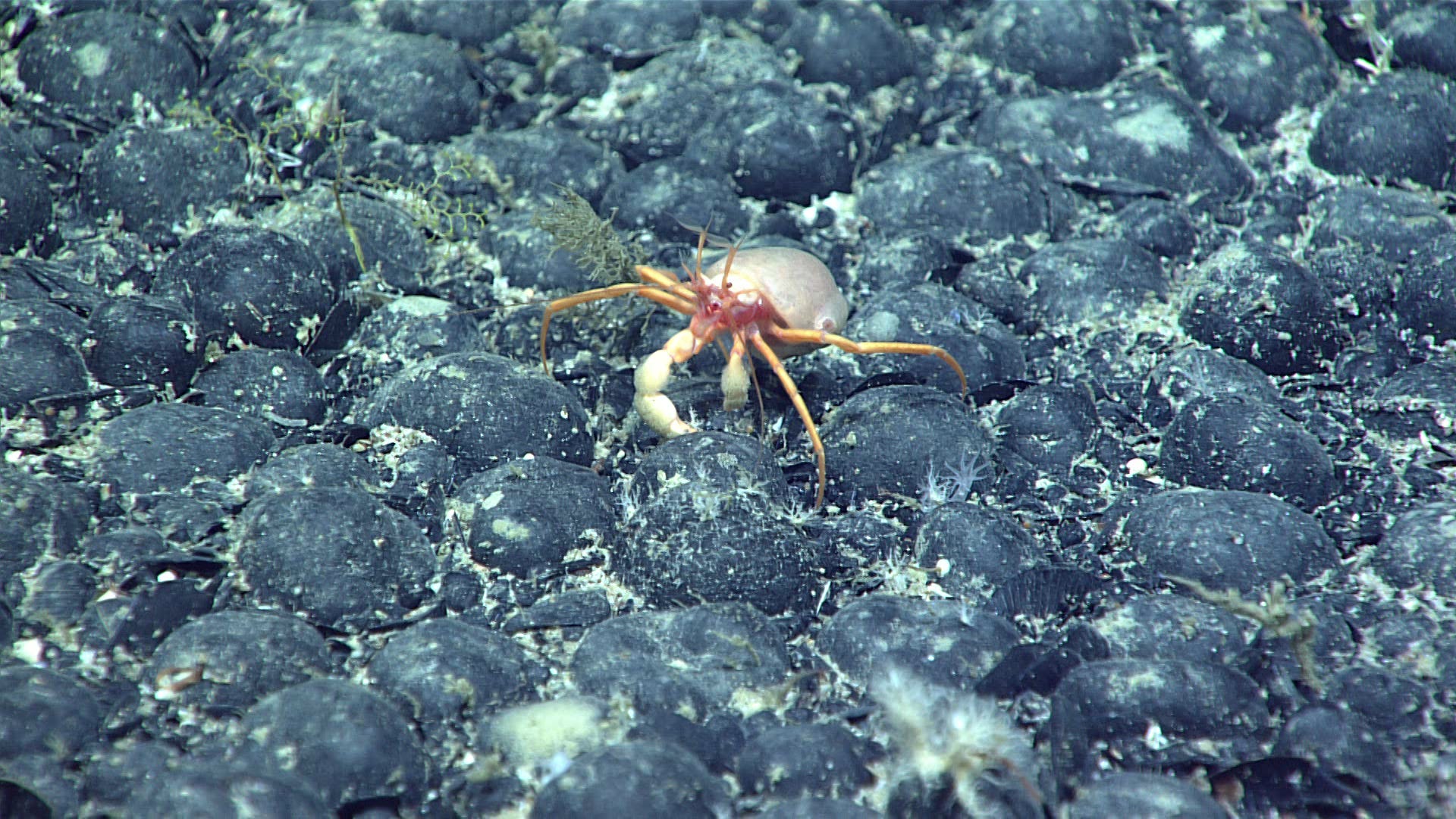
Barron describes the process for collecting nodules as having a minimal impact on its surroundings. The Times article provides a very helpful animation to illustrate the process. Essentially, the project involves lowering a bus-size vehicle a mile or two down to the seabed and letting it zoom on caterpillar treads along the seafloor. It vacuums up nodules on its way, sending them up a tube connected to the surface vessel. The zooming vehicle spits out a plume of sediment behind it, covering whatever is down there with a blanket of mud. More sediment is sucked up the tube with the nodules. That sediment is then pumped back into the water column thousands of feet above the mined area. The two plumes are a big concern to marine researchers because nobody knows much about the life forms down there or how they interact with the rest of the ocean’s chemical and biological systems.
According to the Times:
One study, independently published . . . in the journal Nature Ecology and Evolution, found mining would reduce both the abundance and diversity of some deep-sea animals by more than 30 percent. . . .
Proponents of deep-sea mining say the ocean is huge and that the effects found during the 2022 test were isolated. Environmentalists point out that commercial mining would happen at a much bigger scale.
But Barron has a response. He says we need undersea metals to transition to a green economy and beat back climate change. And also for military defense and economic security. He says harvesting nodules will help us avoid deforestation, toxic pollution, child labor and many other evils linked to terrestrial mining.
In his telling, it would be lovely if there were no climate crisis, no blasting of mountains and poisoning of rivers, no child labor, no A.I.-addled geopolitical threats. But that’s not the case. We can’t afford Business as Usual. We need to trust the technology and deploy it now, while we still have a shot. This, for the sake of the climate, for security and human decency, and the life of the ocean itself.
Barron wants you to know that he is moved by urgency, practicality, and an undying faith in what human beings can accomplish when they set high goals. He’s surely motivated by profit, too, but how else do you encourage audacity?
You can see where this is going.
Barron’s is a mindset that has driven so much technological and industrial progress in our history—and so many of our environmental disasters. Still, if I am being honest, I count urgency, practicality, and faith in human achievement among my emotional drivers too. And I love audacity.
Coming up, I’ll introduce you to a scientist friend of mine who’s studied the deep sea close-up—inside a titanium-clad submersible. And she has a different view.
SOUNDINGS (click below!)
Comments
Nothing yet. Say the first thing.
Sign in to join the conversation.