
I spent two years studying 53 direct selling companies that boomed and then fell apart. They all showed the same cracks before they fell. A few days before my new book comes out, here is the part most owners would rather not hear.
In 2017, one company in this profession did about 2.3 billion dollars in sales. Four years earlier it had done less than ten million. Then one change to the comp plan hit the bonus structure, and within three months its monthly sales reportedly fell by around 250 million dollars. You probably know the company. It was LuLaRoe, and the story everyone tells about it is a story about greed and moldy leggings.
That story is true. It’s also useless, because it doesn’t teach you anything you can use in your own company on Monday morning.
The useful story is mechanical, and once I started looking for it, I found the same one underneath almost every crash I studied. So I went looking on purpose. I coded 53 direct selling companies, fifteen-plus years of data on each, and I tried to find the pattern. What I found is that the companies that flash-crashed weren’t unlucky. They all showed at least three of the same five structural cracks before they fell, and here is the part that should stop you cold. Those cracks were visible the whole time. The revenue was still climbing. The events were still packed. The stage stories were still incredible. And the warning signs were already sitting right there in the data while everyone in the building was busy celebrating.
The reason nobody catches it is that the early warning signs don’t look like warning signs. They look like success.
Take the one number I would check first in any company in this profession. It’s the share of your revenue that comes from real customers, not from distributors buying product to qualify for a check. Across the companies I studied, the ones where a true majority of revenue came from actual customers tended to survive, and the ones running on internal volume tended to crash. It also happens to be the exact line the FTC cares about most. Most owners don’t track it closely, and a lot of the ones who do quietly look away, because they’re afraid of the answer. That fear is exactly why the crash feels like a surprise when it finally comes.
There’s a trap that goes right along with this, and I call it the product alibi. The product is genuinely good, sales look healthy, so leadership uses that as the reason to stop looking at everything else. The retention problem. The customer ratio. The fact that three leaders are quietly carrying the whole thing. The product becomes the alibi that lets them ignore the cracks forming underneath, right up until those cracks bring the building down while everyone is still pointing at the product as proof they were fine. Some of the most spectacular crashes I studied happened to companies whose product was never the problem, which is exactly why nobody saw it coming.
Here is something else that should bother every owner reading this. Most companies can’t recreate their own best year. They lived through it. They were in the room for every decision. And they still can’t do it again, because when a company explodes, leadership writes the story afterward and almost always picks the version that flatters them most. It was the culture. It was the vision. It was that one event in Dallas where everything clicked. So they spend the next three years and the next ten million dollars building around a story that was mostly fiction, and they’re stunned when it doesn’t work the second time. You can’t repeat what you never understood, and that gap between what actually drove the growth and the story leadership tells about it is the most expensive blind spot in this entire profession.
All of this matters more right now than it did five years ago, and the numbers say so. US direct selling fell from 36.7 billion dollars in retail sales in 2023 to 34.7 billion in 2024, and the number of people actually out there selling dropped from about 6.1 million to 5.4 million in a single year. That’s two straight years of decline. Meanwhile an AARP Foundation study found that roughly 73 percent of people who join these companies either lose money or make none, and of the ones who do turn a profit, more than half clear less than five thousand dollars a year. You can get defensive about those numbers, or you can sit with them, because the companies that build the kind of momentum where the math actually works for the field are rare, and they understand something the rest of the profession doesn’t.
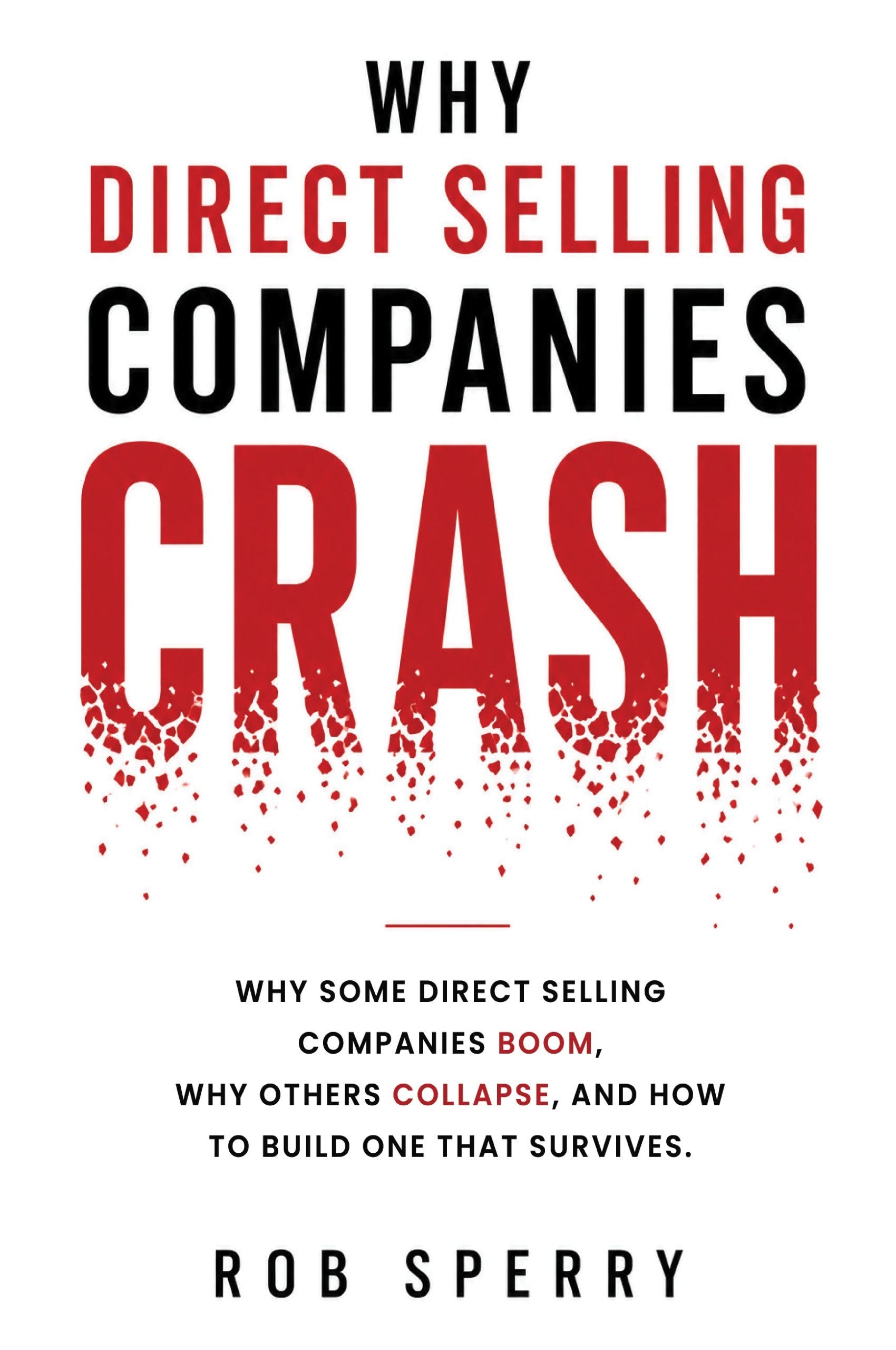
That understanding is what I tried to put in the book. It’s called Why Direct Selling Companies Crash, and it is not a feel-good read. It names companies, shows the real numbers, and refuses to pretend the billion-dollar collapses were bad luck. It also won’t promise you permanent momentum, because nobody stays in momentum forever, and any consultant who tells you otherwise is selling the same fantasy you already stopped believing. What it will do is show you the cracks early, while you still have room to move, and hand you the tools to read your own company instead of guessing. The five drivers that actually create momentum. The three ratios that tell you whether it’s real. The four phases of decline, so you can catch the erosion in phase one instead of finding out in phase three. And a scorecard your leadership team can fill out together in a single meeting.
Twelve company owners have read the early manuscript. They keep telling me, almost word for word, that it might be the most important book ever written in network marketing. I don’t love repeating that, because it’s uncomfortable to say out loud. But one of those twelve ran a company that did over a billion dollars in sales before it fell apart, and he told me that if he’d had this book a few years earlier, he believes it could have stopped the whole thing from happening. That conversation is the reason I stopped sitting on the manuscript and finally decided to publish it.
The book comes out JULY 6th. The presale is open now athttps://a.co/d/0d3vo7cX, and if you’ve ever watched your own growth slow and couldn’t really say why, this is the one to read before your competitors do.
Because the crash is never really a surprise. Every company that fell showed the cracks first. The only question that ever mattered is whether anyone was willing to look.
P.S. If you run or help run a company in this profession, do one thing this week whether or not you buy the book. Pull the number on how much of your revenue comes from real customers versus distributors buying to qualify. Just look at it. That single number predicts more than almost anything else on your dashboard, and most teams have never once put it on a slide.
No posts
Comments
Nothing yet. Say the first thing.
Sign in to join the conversation.