
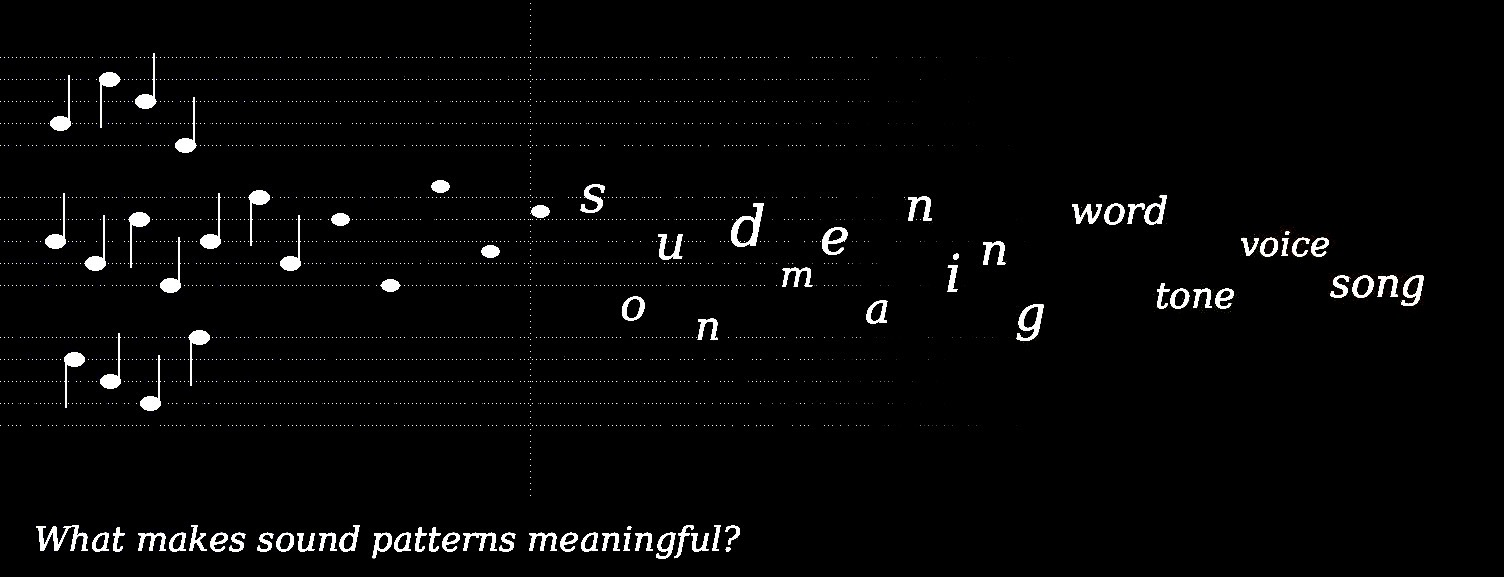
Understanding sound patterns when learning a new language helps to increase your fluency, and composers know that if they stick to certain rules, they can create effective sound patterns by creating a melody and a chord progression that works in a meaningful way.
In its simplest form, a sound pattern becomes meaningful when it sets up an expectation in the listener, then confirms, delays, or denies it. Songs and abstract music both work this way, but they reach it by different methods.
We say that music is organised sound. Pitch, duration, phrasing, complementary and contrasting elements, along with other attributes combine to make what we recognise as organised sound, aka music. So does speech. Pitch contour, rhythm, stress, and tempo make both speech and music instantly recognisable for what they are.
In fact, both are built from a set of elements that generate sound patterns. These patterns are easily recognised, and just as easily transferred between the two. When they merge into one medium, we get song.
We instinctively know how to get a point across with maximum effect when we speak by changing the pitch in our voice, altering tempo, and using bodily movement. Almost everyone recognises these patterns, and together with what we are saying, makes the combination of sound patterns and gestures our most direct and persuasive form of communication. In almost any TED Talk, you can see this used effectively.
Does music use similar patterns to get its point across in an equally meaningful way? Yes, it does, but how does a composer create a sound pattern that will resonate with others? The answer for a song is simple. Words carry meaning, and they can be set to music based on the rhythm of the words and the meaning they carry. In plain English, the word pattern creates the sound pattern. But we all know significant tunes that have no words, which carry just as many feelings as songs do.
With abstract music, non-vocal, the patterns that grammar creates for music is not there. So, music alone sets up implicit probabilities that tells us we know how a phrase will resolve in a particular way and the harmony will move to a place which we know feels right. It’s a system of tension and release.
However, atonality threw almost all this system out the window. Tonal music had centuries-long curation and the act of performance to state its well-known case.
The in-built expectations we hear in tonal music of some sort of sound pattern, deviation, and resolution has made us all experts at recognising what is being played and what will come next. Abstract music creates these expectations that vocal music sets up through its lyrics. Even though a wordless piece will mean different things to different people, it still has to build that sense of expectation entirely on its own, without a lyric to lean on.
Learning to understand a new language takes time and exposure. The slow accumulation of recognising vocal patterns that once sounded almost meaningless eventually develops into a pattern that turns sound into meaning. Tonal music eventually gave us that same fluency through centuries of repetition until it taught every listener how to understand it, whether we were trained or not.
We know what to expect in a phrase and how and when it will move toward its resolution before a single note has confirmed it. But atonality took that fluency away. It didn’t remove our instinct to recognise patterns; that’s still there, we just find it harder as atonality is always looking for a place to land. It removed the shared grammar our instincts depended on. So, we hear tonal abstract music with pattern-hungry ears. We listen and wait for a pattern and then the resolution to arrive, even though no one has taught us to hear these things.
We’ve incorporated sound patterns, like the patterns in visual art, fashion, architecture, and so on, so deeply into our thinking that now it seems like a natural process. We use these patterns as a way to understand our world, and without them, our world would make less sense.
No posts
Comments
Nothing yet. Say the first thing.
Sign in to join the conversation.