
Thank you for subscribing to my posts. If you’re not yet a paying supporter, please consider becoming one. That’ll allow you to DM me with questions and comments. Your contribution will help cover the cost of the data I use in my posts, which I fund out of my own pocket. Thanks so much for your support and feedback!
Media coverage of US sanctions on Iran - and the naval blockade - is unrelentingly negative. The standard narrative goes that we’ve already sanctioned Iran massively, so what good will a few additional measures do. This is nonsense. After Russia’s invasion of Ukraine, I learned that the mainstream media bashes economic warfare no matter what. I’d love to believe that happens out of conviction - even if it’s ill-informed - but the reality is that much of this is lobbying on behalf of Western businesses who see sanctions as interfering with their ability to make money. What gets dressed up as journalism is really just spouting what powerful commercial interests - like Greece’s shipping oligarchs and Germany’s exporters - want people to hear. After all, if you’re doing rampant sanctions evasion, it helps if everyone thinks sanctions don’t work in the first place. Then you’re not doing anything wrong.
I’m a proponent of sanctions and pushed for a naval blockade of Iran back in March. In today’s post, I set the record straight on the scale of economic collapse in Iran and what further steps the US can take to speed things along. This week’s raft of measures from the US Treasury is an important step in the right direction. There’s much hand-wringing over China’s role, but - now that the UAE has suspended all trade with Iran - Turkey is the main country that should be in the crosshairs.
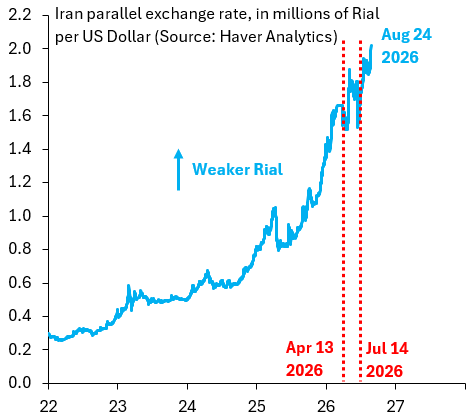
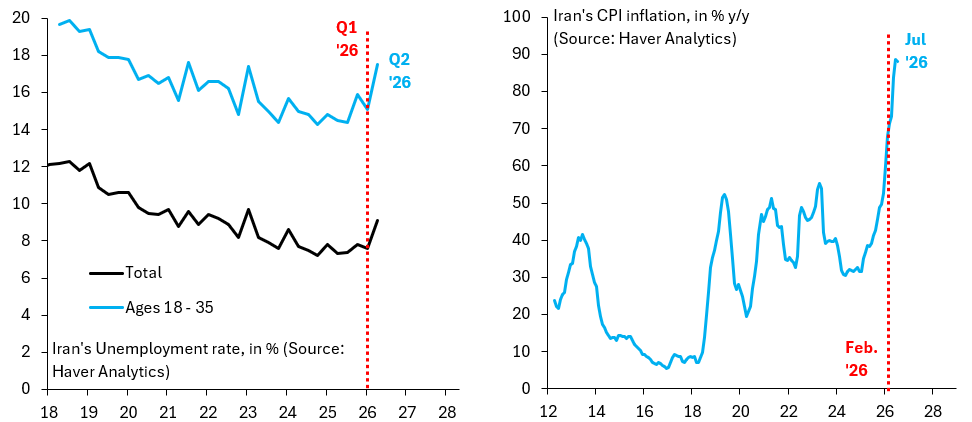
The goal of the US blockade is to collapse Iran’s export revenues, which fuel the rest of the economy. As the chart above shows, that’s clearly happening. Iran’s currency - the Rial - falls sharply whenever the blockade hits, including after its start on April 13 and its re-imposition July 14. Official Iranian data are highly questionable, since they will tend to understate the collapse of the economy. But - bearing that in mind - what data there are look pretty shocking. The left chart below shows that unemployment is spiking, especially among Iran’s massive young population, and severe shortages are tipping the country into hyperinflation as the right chart below shows.
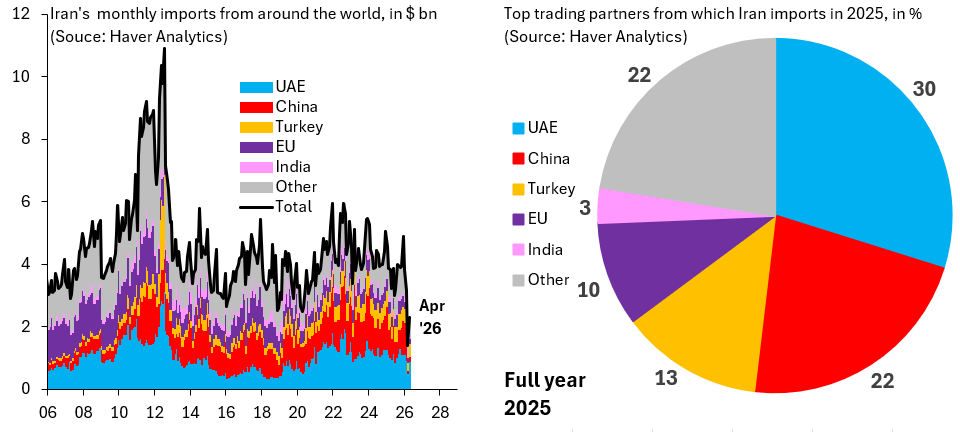
More can be done to accelerate Iran’s economic collapse. This week’s US sanctions package is a step in the right direction. The left chart below shows monthly data for Iran’s goods imports through April 2026. The pie chart on the right highlights who the country imported from most heavily last year. Prior to the war, the UAE were the single biggest trading partner (blue), followed by China (red), Turkey (orange) and the EU (purple). The imposition of the blockade shifted who Iran is able to import from, which is what I look at next.
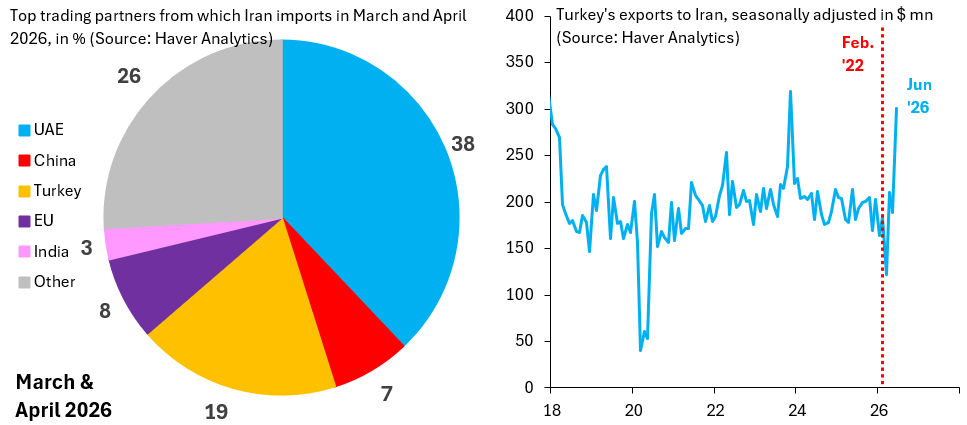
The pie chart on the left below updates from whom Iran imported goods in March and April 2026. The UAE grew even more important, which is nuts, but the US shut this down a few weeks ago. There’s lots of talk how important China is to the latest round of US sanctions, but Turkey - with its land border - is more important at this stage. Indeed, as the chart on the right below shows, exports from Turkey exploded through June, a predictable response to the naval blockade, which shut down Iran’s ports. If this week’s sanctions package shuts down Turkey as a trading hub - together with the UAE having stopped all trade - this will drastically increase Iran’s isolation and make a bad situation worse very quickly.
The drumbeat of negativity on the blockade and sanctions more broadly isn’t well informed. The economic picture in Iran is deteriorating rapidly and the US has easy ways to drastically ramp up Iran’s economic isolation. No regime stays in power for ever and Iran’s won’t either. It’s on much shakier ground than most people think.
No posts
Comments
Nothing yet. Say the first thing.
Sign in to join the conversation.