
Thank you for subscribing to my posts. If you’re not yet a paying supporter, please consider becoming one. That’ll allow you to DM me with questions and comments. Your contribution will help cover the cost of the data I use in my posts, which I fund out of my own pocket. Thanks so much for your support and feedback!
Long-term government bond yields have been rising for several years across much of the G10. This rise is unnerving governments because debt levels are up substantially from a decade ago, so even a small rise can mean a much higher interest bill. Indeed, the US Treasury last week surprised markets with larger-than-expected buybacks of long-dated debt, a move seen by many (including me) as an attempt to artificially cap yields. As a result, the Dollar fell sharply and the debasement trade took off. Markets know exactly what game is being played and are hedging what’s seen as growing risk of debt monetization by buying safe haven assets.
There’s competing theories on why long-term yields are rising. One theory is that it’s the AI buildout that’s driving this, given that lots of companies are chasing a limited pool of financing. This view is popular in Washington, DC, because it distracts from the other theory, which is that it’s the massive budget deficit that’s driving up longer-term yields. Today’s post evaluates these competing theories based on data for the US saving-investment balance. Those data point overwhelmingly to the budget deficit - not the AI buildout - as the reason for rising yields.
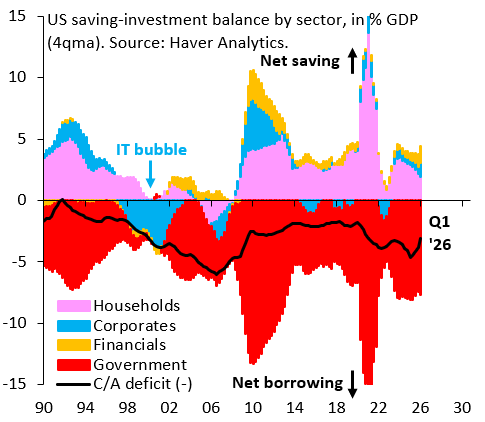
The chart above shows quarterly data for the US saving-investment balance going back to 1990. This is an identity that apportions the current account balance (black line) into net saving in various sectors of the economy. Households (pink bars) tend to be net savers, i.e. providers of capital, as is the financial sector (orange bars) and non-financial corporates (blue bars). The government (red bars) tends to be a net borrower, i.e. absorbs net saving from the rest of the economy via its debt issuance.
The last time we had a lot of excitement about technological innovation and higher productivity growth was in the “IT bubble” of the early 2000s, which saw non-financial corporates flip from being net savers to borrowers, i.e. the capex buildout at the time was very large and - for a few years - accounted for the entire current account deficit. Nothing like that’s happening now. It’s government dissaving, i.e. the budget deficit, that’s eating up resources, while the non-financial corporate sector stayed a net saver in data through the first quarter of this year. The bottom line is that the AI buildout isn’t why government bond yields are rising. It’s good, old-fashioned crowding out and out-of-control fiscal policy that’s driving up yields.
No posts
Comments
Nothing yet. Say the first thing.
Sign in to join the conversation.